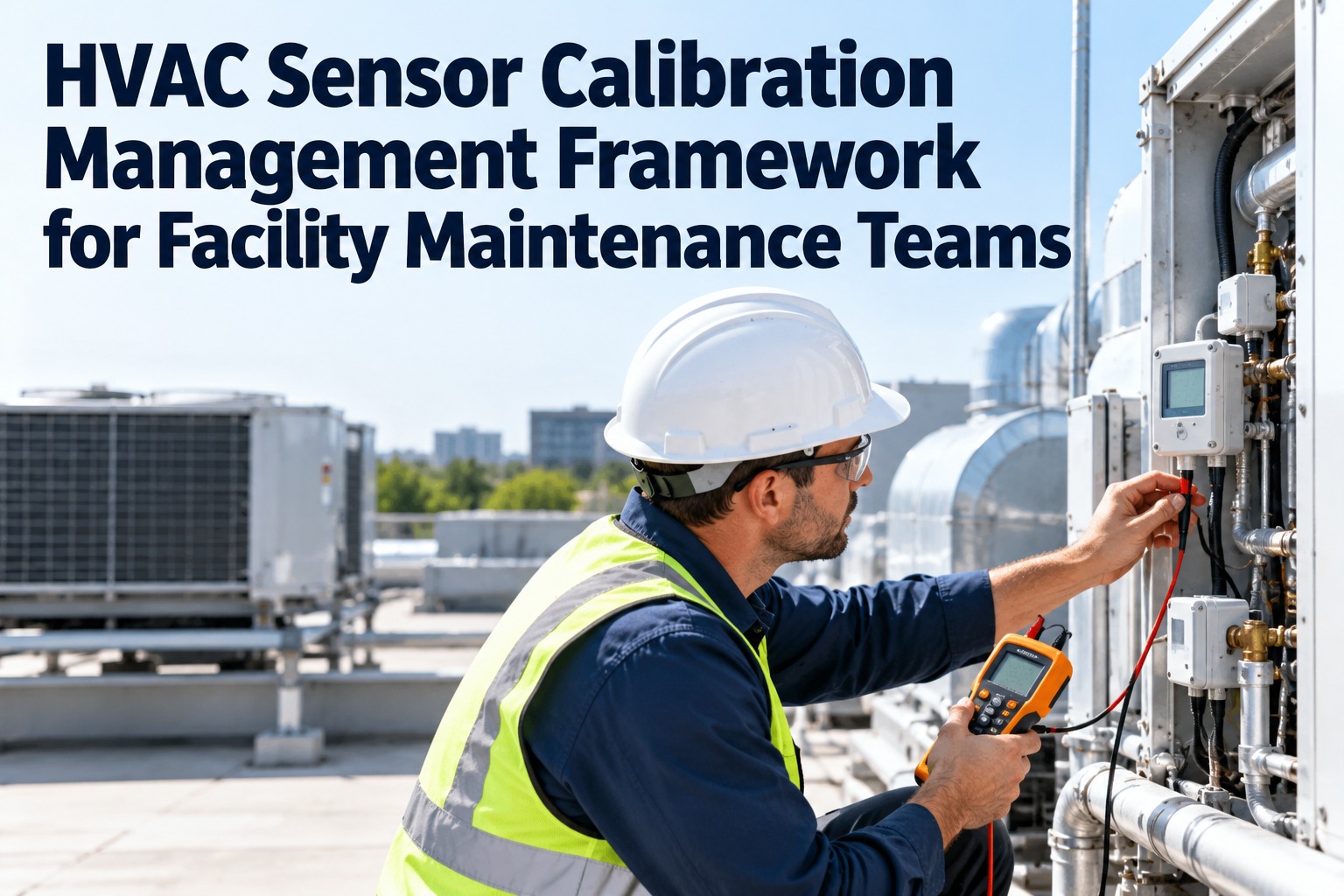
The thermostat says 72° but the room sits at 75°, the economizer never opens, the CO2 sensor over-ventilates all winter — a drifting HVAC sensor never trips an alarm, it just reports the wrong number and the whole system obeys it. Turning calibration into a managed loop — inventory, risk-based intervals, as-found/as-left readings and corrective work orders — is what keeps those numbers honest. This framework runs on OXMAINT AI, the AI-powered CMMS that schedules every calibration and keeps the traceable record behind every reading.
HVAC Facility Operations · Sensor Calibration · Management Framework
A Sensor Is the One Asset That Fails Without Ever Breaking.
It keeps reporting — just wrong — and every control sequence downstream trusts it. This framework turns HVAC sensor calibration into a managed loop on one platform: a sensor register, risk-based intervals, as-found/as-left readings judged against tolerance, and a corrective work order the moment a reading fails.
1 Inventory
2 Interval
3 Calibrate
4 Record
Up to 10%
extra HVAC energy a sensor reading just 2°F off can drive
±0.5°F
typical calibration target for a space or duct temperature sensor
As-Found / As-Left
both readings captured on every calibration, before and after
NIST-Traceable
the reference standard that makes the reading defensible
Why Calibration Needs a Framework, Not a Reminder
Most assets announce their failure — a pump leaks, a belt snaps. A sensor does neither. It drifts a fraction of a degree a month, keeps reporting with total confidence, and the economizer, the DCV logic and the comfort setpoints all act on a number that is quietly wrong. A one-off calibration fixes today and decays by next quarter. What holds the line is a loop: know every sensor, calibrate it on a risk-based interval, judge it against tolerance, record both readings, and let the drift history tune the next interval. Sign up free and build your sensor calibration loop in OXMAINT AI.
The 5-Stage Calibration Management Loop
This is the framework — a closed loop, not a checklist. Each pass through it leaves the next one sharper, because the drift you recorded this time decides how soon you calibrate next time.
01
Inventory the Sensors
Every sensor on the register — type, location, accuracy spec, and how critical its reading is to control.
→
02
Set Risk-Based Intervals
Cadence by criticality and drift history — control-critical sensors far more often than comfort-only ones.
→
03
Calibrate to a Standard
Verify each sensor against a NIST-traceable reference and record the as-found reading before touching anything.
→
04
Judge Against Tolerance
Compare as-found to spec — pass, adjust offset or span, or replace — then record the as-left reading.
→
05
Record, Trend & Tune
Save both readings to the sensor's history, trend its drift, and tighten or relax the next interval.
↻ Stage 05 feeds Stage 02 — the loop tunes its own intervals from each sensor's measured drift.
Stages 1–2 — The Register and Risk-Based Intervals
Calibrating every sensor on the same annual cycle wastes effort on stable ones and lets critical ones drift between visits. The fix is to rank sensors by what their reading actually controls, and set the cadence to match. A space sensor nobody acts on can wait; the economizer changeover sensor cannot. Book a demo to see risk-based calibration intervals scheduled automatically.
CONTROL-CRITICAL
The System Acts On It
Economizer outdoor-air temp · DCV CO2 · VAV flow · discharge-air temp · duct static pressure
Calibrate most often — drift here changes how the plant runs
COMFORT
Occupants Feel It
Space temperature · space humidity · zone setpoint sensors
Calibrate on a standard cycle — drift shows up as complaints
MONITORING
You Only Watch It
Trend-only points · reporting sensors not driving a control loop
Verify on the longest cycle — lowest consequence if it drifts
Stages 3–4 — Calibrate, Then Judge Against Tolerance
This is the metrology core, and it is where paper programs quietly cheat: a technician "calibrates" a sensor, writes a tick, and never records what it actually read. The as-found value — what the sensor said before any adjustment — is the number that proves the program works and reveals which sensors drift. Start free and capture as-found and as-left on every calibration.
Reference
NIST-traceable standard, side by side, allowed to stabilize
→
As-Found
Read the sensor before adjusting anything — this is the drift
→
Tolerance
Compare as-found to the sensor's spec
→
As-Left
Read again after adjustment — the value you hand back to control
PASS
As-found within tolerance — log both readings and schedule the next interval.
ADJUST
Outside tolerance but serviceable — correct offset or span, then re-read as-left.
REPLACE
Beyond adjustment or failed — swap the sensor and calibrate the new one in.
Sensor
Typical Calibration Target
Space / duct temperature
about ±0.5°F
Relative humidity
about ±2–5% RH
CO2 (demand-control ventilation)
about ±30–50 ppm
Static / differential pressure
typically ±1–2% of span
Typical figures only — always calibrate to the specific sensor's published accuracy and your control sequence's needs.
Stage 5 — Record, Trend, and Tune the Interval
The payoff of writing down the as-found reading is the trend line it builds. A sensor that comes back in tolerance three cycles running has earned a longer interval; one that drifts out every time needs a shorter one — or replacement. That is how a calibration program stops being a fixed calendar and starts being risk-based in fact, not just in intention. Book a demo to see per-sensor drift trends tune the next interval.
What Drift Actually Costs
The reason this framework earns its place is that a wrong reading is never just a wrong reading — it is energy, comfort, air quality and compliance, all acting on the same bad number.
Energy
A sensor reading 2°F off can push HVAC energy up by as much as 10% — the system works hard to hit a target that was never real.
Comfort
A silent setpoint error becomes hot-and-cold complaints nobody can trace, because the thermostat insists everything is fine.
Air Quality & Ventilation
A drifted CO2 sensor over-ventilates and wastes energy, or under-ventilates and starves the space — both failures, one cause.
Commissioning & Compliance
Bad sensor data fails commissioning and undermines every control sequence built on top of it — garbage in, garbage controlled.
Stop Trusting Readings You Can't Prove.
Put the sensor register, the intervals, the as-found/as-left readings and the corrective work orders on one platform — so every HVAC control sequence is acting on a number you can stand behind.
How OXMAINT AI Runs Sensor Calibration Management
One platform behind the whole loop — the register, the intervals, the readings, the tolerance check, the corrective work orders and the trend. This is the maintenance management software that keeps every HVAC sensor calibrated on schedule and the record defensible for commissioning and audit.
BUILD IT
A Sensor Register Per Building
Every sensor held with its type, location, accuracy spec and criticality — the foundation the whole framework runs on.
SCHEDULE IT
Risk-Based Calibration Intervals
Control-critical sensors calibrated more often than comfort-only ones — cadence fires automatically, nothing drifts unseen.
CAPTURE IT
As-Found / As-Left on Record
Both readings logged against the sensor's tolerance, with an out-of-spec as-found flagged the moment it is entered.
FIX IT
Failed Reading Becomes a Work Order
An out-of-tolerance result opens a ranked corrective work order — adjust or replace — assigned and tracked to close.
TREND IT
Drift Trended Per Sensor
Each sensor's as-found history charts its drift, so repeat offenders earn tighter intervals and stable ones earn longer.
PROVE IT
Traceable History for Audit
Calibration records and reference traceability certificates retained per sensor — ready for commissioning or an auditor.
"
We thought our sensors were fine because the PM said "calibrated" every year. The first time we actually logged as-found readings, a third of the control-critical sensors were out of tolerance — including two economizer sensors that had quietly been blocking free cooling for a season. Nothing was broken, nothing alarmed. What changed was writing the number down before we adjusted it; the drift trend did the rest.
Controls & Energy Manager · Commercial Portfolio
Frequently Asked Questions
How often should HVAC sensors be calibrated?
Set the interval by criticality and drift history rather than one blanket schedule. Control-critical sensors — economizer, DCV CO2, VAV flow — are calibrated more often; comfort sensors on a standard cycle; monitoring-only points least often. Trend each sensor's drift and tighten or relax from there.
Sign up free to schedule risk-based intervals in OXMAINT AI.
What does as-found / as-left mean in calibration?
As-found is what the sensor read before any adjustment — the real drift. As-left is what it reads after you correct it. Recording both proves the calibration happened, shows how far the sensor had drifted, and builds the trend that sets the next interval.
Which HVAC sensors matter most for calibration?
The ones the system acts on. An economizer outdoor-air sensor, a DCV CO2 sensor, VAV flow and discharge-air temperature all change how the plant runs when they drift. A monitoring-only sensor that drives nothing carries far less consequence.
How much does a drifted sensor actually cost?
A reading just 2°F off can raise HVAC energy by as much as 10%, before any comfort complaints or ventilation problems. Because the sensor keeps reporting confidently, that cost runs for months before anyone connects it to a sensor.
Why manage sensor calibration in a CMMS?
A CMMS holds the register, schedules each interval, captures as-found/as-left against tolerance, raises the corrective work order on a fail, and keeps the traceable history. It is what turns a calendar reminder into a managed, defensible loop.
Every Sensor Registered. Every Reading Proven. Every Interval Earned.
Move your HVAC sensor calibration onto OXMAINT AI — a sensor register, risk-based intervals, as-found/as-left readings against tolerance, corrective work orders and a traceable history per sensor. Stop trusting numbers you can't stand behind and start running the loop.