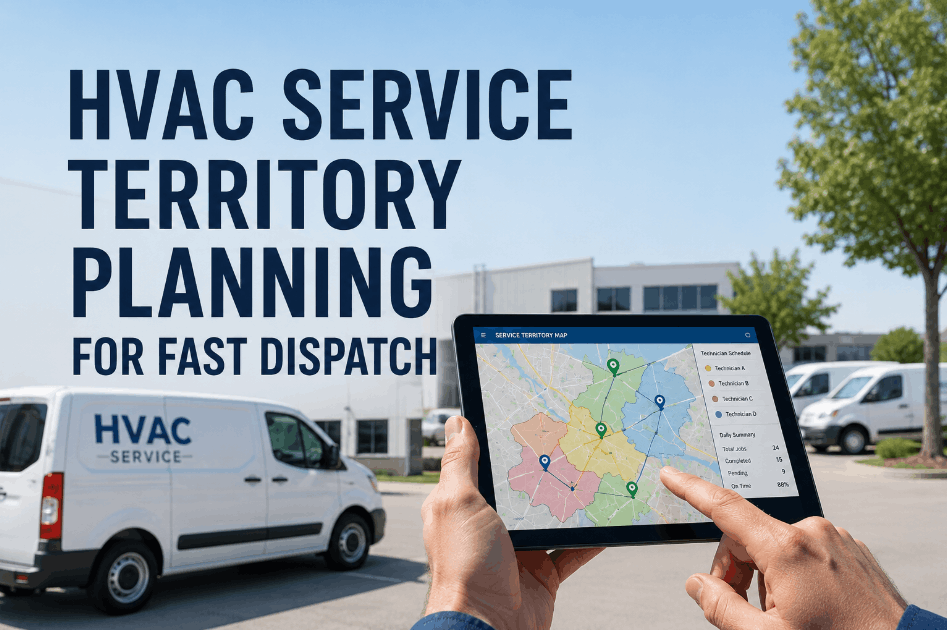
HVAC service territory planning determines how fast a technician reaches a site — and whether that technician arrives with the right skills, parts, and schedule margin to resolve the call on the first visit. Operations teams that Sign Up Free on OxMaint can map site clusters against technician coverage zones, log travel time per service call, and build dispatch sequences that reduce drive time without sacrificing SLA compliance. When territory boundaries are defined around real call density and technician capacity rather than arbitrary geography, field service teams close more work orders per shift. Book a Demo to see how OxMaint structures field service territory data, technician assignments, and work order dispatch in one connected maintenance platform.
Maintenance · Blog · Field Service Operations
HVAC Service Territory Planning for Fast Dispatch
Map site clusters, technician coverage zones, and route sequences to cut drive time and improve first-visit resolution across your HVAC field service operation.
23%Average reduction in drive time when HVAC territories are defined by call density rather than geography
1.4×More work orders closed per technician per day with optimized territory coverage and route sequencing
58%Of missed SLA events in HVAC field service trace to territory imbalance or poor technician-to-site matching
2.8×Faster dispatch decision when site, technician, and route data are visible in a single CMMS view
Six Territory Planning Factors That Determine HVAC Dispatch Speed
Dispatch speed is an output of territory design — not just scheduler effort. Getting the six factors below right before assigning work orders determines whether your HVAC technicians spend their shift servicing equipment or sitting in traffic. Book a Demo to see how OxMaint organizes site, technician, and dispatch data to support territory-aware HVAC scheduling.
Factor 1
Call Density Mapping
Service call volume per geographic zone plotted against technician home base locations — territories built around actual demand patterns, not equal-area splits.
Foundation
Factor 2
Technician Skill Matching
HVAC equipment type, refrigerant certification, and system complexity matched to technician capability before dispatch — reducing return visits caused by skill gaps.
Quality Gate
Factor 3
Site Cluster Grouping
Sites within the same building complex, campus, or street cluster assigned to the same technician to maximize time-on-tool and minimize inter-site travel.
Efficiency
Factor 4
Route Sequencing Logic
Work order sequence within a territory optimized by travel time and priority — not call-receipt order — so urgent calls are reached faster without abandoning planned PM visits.
Dispatch
Factor 5
Capacity Buffer per Zone
Territory sizing accounts for emergency call volume — overpacked territories absorb reactive calls by deferring PM, compounding backlog without a visible trigger.
Planning Risk
Factor 6
Cross-Territory Coverage Rules
Defined escalation logic for when a technician from an adjacent territory is dispatched — preventing coverage gaps from devolving into SLA failures during absence or surge periods.
Resilience
The Territory Planning Failure Cascade — How Poor Zone Design Kills HVAC Dispatch Performance
Territory design failures do not show up as a single missed SLA — they compound across every shift until drive time consumes capacity that should be spent on equipment. Sign Up Free to build structured territory and dispatch logic in OxMaint before the cost cascade below reaches Stage 4 or 5 in your field service operation.
HVAC Territory Planning Failure — 5 Stages from Zone Imbalance to SLA Breach and Customer Loss
Stage 1
Territory Zones Defined by Geography Only
Service territories split by map area rather than call density — some technicians carry double the load of others without visibility in the scheduling system.
$0
Cost if rebalanced at zone-design stage
↓
Stage 2
Drive Time Consumes Productive Capacity
Technicians in over-sized or poorly sequenced zones spend 35–45% of shift in transit — PM backlog builds as call volume stays constant.
$1,400
Lost billable hours per technician per week
↓
Stage 3
Skill Mismatch on Complex Equipment Calls
Nearest-available dispatch sends the wrong technician to a complex chiller or VRF system — resulting in a return visit and additional site travel cost.
$3,800
Return visit and customer time cost
↓
Stage 4
SLA Breaches Accumulate
Response time commitments missed on priority calls — drive time, backlog, and wrong-skill dispatch combining to push resolution outside contract windows.
$9,200
SLA penalties and customer credits
↓
Stage 5
Contract Non-Renewal and Reputation Loss
Customers experiencing repeated SLA failures decline contract renewal — territory planning failure surfaces as a revenue and retention problem.
$24,000+
Annual contract value lost per account
OxMaint CMMS Capabilities for HVAC Field Service Territory Management
Territory-aware dispatch requires a maintenance platform that connects site data, technician profiles, and work order scheduling in one structured view. Book a Demo to see how OxMaint supports HVAC field service operations from site clustering through work order closure.
Site Asset Registry
Full
Every HVAC site and system logged as a tracked asset
Each customer site and HVAC system maintained as a distinct asset record — with equipment type, service history, and skill requirements accessible at dispatch.
Technician Work Order Queue
Live
Real-time work order view per technician and territory
Dispatchers see open, in-progress, and completed work orders per technician in real time — enabling territory rebalancing and priority escalation without phone calls.
PM Schedule Visibility
Per Site
Planned maintenance schedule visible alongside reactive calls
Scheduled PM visits for each site visible in the same dispatch view as reactive work orders — preventing PM deferral when emergency calls arrive in the territory.
Service History per Asset
Complete
Full repair and PM history linked to each site and unit
Technician arrives with complete asset service history — reducing diagnostic time and enabling better parts preparation before reaching the site.
"
Our technicians were crossing each other's zones constantly because we had no structured way to assign sites to coverage areas. Once we mapped our site clusters and built technician territories around them in OxMaint, our average drive time per call dropped by nearly a quarter and our first-visit resolution rate improved noticeably within two months.
Field Service Manager — Commercial HVAC Service Provider
Root Causes of Slow HVAC Dispatch and Missed Service Windows
Slow dispatch in HVAC field service consistently traces to the same planning and data failures. Sign Up Free to address the root causes below with structured site data, technician profiles, and work order visibility in OxMaint.
HVAC Dispatch Failure — Root Cause Distribution (%)
No territory zone structure in dispatch system
73%
Nearest-available dispatch ignoring skill match
65%
No real-time technician workload visibility
57%
Site clusters not grouped in scheduling system
49%
PM and reactive calls competing without priority logic
41%
No cross-territory escalation rules defined
33%
HVAC Territory Planning Maturity Score
Score 5 = structured territory with skill-matched live dispatch · Score 1 = no territory planning in place
5
Optimized — Skill-Matched, Cluster-Aware Live Dispatch
Territories defined by call density, technician skills matched to site type, and real-time workload visible per technician from a single dispatch view.
Action: Review territory boundaries quarterly as call volume or technician headcount changes.
4
Structured — Territory Zones Defined, Manual Skill Check
Coverage zones assigned per technician but skill matching and route sequencing done manually by dispatcher rather than system-supported.
Action: Log technician certifications and equipment competencies in CMMS to enable system-assisted matching.
3
Basic — Geographic Zones Only, No Cluster Logic
Territories exist as geographic areas but site clusters are not grouped and PM versus reactive priority is managed informally.
Action: Map site clusters within each zone and define PM vs. reactive priority rules in the dispatch workflow.
2
Reactive — Nearest-Available Dispatch Only
Calls assigned to nearest available technician without territory, skill, or cluster logic — drive time and return visits accumulate without a visible cause.
Action: Define initial territory zones and log technician skill profiles as the foundation for structured dispatch.
1
No Structure — Work Orders Assigned Ad Hoc
No territory planning, skill matching, or dispatch logic in place — scheduling decisions made call by call without data.
Action: Implement a CMMS with site asset records and technician profiles immediately to build a dispatch foundation.
Build Territory-Aware HVAC Dispatch That Closes More Calls Per Shift.
OxMaint connects site asset data, technician profiles, and work order scheduling in one platform — giving dispatchers the visibility they need to route faster and smarter.
Frequently Asked Questions
What is HVAC service territory planning and why does it matter for dispatch?
Territory planning divides service coverage into defined zones matched to technician capacity and call density — it directly determines how quickly a technician reaches a site and how many calls can be closed per shift.
How does site cluster grouping reduce HVAC drive time?
Assigning sites within the same building complex or street cluster to one technician eliminates cross-zone travel between calls — technicians spend more time on equipment and less time in transit.
Can OxMaint support multi-technician HVAC field service scheduling?
Yes — OxMaint maintains separate work order queues per technician, tracks site and asset records across all coverage zones, and gives dispatchers a unified view of all open, in-progress, and completed work orders in real time.
How often should HVAC service territories be reviewed?
Territory boundaries should be reviewed at least quarterly, and any time technician headcount changes, a major customer site is added or removed, or seasonal call volume patterns shift significantly.
What data is needed to build an effective HVAC territory plan?
Call volume per zone, site equipment types, technician certifications and home base locations, average job duration per equipment class, and historical SLA compliance per territory are the core inputs.
Start Building Smarter HVAC Dispatch Today.
OxMaint gives your field service operation the site data, technician visibility, and work order structure needed for territory-aware dispatch — free to start.