HVAC service managers who rely on job count as a productivity proxy are measuring activity, not performance. The metrics that actually predict service quality — wrench time percentage, first-visit fix rate, travel time as a share of labor, and work order close rates by priority — require structured data that most field teams do not capture consistently. Sign Up Free to see how OxMaint gives HVAC service managers the work order data, mobile field execution tools, and performance reporting needed to track and improve technician productivity across every job type. This guide covers the KPIs that matter most, how to calculate them, and how to use them to coach and structure a higher-performing HVAC team.
Give Your HVAC Team Measurable Productivity Targets
OxMaint captures wrench time, travel data, first-visit fix rates, and job completion speed from mobile work orders — giving service managers the KPI visibility to improve field performance without adding administrative burden.
Why Technician Productivity KPIs Matter for HVAC Service Managers
Field service productivity gaps are typically invisible until they become customer satisfaction problems or labor cost overruns. Service managers who Book a Demo with OxMaint consistently cite the same discovery: they had no structured way to distinguish between a technician spending time on complex jobs versus one generating repeat visits on simple equipment. KPIs create accountability without micromanagement — giving both managers and technicians a shared standard for what strong performance looks like and where improvement is needed.
The percentage of shift time spent on active maintenance versus travel, administration, and waiting. Industry benchmarks target 55–65% for field HVAC technicians with effective dispatch.
Percentage of work orders closed without a repeat visit for the same issue. Low FVFR signals parts availability problems, diagnostic gaps, or insufficient job information at dispatch.
Travel as a share of total logged hours. High travel ratios indicate dispatch inefficiency, poor territory planning, or emergency call volume that overwhelms scheduled routes.
Percentage of assigned work orders closed on time versus deferred or escalated. Tracking close rates by technician identifies workload imbalance and skill coverage gaps.
Average time from work order assignment to job closure by task type. MTTC benchmarks by job category flag outliers where actual time far exceeds expected job duration.
Percentage of completed jobs that generate a return service call within 30 days. High callback rates indicate quality problems that surface after initial closure — a lagging FVFR indicator.
HVAC Technician Productivity KPIs: Definitions, Benchmarks, and Applications
Wrench time is the share of a technician's shift spent actively working on equipment — excluding travel, parts collection, administrative tasks, and waiting. Industry benchmarks for HVAC field technicians typically range from 45–55% without structured dispatch and rise to 60–65% with route-optimized scheduling and pre-staged parts. Improving wrench time by 10 percentage points across a five-technician team is equivalent to adding half a headcount without a new hire. OxMaint captures job start and close timestamps from mobile work order execution — providing the labor data needed to calculate wrench time per technician, route, and job type without self-reported time cards. Managers who Sign Up Free gain access to these timestamps from the first week of mobile work order use.
First-visit fix rate measures the percentage of service calls resolved without a return visit for the same fault. Low FVFR (below 70%) is typically caused by three root issues: insufficient diagnostic information sent with the work order, missing parts that force a revisit, or technician skill gaps on specific equipment types. OxMaint improves FVFR by attaching equipment history, previous fault records, and required parts checklists to every work order before dispatch — giving technicians the context and preparation needed to close jobs in one visit. Managers who Book a Demo can see how asset history integration improves first-visit outcomes for their team.
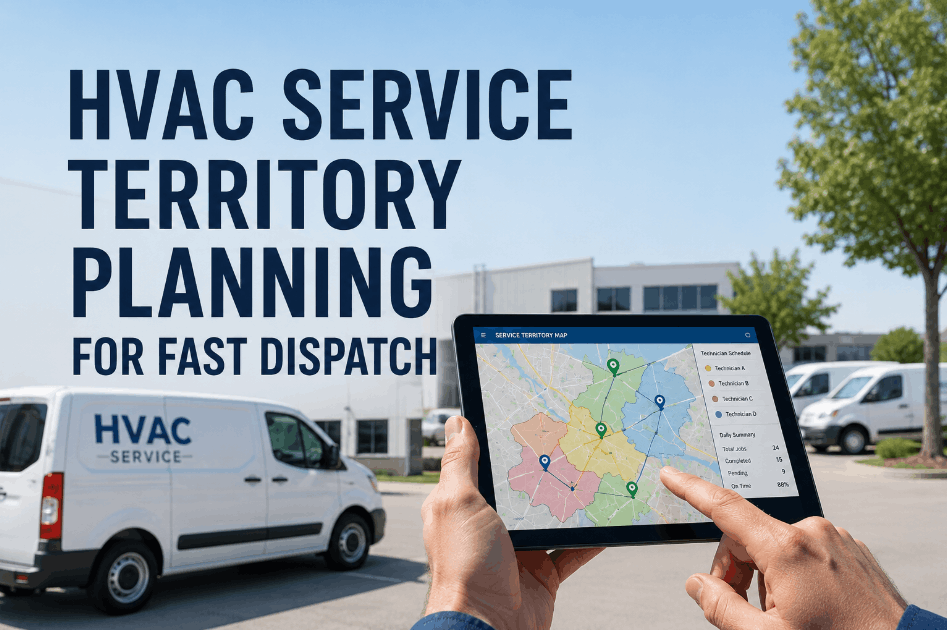
Travel time typically consumes 20–35% of an HVAC technician's day in urban and multi-site commercial service environments. When travel exceeds 35–40%, every additional job dispatched adds disproportionate cost with minimal productive output. Root causes include unstructured dispatch, excessive emergency call interruption of planned routes, and territory overlap between technicians. OxMaint's mobile work order system logs travel start and arrival times — giving dispatch planners the data to optimize routing, identify high-travel technicians for route restructuring, and measure the impact of scheduling changes on productive labor ratios over time.
PM completion rate tracks the percentage of scheduled preventive maintenance work orders closed on time versus deferred or skipped. Industry data consistently shows that facilities maintaining PM completion rates above 85% experience 20–40% lower emergency call volumes — because deferred PMs become reactive jobs. For HVAC service managers, PM completion rate is both a technician accountability metric and a leading indicator of future emergency workload. OxMaint automates PM work order generation and tracks completion status in real time — flagging overdue tasks before they age into equipment failures. Service managers who Sign Up Free see their PM backlog and completion rate from their first dashboard view.
Mean time to complete (MTTC) benchmarks expected job duration by task type — filter replacement, refrigerant service, belt replacement, diagnostic call — allowing managers to identify jobs that consistently run over expected time. Outliers reveal either chronic parts availability problems, inadequate job scope definitions, or technicians who need additional training on specific equipment types. OxMaint's work order system captures task category and timestamps automatically from mobile execution, producing MTTC data by job type, technician, and equipment category without manual time tracking.
Callback rate measures repeat service calls on the same equipment within 30 days of a completed work order — the lagging quality indicator that confirms whether first-visit fix performance is holding up over time. High callback rates on specific technicians or equipment types signal training gaps, incorrect repair procedures, or parts quality issues that require manager intervention. OxMaint's asset history links work orders chronologically — making it straightforward to identify repeat visits on the same asset and calculate callback rates by technician, equipment type, and job category for monthly performance reviews. Teams that Book a Demo see the callback analysis view in the performance reporting module.
HVAC Technician KPI Dashboard: Benchmark Reference
| KPI | Calculation | Industry Benchmark | OxMaint Data Source | Improvement Lever |
|---|---|---|---|---|
| Wrench Time | Active work time / shift hours | 55–65% | Mobile WO timestamps | Route optimization, parts staging |
| First-Visit Fix Rate | Single-visit closures / total jobs | >80% | Asset history on dispatch | Pre-job parts check, equipment history |
| Travel Time Ratio | Travel hours / total logged hours | <25% | Travel vs. active time logs | Territory planning, dispatch batching |
| PM Completion Rate | On-time PMs / scheduled PMs | >85% | Auto PM schedule tracking | Automated scheduling, overdue alerts |
| Mean Time to Complete | Average WO open-to-close time | By job category | Task duration by category | Job standards, parts availability |
| Callback Rate | Repeat visits / completed WOs (30d) | <10% | Chronological asset WO history | Training, repair procedure review |
How OxMaint Gives HVAC Service Managers Productivity Visibility
Productivity data lives inside work orders — but only if work orders are structured to capture it. OxMaint's mobile-first work order execution ensures that every job generates the timestamps, task records, and asset linkages that KPI calculations require, without adding reporting steps for technicians. Service managers access performance metrics from the OxMaint dashboard — viewing individual technician performance, team-level KPI trends, and PM completion status in real time. Facilities can Sign Up Free and begin capturing structured productivity data from the first work order executed through the mobile app.
Building a Technician Performance Management Program: Implementation Steps
Define KPI Targets by Job Type
Establish wrench time, FVFR, and MTTC benchmarks for each work order category in your service mix — creating the performance standards that make coaching conversations data-driven.
Deploy Mobile Work Order Execution
Roll out OxMaint mobile to field technicians — capturing job timestamps, task completions, and asset findings automatically on every work order without additional administrative steps.
Attach Asset History to Every Dispatch
Configure OxMaint to include equipment service history and parts checklist on every dispatched work order — giving technicians the information needed to achieve first-visit fix targets.
Review KPIs Weekly with Technicians
Use OxMaint's performance dashboard to review individual metrics weekly — identifying wrench time gaps, high callback rates, or MTTC outliers that require coaching or process adjustment.
Optimize Dispatch and Territory Planning
Analyze travel time ratios by technician and territory to restructure routes that consistently exceed travel benchmarks — converting travel hours into billable wrench time.
Track Trend Improvement Over Quarters
Compare quarterly KPI performance to establish improvement trajectory — validating that coaching, dispatch changes, and parts availability investments are producing measurable productivity gains. Book a Demo to explore the performance reporting module.
Measure and Improve HVAC Team Performance with OxMaint
OxMaint gives HVAC service managers the work order data, mobile execution, and performance dashboards needed to track wrench time, FVFR, and PM completion rate across every technician — without adding administrative overhead to field teams.
Frequently Asked Questions
What is a good wrench time percentage for HVAC technicians?
Industry benchmarks target 55–65% wrench time for field HVAC teams with structured dispatch and route planning. Below 45% indicates significant dispatch, travel, or administrative inefficiency worth investigating.
How does OxMaint capture HVAC technician productivity data?
OxMaint mobile work order execution automatically captures job start, travel, and close timestamps — producing the structured data needed to calculate wrench time, MTTC, and callback rates without manual time tracking.
What causes low first-visit fix rates in HVAC service teams?
The most common causes are missing parts at the job site, insufficient equipment history sent with the work order, and technician skill gaps on specific equipment. OxMaint addresses the first two by attaching asset history and parts checklists to every dispatched work order.
How many KPIs should HVAC service managers track per technician?
Start with three to four: wrench time, first-visit fix rate, PM completion rate, and callback rate. These cover productivity, quality, and program health without overwhelming weekly review conversations.
Can OxMaint generate performance reports for HVAC service reviews?
Yes. OxMaint's performance dashboard produces KPI summaries by technician, team, and work order category — accessible in real time for weekly coaching and exportable for monthly service review presentations.
Start Building a Data-Driven HVAC Service Team
Join HVAC service managers using OxMaint to track technician productivity KPIs, automate PM scheduling, and improve first-visit fix rates — with mobile-first work order execution that technicians actually use.