HVAC maintenance and repair work was linked to nearly 475 fatal injuries in 2021 alone — almost 10% of all installation, maintenance, and repair fatalities that year. Behind those fatalities are thousands of unreported non-fatal incidents: electrical shocks, refrigerant burns, falls from rooftops and ladders, musculoskeletal injuries from lifting heavy equipment, and heat-related illnesses in attics and mechanical rooms. The technicians who keep buildings comfortable are exposed to a unique combination of hazards — high voltage, toxic chemicals, confined spaces, extreme temperatures, and working at heights — often alone at customer sites with no supervisor present.
The regulatory landscape is equally demanding. OSHA conducted approximately 34,700 federal inspections in FY 2024, with fall protection topping the citation list for the 14th consecutive year. EPA fines for refrigerant violations reach up to $69,733 per day. And the HFC phasedown is adding new compliance requirements every year. Safety training isn't optional — it's the legal minimum. But training that actually prevents injuries requires tracking, documentation, and accountability that paper systems can't deliver. Oxmaint CMMS tracks every technician's certifications, training completions, PPE assignments, and safety compliance — ensuring no one goes to a job site without current qualifications. Schedule a demo.
Your Technicians Face Real Danger Every Day. Your Training Program Must Be Just as Serious.
The Six Hazard Zones Every HVAC Tech Enters
Each job site presents a unique combination of dangers. Training must address all six categories — not just the obvious ones:
Contact with live circuits (120V-480V+), arc flash, shock from capacitors retaining charge after system shutdown. OSHA's Control of Hazardous Energy (LOTO) is the #3 most cited standard in FY 2024. Proper lockout/tagout, insulated tools, voltage verification, and NFPA 70E arc flash boundaries are mandatory.
Chemical burns from liquid refrigerant contact, asphyxiation in confined spaces from refrigerant pooling, frostbite. New A2L refrigerants (R-454B, R-32) add mild flammability risk. EPA Section 608 certification required. Proper recovery equipment, leak detectors, ventilation, and respiratory protection mandatory.
Rooftop unit access, ladder work, attic crawlspaces, elevated mechanical rooms. Fall protection is OSHA's #1 cited standard for 14 consecutive years (29 CFR 1926.501). Harnesses, guardrails, ladder safety training, and roof edge protection required above 6 feet in construction, 4 feet in general industry.
Contact burns from heat exchangers, furnace components, brazing operations. Heat illness in unconditioned attics (140°F+) and mechanical rooms. Soldering/brazing produces toxic fumes requiring ventilation. Fire risk from torch work near combustibles. Hot work permits, fire watch, and heat illness prevention programs required.
Mechanical rooms, crawlspaces, ductwork, plenums. Oxygen-deficient atmospheres from refrigerant leaks. Exposure to fiberglass, mold, asbestos (older buildings), and combustion byproducts. OSHA confined space entry (29 CFR 1910.146) requires atmospheric testing, ventilation, attendant, and rescue plan.
Lifting condensing units (150-400+ lbs), carrying tools up ladders, working in cramped positions. Sprains, strains, and repetitive motion injuries are the most common non-fatal HVAC injuries. Mechanical lifts, team-lift policies, task rotation, and ergonomic tool design reduce musculoskeletal injury risk.
Track Every Certification. Every Expiration Date. Automatically.
Oxmaint alerts managers before EPA 608, NATE, OSHA 10/30, or state licenses expire — so no tech goes to a job site with lapsed credentials.
Required Certifications & Licenses
HVAC technicians operate under a complex web of federal, state, and industry certifications. Missing any one can mean fines, shutdowns, or personal liability:
EPA Section 608
REQUIRED BY LAW
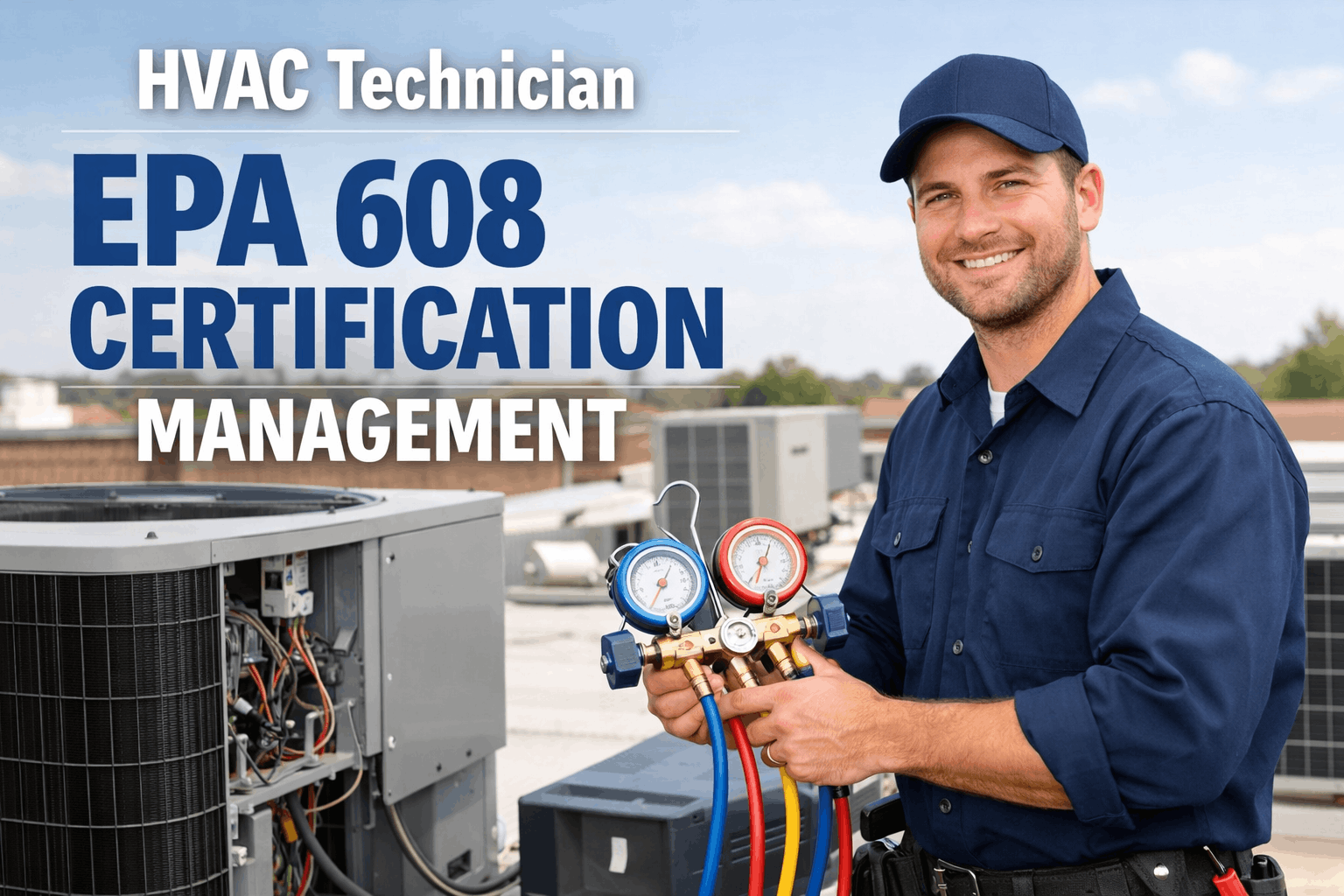
Types I, II, III, or Universal — required for any technician who maintains, services, or disposes of equipment containing regulated refrigerants. 100-question proctored exam. Does not expire, but technicians must stay current on HFC phasedown changes. Violations: up to $44,539-$69,733/day.
OSHA 10 / OSHA 30
INDUSTRY STANDARD
10-hour card for technicians, 30-hour for supervisors. Covers hazard recognition, PPE, fall protection, electrical safety, LOTO, confined space. Not technically required by federal OSHA, but mandated by many states, clients, and general contractors. Increasingly required for commercial work.
NATE Certification
INDUSTRY RECOGNIZED
North American Technician Excellence — the HVAC industry's most recognized certification. Core + specialty exams (AC installation, heat pump service, gas furnace, etc.). Expires every 2 years — requires continuing education. NATE-certified techs consistently earn higher wages and drive higher customer satisfaction.
State Licensing
VARIES BY STATE
Most states require HVAC contractor licenses. Many require journeyman/master-level licensing for individual technicians. Requirements vary: exam, experience hours (2,000-8,000+), insurance, bonding. Some states require separate electrical, plumbing, or gas piping licenses for cross-trade work.
OSHA's Top 10 — And How They Hit HVAC
These are the most frequently cited OSHA standards in FY 2024. Every single one applies directly to HVAC field work:
The Penalty Math: What Non-Compliance Actually Costs
Fines are just the beginning. The real cost of a safety failure includes lost work days, workers' comp premiums, legal exposure, and reputation damage:
Building a Training Program That Actually Works
Compliance-only training checks a box. Effective training changes behavior. Here's how to structure a program that does both:
New Hire Orientation
Complete before first solo job assignment
Role-Specific Technical
Complete within first 90 days
Ongoing & Refresher
Continuous — tracked in CMMS with expiration alerts
Safety Isn't Just Training — It's Tracking
Oxmaint tracks every certification, training completion, PPE assignment, and safety inspection for your entire HVAC team — with automated expiration alerts so no one falls through the cracks.
Frequently Asked Questions
What safety certifications do HVAC technicians need?
At minimum: EPA Section 608 certification (required by federal law for anyone handling refrigerants — Types I, II, III, or Universal). Beyond that: OSHA 10-Hour (increasingly required by states and clients), NATE certification (industry standard, expires every 2 years), and applicable state HVAC contractor/journeyman licenses. Specialized work may require confined space entry training, fall protection certification, A2L refrigerant handling, and CPR/First Aid. A CMMS like Oxmaint tracks all certifications with expiration alerts.
What are the biggest safety hazards for HVAC technicians?
Six primary hazard categories: Electrical (shock, arc flash — LOTO is OSHA's #3 cited standard), refrigerant exposure (chemical burns, asphyxiation, frostbite), falls (#1 OSHA citation for 14 years), burns and heat stress (attics reaching 140°F+, brazing operations), confined spaces (mechanical rooms, crawlspaces with oxygen-deficient atmospheres), and ergonomic injuries (lifting heavy equipment, working in cramped positions — the most common non-fatal HVAC injuries). Maintenance and repair work was linked to nearly 475 fatal injuries in 2021.
What are the fines for HVAC safety violations?
OSHA serious violations: up to $16,131 per violation. Willful or repeat violations: up to $161,323 per violation. EPA refrigerant violations under Section 608: up to $69,733 per day per violation — including venting refrigerants, using uncertified technicians, and failing to maintain records. Criminal prosecution is possible under the Clean Air Act, with up to 5 years imprisonment (doubled for repeat offenses). Beyond fines, safety failures drive up workers' compensation premiums, lost-time injury costs ($40,000+ per claim), and can result in contract disqualification.
How does a CMMS help with HVAC safety compliance?
A CMMS like Oxmaint manages the documentation and tracking side of safety: certification records with expiration alerts, training completion logs, PPE assignment and inspection schedules, safety checklist enforcement on work orders, incident reporting and investigation tracking, and audit-ready compliance reports. The system ensures no technician is dispatched to a job requiring certifications they don't hold — and alerts managers before credentials expire, not after an inspector finds the gap.
Does EPA 608 certification expire?
No — Section 608 certification does not expire. However, technicians must stay current on regulatory changes, particularly the ongoing HFC phasedown adding new refrigerants like R-454B (A2L classification with mild flammability). The transition from R-410A to R-454B requires updated handling procedures and safety knowledge even though the base certification remains valid. NATE certifications, by contrast, expire every 2 years and require continuing education credits for renewal. State licenses also have their own renewal cycles.