The HVAC industry is running out of people. Not equipment, not parts, not technology — people. The U.S. faces a shortage of more than 110,000 qualified HVAC technicians, and the gap is widening every year as retirements outpace new entries into the trade. Building owners and facility managers are already feeling it: longer wait times for service, premium pricing for routine work, and the uncomfortable reality that a single technician calling in sick can mean a day of unresolved maintenance requests. The answer is not to find technicians that do not exist. The answer is to make the technicians you have dramatically more effective — and digital tools are proving they can extend technician capacity by 30 to 40 percent without adding a single person to the payroll. Sign up free to see how Oxmaint's full platform puts that capacity multiplier to work for your team.
110K+
Technician Shortage
unfilled HVAC technician positions across the U.S. — a gap that is growing as Baby Boomer retirements accelerate and trade school enrollment lags behind industry demand
38%
Retirement Rate
of currently working HVAC technicians are expected to retire within the next decade — removing experienced institutional knowledge faster than apprenticeship programs can replace it
30-40%
Capacity Gain
increase in effective technician output documented in facilities that deploy digital work order, scheduling, and guided diagnostics tools — the equivalent of adding 1 technician per every 2.5 on your team
$8,400
Cost Per Reactive Call
average fully-loaded cost of an unplanned HVAC breakdown requiring emergency dispatch — compared to $340 for a preventive maintenance visit that catches the same failure before it happens
Where Technician Time Actually Goes — and Where It Gets Lost
Before solving the shortage problem with technology, it helps to understand exactly where the hours go. Studies of HVAC technician time allocation consistently show the same pattern: a surprisingly small fraction of a technician's day involves hands-on mechanical work. The rest is consumed by logistics, documentation, and information-seeking — tasks that digital tools can dramatically compress or eliminate. Book a demo to see how Oxmaint restructures that time allocation for HVAC teams.
Hands-on mechanical work
35%
Paperwork and documentation
18%
Waiting for parts or access
13%
Diagnosing without data or history
12%
43% of a technician's day is consumed by paperwork, waiting, and uninformed diagnostics — all directly addressable with digital tools
2.1 hrs
average time wasted per technician per day on manual documentation and work order handling — that is 500+ hours per year per person
47 min
average time spent per job finding equipment history, locating manuals, or calling the office for information — eliminatable with mobile asset access
1 in 3
reactive calls that could have been prevented by a scheduled preventive maintenance visit — each one taking 4x longer to resolve than planned work
Four Ways Digital Tools Multiply Technician Capacity
Digital workforce planning and maintenance management tools do not replace technicians — they remove the friction that stops technicians from doing the work they were trained to do. Four specific capabilities drive the 30-40% capacity gain that well-implemented platforms consistently deliver. Sign up free and see which of these your current operation is missing.
01
Optimized Work Order Scheduling
Manual scheduling — assigning jobs by phone, whiteboard, or spreadsheet — consistently produces inefficient route sequences and double-dispatching. Digital scheduling clusters jobs by location, matches work to technician skill level, and surfaces priority conflicts automatically. The result: 2-4 additional completed jobs per technician per day without increasing headcount or hours.
Capacity Gain: 15-20% more jobs completed per technician daily
02
Mobile Asset Access and History
When a technician arrives at a job without equipment history, they start diagnosing from scratch — even if the same unit had the same failure six months ago. Mobile access to asset records, maintenance history, open work orders, and equipment documentation eliminates the 47 minutes per job lost to information-seeking. Every visit begins from a position of knowledge rather than zero.
Capacity Gain: 45-60 min recovered per technician per day
03
Guided Digital Checklists
Senior technicians carry institutional knowledge in their heads. When they retire, that knowledge leaves with them. Digital guided checklists encode expert-level diagnostic sequences, safety steps, and documentation requirements so that junior technicians execute work at a higher standard — consistently. Less rework, fewer callbacks, and faster skill development for new hires entering an understaffed trade.
Capacity Gain: 30-40% reduction in callback visits on completed work
04
Preventive vs. Reactive Work Ratio
A reactive breakdown takes 4 to 5 times longer to resolve than a planned preventive maintenance visit on the same equipment. Facilities that shift from reactive to preventive — enabled by automated PM scheduling that generates work orders before equipment fails — accomplish more maintenance per technician hour while simultaneously reducing the frequency of emergency calls that disrupt every other schedule in the queue.
Capacity Gain: 40-50% reduction in emergency dispatch hours
More Output. Same Team. Starting This Week.
Oxmaint's full platform — work order management, mobile asset access, guided checklists, and automated PM scheduling — is the fastest way to extend your existing HVAC workforce capacity without waiting for the hiring market to improve.
Knowledge Retention: The Hidden Workforce Crisis Within the Shortage
The 110,000-technician shortage is visible and widely reported. Less visible — but equally damaging — is the knowledge loss that accompanies each retirement. A senior HVAC technician leaving after 25 years takes with them an accumulated library of building-specific knowledge: which units are problem equipment, which VAV boxes drift, which controllers need manual overrides in summer, which mechanical rooms have access complications. That knowledge exists nowhere else. Digital asset management is the only tool that captures and retains it.
Equipment quirks and workarounds
Every experienced technician knows which units behave differently than the spec sheet says. This knowledge is never written down — it lives in their head and walks out the door when they leave.
Failure pattern history
Which unit has had the same bearing failure three times in two years. Which controller loses its program after a power event. Pattern recognition that only comes from years of site history — and can be captured digitally.
Vendor and parts contacts
The supplier who has the right part in stock, the rep who answers on the first call, the warranty contact for the rooftop units installed in 2019. Relationship knowledge that translates directly into response speed.
Building access and safety specifics
Which mechanical room requires a specific key, which roof access has a faulty latch, which electrical panel feeds the AHU on the third floor. Logistics knowledge that junior technicians learn the hard way.
NOTE
Asset Notes and Flags
Equipment-level notes capture quirks, workarounds, and known issues that stay with the asset record permanently — visible to every technician dispatched to that unit.
HIST
Full Work Order History
Every service visit, every part replaced, every failure mode documented — creating the failure pattern record that previously lived only in a senior technician's memory.
DOC
Attached Documentation
Manuals, wiring diagrams, warranty documents, and access instructions attached directly to the asset record — accessible from any mobile device at the job site.
Workforce Planning: Shifting from Reactive Hiring to Proactive Capacity Management
Most facility managers respond to the technician shortage by trying to hire — placing ads, working with staffing agencies, and competing on salary in a market where competition for qualified technicians is intense. A parallel strategy is more immediately controllable: understanding where your current team's capacity is going and restructuring work allocation to recover lost hours. Digital workforce planning tools make this analysis possible for the first time. Book a demo to see how Oxmaint's workforce planning dashboard surfaces capacity insights for HVAC teams.
WRK
Work Mix Analysis
How much of your team's time is reactive vs. preventive? What percentage of reactive calls were on equipment that had no PM in the prior 12 months? Answering these questions with data — not estimates — is the first step toward restructuring work allocation to reduce emergency demand.
SKL
Skill-Based Routing
Not every HVAC work order requires your most experienced technician. Digital systems that match work complexity to technician skill level ensure that senior technicians spend their hours on high-complexity work while juniors build competency on routine tasks — maximizing the output of every skill tier simultaneously.
BCK
Backlog Visibility
Without a digital system, PM backlog is invisible — nobody knows which scheduled maintenance is overdue until a failure makes the gap obvious. Real-time backlog visibility lets managers make informed decisions about overtime, contractor supplementation, and priority sequencing before a backlog becomes a breakdown.
NEW
New Hire Onboarding Speed
A new technician reaching full productivity in 3 months instead of 9 is the equivalent of hiring 2 productive technicians instead of 1 in the first year. Digital guided checklists, asset history access, and structured work orders compress the learning curve by giving new hires the context that used to require years of site experience to accumulate.
Workforce Planning
See Where Your Team's Capacity Is Going.
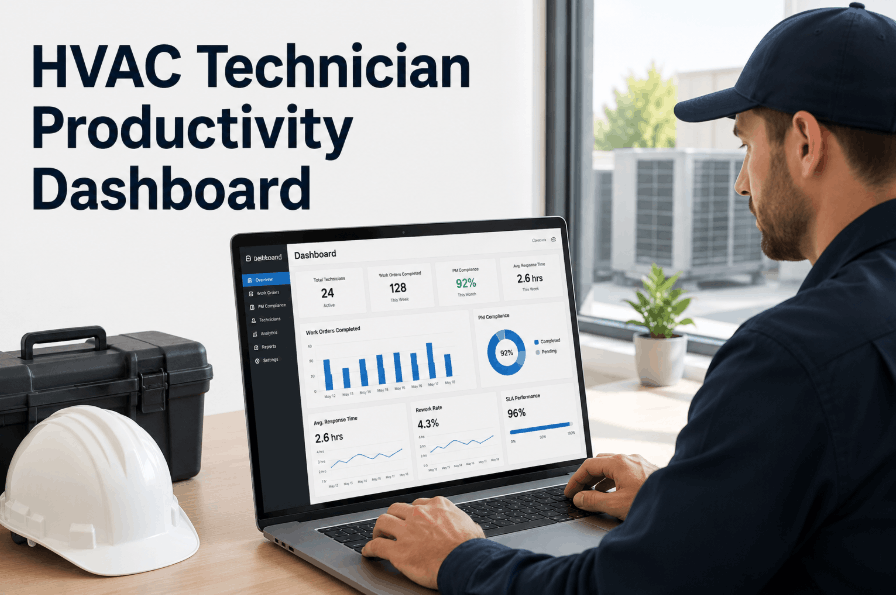
Oxmaint's workforce planning dashboard shows work mix, technician utilization, PM compliance, and backlog — giving managers the data to restructure team output without adding headcount.
Sign up free or
book a demo to see the planning view.
30-40%
capacity increase achievable with existing team using digital tools
3 mo
vs. 9-month onboarding timeline with guided checklists and asset history access
4x
longer to resolve reactive breakdown vs. planned PM visit on same equipment
Technician Retention: Why Digital Tools Also Reduce Turnover
Hiring a replacement HVAC technician costs between $15,000 and $25,000 in recruiting, training, and productivity loss during the gap period. Retaining technicians is not just a human resources priority — it is a financial one. Digital tools have a documented positive effect on technician retention because they directly address the most common causes of voluntary departure: administrative frustration, lack of growth, and the feeling that their work is not valued or tracked. Sign up to start building the kind of work environment that keeps qualified technicians.
Excessive paperwork and manual reporting
Mobile work orders replace paper — documentation takes 3 minutes instead of 30
No visibility into their own performance or contribution
Digital dashboards show completed work, response times, and PM compliance — making good work visible
Repeatedly sent to jobs without the information needed to succeed
Asset history and documentation accessible on mobile — technicians arrive informed, not frustrated
No structured path for skill development or advancement
Guided checklists build competency progressively — junior technicians can see their own skill growth
Constant reactive chaos with no sense of control
Preventive maintenance scheduling reduces emergency volume — work becomes manageable and predictable
The Shortage Is Not Going Away. Your Response to It Can Change Today.
Oxmaint's full platform gives HVAC teams the scheduling intelligence, mobile asset access, guided diagnostics, and workforce analytics to operate at 30-40% greater capacity with their existing team. The technician market is tight. Your tools do not have to be.
Sign up free to get started, or
book a demo to see the full workforce capability.
30-40%
more jobs completed per technician per day with optimized scheduling and mobile access
$8,400
average cost of a reactive HVAC emergency call — vs. $340 for a planned PM visit on the same equipment
500+
hours per year per technician recovered from manual paperwork and information-seeking with digital tools
You Cannot Hire Your Way Out of the HVAC Shortage. You Can Work Smarter Through It.
Oxmaint's full platform — work order management, mobile asset access, guided checklists, workforce planning, and automated PM scheduling — extends your existing HVAC team's capacity by 30-40% without adding headcount. It also reduces turnover, retains institutional knowledge, and accelerates new hire productivity. The shortage is real. The solution is operational.
Optimized Work Order Scheduling
Mobile Asset History Access
Guided Digital Checklists
Workforce Planning Dashboard
Frequently Asked Questions
How severe is the HVAC technician shortage and how long will it last?
The U.S. HVAC industry currently faces a shortage of more than 110,000 qualified technicians, and the gap is projected to widen through the mid-2030s as retirements accelerate. The Bureau of Labor Statistics projects 6% annual growth in HVAC technician demand through 2032, while trade school enrollment and apprenticeship completion rates are not keeping pace. The shortage is structural — driven by demographic retirement patterns in a generation that built out the bulk of current commercial HVAC infrastructure — and is not expected to self-correct within the next decade. Facility operations teams that wait for the hiring market to improve are making a costly assumption. The practical response is capacity management: using digital tools to extract more output from the technicians already on payroll.
Sign up free to start building your capacity-multiplying workflow today.
How much can digital tools realistically increase HVAC technician productivity?
Documented results across facilities implementing digital work order management, mobile asset access, and optimized scheduling consistently show 30-40% capacity increases. The gains come from four sources: route optimization that adds 2-4 jobs per day, mobile information access that recovers 45-60 minutes per technician per day, guided checklists that reduce callback visits by 30-40%, and PM scheduling that shifts time from reactive (4-5x longer per job) to planned work. In a 5-person HVAC team, a 30% capacity increase is effectively equivalent to adding 1.5 technicians without recruiting, onboarding, or compensating a single new hire.
Book a demo to see how these gains apply to your specific team size and work mix.
What is the most common source of wasted technician time in HVAC operations?
Studies consistently identify three major sources of wasted technician time. First, documentation and paperwork — averaging 2.1 hours per technician per day in facilities using paper-based systems, most of which is eliminatable with mobile digital work orders. Second, information-seeking at the job site — averaging 47 minutes per job when technicians arrive without equipment history, documentation, or prior work order context. Third, reactive emergency calls — each taking 4-5 times longer to complete than a planned PM visit on the same equipment. Together these account for 40-45% of the average HVAC technician's working hours. Digital tools directly address all three categories without requiring technicians to work harder or longer.
How do digital tools help retain experienced HVAC technicians?
HVAC technician turnover is driven by a consistent set of factors: administrative frustration from excessive paperwork, reactive chaos that makes work feel uncontrollable, lack of visibility into their own performance and contribution, and no clear path for skill development. Digital tools address all four. Mobile work orders eliminate the documentation burden. PM scheduling reduces the reactive emergency volume that creates chaos. Performance dashboards make good work visible and recognized. Guided checklists provide a structured skill development path. Replacing an HVAC technician costs $15,000 to $25,000 in recruiting and productivity loss — making retention a significant financial priority, not just a management preference.
Sign up free to start building a work environment that retains your best people.
How do guided digital checklists help junior technicians work at a higher level?
Senior HVAC technicians carry diagnostic sequences, safety protocols, and quality standards in their heads — built over years of experience. When they retire, that expertise leaves with them. Guided digital checklists encode this expertise into step-by-step task sequences that junior technicians follow at the job site. The result is that a technician with two years of experience executes preventive maintenance and diagnostic work at a standard previously requiring five or more years of experience. Callback rates drop because work is completed correctly the first time. New hire ramp-up compresses from 9 months to approximately 3 months. In a shortage environment where every hire matters, making each new technician productive faster is one of the highest-value investments a facility operation can make.
Book a demo to see Oxmaint's guided checklist builder.
What workforce planning data does Oxmaint provide for HVAC teams?
Oxmaint's workforce planning capabilities give HVAC team managers visibility into the data that drives capacity decisions: work mix breakdown (reactive vs. preventive percentage), technician utilization by individual and team, PM compliance rate by asset class and zone, backlog volume and aging, average response time and resolution time by work order type, and callback rate by technician and asset. This data answers the questions that most HVAC managers currently have to estimate: How much of our time is reactive? Which assets are generating disproportionate emergency demand? Are we keeping up with PM schedules? Who on the team has capacity for additional work? Where is our backlog building? The answers determine where digital tools create the most immediate capacity gain.
Sign up free to begin collecting this data for your team.