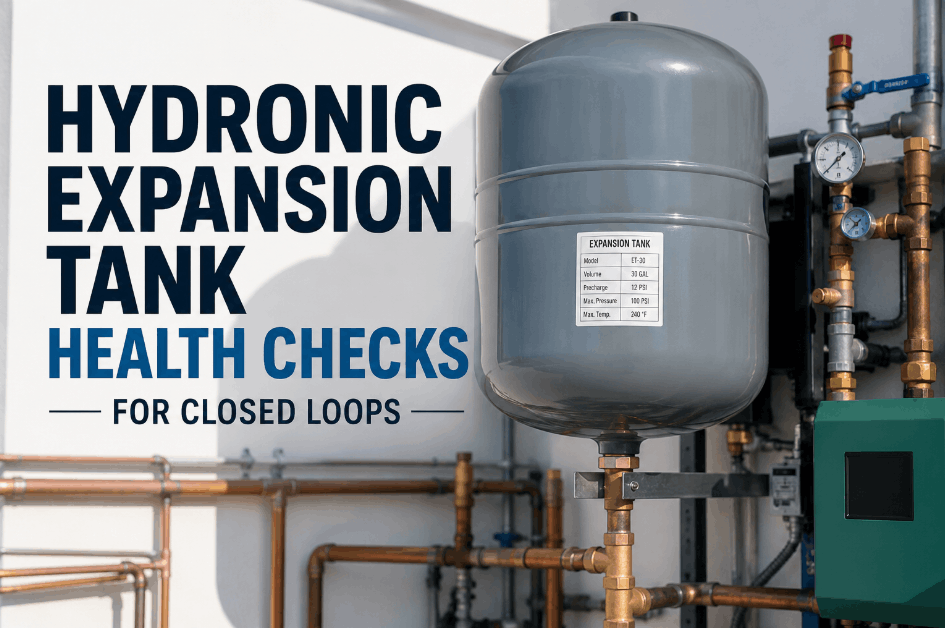
Hydronic expansion tank health is a silent variable in closed-loop system reliability — and most facility teams discover a problem only after pressure instability has already triggered nuisance trips, waterlogged conditions, or safety valve discharges. When precharge loss goes undetected, bladder integrity is never verified, and pressure behavior across the loop is never trended, the closed loop operates outside its design envelope long before any alarm fires. Maintenance teams using Sign Up Free on OxMaint can build the structured inspection records, equipment history, and work order linkage that hydronic expansion tank health monitoring requires across chilled water, condenser water, and heating hot water systems.
Why Closed-Loop Reliability Depends on Expansion Tank Health
Expansion tanks absorb system volume changes as fluid temperature fluctuates — and when bladder integrity or precharge pressure degrades, the loop loses its pressure buffer. Book a Demo to see how OxMaint's inspection and work order structure captures the precharge readings, bladder condition notes, and pressure trending data your facility engineering team needs to identify expansion tank degradation before it cascades into loop instability.
Six Health Check Signals Every Closed-Loop Expansion Tank Inspection Must Capture
Reliable expansion tank health monitoring requires consistent capture of multiple condition signals on every inspection cycle. OxMaint's inspection work order structure records all six signals in a queryable format that enables trend analysis across service intervals. Sign Up Free to configure OxMaint's inspection templates for expansion tank health checks across your hydronic system inventory.
Precharge Pressure Verification
Recording nitrogen precharge pressure on each inspection cycle in OxMaint creates the trending record that identifies gradual precharge loss — the most common expansion tank failure mode — before the loop enters an under-pressurized operating condition.
Bladder Integrity Assessment
OxMaint inspection work orders capture bladder condition observations — water discharge from the Schrader valve, abnormal precharge loss rate, or physical deformation — that indicate bladder failure requiring tank replacement before waterlogging occurs.
System Static Pressure at Fill Point
Logging static fill pressure against the expansion tank's precharge reading in OxMaint verifies that the pressure differential matches the tank's design specification — and surfaces mismatches that indicate either improper fill pressure or precharge drift.
Loop Pressure Behavior During Thermal Cycling
OxMaint work orders capture pressure readings at operating temperature alongside cold static pressure — identifying tanks that are undersized for the loop's actual thermal expansion volume or that have lost effective acceptance volume due to bladder collapse.
Pressure Relief Valve Discharge History
Recording safety valve discharge events against the expansion tank's inspection history in OxMaint correlates pressure relief activations with tank health status — distinguishing between overpressure from a failed tank and overpressure from a separate system fault.
Tank Isolation Valve and Connection Condition
OxMaint inspection records capture isolation valve position, connection fitting condition, and visible corrosion indicators — ensuring the tank remains hydraulically active in the loop and that physical degradation is identified before it causes tank disconnection under operating pressure.
Expansion Tank Health Check Value by Hydronic System Type
Book a Demo to see how OxMaint structures asset records and inspection work orders to support hydronic expansion tank health monitoring across multiple closed-loop system types.
| System Type | Primary Failure Risk | Key Health Check Signal | Inspection Frequency | OxMaint Data Captured |
|---|---|---|---|---|
| Chilled Water Loop | Low-pressure cavitation at pump suction | Precharge vs. static pressure differential | Semi-annual | Precharge reading + loop pressure trend |
| Heating Hot Water Loop | Pressure relief discharge from thermal overexpansion | Operating pressure at design temperature | Annual pre-season | Cold/hot pressure pair + PRV discharge history |
| Condenser Water Loop | Waterlogging from bladder failure | Schrader valve water discharge test | Annual | Bladder condition note + precharge history |
| Glycol-Filled Loop | Precharge loss accelerated by fluid density | Adjusted precharge for glycol concentration | Semi-annual | Glycol % + corrected precharge target |
| Dual-Temperature Loop | Pressure swing outside tank acceptance range | Pressure behavior across heating/cooling modes | Quarterly | Mode-specific pressure readings + trend |
Four Outcomes Structured Expansion Tank Inspections Deliver
Sign Up Free to build the structured expansion tank inspection history in OxMaint that makes all four outcomes achievable across your hydronic closed-loop system portfolio.
Building a Hydronic Expansion Tank Health Check Program with OxMaint
Register Expansion Tanks as Individual Asset Records
Create individual OxMaint asset records for each expansion tank with design precharge, acceptance volume, tank model, and loop assignment. Asset-level records enable precharge trending and failure history queries that are not possible when tanks are managed as generic equipment line items.
Configure Inspection Templates with Structured Condition Fields
Build OxMaint inspection work order templates with dedicated fields for precharge reading, bladder condition, static fill pressure, operating pressure, PRV status, and isolation valve position — replacing free-text notes with queryable structured data on every inspection cycle.
Link Expansion Tanks to Loop and System Parent Assets
Map each expansion tank to its parent loop and associated pump, heat exchanger, and pressure control valve assets in OxMaint's asset hierarchy — enabling correlation queries that connect tank health status with loop pressure complaints and pump performance anomalies.
Schedule Seasonal and Annual Inspection Cycles
Configure OxMaint PM schedules to trigger expansion tank inspections before seasonal heating and cooling mode transitions — capturing precharge and pressure data at the operating conditions most likely to reveal degradation before peak-load season begins.
Trend Precharge and Pressure Data Across Inspection Cycles
OxMaint's reporting dashboards enable precharge trend queries filtered by asset, loop type, and inspection date — producing the health trend outputs that facility engineers use to schedule corrective recharge, plan tank replacements, and validate loop stability after maintenance interventions.
Frequently Asked Questions: Hydronic Expansion Tank Health Checks for Closed Loops
What causes precharge loss in hydronic expansion tanks?
Precharge loss typically results from nitrogen permeation through the bladder membrane, Schrader valve leakage, or bladder rupture. Gradual loss is normal over years; rapid loss indicates bladder failure or valve damage requiring immediate inspection.
How do I know if a hydronic expansion tank bladder has failed?
A failed bladder discharges water from the Schrader valve when depressed with system pressure present. Other indicators include rapid precharge loss between inspections and pressure swings that exceed the tank's rated acceptance volume during thermal cycling.
How often should closed-loop expansion tanks be inspected?
Semi-annual inspections before seasonal mode transitions are recommended for most closed loops. High-temperature or glycol-filled loops benefit from quarterly precharge verification due to accelerated bladder degradation at elevated operating temperatures.
How does OxMaint support expansion tank health monitoring?
OxMaint provides structured inspection templates, asset-level precharge trending, loop hierarchy mapping, and corrective work order linkage — giving facility teams the data architecture that makes expansion tank health checks queryable and actionable across the entire closed-loop system portfolio.
Can expansion tank failures cause pressure relief valve damage?
Yes. A waterlogged or undersized expansion tank cannot absorb system thermal expansion, driving loop pressure above the PRV set point on every heating cycle. Repeated PRV discharges cause valve seat damage and eventual valve failure requiring replacement.