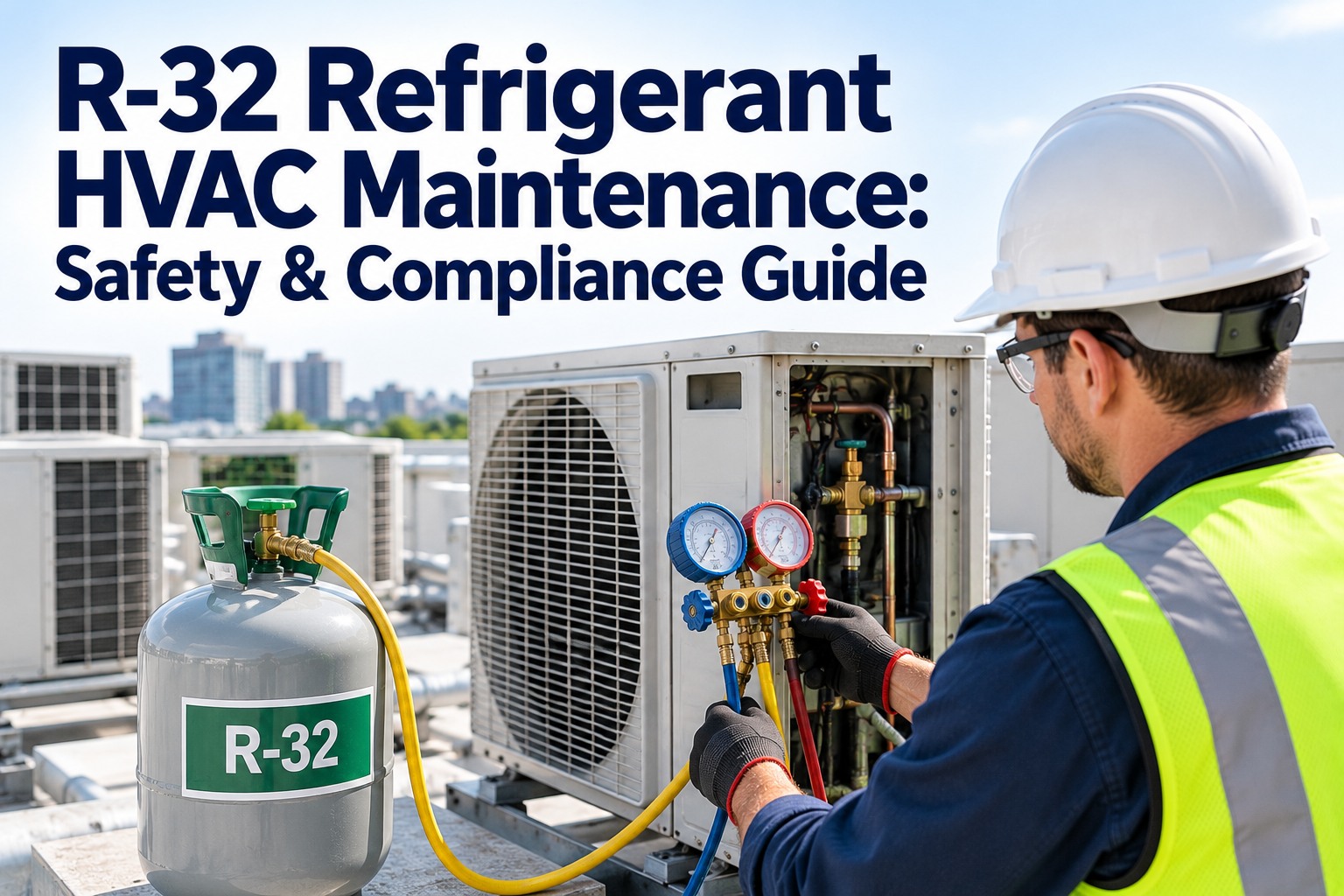
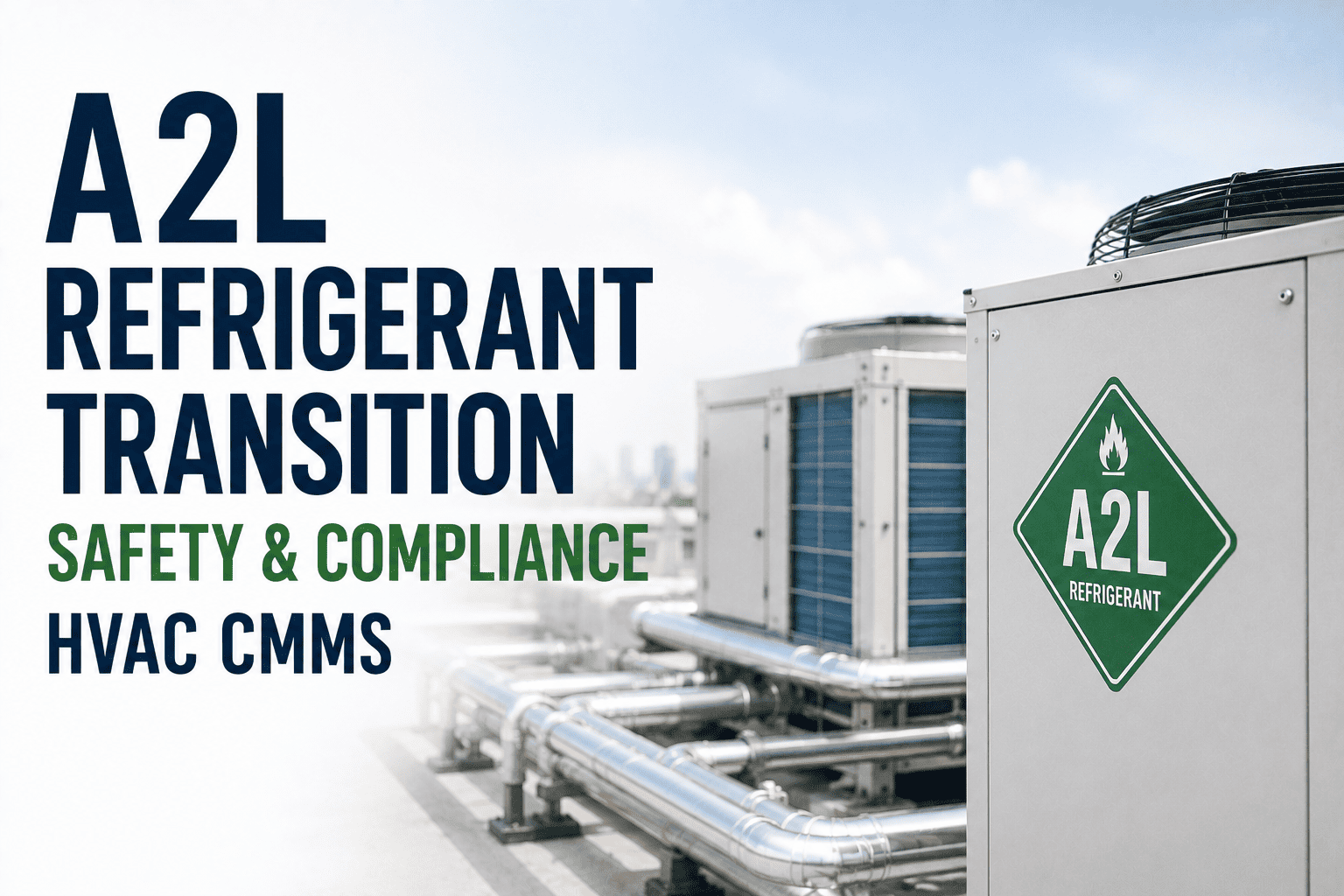
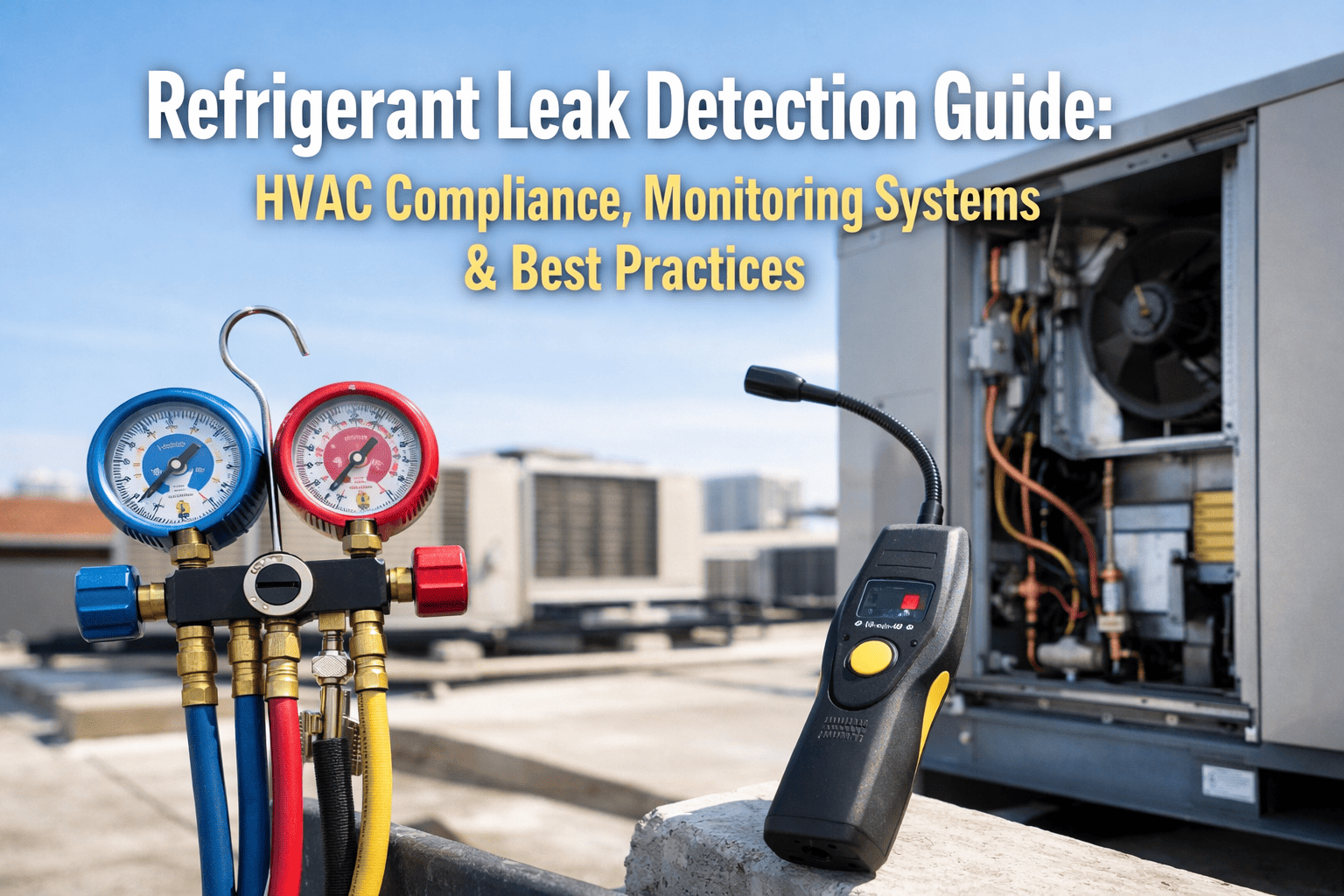
The crews servicing today's air conditioners trained on R-410A — a refrigerant you could braze near with the charge still in the system. R-32 is different. It's an A2L: lower global-warming impact, but mildly flammable, which means some old habits are now hazards. Handled correctly, R-32 is safe and routine; handled like an A1, it isn't. This guide explains what A2L means, how R-32 compares to R-410A, the safe-handling and leak-detection practices it demands, and how to keep the maintenance and compliance records straight in OXMAINT AI — or book a demo of refrigerant compliance tracking in OXMAINT AI.
R-32 cuts the global-warming impact of a system by roughly two-thirds — but it's mildly flammable, so brazing on a live charge, a non-rated leak detector or a bypassed sensor are no longer acceptable. OXMAINT AI is the AI-powered CMMS that schedules A2L maintenance, logs leak and sensor checks, and keeps the handling and compliance records on each asset — so safe practice is routine and provable.
lower toxicity, mild flammability — R-32's ASHRAE 34 safety class
~675
R-32 GWP, against roughly 2,088 for the R-410A it replaces
≤10
cm/s max burning velocity defines a 2L refrigerant — it burns slowly
25%
of the LFL is the concentration ceiling designs must stay under
What "A2L" Actually Means
The safety class isn't a grade — it's two separate facts about the refrigerant, from ASHRAE Standard 34. The letter is toxicity, the number-and-letter is flammability. R-32 sits at A2L: low toxicity, mild flammability with a slow burning velocity. Start free and tag each asset's refrigerant and class in OXMAINT AI.
A
Lower toxicity
Occupational exposure limit of 400 ppm or higher — the safer toxicity group.
+
2L
Mild flammability
Burns only in a narrow band, needs a strong ignition source, and spreads slowly (≤10 cm/s).
Class
Flammability
Examples
A1
No flame propagation
R-410A, R-134a
A2L
Mild, slow burning velocity
R-32, R-454B
A2
Higher flammability
R-152a
A3
Highly flammable
R-290 (propane)
R-32 vs R-410A: What Changes for the Technician
R-32 isn't just a greener swap — the switch changes how a system is serviced. The big wins are a much lower GWP and a single-component charge with no glide; the trade-off is the flammability class that drives new handling rules.
R-410A
A1 · non-flammable
GWP ~2,088
Blend — has glide
No A2L handling rules
Legal to keep servicing
R-32
A2L · mildly flammable
GWP ~675
Single component — no glide
A2L handling & detection apply
Charge by weight, don't mix
The Three Conditions for a Flammable Event
A2L flammability is often misread as constant danger. It isn't — a fire needs all three of these at once, and safe practice is simply about making sure they never line up. Remove any one and there is no event. Book a demo of A2L maintenance scheduling in OXMAINT AI.
1
A Leak
Refrigerant escapes the sealed system — so a proven-tight system is the first and best safeguard.
+
2
Concentration in the Band
It builds to within the flammable range — ventilation and charge limits keep it below 25% of the LFL.
+
3
An Ignition Source
A strong, sustained source ignites it — no open flame, smoking or non-rated devices in the work zone.
Safe Handling: The Rules That Changed
Most A2L accidents come from treating R-32 like R-410A. These are the practices that are now non-negotiable — the ones that break the flammability chain before it can form.
✓
Recover before hot work
Fully recover the charge and nitrogen-purge before any brazing — never braze on a live A2L charge.
✓
Use A2L-rated equipment
Leak detector, recovery machine, hoses and cylinders all listed for flammable refrigerant — no halide torch.
✓
Ventilate the work zone
Force air movement in basements, closets and crawlspaces before and during any procedure that could release charge.
✓
Kill ignition sources
No smoking, open flame or non-rated electrical devices where refrigerant could accumulate.
✓
Never mix refrigerants
Don't add A2L to an R-410A system or the reverse; charge R-32 by weight to the nameplate.
✓
Store cylinders correctly
A2L cylinders are flammable gas — upright, secured, ventilated, away from ignition sources and oxidizers.
Leak Detection & the Mitigation Sequence
Modern A2L equipment protects itself. A factory refrigerant detection sensor watches for a leak and, on alarm, runs an automatic sequence to keep the concentration safe — a listed safety system that must never be bypassed.
1
Sensor Detects
The refrigerant detection sensor (RDS) senses a leak in the indoor unit or plenum.
→
2
Compressor Off
The control stops the compressor so no more refrigerant is pumped to the leak.
→
3
Blower Dilutes
The indoor blower energizes and dampers open to disperse refrigerant below the flammable band.
→
4
Fault Lockout
The system locks out for service rather than auto-resetting — the leak must be found and fixed.
RDS units have a stated life, commonly 10–15 years, and must be replaced on schedule — never bypassed, which defeats the listing.
R-32 Maintenance Best-Practice Checklist
The recurring checks that keep an R-32 system safe and compliant between services. Tick each as you complete it; the whole row toggles.
How OXMAINT AI Keeps R-32 Safe and Compliant
OXMAINT AI is the AI-powered maintenance management software that keeps A2L systems on schedule and on record — the asset register with refrigerant and safety class, the PM routine, the sensor-life clock and the service log on one platform. Put your R-32 equipment on it when you start free and schedule A2L maintenance in OXMAINT AI.
Refrigerant Asset Register
Each unit tagged with its refrigerant, A2L class, charge and required mitigation on file.
Scheduled A2L PMs
Leak, sensor and ventilation checks generated on cadence so safety tasks never slip.
Sensor-Life Clock
The 10–15 year RDS replacement tracked as a task so no sensor runs past its life.
Leak → Work Order
A detected leak raises a prioritised repair with the location, method and reading attached.
Service & Charge Log
Every gram added and recovered logged by date and technician for the compliance record.
Document Trail
Labels, readings and sensor checks retained as the record of a safely maintained A2L fleet.
A2L Is Safe When the Habits Catch Up.
R-32 asks for a few new rules — recover before hot work, rated tools, a sensor that's never bypassed. Build those into the schedule and the fleet runs cleaner and just as safely as it ever did. OXMAINT AI makes the new practice routine and the record automatic.
Written for HVAC-R, facilities and building-operations teams. R-32 is an A2L refrigerant, and its handling is governed by standards and codes including ANSI/ASHRAE 15 and 34, UL/CSA 60335-2-40, and the model mechanical codes, alongside the AIM Act phasedown and EPA Section 608, which requires certified technicians to handle refrigerant. The classification, GWP, burning-velocity and concentration figures here are reference values that vary by standard edition and have exceptions — confirm the current requirements, charge limits and minimum-room-area tables against the standards, the manufacturer's data and your authority having jurisdiction. OXMAINT AI is a maintenance management platform that schedules the work, logs the readings and tracks sensor life and records — it is not a leak detector, a refrigerant-handling certification, or a substitute for a trained A2L technician.
Frequently Asked Questions
Is R-32 dangerous to work with?
R-32 is mildly flammable (A2L), not highly flammable — it burns only within a narrow concentration band and needs a strong, sustained ignition source. Handled with A2L-rated tools, proper ventilation, no ignition sources and recovery before any hot work, it's safe and routine. The risk comes from servicing it with R-410A habits. Start free and schedule A2L safety checks in OXMAINT AI.
Why is the industry moving to R-32?
Mainly global-warming impact. R-32's GWP is around 675 against roughly 2,088 for R-410A, and the AIM Act phases down high-GWP HFCs — new residential and light-commercial equipment has moved to lower-GWP A2L refrigerants. R-32 is also a single component with no glide, which makes it simpler to charge and reclaim.
Can I use my R-410A tools and gauges on R-32?
Not for anything that must be rated for flammable refrigerant. Leak detectors, recovery machines, hoses and cylinders must be listed for A2L use, with spark-free recovery motors. Some tools carry over, but the safety-critical equipment does not — and A2L and R-410A must never be mixed in a system.
What is the refrigerant detection sensor and can I bypass it?
It's a factory-fitted sensor that detects an A2L leak and triggers mitigation — stopping the compressor and running the blower to dilute the refrigerant, then locking out for service. It's a listed safety component with a stated life (commonly 10–15 years) that must be replaced, never bypassed; bypassing it defeats the safety system and voids the listing.
Do I need special certification for R-32?
EPA Section 608 certification is the legal requirement for handling regulated refrigerant, including A2Ls. Beyond that, A2L-specific safety training is strongly recommended and increasingly expected, covering flammability, charge limits, detection and the service practices that differ from A1 refrigerants. Book a demo of tracking technician and asset compliance in OXMAINT AI.
Run R-32 the Right Way, On the Record.
Maintain your A2L fleet on OXMAINT AI: every R-32 unit tagged with its class and charge, A2L leak and sensor checks on a schedule, the sensor-replacement clock tracked, and a service-and-charge log that keeps the fleet safe, compliant and audit-ready.