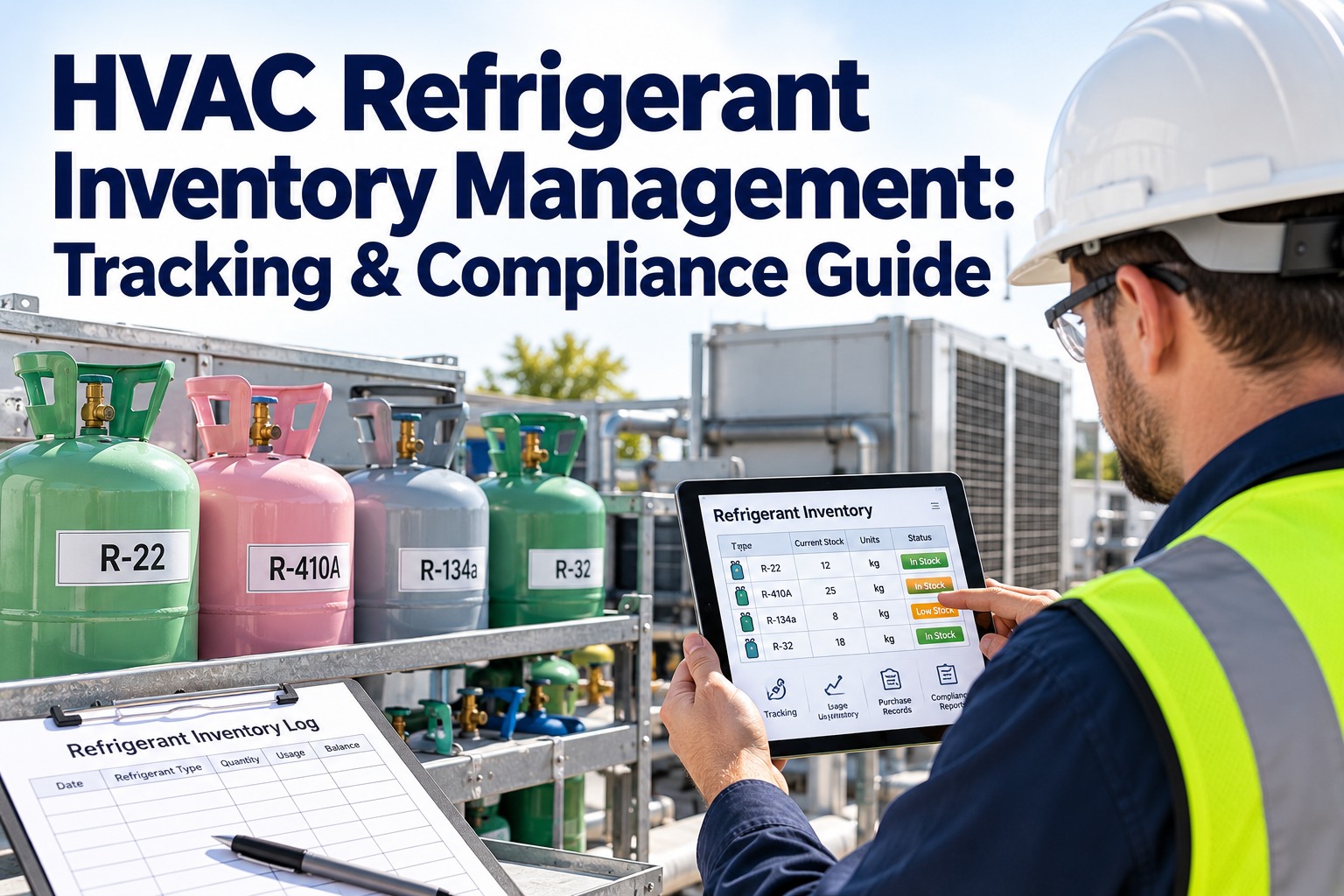
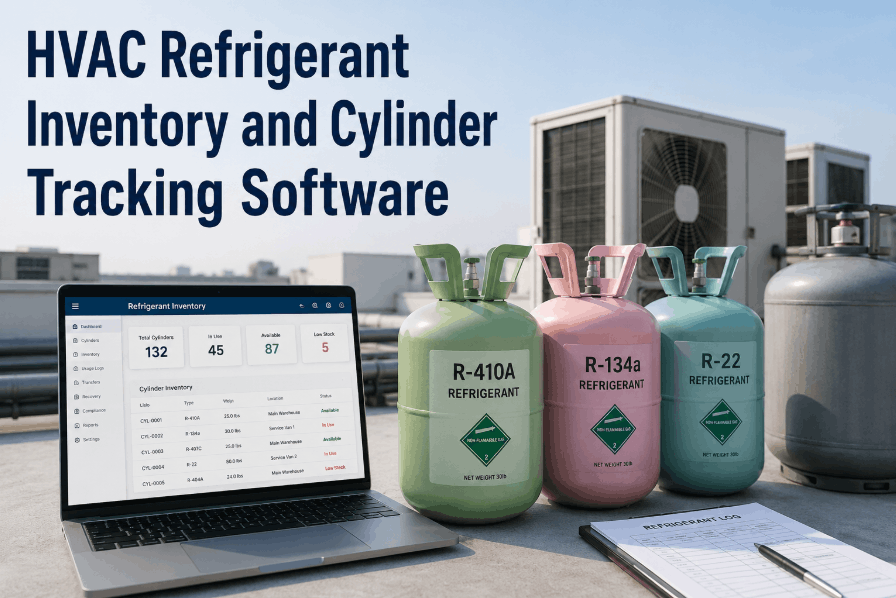
Refrigerant is no longer a maintenance consumable you restock without thinking—it's a volatile commodity that now represents one of the fastest-rising cost categories in commercial HVAC operations. R-410A prices have surged 30–60% since the AIM Act phase-down began in 2022, and they're projected to double again before the 2029 allocation step-down. R-404A has tripled in some markets. Even mid-GWP alternatives like R-407C are climbing as supply tightens across the HFC spectrum. Yet most facility managers have no idea what they actually spend on refrigerant each year. The costs are buried in contractor invoices, blended into service call charges, split across purchase orders from multiple vendors, and allocated to general HVAC maintenance budgets where they're invisible as a distinct cost category. A 500-ton commercial chiller leaking 8% annually at $35/lb for R-410A costs $8,400/year in refrigerant alone—and that's before the service labor to add it. A portfolio of 50 rooftop units with average 12% leak rates can burn through $40,000–$80,000 in refrigerant annually without anyone noticing because nobody's tracking the spend at the system level. The AIM Act phase-down guarantees that every dollar of untracked refrigerant waste today will cost two to three dollars within five years. The facilities that start tracking refrigerant costs now—by system, by refrigerant type, by leak rate, by vendor—will be the ones that control this expense before it controls their budgets.
Refrigerant Costs Are Rising. Most Facilities Can't See It.
↑
30–60%
R-410A price increase since 2022 phase-down began
↑
200–300%
R-404A price spike in constrained markets
↑
2–3x
Projected further increase by 2029 allocation step-down
Unknown
What most facilities actually spend on refrigerant per year
Where Refrigerant Costs Hide in Your Budget
The first problem with managing refrigerant costs is that most organizations can't see them. Refrigerant spend is fragmented across so many budget lines, invoices, and service contracts that it never surfaces as a distinct, manageable cost category. Until you make it visible, you can't manage it. Facilities that sign up to centralize their HVAC service records and refrigerant transactions on a single platform gain the cost visibility that transforms refrigerant from an invisible expense into a manageable line item.
Bundled Service Invoices
Contractor charges $850 for a service call that includes 6 lbs of R-410A at $45/lb ($270) plus $580 labor—but the invoice shows one line: "HVAC Service — $850"
General Maintenance Budgets
Refrigerant costs lumped into "HVAC Maintenance" alongside filters, belts, compressor repairs, and controls work—making the refrigerant-specific trend invisible
Multiple Vendor Fragmentation
Three different HVAC contractors each buy refrigerant from different suppliers at different prices—total spend spread across 15–30 invoices annually per facility
Service Contract Inclusions
Full-service contracts include "up to X lbs of refrigerant per year"—masking real consumption and eliminating price transparency entirely
Multi-Site Aggregation Gaps
Each building or site tracks expenses independently—portfolio-level refrigerant spend never gets consolidated into a single view for management analysis
No System-Level Attribution
Refrigerant purchased but never tracked to the specific system that consumed it—making it impossible to identify which units are driving cost and which are operating efficiently
What Refrigerant Cost Tracking Actually Looks Like
Effective refrigerant cost tracking isn't a spreadsheet exercise performed quarterly. It's a continuous data capture process embedded in every HVAC service event that builds a complete cost picture at the system level, site level, and portfolio level—automatically, in real time, without depending on anyone to remember to log data after the fact.
Per-Unit Cost Attribution
Every pound of refrigerant added to a system is recorded with the equipment asset tag, refrigerant type, quantity, unit cost, vendor, and service date. The system calculates total refrigerant cost for each unit over any time period—identifying the specific systems consuming the most refrigerant and the highest cost per ton of cooling capacity.
Tracks: Cost per system, cost per lb added, cost per ton of cooling, leak-driven cost vs. maintenance-driven cost
Facility-Wide Cost Consolidation
Aggregate refrigerant costs across all systems at each site into a single facility view. Break costs down by refrigerant type, by equipment category, by contractor, and by root cause (leak-related additions vs. planned maintenance). Compare current period costs to prior year to identify trends before they become budget problems.
Tracks: Total site spend, year-over-year trend, cost by refrigerant type, cost by equipment category
Enterprise Refrigerant Intelligence
Roll up refrigerant costs across all sites for executive-level visibility. Benchmark facilities against each other to identify best practices and outliers. Forecast future refrigerant spend based on current consumption rates, phase-down-driven price projections, and planned equipment transitions.
Tracks: Portfolio-wide spend, site-to-site benchmarking, forward cost projections, transition planning impact
The Cost Impact of Leak Rates: Making the Invisible Visible
Leak rates are where the real money hides. A system running at 5% annual leak rate costs a fraction of the same system running at 15%. But without tracking refrigerant additions at the system level and calculating the annualized leak rate, the cost difference between a tight system and a leaky one is completely invisible. The table below shows what untracked leaks actually cost at current and projected refrigerant prices.
Scroll horizontally on mobile
See Exactly Where Your Refrigerant Budget Is Going
OxMaint tracks every pound and every dollar of refrigerant at the system level—automatically calculating leak rates, cost trends, and savings opportunities across your entire HVAC portfolio.
Five Cost Analyses That Change How You Manage Refrigerant
Tracking refrigerant cost data at the system level unlocks five analyses that are impossible with manual tracking—each one revealing actionable savings opportunities that compound as refrigerant prices rise.
System-level cost tracking reveals the small number of units driving disproportionate refrigerant expense. A portfolio of 80 rooftop units might have 12 chronic leakers consuming $45,000/year in refrigerant while the other 68 consume $15,000 combined. Without system-level tracking, those 12 units are invisible.
Action: Prioritize repair or replacement of chronic leakers by comparing annual refrigerant cost to repair cost to replacement cost—an ROI calculation impossible without system-level data
When a system's cumulative refrigerant cost over 3 years exceeds 40–60% of replacement cost—and rising refrigerant prices are accelerating that trajectory—the economics flip in favor of replacement with a lower-GWP system. This crossover analysis requires historical system-level cost data that manual tracking cannot provide.
Action: Generate repair-vs-replace analyses for every system using actual cost history and projected refrigerant price escalation
When three contractors service your HVAC systems and each charges different rates for refrigerant, tracking the per-pound cost across vendors reveals pricing disparities of 15–40%. One contractor charging $52/lb for R-410A while another charges $38/lb costs you $14/lb on every service event—a difference that compounds to thousands annually.
Action: Negotiate vendor pricing using actual consumption data and competitive benchmarks across your service provider portfolio
Using current consumption data and AIM Act-driven price projections, forecast your refrigerant budget 1, 3, and 5 years forward. A portfolio spending $80,000/year at today's prices could face $160,000–$240,000 by 2029 at projected R-410A pricing—unless leak rates are reduced or equipment transitions to lower-GWP refrigerants.
Action: Build multi-year refrigerant budgets that account for phase-down price escalation and plan transitions before costs peak
Comparing the total refrigerant-related cost of owning an R-410A system vs. an R-32 or R-454B system over a 15-year lifecycle reveals that lower-GWP systems—despite higher initial equipment cost—deliver 25–45% lower total refrigerant lifecycle cost due to lower per-pound pricing, better supply stability, and lower GWP-weighted consumption charges.
Action: Make new equipment purchase decisions using lifecycle refrigerant cost data rather than first-cost comparison alone
Refrigerant Price Trends: What the Phase-Down Means for Your Budget
Refrigerant pricing is no longer stable. The AIM Act phase-down is creating a structural supply squeeze that will progressively increase the cost of high-GWP refrigerants through 2036. Understanding these trends is essential for budgeting, capital planning, and transition timing.
R-410A
Driver: 85% production phase-down by 2036; GWP 2,088 makes R-410A a priority reduction target
R-404A
Driver: GWP 3,922 — highest-priority phase-down target; new equipment already banned in most applications
R-32
Driver: GWP 675 — well within phase-down limits; growing production scale keeping prices moderate
The price divergence between high-GWP and low-GWP refrigerants will accelerate dramatically after 2029. Facilities still running R-410A and R-404A systems at that point will face refrigerant costs 3–5x higher than comparable systems using R-32 or R-454B. Tracking current costs and projecting future exposure is how you build the business case for planned transitions before the price cliff arrives. Facilities that sign up to track their refrigerant costs at the system level can model this exposure against their own portfolio and build transition timelines based on actual data.
ROI: Refrigerant Cost Tracking and Active Management
$55K
Leak Rate Reduction Savings
Identifying and repairing chronic leakers reduces portfolio-wide consumption by 30–50%
$30K
Vendor Price Optimization
Benchmarking and consolidating vendor pricing saves 10–20% on per-pound refrigerant costs
$40K
Optimized Replacement Timing
Data-driven replace vs. repair decisions avoid $25K–$100K emergency replacements
$25K
Budget Accuracy Improvement
Accurate forward projections eliminate budget surprises from refrigerant price spikes
Expert Perspective: Getting Refrigerant Costs Under Control
"
I managed HVAC for a portfolio of 120 commercial buildings for eight years before we started tracking refrigerant costs at the system level. When we finally did, the numbers were staggering. We were spending $280,000 a year on refrigerant—and 60% of it was going into 15 rooftop units that we'd been re-charging three or four times a year because nobody was connecting the service calls to a running total. Some of those units had consumed more in refrigerant over the past three years than it would have cost to replace them with new, lower-GWP equipment. But we never saw it because the costs were scattered across 40 contractor invoices, coded to a general maintenance GL account, and never reconciled at the equipment level. Within six months of implementing system-level tracking, we replaced the eight worst chronic leakers, renegotiated our contractor pricing based on actual consumption data, and cut our annual refrigerant spend by 45%. The tracking system paid for itself in the first month.
Track every pound to a specific system—portfolio-level totals hide the real cost drivers
Compare 3-year refrigerant cost to replacement cost—the crossover point comes sooner than you think
Require itemized contractor invoices—bundled billing makes refrigerant costs invisible
Project future costs using AIM Act pricing—today's budget is not tomorrow's reality
Whether you manage a single facility or a national portfolio, refrigerant cost is a line item that's growing faster than almost any other HVAC expense—and it's the one expense most organizations don't track with any precision. If you're ready to see where your refrigerant money is going, book a free demo to see how system-level cost tracking works inside a modern maintenance platform.
Every Pound Has a Price. Every System Has a Story. Start Tracking Both.
OxMaint captures refrigerant cost data at every service event—by system, by refrigerant type, by vendor, by site. Identify chronic leakers, benchmark contractor pricing, forecast future costs, and build the business case for equipment transitions with real data.
Frequently Asked Questions
How much does the average commercial building spend on refrigerant per year?
Annual refrigerant spend varies enormously depending on system size, age, condition, and refrigerant type—which is exactly why tracking is essential. A well-maintained commercial office building with 200 tons of cooling capacity and a 5% average leak rate might spend $3,000–$5,000 annually at current R-410A prices. The same building with older equipment running a 15% leak rate could spend $10,000–$18,000. Supermarkets and cold storage facilities with large commercial refrigeration systems commonly spend $20,000–$80,000 annually on refrigerant. Multi-site portfolios with 50–200 systems typically discover $50,000–$300,000 in annual refrigerant spend once they implement system-level tracking—often 2–3x more than they estimated based on general budget categories. The most important finding for most facilities isn't the total—it's the distribution: typically 15–20% of systems drive 60–80% of refrigerant cost.
How do rising refrigerant prices affect our equipment replacement decisions?
Rising refrigerant prices fundamentally change the economics of repair vs. replace decisions. Under stable pricing, the traditional approach of running equipment until repair costs exceed 50% of replacement cost made sense. Under AIM Act-driven price escalation, you need to factor in the projected future cost of refrigerant over the remaining life of the equipment. A 12-year-old R-410A chiller with 8 years of remaining life and a 10% leak rate currently costs $8,400/year in refrigerant (700 lbs × 10% × $12/lb service cost increase). At projected 2029 pricing, that same leak rate costs $16,000–$20,000/year. Over 8 remaining years with escalating prices, the cumulative refrigerant cost could exceed $100,000—potentially making early replacement with an R-32 or R-454B system the economically superior decision even before the equipment reaches end of life. System-level cost tracking provides the actual data needed to make this calculation for each specific unit in your portfolio.
What data do I need to start tracking refrigerant costs effectively?
Effective refrigerant cost tracking requires five data elements captured at every service event: the specific equipment identified by asset tag or unique ID, the refrigerant type added or recovered, the quantity in pounds, the unit cost per pound (separated from labor charges), and the service date. Additionally, you need a baseline equipment inventory that includes each system's refrigerant type, design charge, installation date, and cooling capacity. With these elements, your tracking system can automatically calculate annualized leak rates, total cost per system, cost per ton of cooling capacity, vendor price comparisons, and year-over-year trends. The key requirement is that refrigerant quantity and cost must be itemized separately on service invoices—not bundled into a single service charge. Establishing this requirement with your contractors is the single most impactful step you can take toward cost visibility.
Can refrigerant cost tracking help us negotiate better contractor pricing?
Absolutely—and this is one of the fastest-returning benefits of implementing system-level tracking. When you can show contractors your actual annual refrigerant consumption by type, compare their per-pound pricing against other vendors in your portfolio, and demonstrate the total volume they're servicing, you have negotiating leverage that most facility managers lack entirely. Common findings include price disparities of 15–40% between contractors for the same refrigerant on the same account, markup rates that vary from 30% to 100%+ above wholesale cost depending on the vendor, and opportunities to consolidate purchasing through preferred vendors at volume-negotiated rates. One portfolio manager discovered they were paying $52/lb from one contractor and $36/lb from another for R-410A—a difference of $16/lb that was costing them over $8,000 annually on refrigerant alone. That single discovery paid for the entire tracking system implementation.
How does refrigerant cost tracking integrate with maintenance management?
Refrigerant cost tracking delivers the most value when it's embedded in your maintenance management workflow rather than operated as a separate system. In an integrated CMMS like OxMaint, refrigerant data capture is built into the work order process—when a technician completes an HVAC service event, the system requires entry of refrigerant type, quantity, and cost as part of work order completion. This data automatically feeds into equipment-level cost histories, leak rate calculations, and compliance records without any additional data entry. The integration also enables automatic triggering of follow-up actions: when a system's refrigerant cost exceeds a defined threshold or its leak rate crosses an alarm level, the system generates work orders for leak investigation, repair verification, or replacement evaluation. The maintenance platform becomes both the data capture mechanism and the action management system—closing the loop between cost visibility and cost reduction.