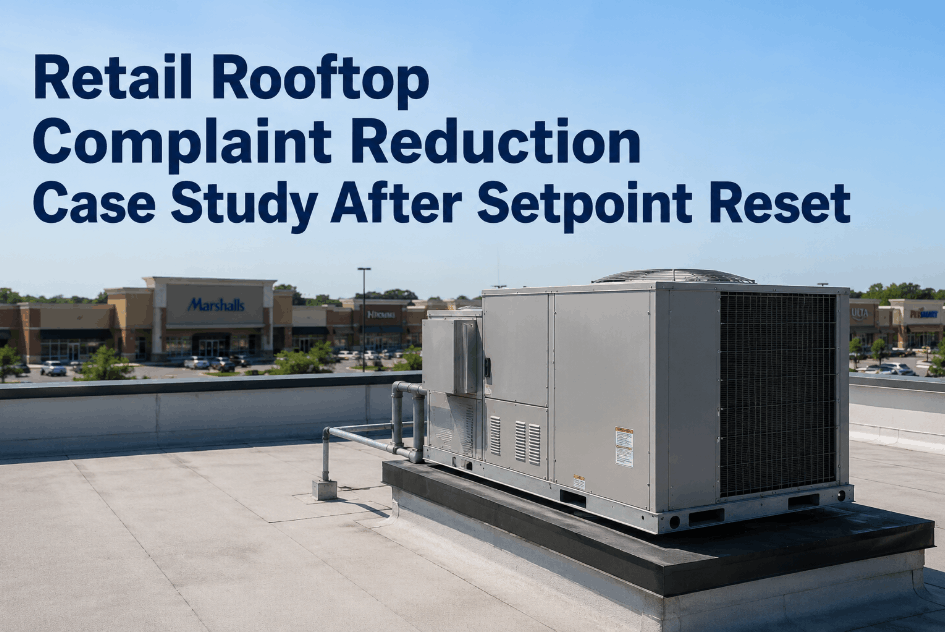
Comfort complaints in retail environments are among the most operationally costly HVAC problems a portfolio manager can face — not because the equipment is failing, but because setpoints, schedules, and sensor accuracy have drifted away from design intent while stores continued to operate around them. A regional retail portfolio operating rooftop units across multiple store locations found itself fielding recurring comfort complaints despite having functional equipment at every site. Rooftop setpoints had not been reviewed since original installation, occupancy schedules embedded in control systems no longer reflected current store hours, and sensor accuracy had not been validated across the portfolio. The result was thermal inconsistency that drove customer and staff complaints without any visible equipment fault to diagnose. If your retail portfolio is managing rooftop unit complaints without structured setpoint control and sensor validation, Sign Up Free to see how Oxmaint tracks control tuning and PM execution across retail locations — or Book a Demo with a retail facility operations specialist.
Setpoint Reset · Schedule Tuning · Sensor Validation · Comfort Complaints
Stop Fielding Retail Comfort Complaints From Rooftop Units That Were Never Properly Retuned After Opening
Work order management, control tuning records, sensor validation scheduling, PM checklists, and multi-site asset visibility — Oxmaint helps retail facility teams eliminate comfort complaints through structured setpoint management and consistent HVAC execution.
Facility Profile
The Operation: Regional Retail Portfolio With Misaligned Rooftop Setpoints and Rising Store Comfort Complaints
Facility Overview
IndustryCommercial retail — multi-location portfolio, rooftop package units, varied store formats
Scope14 store locations, 2–4 rooftop units per site, centralized FM team with local technicians
Team9 field technicians, 3 regional supervisors, 1 FM portfolio coordinator
Prior SystemComplaint-based dispatch, manual store visit logs, no structured setpoint audit process
Oxmaint FeaturesWork Order Management · Preventive Maintenance · Asset Tracking · Control Tuning Records · Sensor Validation Checklists · Complaint-to-WO Linking · Multi-Site Visibility · Scheduled Audits
Baseline Pressure Points
64%
Of stores reporting at least one recurring comfort complaint per month — complaints unlinked to any structured HVAC maintenance record
2.9×
Average repeat complaint rate per store before setpoint resets — the same locations generating complaints repeatedly without root cause correction
71%
Of rooftop units operating on original commissioning setpoints — never reviewed against current store hours or seasonal occupancy patterns
Root Cause Analysis
Why Comfort Complaints Persisted Despite Functional Rooftop Equipment at Every Store
A structured audit of setpoint records, complaint logs, and sensor data across the 14-store portfolio identified four control and visibility gaps that were sustaining the comfort problem. Equipment condition was not the issue — setpoint misalignment, schedule drift, and unvalidated sensors were producing thermal inconsistency that equipment in good condition could not overcome. Each visit to resolve a complaint addressed the symptom without correcting the underlying control configuration, allowing the same stores to generate complaints repeatedly. Sign Up Free to build structured setpoint audit and validation workflows for your retail portfolio — or Book a Demo to see how Oxmaint links complaint history to HVAC asset maintenance records.
39%
Original Commissioning Setpoints Never Reviewed Against Current Store Operations
Rooftop units across 71% of locations were still operating on setpoints configured at commissioning. Store hours, occupancy patterns, and seasonal demand had shifted since opening — but control parameters had not been updated to reflect those changes, leaving units chasing targets that no longer fit actual conditions.
28%
Occupancy Schedules Embedded in Controls No Longer Matched Actual Store Hours
Several locations had changed their operating hours after original installation. Control system schedules had not been updated to match, causing units to reduce output before closing or ramp up after opening — creating temperature swings at exactly the times customers and staff noticed most.
21%
Sensor Accuracy Not Validated — Controls Operating on Drifted Temperature Readings
Space temperature sensors across multiple locations had not been verified against calibrated references. Units were satisfying control setpoints based on inaccurate readings, meaning the system was technically "in control" while the actual space was overcooled or underheated depending on sensor drift direction.
12%
Complaints Resolved Reactively With No Link to HVAC Asset or Control History
When complaints were received, technicians visited and made adjustments without logging what was found, what was changed, or which unit was involved. There was no record linkage to the asset, so repeat visits to the same store addressed the same unresolved root cause each time without escalating to a corrective audit.
The Solution
How Oxmaint Reduced Retail Comfort Complaints Through Structured Setpoint Auditing and Sensor Validation
The portfolio team deployed Oxmaint to bring structured control management to a complaint-driven maintenance environment. Every rooftop unit across all 14 stores was set up as an asset in Oxmaint with make, model, and commissioning setpoint data attached. A setpoint audit was executed as a structured work order at each location — technicians compared as-found setpoints against current store operating parameters and documented all changes in the work order record. Occupancy schedules were reviewed and corrected as part of each audit visit. Sensor validation was added as a recurring PM task, with as-found and as-left temperature readings captured at every check. Complaints were linked to work orders on the specific unit and location, enabling the team to identify chronic problem sites and track resolution through closure. Book a Demo to see how structured HVAC audit and tracking applies to retail portfolio management.
01
Portfolio-Wide Setpoint Audit Executed as Structured Work Orders by Location
A setpoint review was triggered for every rooftop unit across all 14 stores using work orders in Oxmaint. Technicians documented as-found setpoints, compared them against current operating parameters, made corrections on site, and recorded as-left values — creating the first complete, auditable setpoint baseline the portfolio team had ever had.
02
Occupancy Schedule Correction Included in Every Audit Visit Checklist
Control system occupancy schedules were added to the audit checklist in Oxmaint. Technicians verified embedded schedules against current store hours at every location and corrected mismatches as part of the same visit — ensuring units were operating at the right output level during actual store hours rather than drifted schedule parameters.
03
Sensor Validation Added as Recurring PM Task With Temperature Reading Documentation
Space temperature sensors were scheduled for periodic validation in Oxmaint with checklists capturing reference temperature, sensor reading, and variance at each unit. Sensors reading outside acceptable tolerance were flagged for recalibration or replacement through the work order system, ensuring control logic operated on accurate feedback across the portfolio.
04
Complaint-to-Asset Work Order Linking for Portfolio-Wide Pattern Visibility
Comfort complaints were entered as work orders in Oxmaint and linked to the specific rooftop unit and store location. The FM coordinator could now see which stores and units generated the highest complaint volume, track whether prior corrective visits had resolved the root cause, and escalate chronic locations to a more thorough diagnostic review rather than repeated reactive visits.
Results at 90 Days
Comfort Complaint and Control Consistency Metrics Three Months After Portfolio Audit and Deployment
67%
Reduction in monthly comfort complaints across the 14-store portfolio after setpoint resets and schedule corrections
100%
Of rooftop units audited with documented as-found and as-left setpoint records — first complete portfolio baseline established
-74%
Reduction in repeat complaint visits to the same store location — root cause correction replaced reactive revisiting
88%
Of sensors validated across the portfolio — units now operating on verified temperature readings rather than drifted sensor data
-51%
Reduction in reactive HVAC dispatch visits — structured PM and audit schedules replaced complaint-triggered field responses
3.2×
ROI on Oxmaint platform cost within 90 days from reduced field visits, complaint handling, and recovered store environment quality
| Metric |
Before Oxmaint |
90 Days After |
Change |
| Monthly comfort complaints (portfolio-wide) |
High — 64% of stores affected |
67% reduction |
-67% |
| Rooftop units with audited setpoint records |
0% — no audit baseline |
100% documented |
+100% |
| Repeat complaints at the same location |
2.9× average recurrence |
74% reduction |
-74% |
| Sensor validation coverage |
0% — never systematically validated |
88% validated |
+88% |
| Reactive dispatch visits |
Complaint-driven, high volume |
51% reduction |
-51% |
| Control tuning documentation |
None — verbal or informal |
Full work order audit trail |
Structured |
Key Business Impact
What Structured Setpoint Management Means for Retail HVAC Portfolio Operations
"Retail comfort complaints almost never point to equipment that is broken — they point to equipment that was never properly dialed in after opening, or that drifted away from its settings without anyone noticing. Stores change hours, seasons change, and occupancy patterns shift, but rooftop setpoints stay exactly where they were on commissioning day. When you run a portfolio audit and capture what every unit is actually set to versus what it should be, the fixes are usually straightforward. Resetting a setpoint or correcting an occupancy schedule takes minutes. But without a structured work order process to trigger those visits and document what was changed, the same problems come back to the same stores every season. Oxmaint gives retail teams the audit framework to get ahead of that cycle instead of chasing it."
Terrence Okolo, Retail Facility Management and HVAC Portfolio Advisor
18 years retail FM and commercial HVAC management · Former regional facilities director, national retail brand with 200+ locations · Specialist in rooftop unit management, setpoint auditing, and multi-site comfort complaint reduction
Setpoint Audit · Schedule Correction · Sensor Validation · Complaint Reduction
Replace Reactive Comfort Complaint Response With Structured Rooftop Setpoint Management Across Your Retail Portfolio
Work order-based setpoint audits, occupancy schedule validation, sensor accuracy tracking, complaint-to-asset linking, and multi-site PM scheduling — Oxmaint gives retail FM teams the execution structure to resolve comfort complaints at the root rather than revisiting the same stores every season.
FAQs
Frequently Asked Questions
How does Oxmaint support rooftop setpoint auditing across a retail portfolio?
Oxmaint enables portfolio-wide setpoint audits through structured work orders assigned per location. Technicians document as-found and as-left setpoints with checklist fields, creating an auditable correction record for every rooftop unit across all stores.
Can Oxmaint link customer or staff comfort complaints to specific HVAC assets?
Yes. Complaints are entered as work orders in Oxmaint and associated with the relevant rooftop unit and store location, enabling FM teams to identify chronic problem assets and track resolution through work order closure.
How does Oxmaint help manage sensor validation across multiple retail sites?
Sensor validation is configured as a recurring PM task in Oxmaint per unit. Technicians capture reference versus actual temperature readings at each check, with out-of-tolerance results escalating to a calibration or replacement work order automatically.
Is Oxmaint suitable for managing HVAC maintenance across a dispersed retail portfolio?
Yes. Oxmaint supports multi-site asset management with location-level filtering. FM coordinators can view open work orders, PM status, and complaint trends across all store locations from a single portfolio view.
How long does it take to set up a retail HVAC portfolio in Oxmaint and begin a setpoint audit?
Asset setup and audit workflow configuration typically complete within one week. Most retail teams begin executing structured setpoint visits and capturing documentation within the first two weeks of deployment.
Every Corrected Setpoint Is a Store That Stops Complaining
Give Your Retail Portfolio the HVAC Control Structure It Needs to Eliminate Rooftop Comfort Complaints
Oxmaint brings setpoint audit workflows, sensor validation scheduling, complaint-to-asset linking, and multi-site PM management to retail facility teams — with no additional headcount required.