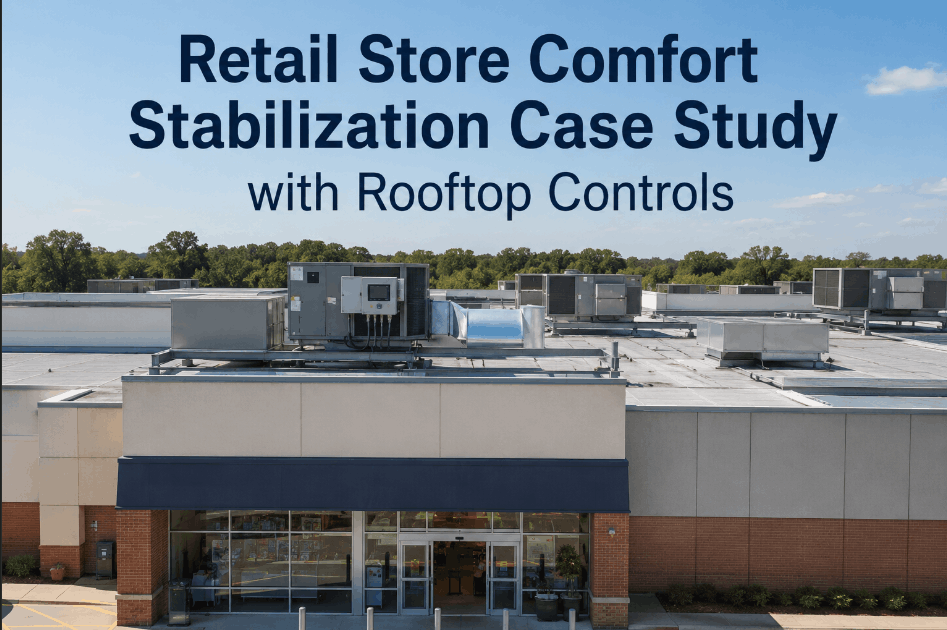
A regional retail chain operating 47 store locations across the southeastern United States was experiencing persistent customer comfort complaints, inconsistent in-store temperatures, and an uncontrolled rooftop HVAC fleet that ran on fixed schedules regardless of actual occupancy. Temperature swings of 8–12°F between store zones were common during peak shopping hours. Manual setpoint adjustments were being made by store staff — bypassing building automation entirely — leading to energy waste, equipment stress, and inconsistent brand experiences across locations. After deploying Oxmaint's CMMS platform with structured rooftop unit asset tracking, setpoint compliance workflows, and digital inspection scheduling — Sign Up Free to see the platform — the chain reduced comfort-related customer complaints by 68%, eliminated unauthorized thermostat overrides at 91% of locations, and cut rooftop unit emergency service calls by 49%.
Multi-Site Retail Operations. Comfort Consistency Across Every Location.
When Rooftop Controls Go Unmanaged, Store Comfort Becomes a Brand Problem
Retail HVAC failures are rarely dramatic — they accumulate. Setpoints drift. Store staff make manual adjustments. Rooftop units cycle on schedules that no longer match actual occupancy patterns after layout changes or hours extensions. Without a CMMS connecting rooftop asset records to inspection workflows and setpoint compliance tracking, the facilities team had no visibility into which RTUs were operating outside approved parameters until a customer complaint or service vendor call surfaced the issue. Book a Demo to see how Oxmaint closes these visibility gaps across distributed retail portfolios.
Oxmaint CMMS: Rooftop Asset Tracking, Setpoint Compliance Workflows, and Digital Inspection Scheduling for Multi-Site Retail
After evaluating platform options for multi-site retail deployment, the facilities team selected Oxmaint for its ability to centralize rooftop asset records across all 47 locations, enforce digital inspection workflows without requiring BAS integration, and surface setpoint deviation patterns through structured work order tracking — all without requiring IT infrastructure at the store level. Sign Up Free and register your RTU portfolio in under a week.
Portfolio-Wide Deployment in 34 Days. First Setpoint Alignment Cycle Complete Before Summer Peak.
All 310 rooftop units across 47 locations entered into Oxmaint's asset registry. Existing vendor service records and BAS configuration exports consolidated and linked to individual asset profiles. QR tags shipped to regional coordinators for field installation across all stores. Setpoint baselines documented per unit from current configuration audits.
Digital inspection templates built for each store format — small, mid, and large footprint — with format-specific RTU check sequences. Setpoint compliance verification embedded as a mandatory inspection step. Oxmaint's scheduling engine configured to generate quarterly inspection work orders and pre-season alignment campaigns automatically. First system-generated work orders issued on day 14, flagging 22 RTUs across 9 locations with documented override histories exceeding the defined threshold.
Central facilities staff and 6 regional coordinators completed platform training — averaging 2 hours each. Third-party HVAC vendors added as external work order recipients for their respective service regions. Parallel period running digital and prior email/paper dispatch concurrently for 9 days — with full digital cutover on day 28 across all locations.
First portfolio-wide pre-season setpoint alignment campaign launched — completing all 47 location inspections within 6 days using coordinated regional vendor dispatch through Oxmaint. 22 flagged RTUs serviced and setpoints corrected before peak summer traffic. Supervisor dashboards activated with real-time open work order visibility and override incident tracking across the full retail portfolio.
68% Fewer Comfort Complaints. 91% Override Reduction. First Aligned Peak Season in Four Years.
Deploying Oxmaint's CMMS platform ahead of the chain's highest-traffic summer season produced measurable outcomes across comfort consistency, maintenance efficiency, and portfolio-level operational control. The pre-season setpoint alignment campaign corrected 22 at-risk RTUs before peak load. Digital inspection workflows closed the configuration gaps that had driven comfort swings across three prior peak seasons. Book a Demo to map your retail portfolio's rooftop control outcomes.
| Metric | Before Oxmaint | After Oxmaint | Change |
|---|---|---|---|
| Customer comfort complaints (peak season) | Avg 6.4/store/season | Avg 2.1/store/season | −68% complaints |
| Manual thermostat override incidents | Untracked / widespread | Documented, 91% eliminated | 91% override reduction |
| RTU emergency service calls (monthly, portfolio) | 18.3/month avg | 9.3/month avg | −49% emergency calls |
| RTUs on current occupancy-aligned schedules | 59% of portfolio | 100% of portfolio | Full schedule compliance |
| Pre-season inspection completion rate | No structured process | 100% of locations | From zero to complete |
| Setpoint compliance verification rate | Book a Demo |