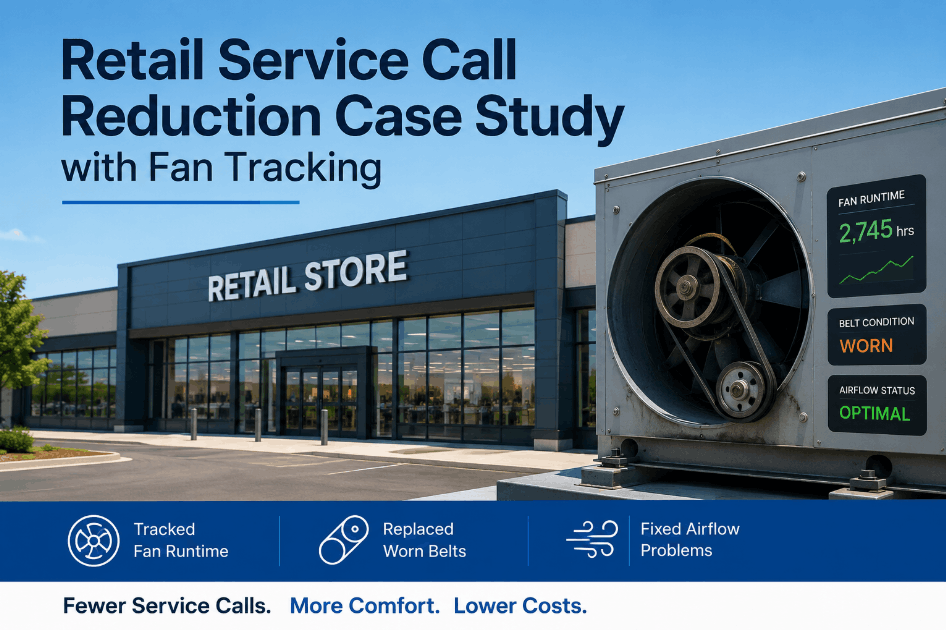
Service calls in a retail chain rarely come from one bad rooftop unit — they come from fans running on worn belts for weeks with nobody tracking runtime hours until airflow drops enough to trigger a store-level complaint. Maintenance teams dispatch technicians store by store because nobody can see which fan is actually approaching failure until it stops. A 64-location retail chain ran into exactly this pattern: HVAC and refrigeration service calls kept climbing across stores even as the maintenance team closed every ticket, and nobody could confirm whether fan wear was the recurring root cause. If your retail chain is managing service calls without fan runtime tracking or belt wear monitoring, Sign Up Free to see how Oxmaint connects sensor data to service tickets across retail locations — or Book a Demo with a retail maintenance specialist.
Fan Runtime Tracking · Belt Wear Monitoring · Service Call Reduction
Stop Dispatching on Every Airflow Complaint and Start Tracking Fan Wear Before It Fails
Predictive fan runtime monitoring, belt-wear-weighted preventive maintenance, recurring service call escalation, and consolidated store dashboards — Oxmaint helps retail maintenance teams fix worn equipment before it generates a call.
Operation Profile
The Operation: A Retail Chain Chasing Service Calls With No Link to Fan Runtime Data
Chain Overview
IndustryMulti-location retail — 64-store regional chain
Scope64 stores, 312 tracked rooftop units, evaporator and condenser fans, and refrigeration assets
Team2 regional maintenance managers, 18 field service technicians, 1 parts coordinator
Prior SystemService tickets tracked store by store with no shared fan runtime or belt replacement history
Oxmaint FeaturesPredictive Maintenance · Asset Management · Work Order Management · Parts & Inventory · Analytics & Reporting Dashboards
Baseline Service Issues
156/mo
Average monthly HVAC and refrigeration service calls across the chain
37%
Of service calls traced to fan or belt issues that recurred at the same store within 90 days
12 days
Average time before a recurring fan issue at a store was flagged for proactive review
Root Cause Analysis
Why Service Calls Kept Climbing Even as Technicians Closed Every Ticket
A review of service tickets, fan runtime logs, and belt replacement records revealed four compounding gaps in how the chain tracked airflow issues across stores. None of the issues traced to a lack of skilled technicians — the failure was in connecting service calls to fan condition data. Sign Up Free to bring fan runtime tracking to your retail locations — or Book a Demo to see predictive maintenance on a live system.
32%
Service Calls Logged With No Link to Fan Runtime or Belt Age
Tickets captured store and symptom but not fan motor runtime hours or last belt replacement, so technicians couldn't tell whether wear was the likely cause before arriving on site.
28%
Preventive Maintenance Followed a Fixed Calendar Instead of Runtime Trends
Belt and fan PM ran on a routine schedule regardless of how heavily a unit was actually running, so high-use stores wore out belts between scheduled visits.
25%
Recurring Fan Failures at the Same Store Went Unescalated
Each new airflow complaint at a chronic-failure store was dispatched as a standalone call instead of being tied to the same underlying fan or belt issue.
15%
No Reporting Connected Service Call Volume to Fan Condition Across Stores
Regional managers reviewed service call counts and equipment age separately, with no shared view of which stores had the highest fan wear risk.
The Solution
How Oxmaint Linked Retail Service Calls to Fan Runtime and Belt Wear Data
The chain deployed Oxmaint to connect every service ticket to fan runtime history, weight PM by actual wear, and flag recurring stores automatically. Sign Up Free to see fan-linked work orders on your own locations — or Book a Demo to walk through predictive fan tracking live.
01
Predictive Maintenance Linked Fan Runtime Hours to Every Service Ticket
Oxmaint's predictive maintenance tracked runtime hours and vibration trends for evaporator and condenser fans across all 64 stores, surfacing wear risk before a unit failed.
02
Belt Replacement Schedules Now Respond to Actual Runtime, Not a Fixed Calendar
Instead of a chain-wide PM calendar, belt and fan PM tasks are weighted by each unit's actual runtime hours, catching wear at high-use stores before a fan seizes or a belt snaps.
03
Recurring Fan Failures Are Automatically Flagged for Proactive Review
When a store generates more than a defined number of fan-related service calls within a window, Oxmaint escalates it for root-cause review instead of dispatching another standalone repair.
04
Consolidated Dashboards Connect Service Call Volume to Fan Condition Across Stores
Regional managers now see service call trends next to fan runtime and belt age for every store on one dashboard, showing exactly where wear risk is concentrated.
Results at 90 Days
Service Call Volume, Proactive Catches, and Parts Efficiency Three Months After Deployment
39%
Reduction in monthly HVAC and refrigeration service calls chain-wide
3 days
Average time to flag a recurring fan issue — down from 12 days
100%
Of service calls now linked to fan runtime and belt history
61%
Of belt replacements now caught proactively before failure instead of reactively
24%
Reduction in emergency after-hours technician dispatches
2.6×
ROI on Oxmaint platform cost within 90 days from reduced calls and parts efficiency
| Metric |
Before Oxmaint |
90 Days After |
Change |
| Monthly HVAC and refrigeration service calls |
156 average tickets |
~95 average tickets |
-39% |
| Time to flag a recurring fan issue |
12 days average |
3 days average |
-75% |
| Service calls linked to fan runtime data |
0% linked |
100% linked |
+100% |
| Belt replacements caught proactively |
Untracked baseline |
61% of replacements |
+61% |
| Emergency after-hours dispatches |
Baseline monthly rate |
24% reduction measured |
-24% |
| Platform ROI |
Not measured |
2.6× within 90 days |
2.6× |
Key Business Impact
What Fan Runtime Tracking Means for Retail Service Call Volume
Service calls across a retail chain are almost never about one unlucky rooftop unit — they're about a fan running past its safe wear window for weeks before a store manager notices warm air and calls it in. When runtime hours and belt age live outside the service ticket, technicians end up replacing the same part every quarter at the same handful of stores instead of catching wear early. Linking every dispatch to actual fan condition is what lets a lean regional team turn 64 stores from reactive calls into a predictable maintenance rhythm. Oxmaint gives retail maintenance teams that visibility across every location.
Carla Jiménez, Multi-Site Retail Maintenance & Equipment Reliability Specialist
10 years multi-site retail maintenance operations · Former regional maintenance manager, national retail chain · Specialist in fan runtime tracking, predictive belt replacement, and service call reduction for retail operations
Fan-Linked Tickets · Runtime-Weighted PM · Fewer Service Calls
Give Your Maintenance Team Fan Data They Can Actually Act On
Predictive fan runtime tracking, belt-wear-weighted preventive maintenance, automated recurring-call escalation, and consolidated store dashboards — Oxmaint helps retail maintenance teams fix the cause instead of dispatching on every call.
FAQs
Frequently Asked Questions
How does Oxmaint connect retail service calls to fan runtime data?
Through predictive maintenance that tracks fan runtime hours and vibration trends, linked directly to the work order created from each service ticket.
Can Oxmaint flag stores with recurring fan or belt failures automatically?
Yes. When a store exceeds a defined number of fan-related calls within a window, it's automatically escalated for proactive review.
Does Oxmaint adjust belt replacement schedules based on actual runtime?
Yes. PM tasks are weighted by each unit's runtime hours rather than a fixed chain-wide calendar.
How does Oxmaint report on fan and service call performance across stores?
Consolidated dashboards show service call volume next to fan runtime and belt age for every store in one view.
How long does fan runtime tracking setup take with Oxmaint?
Most retail maintenance teams connect asset and runtime data and configure escalation rules within the first one to two weeks.
Every Store, One Reliability Standard
Bring Fan Runtime Tracking and Predictive Maintenance to Your Retail Chain
Oxmaint brings fan-linked work orders, runtime-weighted PM, recurring service call escalation, and consolidated store dashboards to multi-site retail maintenance teams.