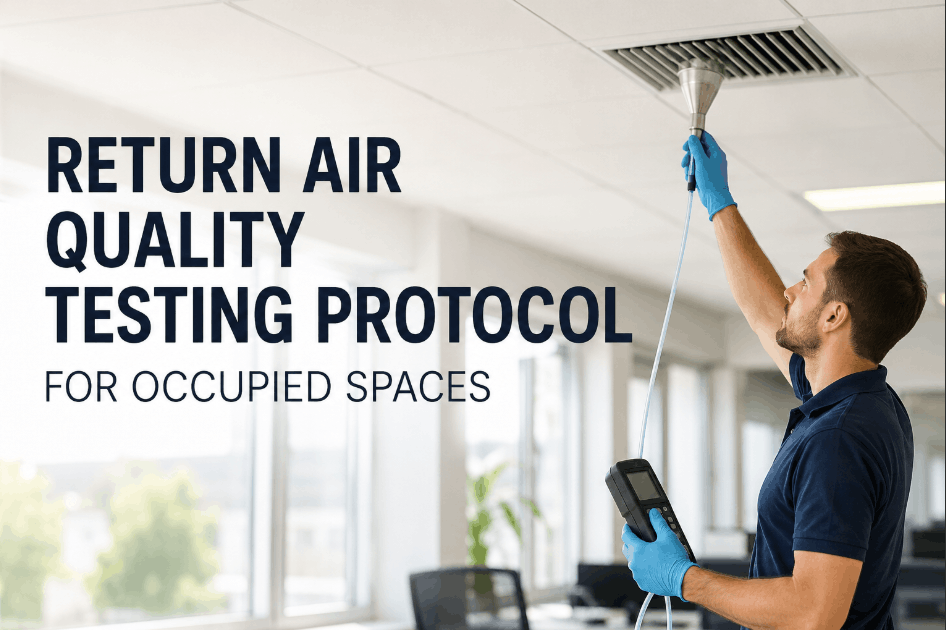
Return air quality in occupied buildings directly shapes occupant health, comfort, and HVAC system performance — yet most facilities rely on reactive responses to complaints rather than structured testing protocols. When particulates, humidity deviations, and contaminants go unmonitored in return air streams, HVAC systems compensate inefficiently, indoor air quality degrades invisibly, and occupant wellbeing is compromised without a measurable trigger. Facilities that Sign Up Free on Oxmaint can build return air quality inspection checklists, configure condition-based alerts from air monitoring sensors, and generate automatic work orders when contaminant or humidity thresholds are exceeded. For building operations teams managing occupied multi-zone environments, Book a Demo to see how Oxmaint connects indoor air quality data to maintenance workflow execution.
Oxmaint connects air quality sensor data, humidity readings, and particulate monitoring to your maintenance workflow — so your team acts before health or comfort issues reach occupants.
6 Return Air Quality Parameters Every Occupied Building Should Test
A structured return air testing protocol goes beyond filter inspections. It requires measuring particulate concentration, humidity, CO₂ levels, VOC loading, and contaminant markers across return air zones — and linking results to maintenance actions. Facility teams that Sign Up Free on Oxmaint can attach air quality inspection checklists to HVAC assets and configure condition-triggered work orders for any parameter breach.
Elevated particulate levels in return air indicate filter degradation, bypass leakage, or upstream contamination sources. PM2.5 exceedance directly affects respiratory health in occupied zones and triggers filter replacement protocols.
Return air humidity outside the 40–60% operational band promotes microbial growth, electrostatic discharge, and occupant discomfort. Humidity sensor monitoring surfaces control system failures before conditions become visible or reportable.
Return air CO₂ above 1,000 ppm signals inadequate fresh air delivery relative to occupancy. CO₂ monitoring drives demand-controlled ventilation adjustments and flags zones where AHU outdoor air dampers need inspection.
VOC concentration spikes in return air from building materials, cleaning products, or off-gassing sources require ventilation rate adjustments and source investigation — detectable before occupant complaints through continuous monitoring.
Periodic return air sampling for microbial markers detects early duct contamination or drain pan issues that humidity monitoring alone cannot confirm. Sampling results link directly to duct cleaning and coil drain inspection work orders.
Unexpected temperature differentials between zone return air and AHU return plenums indicate bypass or mixing failures that degrade both air quality control and HVAC system efficiency simultaneously.
Return Air Quality Testing Protocol: Parameters, Limits, and Maintenance Response
Each return air quality parameter carries a distinct acceptable range, testing frequency, and maintenance response. Use this protocol reference to evaluate your current monitoring coverage and identify where Oxmaint's condition-based PM engine automates the response. Facilities with reactive-only indoor air quality programs are encouraged to Book a Demo to see how sensor-triggered work orders work in live building environments.
| Parameter | Measurement Source | Alert Threshold | Maintenance Response | Priority |
|---|---|---|---|---|
| PM2.5 Particulate | In-duct particle counter | >25 µg/m³ sustained 30 min | Filter inspection and replacement work order | Critical |
| Relative Humidity | Return duct humidity sensor | Outside 40–60% RH for 60 min | Inspect humidifier or dehumidification control | Critical |
| CO₂ Concentration | Zone CO₂ sensors + BMS | >1,000 ppm during occupied hours | Verify outdoor air damper position and DCV logic | Critical |
| VOC Loading | VOC sensor or handheld sampler | TVOC >500 µg/m³ above baseline | Increase ventilation rate, investigate source zone | Important |
| PM10 Particulate | In-duct particle counter | >50 µg/m³ sustained 30 min | Pre-filter inspection, duct leakage audit | Important |
| Microbial Marker Sampling | Periodic air sampling | Lab result above baseline CFU | Duct cleaning PM, coil drain inspection | Important |
| Return Air Temp Delta | Zone and plenum sensors | Delta >2°C from design value | Inspect return air path for bypass or leakage | Routine |
| Seasonal Protocol Review | Asset history + calendar | Seasonal transition trigger | Full return air quality checklist — all parameters | Routine |
How Building Teams Run Continuous Return Air Quality Monitoring Without Extra Staff
Manual air quality sampling is periodic and resource-intensive. Oxmaint enables building operations teams to automate return air quality monitoring through sensor-connected condition alerts — with work orders generated and assigned automatically when parameters breach acceptable ranges. Facilities can Sign Up Free and configure air quality alert rules against their HVAC asset hierarchy in the first session.
- Air quality sensor data mapped to specific AHU and zone assets
- Threshold-based alerts configured per parameter and occupancy type
- Automatic work orders generated when CO₂, PM, or humidity thresholds breach
- Mobile app delivers inspection tasks with asset context and test checklist
- Sampling results and technician notes attached directly to asset records
- Audit trail supports health compliance, tenant reviews, and certification programs
- No dedicated IAQ team? Alert-to-work-order automation removes manual monitoring
- Multiple zones? Multi-zone alert rules with zone-specific thresholds supported
- Paper inspection records? Mobile checklists capture data at the asset in real time
- Reactive complaint culture? Proactive alerts surface issues before occupants report
- No sensor infrastructure? Protocol supports both sensor monitoring and manual sampling
- Compliance requirements? Timestamped records support ASHRAE 62.1 and WELL audits
Return Air Quality Monitoring ROI: Health Outcomes, System Performance, and Compliance
Per-user SaaS pricing with no infrastructure overhead. Most facilities configure return air quality alert rules and inspection checklists within 30–45 days using Oxmaint's no-code setup tools.
Early detection of humidity exceedance, high CO₂, and particulate spikes prevents the occupant health complaints and sick building syndrome escalations that disrupt operations and trigger formal investigations.
Return air quality issues — particularly filter bypass and humidity imbalance — force HVAC systems to work harder than designed. Correcting these conditions measurably reduces energy consumption and equipment wear.
Structured return air quality records support ASHRAE 62.1 ventilation compliance, WELL building certification, and tenant health audits — reducing preparation overhead for formal reviews.
Condition-based filter replacement triggered by actual PM readings avoids both premature replacement and the energy penalty of delayed replacement — optimising filter spend based on real loading data.
Return air quality data identifying microbial markers or VOC accumulation directs duct cleaning and coil maintenance to the specific assets and zones where intervention delivers measurable air quality improvement.
Oxmaint gives building teams sensor-triggered air quality alerts, mobile inspection checklists, and compliance audit trails — go live in 60 days without an IT project.
Return Air Quality Testing — Questions Building Operations Teams Ask
A complete protocol covers PM2.5 and PM10 particulates, relative humidity, CO₂ concentration, TVOC loading, and periodic microbial sampling. Return air temperature delta verification rounds out the parameter set for system performance assessment.
Oxmaint maps sensor data to HVAC assets and generates work orders automatically when air quality thresholds are breached — eliminating the manual monitoring step and ensuring technicians receive tasks with full asset context on mobile.
Return air CO₂ sustained above 1,000 ppm during occupied hours indicates inadequate fresh air delivery relative to occupancy load. This threshold aligns with ASHRAE 62.1 guidance and should trigger outdoor air damper and DCV logic inspection.
Yes. Oxmaint's timestamped inspection records, sensor alert history, and PM completion audit trails provide the documented evidence needed for ASHRAE 62.1 compliance reviews and tenant indoor air quality audits.
Continuous sensor monitoring for CO₂, PM, and humidity is recommended for critical occupied zones. Microbial and VOC sampling should occur quarterly or following any IAQ complaint, renovation activity, or filter bypass event.
Oxmaint gives building teams structured return air quality protocols, automated alert-to-work-order execution, and compliance-ready documentation — no IT project required.