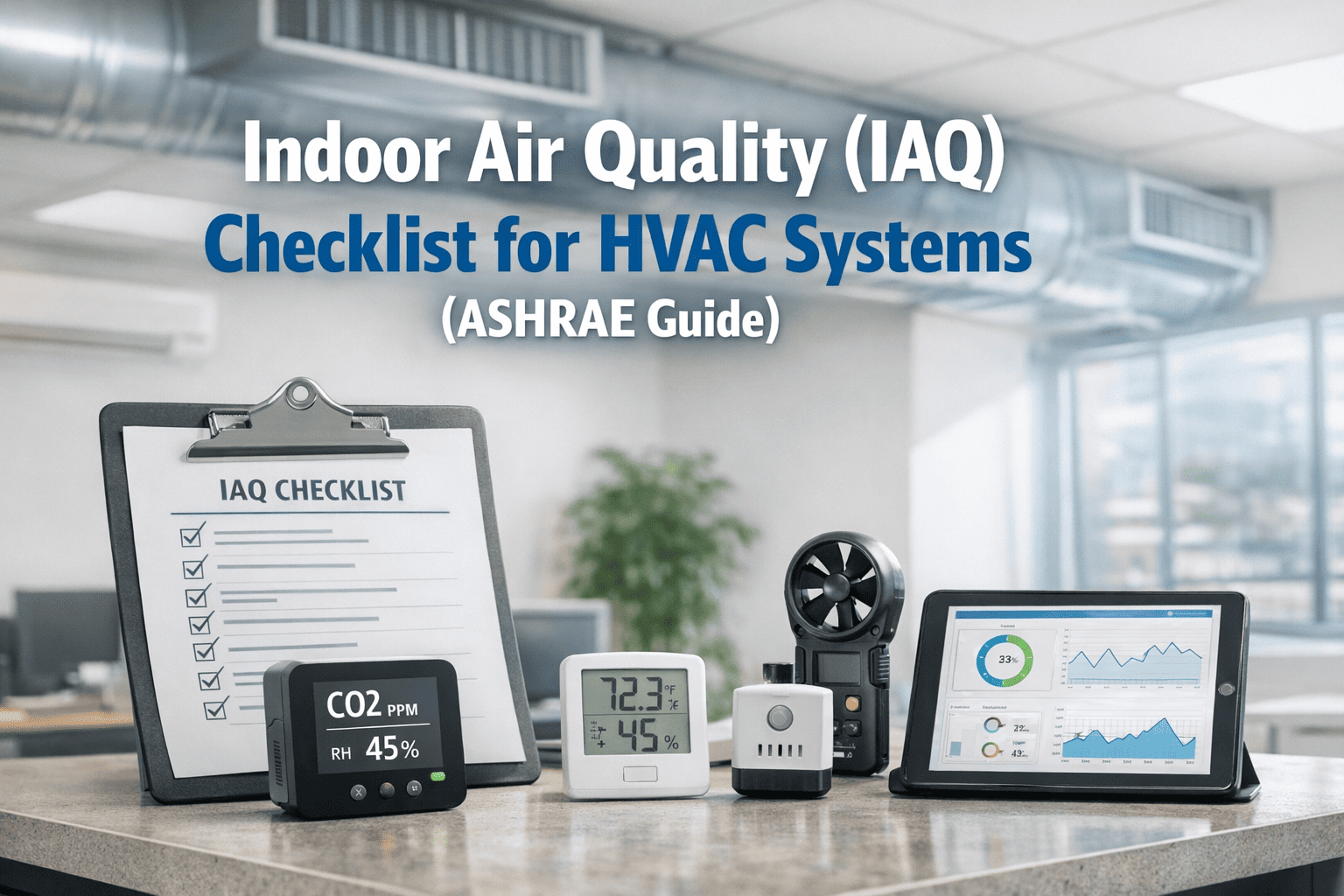
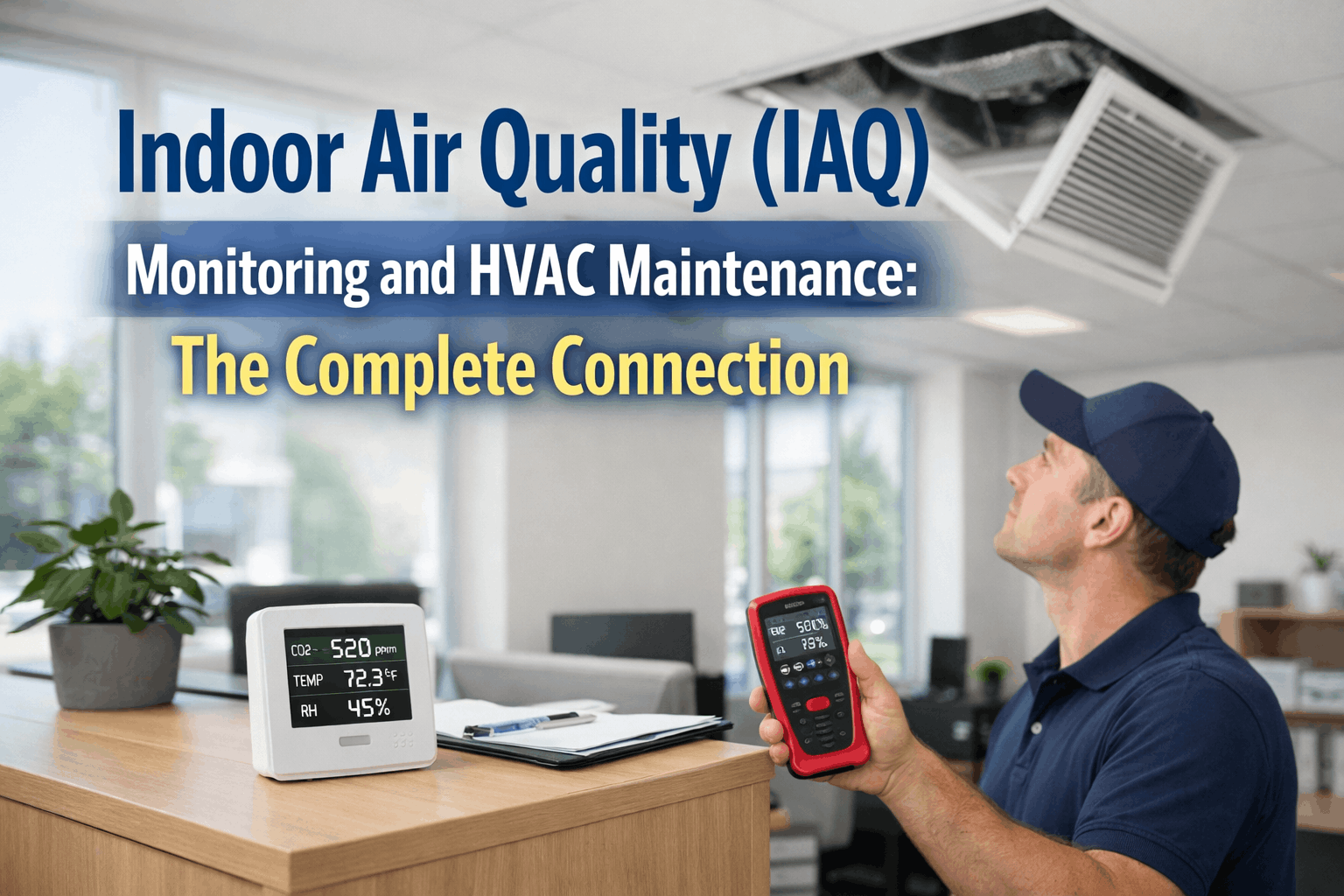
Indoor Air Quality (IAQ) Management: HVAC Maintenance for Healthier Buildings

By James smith on April 6, 2026

indoor-air-quality-iaq-hvac-maintenance-healthier-buildings

Harvard University research found that poor indoor air quality decreases cognitive performance by up to 50% and increases sick days from Sick Building Syndrome. Studies show that improved IAQ can boost cognitive performance by 61% and productivity by 10% — a measurable business return that extends well beyond occupant comfort. The mechanism connecting HVAC maintenance to occupant health is direct: a clogged filter restricts outdoor air volume, reducing ventilation below ASHRAE 62.1 minimums. An uncalibrated CO2 sensor fails to trigger demand-controlled ventilation, leaving a densely occupied conference room running on minimum outdoor air while CO2 climbs to 1,500 ppm. A drain pan with standing water breeds Legionella. A humidifier operating above dew-point limits prescribed by ASHRAE 62.1-2025 creates condensation that supports mould growth in the air stream. Every IAQ failure in a commercial building traces to a maintenance gap. Sign in to OxMaint to build a CMMS-tracked IAQ maintenance programme covering all five compliance domains — or book a demo to see ASHRAE 62.1 maintenance workflows configured for your building portfolio.

Compliance Tracking / HVAC Indoor Air Quality

Indoor Air Quality (IAQ) Management: HVAC Maintenance for Healthier Buildings

Filter selection, ventilation verification, CO2 monitoring, humidity control, mould prevention, and ASHRAE 62.1-2025 compliance — the complete HVAC maintenance framework for IAQ that protects occupant health and building certification status.

62.1
primary IAQ standard
ANSI/ASHRAE 62.1-2025 — minimum ventilation rates and maintenance requirements for acceptable IAQ in commercial buildings. Referenced in 18 US state codes, OSHA guidance, and required for LEED certification
1,000
ppm CO2 threshold
CO2 concentration above 1,000 ppm indicates inadequate outdoor air per person — DCV-controlled zones should trigger increased OA delivery before this threshold is reached
40–60%
relative humidity target
ASHRAE 55 thermal comfort and 62.1-2025 mould prevention requirements — above 60% RH supports mould growth; below 30% RH causes respiratory irritation and static buildup
61%
cognitive improvement
Harvard University research: improved IAQ increases cognitive performance by 61% and productivity by 10% — the measurable business return from HVAC IAQ maintenance

ASHRAE 62.1-2025 — What Operations and Maintenance Teams Must Do

ASHRAE 62.1-2025 is not solely a design standard — it includes specific operations and maintenance requirements that apply throughout the building's life. The 2025 edition expands and refines humidity control requirements, adds emergency ventilation control requirements for atypical operating modes, and maintains filtration and sensor calibration obligations that must be tracked and documented to demonstrate ongoing compliance. ASHRAE 62.1 is referenced in 18 state building codes, is required for LEED certification, and is cited by OSHA for guidance on IAQ issues in commercial and institutional buildings.

The three compliance procedures under ASHRAE 62.1 — the Ventilation Rate Procedure (prescriptive), the Indoor Air Quality Procedure (performance-based), and the Natural Ventilation Procedure — all share the same operations and maintenance obligations: ventilation systems must be maintained at design performance, filters replaced per schedule, sensors calibrated per interval, and drain pans and cooling coils kept free from biological contamination. A building with correctly designed HVAC that is maintained below these standards is out of compliance under all three procedures. Sign in to OxMaint to configure ASHRAE 62.1 maintenance tasks as automated PM work orders per asset.

ASHRAE 62.1 compliance is an ongoing operational obligation, not a commissioning checkbox. The standard's Section 8, "Operations and Maintenance," requires that ventilation systems be maintained to deliver design outdoor air volumes, that filters be replaced on a documented schedule, that sensors be calibrated against reference instruments, and that cooling coils and drain pans be inspected for biological contamination — all with records available on request. A CMMS-tracked IAQ maintenance programme creates this evidence automatically from daily operations.

Build Your ASHRAE 62.1 Compliance Maintenance Programme in OxMaint

Filtration schedules, ventilation verification tasks, sensor calibration reminders, humidity monitoring records, and mould prevention inspections — all configured as automated CMMS work orders with mandatory documentation fields for every IAQ maintenance action.

The Six IAQ Maintenance Domains — What Each Controls and What Fails Without It

IAQ in a commercial building is the product of six interdependent maintenance domains. A failure in any one domain can drive IAQ below ASHRAE 62.1 minimums — and produce occupant health symptoms — regardless of how well the other five domains are maintained. Book a demo to see all six domains configured as scheduled maintenance work orders per asset in OxMaint.

FLT
Filtration — MERV Selection and Replacement Schedule

Filter selection and replacement frequency are the primary determinants of particulate contamination in the supply air stream. A clogged filter creates two simultaneous IAQ failures: it reduces outdoor air volume (ventilation failure) and allows particulate bypass around the filter seal as differential pressure forces air through unsealed gaps (filtration failure). Healthcare and laboratory environments should use MERV 13 or higher; standard commercial offices require minimum MERV 8 with MERV 11–13 recommended for improved IAQ.

CMMS Scheduling Requirements
MERV 8 pre-filters: every 60–90 days — shorter in high-occupancy, high-density, or urban environments
MERV 13 final filters: every 120–180 days — mandatory in healthcare, food processing, educational facilities
Record: filter MERV rating installed, differential pressure before and after replacement, date and technician
IAQ failure if skipped
Increased particulate in supply air — PM2.5 exposure linked to respiratory symptoms and cardiovascular effects
Reduced outdoor air volume as static pressure rises — ventilation rate falls below ASHRAE 62.1 minimums Sign in to configure filter PM schedules.
VNT
Ventilation Verification — Outdoor Air Delivery

ASHRAE 62.1 specifies minimum outdoor air rates by space type and occupancy — approximately 10 L/s per person and 0.3 L/s per m² for standard office occupancies. These rates must be delivered at design values regardless of system age, filter condition, or duct leakage. Periodic verification that actual outdoor air delivery matches design values is an explicit ASHRAE 62.1 operational requirement — not an optional commissioning activity.

CMMS Scheduling Requirements
Annual: measure actual outdoor air CFM per AHU against design minimum — use pitot tube traverse or tracer gas method for accurate measurement
Semi-annual: verify outdoor air damper opens to minimum position at design occupancy conditions — confirm BAS setpoint matches design
After any HVAC modification: re-verify outdoor air delivery before occupying modified zones
IAQ failure if skipped
Outdoor air delivery below ASHRAE 62.1 minimum — direct LEED, OSHA, and local code compliance exposure
Elevated CO2, VOCs, and bioeffluents in occupied spaces — occupant complaints, sick building syndrome symptoms Book a demo to see ventilation verification workflow.
CO2
CO2 Monitoring and Demand-Controlled Ventilation

CO2 concentration is the primary real-time indicator of ventilation adequacy per person. Outdoor air CO2 is approximately 420 ppm; elevated indoor CO2 above 1,000 ppm indicates inadequate outdoor air delivery per occupant. Demand-Controlled Ventilation (DCV) uses CO2 sensor readings to modulate outdoor air dampers — increasing OA when occupancy rises and reducing it when spaces are empty, delivering both IAQ compliance and energy efficiency simultaneously. An uncalibrated CO2 sensor defeats both functions.

CMMS Scheduling Requirements
Annual: calibrate all CO2 sensors against a certified reference gas (400 ppm span gas minimum)
Quarterly: verify sensor response — introduce elevated CO2 and confirm BAS DCV modulation triggers at correct setpoint
Alert threshold: configure BAS alarm at 1,000 ppm CO2 — generate investigation work order in OxMaint on alarm
IAQ failure if skipped
Uncalibrated sensor reads low — DCV does not open OA damper during peak occupancy — CO2 rises to 1,500+ ppm undetected
Harvard research: CO2 at 1,000 ppm reduces decision-making performance by 15%; at 2,500 ppm by 50% Sign in to schedule CO2 sensor calibration.
HUM
Humidity Control — ASHRAE 62.1-2025 Expanded Requirements

ASHRAE 62.1-2025 expanded humidity control requirements — expressing control in dew-point terms rather than relative humidity alone, and setting maximum dew-point temperatures for mechanically cooled buildings. Relative humidity above 60% supports mould growth on duct surfaces, insulation, and supply air components. Below 30% RH, respiratory irritation increases and infection risk rises from desiccated respiratory mucosa. The maintenance programme must verify that humidity control equipment is operating and sensors are calibrated — both are explicitly required by ASHRAE 62.1-2025 Section 8.

CMMS Scheduling Requirements
Annual: calibrate humidity sensors against calibrated reference instrument — note drift against previous calibration reading
Quarterly: verify humidifier and dehumidifier operation through full control range — confirm setpoint response
After any HVAC coil cleaning or cooling system service: re-verify humidity control before occupying affected zones
IAQ failure if skipped
RH above 60% sustained: mould growth initiation on duct liner, diffusers, and ceiling tiles within days in warm climates
Drifted humidity sensor: humidifier or dehumidifier responds to false readings — actual RH outside target range undetected Book a demo to see humidity compliance tracking.
MOL
Mould Prevention — Cooling Coils, Drain Pans, and Duct Liner

Cooling coils operate below dew point during summer conditions, condensing moisture from the air stream onto the coil surface. This moisture collects in the drain pan and drains through the condensate line. Standing water in a drain pan, a blocked condensate drain, or a wet cooling coil that remains damp between operating cycles creates conditions for rapid mould growth — directly in the supply air stream. ASHRAE 62.1 Section 5.11 requires airstream surfaces to be resistant to mould growth. Maintenance must prevent the moisture conditions that overcome that resistance.

CMMS Scheduling Requirements
Quarterly: inspect cooling coil drain pans for standing water, scale, and biological growth — flush drain pan and treat with pan tablets
Quarterly: verify condensate drain line flow — pour water into drain pan and confirm it drains freely within 60 seconds
Annual: inspect duct liner condition in sections downstream of cooling coil — look for staining, odour, and visible growth
IAQ failure if skipped
Blocked drain: standing water becomes a Legionella and mould reservoir directly in the supply air path — ASHRAE Standard 188 Legionella WMP trigger
Contaminated duct liner: mould spore release during system operation — occupant respiratory symptoms, formal IAQ complaint cycle Sign in to configure drain pan and coil PM.
CAL
IAQ Sensor Calibration — CO2, VOC, Particulate, Humidity

IAQ sensor networks are only as useful as their calibration accuracy. A CO2 sensor that reads 300 ppm low will not trigger DCV even when occupant density is high. A humidity sensor that reads 5% low will allow the humidifier to drive RH above 60% without alarming. A particulate sensor that reads high will generate unnecessary maintenance calls. All sensors drift over time — accelerated by temperature cycling, chemical exposure, and sensor element ageing. Annual calibration against traceable reference standards is the minimum maintenance standard for all IAQ-critical sensors.

CMMS Scheduling Requirements
CO2 sensors: annual calibration against certified 400 ppm span gas — record pre- and post-calibration offset
Humidity sensors: annual calibration against calibrated reference at two humidity points (30% and 70% RH)
PM2.5 sensors: annual verification against gravimetric reference or co-location with certified monitor
IAQ failure if skipped
Drifted sensors generate false-compliant BAS readings — actual IAQ conditions below ASHRAE 62.1 requirements undetected for months
LEED O+M and WELL Building Standard certification audits require calibration records — absence is an automatic finding Book a demo to see sensor calibration tracking.
"
The framing of IAQ as an occupant wellness issue is technically accurate but commercially incomplete. The more precise framing is this: poor IAQ is a documented productivity liability, and the maintenance programme that prevents it has a quantifiable return. When Harvard's research showed that cognitive performance dropped 50% in poorly ventilated buildings and recovered 61% with adequate ventilation, it was describing the impact of a maintenance decision — specifically, the decision about whether the outdoor air damper was open to its design minimum and whether the CO2 sensor triggering it was calibrated. Those are maintenance questions, not design questions. I audit buildings where the ventilation system was correctly designed and correctly commissioned and is now delivering 60% of the design outdoor air because nobody verified actual OA delivery after two years of filter loading, duct degradation, and fan belt wear. The occupants are experiencing the productivity impact of that maintenance gap without knowing what is causing it. A CMMS that requires an annual actual OA measurement as a mandatory PM task — not just a BAS setpoint check, but an actual CFM measurement — closes that gap systematically. Without the actual measurement, you are trusting that the system is delivering what it was designed to deliver. That trust is usually wrong by the third year of operation.

ASHRAE 62.1 Compliance Records Generated Automatically at Every PM Closure

OxMaint logs filter replacement, sensor calibration, ventilation verification, and mould prevention inspections as structured CMMS records — timestamped, technician-attributed, and exportable for LEED O+M, WELL, and ASHRAE 62.1 compliance documentation.
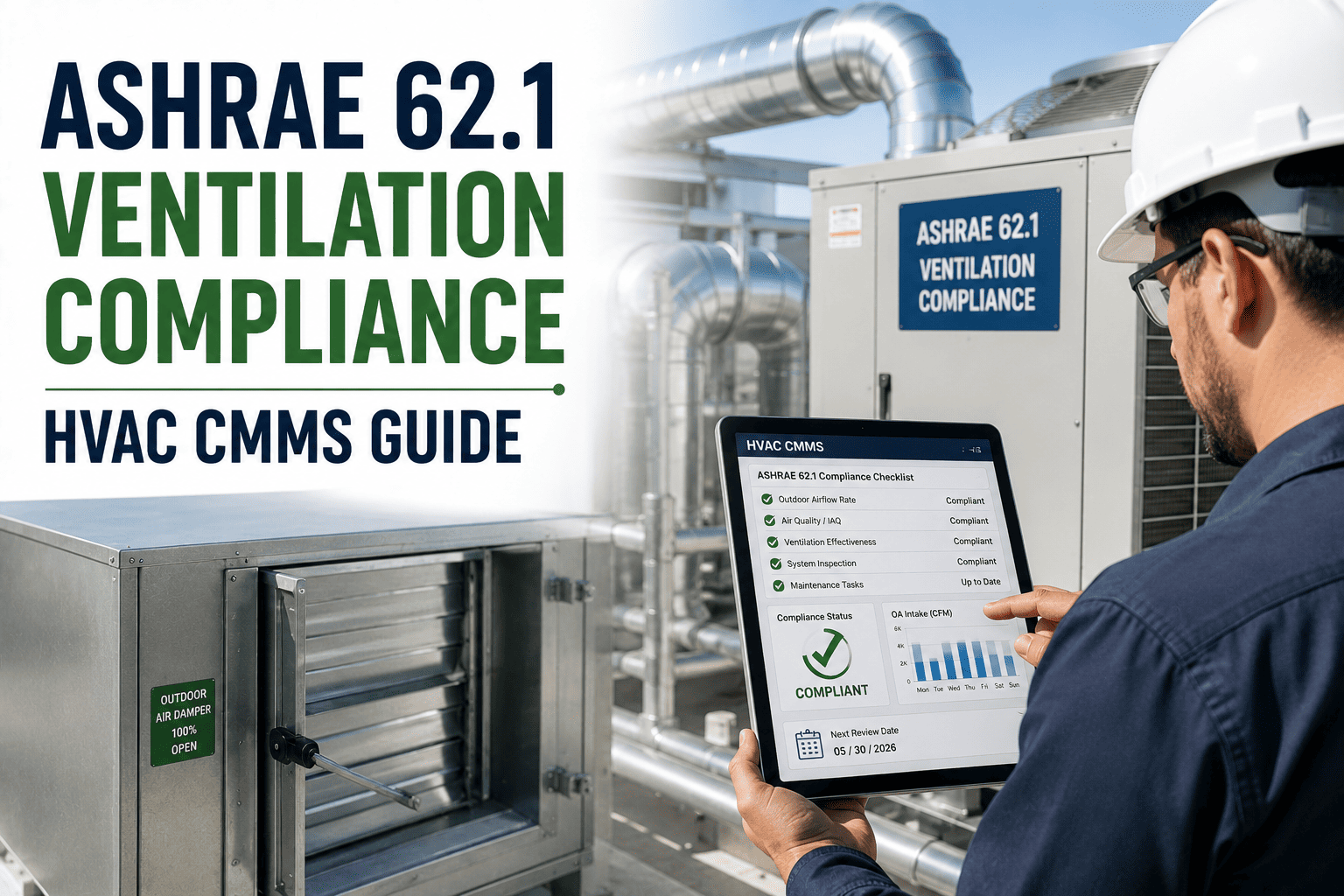
How OxMaint Manages IAQ Compliance Tracking

62.1
ASHRAE 62.1 Maintenance Task Library
Pre-built maintenance task templates covering all ASHRAE 62.1 Section 8 operations and maintenance requirements — filter replacement, OA verification, sensor calibration, drain pan inspection, and humidity verification — with mandatory documentation fields per task type. Sign in to access the ASHRAE 62.1 task library.
Sensors
IAQ Sensor Calibration Scheduling
CO2, humidity, VOC, and particulate sensor calibration work orders scheduled per sensor asset with calibration interval, reference standard specification, and mandatory pre/post-calibration reading fields. Out-of-tolerance findings auto-generate investigation work orders. Book a demo to see sensor tracking.
Compliance
LEED and WELL Documentation Export
Maintenance records for LEED O+M and WELL Building Standard certification audits — filtration history, sensor calibration logs, ventilation verification reports, and mould prevention inspection records — exported in minutes from CMMS data rather than assembled from scattered paper logs. Sign in to activate compliance documentation.
DCV
BAS-Integrated CO2 Alert Workflows
BAS CO2 alarms above configured thresholds (typically 1,000 ppm) auto-generate OxMaint investigation work orders — routing to the HVAC technician with the zone location, current reading, and last sensor calibration date. Closes the loop between real-time monitoring and maintenance response. Book a demo to see BAS integration.
Mould
Drain Pan and Coil Inspection Records
Quarterly drain pan, condensate drain, and cooling coil inspections with mandatory photo documentation, biological growth classification, and treatment record at closure. Positive findings auto-generate corrective work orders with required remediation checklist. ASHRAE Standard 188 Legionella WMP trigger log. Sign in to configure mould prevention PM.
History
IAQ Maintenance Asset History
Every IAQ-related maintenance action linked to the specific AHU, sensor, or duct zone asset — building a searchable compliance history that answers: when was the last filter change, what MERV rating was installed, when was the CO2 sensor last calibrated, and what was the pre-calibration offset? Book a demo to see asset history for IAQ.
Every Filter Change. Every Sensor Calibration. Every ASHRAE 62.1 Record. In One Platform.
OxMaint converts ASHRAE 62.1 maintenance obligations into automated CMMS work orders — with documentation generated at every closure and compliance exports ready for LEED, WELL, and regulatory audit on demand. Free trial, no implementation fees.

Frequently Asked Questions

What are the HVAC maintenance requirements of ASHRAE 62.1-2025?
ASHRAE 62.1-2025 Section 8 specifies ongoing operations and maintenance requirements including: filter replacement on a documented schedule to maintain filtration efficiency, periodic verification that actual outdoor air delivery meets design minimums, calibration of CO2 and other IAQ sensors on defined intervals, inspection and cleaning of cooling coils and drain pans to prevent biological contamination, and humidity control maintenance to keep indoor dew-point below the 2025 edition's expanded thresholds. All maintenance must be documented — records must be available on request for commissioning verification, LEED certification, and OSHA compliance purposes. The 2025 edition added new requirements for emergency ventilation controls and expanded humidity control to dew-point specification. Sign in to configure ASHRAE 62.1-2025 maintenance tasks in OxMaint.
What CO2 level indicates inadequate ventilation in a commercial building?
Outdoor ambient CO2 is approximately 420 ppm. A sustained indoor CO2 reading above 1,000 ppm indicates inadequate outdoor air delivery per person — typically the result of insufficient outdoor air volume, a DCV system failing to modulate dampers at peak occupancy, or an uncalibrated CO2 sensor providing false-low readings that suppress DCV response. Facilities should configure BAS alarms at 1,000 ppm with automatic investigation work orders generated for the maintenance team. At 1,500+ ppm, ASHRAE 62.1 minimum ventilation rates are clearly not being delivered. Harvard research documented cognitive performance reductions beginning around 1,000 ppm and reaching 50% impairment at 2,500 ppm. Annual CO2 sensor calibration is the primary maintenance action that keeps DCV systems functioning as designed. Book a demo to see CO2 alert-to-work-order integration in OxMaint.
How does HVAC filter MERV rating affect indoor air quality?
MERV (Minimum Efficiency Reporting Value) rates filter capture efficiency at different particle sizes. MERV 8 (standard commercial) captures particles down to 3 microns — adequate for general office environments but insufficient for fine particulate PM2.5, which requires MERV 13 or higher. MERV 13 captures 85%+ of particles in the 0.3–1.0 micron range, including many respiratory aerosols and fine combustion particles. Healthcare, food processing, and high-occupancy facilities should use MERV 13 minimum. Higher MERV filters also have higher pressure drop — a MERV 13 filter operating near its change interval can reduce outdoor air delivery below ASHRAE 62.1 minimums, so filter change intervals must be maintained as strictly as filter selection. Record the MERV rating installed at each change — not all MERV 13 filters are from the same manufacturer or have identical performance. Sign in to configure filter PM schedules with MERV rating capture fields in OxMaint.

Share This Story, Choose Your Platform!