The air inside most commercial buildings is two to five times more polluted than the air outside — and the people inside those buildings breathe it for eight or more hours every day. Indoor air quality is not a comfort issue or a luxury amenity. The building's HVAC system is both the primary cause of poor IAQ when mismanaged and the primary solution when properly operated. This guide covers the strategies, technologies, and monitoring systems that HVAC and facilities teams are using in 2026 to deliver measurably healthier indoor environments — and how IoT-connected monitoring transforms IAQ from a periodic audit concern into a continuously managed operational metric. Sign up free to connect your building's IAQ sensors to OxMaint's IoT dashboard, or book a demo to see the monitoring workflow configured for your building type.
HIGH RISK
CO₂
Occupants — exhaled breath
Above 1,000 ppm: 15% cognitive decline. Above 2,500 ppm: headaches, fatigue, poor decision-making
↑ Fresh air ventilation rate
HIGH RISK
PM2.5
Outdoor ingress, printers, cooking, combustion
Penetrates deep lung tissue. Linked to respiratory disease and long-term cardiovascular risk
MERV-13+ filtration or HEPA
MODERATE
VOCs
Furniture, carpets, cleaning products, adhesives
Eye and respiratory irritation, headaches, long-term exposure linked to organ damage
Increased ventilation + activated carbon filtration
MODERATE
Humidity
Occupants, HVAC system, external climate
Below 30%: dry skin, static, viral transmission. Above 60%: mould growth, dust mite proliferation
Dehumidification and humidification control
BASELINE
Mould Spores
Damp surfaces, condensation, drainage systems
Allergic reactions, asthma exacerbation, respiratory infections in vulnerable occupants
Humidity control + coil cleaning + drain maintenance
BASELINE
Legionella
Water systems, cooling towers, humidifiers
Legionnaires' disease — potentially fatal in vulnerable individuals. Regulatory liability
Water temperature management + biocide treatment + monitoring
Why Most Buildings Have Poor IAQ — Even With Modern HVAC
The HVAC system is designed to manage indoor air quality, but it can only do so if it is operated correctly, maintained regularly, and calibrated to actual building occupancy. The gap between a well-specified HVAC system and good real-world IAQ is almost always a maintenance and monitoring gap — not a design gap. CO₂ levels drift above 1,000 ppm during peak occupancy because the ventilation rate was set for a typical occupancy that no longer reflects actual use patterns. Humidity climbs above the mould threshold because the drain pan is blocked. Filter differential pressure is never checked so a MERV-13 filter loaded to bypass is delivering the same protection as no filter at all. Book a demo to see how OxMaint's IoT integration monitors these parameters continuously and triggers PM work orders when thresholds are breached.
01
Filter Bypass — The Most Common IAQ Failure
A filter loaded past its capacity develops bypass channels — air flows around the filter media rather than through it. Differential pressure monitoring across the filter is the only reliable detection method. Without it, a MERV-13 filter in bypass delivers zero filtration protection despite appearing installed and intact.
Fix: Differential pressure sensor on every AHU filter bank → auto work order when bypass threshold crossed
02
Static Ventilation Rates — Designed for Average Occupancy, Not Actual
Fresh air damper positions are set at commissioning for an assumed occupancy level. When actual occupancy exceeds design (hot desking, event days) or drops well below it (summer, hybrid working), the ventilation rate is wrong in both directions — over-ventilating wastes energy, under-ventilating allows CO₂ to build. Demand-controlled ventilation using CO₂ sensors solves this.
Fix: CO₂ sensors in occupied zones → BMS-linked demand-controlled ventilation → fresh air modulated to actual CO₂ level
03
Drain Pan and Coil Contamination — Mould in the Air Handler
AHU drain pans that are not cleaned and inspected on schedule accumulate biological growth — algae, bacteria, and mould — that is then distributed through the air system to every occupied space the unit serves. A contaminated drain pan or evaporator coil can explain persistent IAQ complaints across an entire floor or building zone that are impossible to trace without opening the AHU.
Fix: Scheduled drain pan inspection and coil cleaning in CMMS PM programme → photo-documented at each event
04
Humidity Out of Range — Too Dry or Too Wet
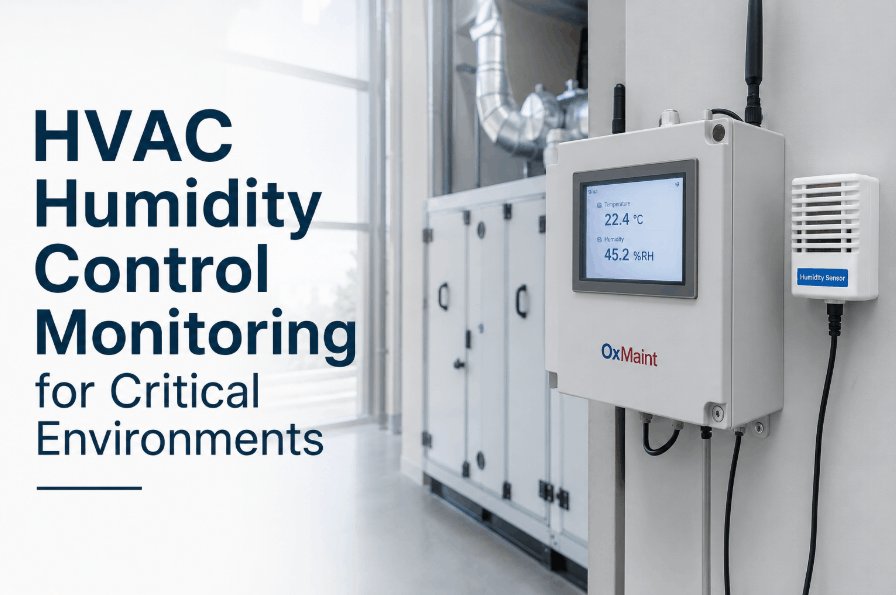
The target relative humidity range for occupied commercial buildings is 40–60%. Below 30%, viral transmission increases significantly and respiratory surfaces dry out. Above 65%, mould begins to establish on surfaces within days. Most buildings run at the wrong humidity level for weeks at a time without anyone knowing because nobody is monitoring it continuously at zone level.
Fix: Continuous RH sensors per zone → alert when outside 35–65% operating band → HVAC controls investigation triggered automatically
The Four HVAC Strategies That Deliver Measurable IAQ Improvement
IAQ improvement in commercial buildings is not a single intervention — it is a programme of coordinated HVAC strategies, each addressing a different pollutant pathway. The strategies below are sequenced by implementation priority, starting with the changes that deliver the broadest IAQ benefit at lowest cost. Sign up free to track IAQ-related PM tasks and sensor alerts in OxMaint's IoT dashboard.
Upgrade Filtration to MERV-13 Minimum
Broadest Impact · Lowest Cost
MERV-13 filters capture particles down to 0.3–1.0 microns — the size range that includes PM2.5, most bacteria, and a significant proportion of airborne viral particles. The upgrade from MERV-8 (the most common specification in older commercial buildings) to MERV-13 requires verifying that existing air handlers can accommodate the higher static pressure drop. Most commercial AHUs manufactured after 2010 can handle MERV-13 without fan modification. The IAQ improvement is immediate — no other single change delivers broader particle reduction faster.
85%PM2.5 removal at MERV-13 vs 20–30% at MERV-8
MERV-16or HEPA recommended for healthcare, schools, and high-density occupancy
Implement Demand-Controlled Ventilation (DCV)
CO₂ Control · Energy Saving
DCV uses CO₂ sensors in occupied zones to modulate fresh air supply in real time based on actual occupancy-generated CO₂ rather than a fixed assumed rate. When occupancy drops (conference room empties, open plan below capacity), fresh air is reduced — saving heating and cooling energy. When occupancy spikes, fresh air increases automatically — preventing CO₂ accumulation. ASHRAE 62.1-2022 endorses DCV as a compliant alternative to fixed ventilation rates for variable-occupancy spaces.
800 ppmTarget CO₂ setpoint for optimal cognitive performance (vs 1,400+ in uncontrolled offices)
20–30%Typical HVAC energy saving from DCV in variable-occupancy commercial buildings
Precision Humidity Control — 40–60% RH Target
Mould Prevention · Viral Transmission
Maintaining relative humidity between 40% and 60% is the single most effective HVAC intervention for reducing airborne pathogen transmission — more impactful than many filtration upgrades because it affects viral survival directly. Below 40%, respiratory mucosa dries and becomes less effective at pathogen defence. Above 60%, mould and dust mite populations establish rapidly on any porous surface. Zone-level humidity monitoring is required — central plant RH readings do not reflect actual zone conditions where supply air mixes with occupant-generated moisture and heat.
200%Increase in influenza virus survival when humidity drops from 50% to 20% RH
48 hrsTime for visible mould to begin establishing on damp surfaces above 65% RH
Continuous IoT Air Quality Monitoring
Real-Time Detection · Compliance Evidence
Periodic IAQ audits (quarterly or annually) tell you what the air quality was on the day someone visited with monitoring equipment. Continuous IoT sensors tell you what it is at every hour, in every zone, every day — including during the weekends when drain pans overflow, during the early morning when cleaning products off-gas, and during peak occupancy events when CO₂ spikes before anyone notices symptoms. IoT-connected monitoring feeds data directly into a CMMS, triggering automated maintenance actions when parameters breach thresholds rather than waiting for a complaint or inspection.
24/7Monitoring coverage vs point-in-time annual audit — 8,760 hours of data vs a single day
WELL / LEEDCertification programmes require continuous monitoring data — not just audit reports
MERV Rating Guide: Choosing the Right Filter for Your Building
Filter selection is the most consequential single IAQ decision for most commercial buildings — and the most commonly misunderstood. The MERV (Minimum Efficiency Reporting Value) scale runs from 1 to 20. The higher the number, the smaller the particles captured and the higher the static pressure drop across the filter. Matching the MERV rating to the building type and HVAC capacity is essential: specifying a filter too high for the AHU fan curve creates bypass problems worse than a lower-rated filter installed correctly. Book a demo to see OxMaint track filter change schedules and differential pressure readings for every AHU in your building.
MERV Rating
Particle Size Captured
Removal Efficiency
Typical Application
IAQ Status
MERV 1–4
Above 10 microns
Less than 20%
Pre-filters, residential window units
Inadequate
MERV 5–8
3–10 microns
20–70%
Standard commercial HVAC — older installations
Basic
MERV 13
0.3–1 microns
75–85% PM2.5
Commercial offices, retail, hospitality — 2026 best practice minimum
Recommended
MERV 14–16
0.3–0.5 microns
85–95%
Schools, healthcare facilities, high-occupancy spaces
High Performance
HEPA (MERV 17+)
0.1 microns and above
99.97%+
Cleanrooms, isolation rooms, surgical suites, data centres
Maximum
IoT Monitoring: From Periodic Audit to Continuous Intelligence
The shift from periodic IAQ auditing to continuous IoT monitoring is the most significant operational change in commercial building management since the introduction of building automation systems. An annual IAQ audit produces a compliance report. A continuous monitoring network produces actionable operational intelligence — the CO₂ in Meeting Room 4 has been above 1,200 ppm every Tuesday afternoon for six weeks; the humidity in the server room wing drops below 35% every winter morning; the PM2.5 in the atrium spikes at 7am when the loading dock is in use. These are not patterns visible in any audit. They are only discoverable through continuous data.
1
IoT Sensor Reading
CO₂, PM2.5, RH, VOC, or temperature breaches defined threshold
→
2
OxMaint Alert
Parameter, zone, severity level, and suggested cause logged automatically
→
3
Work Order Generated
Correct maintenance action assigned — filter check, damper inspection, drain pan cleaning
→
4
Technician Dispatched
Mobile notification sent to engineer — work order with asset details and zone location
→
5
IAQ Restored
Sensor confirms return to normal range — work order closed with resolution documented
Connect Your Building's Air Quality Sensors to OxMaint
OxMaint's IoT Integration connects CO₂, PM2.5, humidity, and VOC sensors to automated work order generation — so every IAQ threshold breach becomes a tracked maintenance action, not a missed alert.
Sign up free to configure your sensor connections, or
book a demo to see the workflow live.
IAQ Standards and Compliance Benchmarks — What Buildings Are Measured Against
IAQ compliance requirements are increasingly codified across multiple frameworks simultaneously — from ASHRAE standards used by engineers and regulators, to voluntary certification programmes used by building owners to attract tenants, to post-pandemic workplace health standards referenced in lease agreements and ESG reporting. Understanding which standards apply to your building type and occupancy determines your monitoring and documentation obligations. Sign up free to track IAQ compliance metrics per zone in OxMaint.
Regulatory
ASHRAE 62.1-2022
Commercial buildings, offices, retail, hospitality
Ventilation5–10 cfm/person fresh air (varies by space type)
CO₂No hard limit — but 700 ppm above outdoor as indicator
FiltrationMERV-8 minimum — MERV-13 for PM2.5 targets
Certification
WELL Building Standard v2
Premium offices, healthcare, mixed-use developments
CO₂Below 900 ppm in occupied spaces — continuous monitoring required
PM2.5Annual average below 15 μg/m³
Humidity30–60% RH in occupied spaces
VOCsTVOC below 500 μg/m³
Certification
LEED v4.1 — Indoor Environmental Quality
New construction, major renovation, existing buildings
VentilationASHRAE 62.1 compliance + DCV for variable occupancy
FiltrationMERV-13 minimum for all air handling equipment
MonitoringContinuous CO₂ monitoring with occupant notification system
IAQ Monitoring That Works While You Sleep
OxMaint connects to your building's CO₂, humidity, PM2.5, and VOC sensors — alerting your maintenance team the moment a parameter drifts out of range and automatically generating the work order to resolve it. Continuous IAQ management without continuous manual attention.
Frequently Asked Questions: Indoor Air Quality and HVAC
What CO₂ level is acceptable in a commercial office building?
ASHRAE 62.1 does not set a hard CO₂ limit but uses CO₂ concentration as a proxy for ventilation adequacy — a level 700 ppm above outdoor ambient (typically around 1,100 ppm total) indicates adequate fresh air delivery. WELL Building Standard sets a stricter 900 ppm ceiling in occupied spaces for certification. Cognitive performance research consistently shows measurable decision-making impairment beginning at 1,000 ppm, with significant degradation above 1,400 ppm. In practice, target below 900 ppm for high-performance workplaces and below 1,200 ppm as an operational minimum.
Sign up free to configure CO₂ alert thresholds per zone in OxMaint.
How often should commercial HVAC filters be changed for good IAQ?
Filter change interval depends on the filter rating, building location, and occupancy — not a fixed calendar schedule. MERV-13 filters in a typical urban commercial building last 60–90 days under normal occupancy. The correct approach is differential pressure monitoring: when the pressure drop across the filter exceeds the manufacturer's rated terminal differential, it should be changed regardless of elapsed time. Buildings near construction activity, high-traffic areas, or with high occupancy density will load filters faster. OxMaint's IoT integration monitors filter differential pressure continuously and auto-generates a change work order when threshold is reached.
Book a demo to see differential pressure monitoring configured for your AHU fleet.
What sensors does a commercial building need for comprehensive IAQ monitoring?
A comprehensive IAQ monitoring deployment for a typical commercial office building requires CO₂ sensors in every occupied zone (one per 200–400m² minimum), humidity sensors at zone level (not just central plant), differential pressure sensors across AHU filter banks, PM2.5 sensors at building intake and key internal zones, and TVOC sensors in spaces with high off-gassing risk (new fitouts, print rooms, cleaning stores). Temperature sensors are generally already present in BMS. The sensor data should flow into a platform that correlates readings with maintenance actions — not just a dashboard.
Sign up free to connect your sensor network to OxMaint.
Can upgrading to MERV-13 filters damage my existing HVAC system?
It can if the fan system is not sized for the higher static pressure. MERV-13 filters have approximately 2–3× the static pressure drop of MERV-8 filters of the same size. Before upgrading, verify the AHU fan curve against the manufacturer's rated capacity at the increased static pressure. Most commercial AHUs manufactured after 2005 can accommodate MERV-13 without modification. Older systems may require fan speed adjustment, fan replacement, or a staged approach using MERV-11 as an intermediate step. Have a qualified HVAC engineer verify static pressure margins before changing filter specifications on any unit.
How does OxMaint's IoT integration support IAQ management?
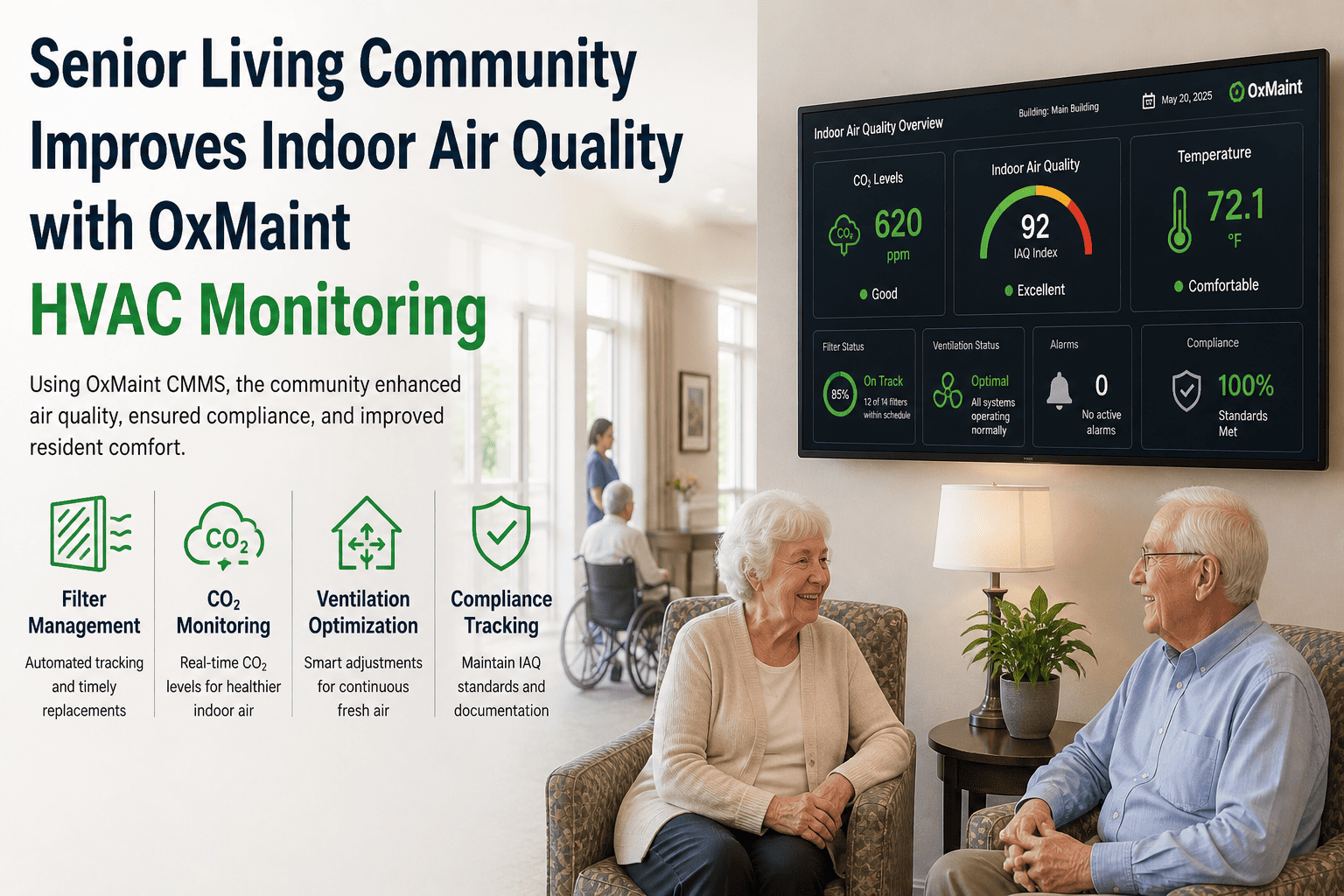
OxMaint connects to IAQ sensors via standard protocols and triggers automated maintenance actions when parameters breach configured thresholds. A CO₂ spike in a meeting room generates a ventilation inspection work order. A humidity reading above 65% generates a drain pan inspection work order. A filter differential pressure crossing its terminal value generates a filter change work order. Every sensor alert, work order, and resolution is stored in a permanent audit trail per asset per zone — providing the continuous monitoring evidence required for WELL and LEED certification, and the operational visibility to identify recurring patterns before occupants notice symptoms.
Book a demo to see the full IoT integration workflow.