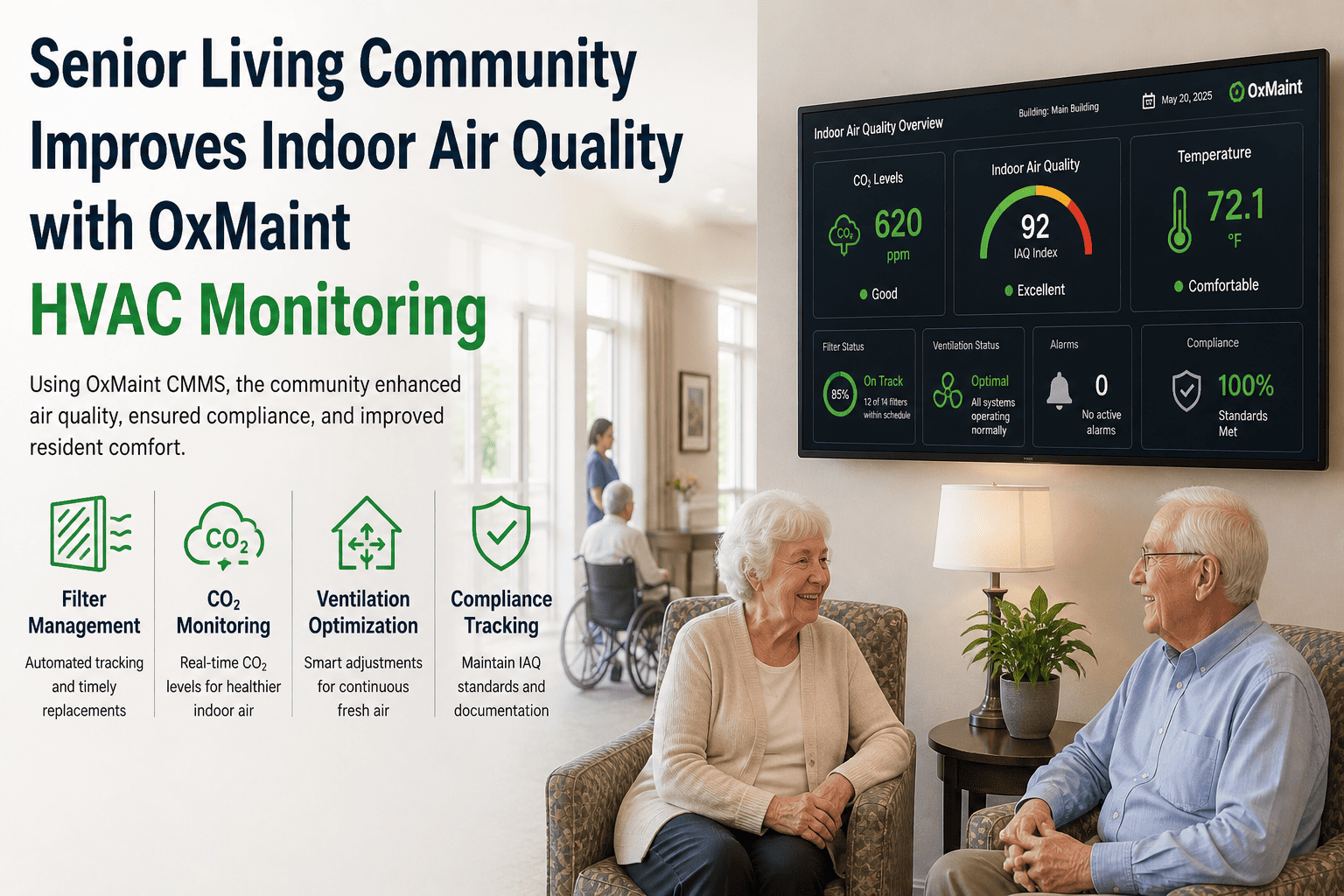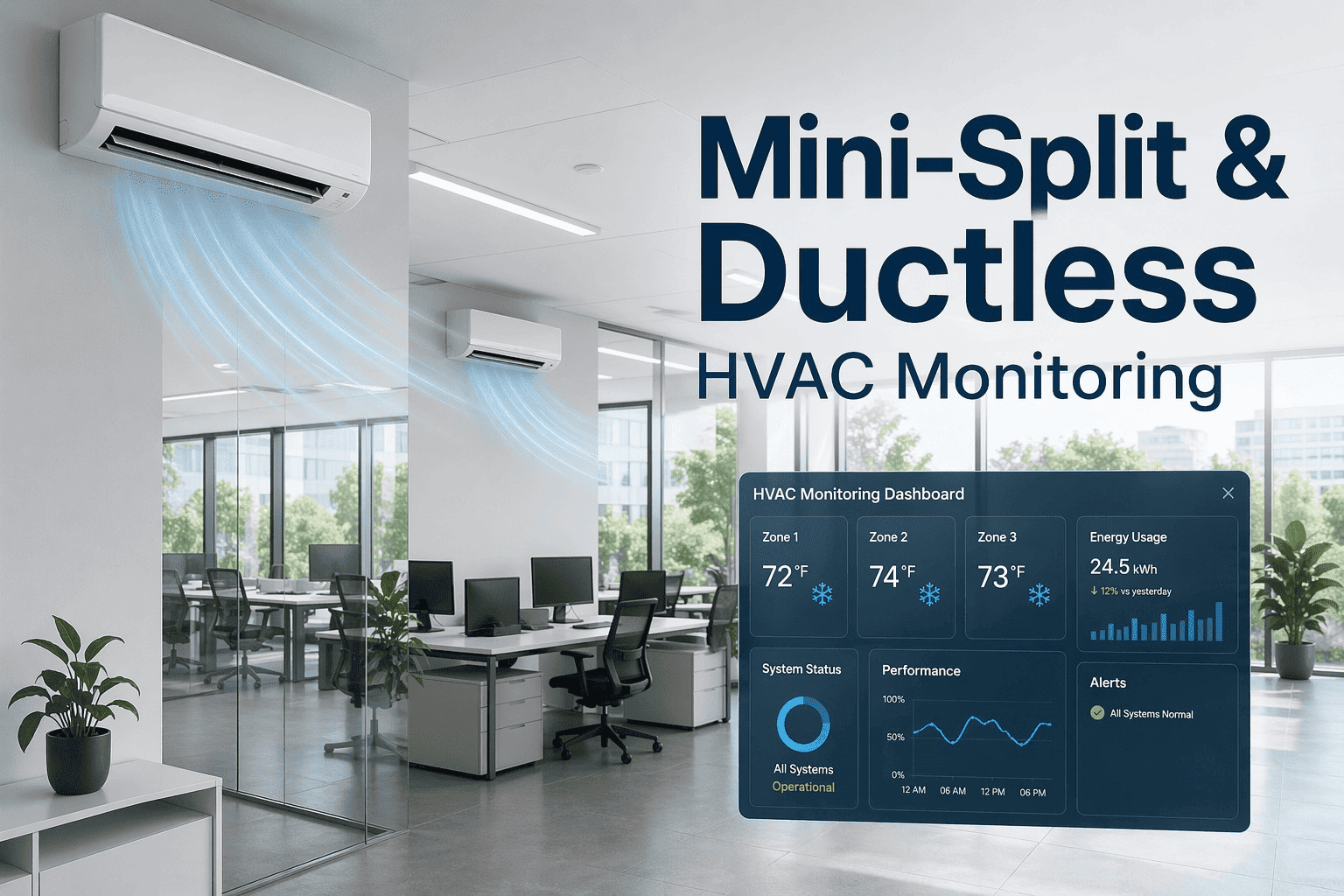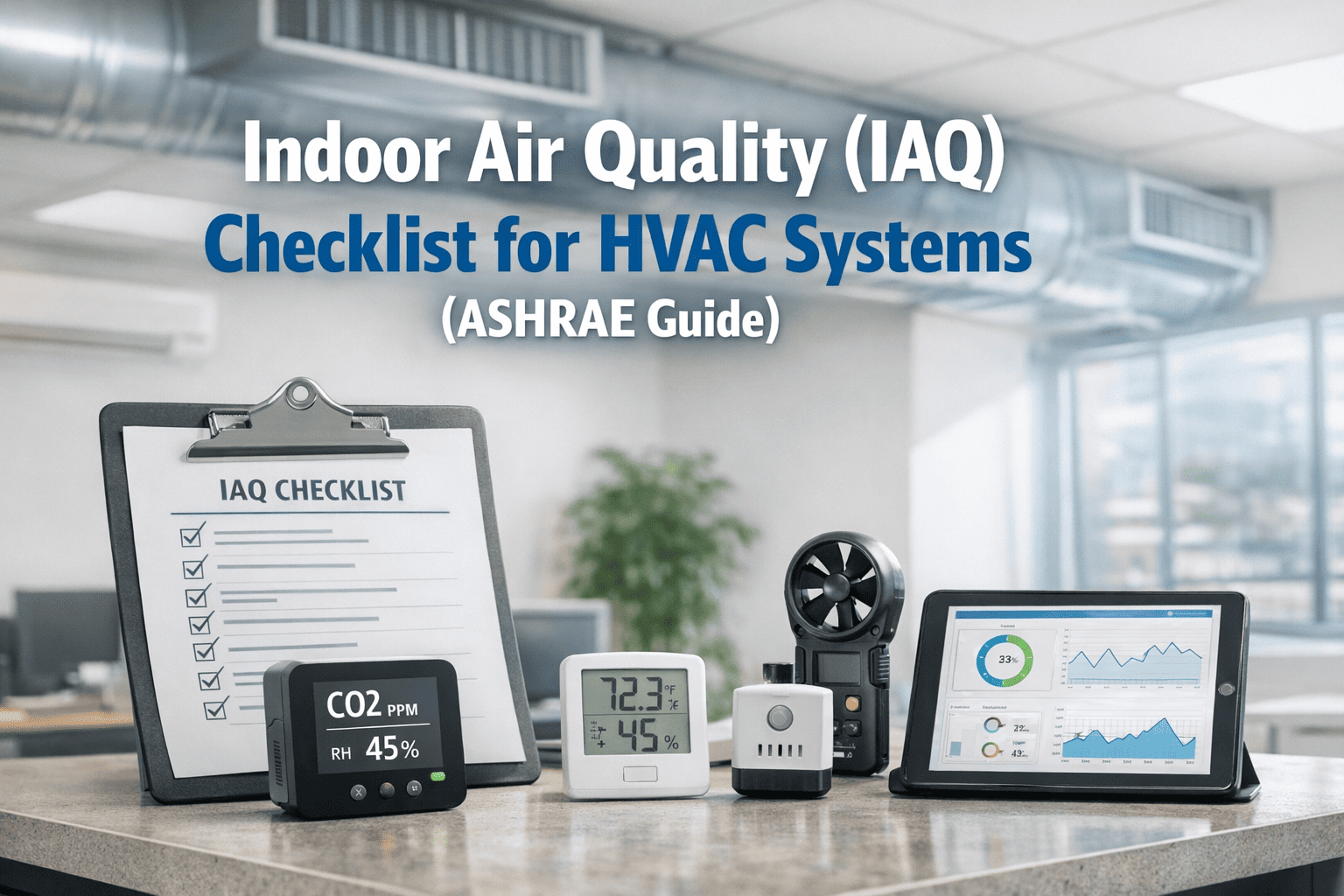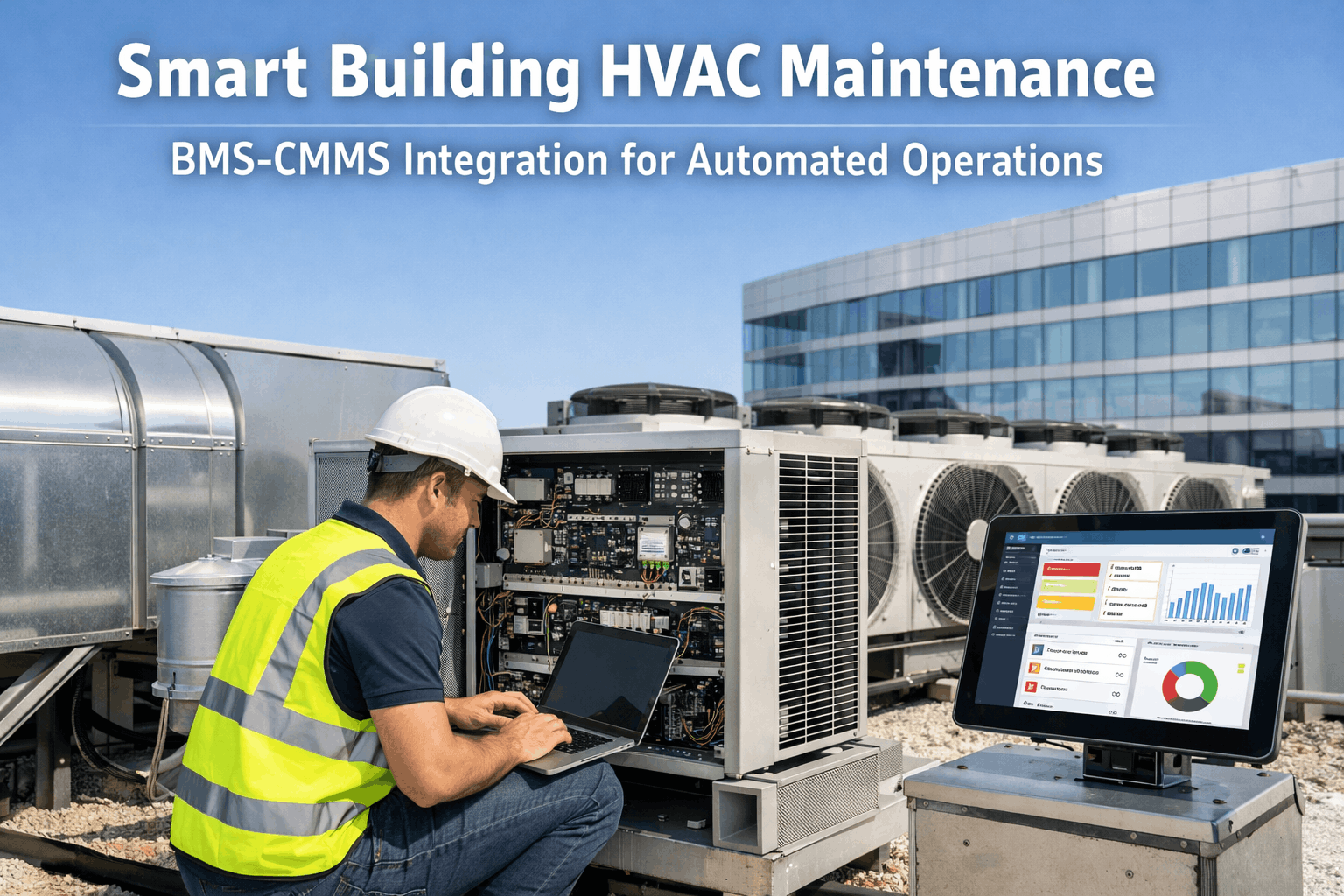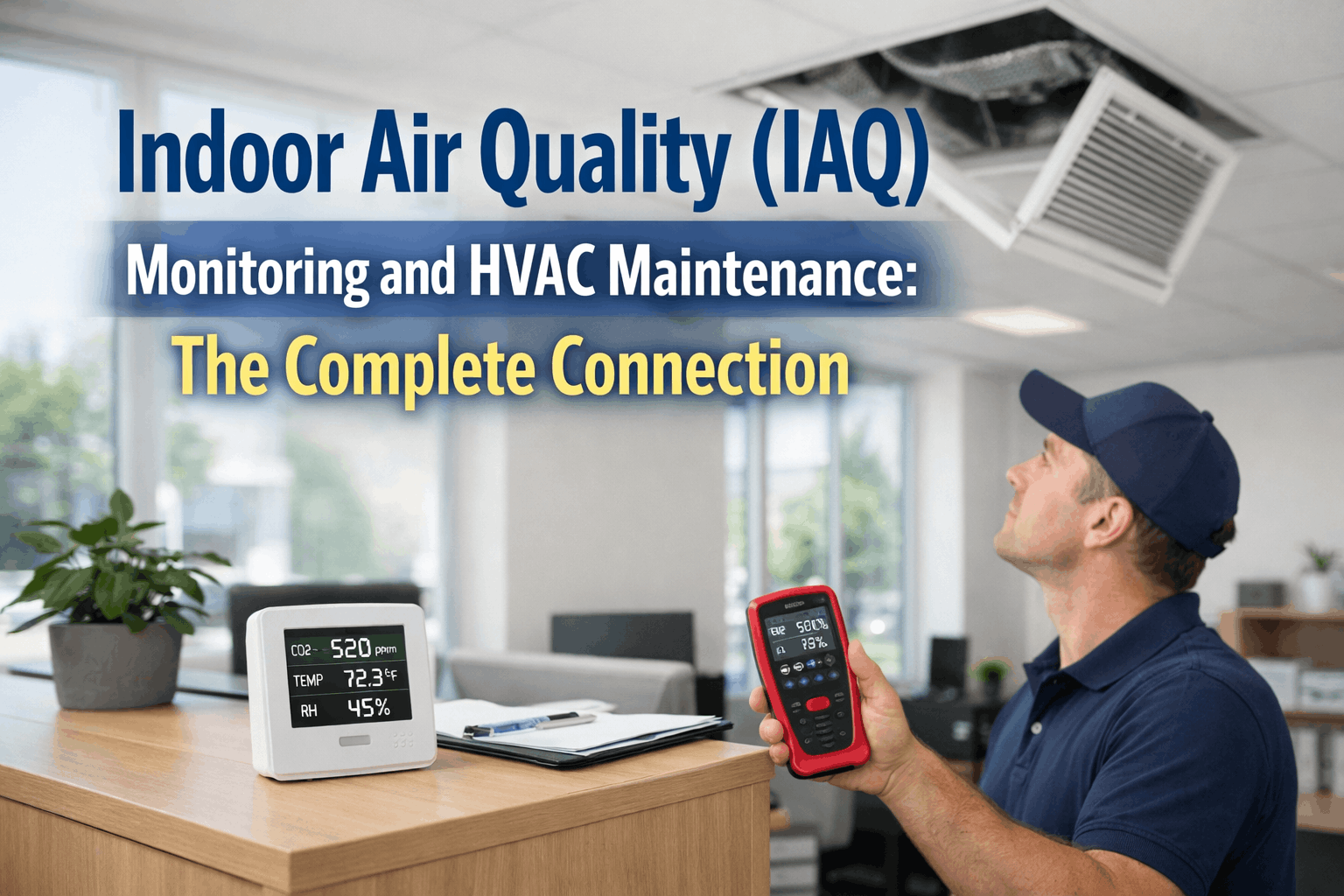
Indoor air quality is not a mystery. It's a direct, measurable output of how well your HVAC systems are maintained. Every IAQ failure — elevated CO2, high particulate matter, mould growth, temperature complaints, VOC buildup — traces back to a specific equipment condition: a clogged filter, a stuck outdoor air damper, a failed fan motor, a dirty coil, or a broken humidifier. When a building's air quality degrades, the problem isn't the air. The problem is the equipment that conditions it.
Yet in most commercial buildings, IAQ monitoring and HVAC maintenance operate as separate worlds. Air quality sensors generate data that sits in dashboards. Maintenance teams follow calendar-based PM schedules disconnected from actual air quality outcomes. The result is that filters get changed on a fixed schedule regardless of particulate load, dampers are checked annually even when CO2 has been climbing for weeks, and coils are cleaned on a calendar that doesn't account for the mould growing on them right now. Connecting IAQ data to HVAC maintenance actions — automatically — is the single most impactful step any facility can take to improve occupant health, reduce complaints, cut energy waste, and prove compliance.
Of our time is spent indoors — IAQ directly impacts health, cognition, and productivity
CO2 threshold above which cognitive function measurably declines
Cognitive performance lost per degree outside the 68–76°F comfort range
Minimum outdoor air per person required by ASHRAE 62.1 for occupied spaces
The 6 Parameters That Define Your Indoor Air Quality
Comprehensive IAQ management means monitoring every factor that impacts occupant health and comfort. Each parameter is controlled by specific HVAC components — which means each parameter is a maintenance responsibility:
Carbon Dioxide (CO2)
Particulate Matter (PM2.5 / PM10)
Temperature
Relative Humidity
Volatile Organic Compounds (VOCs)
Ventilation Rate (CFM/person)
Every IAQ Problem Is a Maintenance Problem
This is the connection most facilities miss. When air quality degrades, the reflex is to buy air purifiers, increase ventilation blanket-wide, or install new sensors. But the root cause is almost always an HVAC maintenance issue that already has a known fix:
CO2 Rising Above 1,000 ppm
Outdoor air damper stuck closed or limited. Actuator failed. Damper linkage disconnected. Economizer controller fault.
Inspect damper operation and actuator. Verify minimum position. Check economizer sequence.
PM2.5 Elevated Indoors
Filters bypassed, loaded beyond capacity, or wrong MERV rating. Ductwork leaks pulling unfiltered air. Dirty coils re-entraining particles.
Replace filters based on pressure drop, not calendar. Seal duct leaks. Clean coils. Verify filter fit.
Humidity Above 60%
Cooling coil not dehumidifying. Condensate drain clogged. Humidifier running when it shouldn't. Building envelope leak.
Clean/inspect coils. Clear condensate drains. Verify humidistat calibration. Check controls sequence.
Temperature Complaints / Hot Spots
VAV box stuck, thermostat miscalibrated, zone valve failed, dirty coil reducing capacity, belt slipping on supply fan.
Calibrate thermostats. Inspect VAV actuators. Check valve operation. Inspect belts and coils.
Musty Odour / Mould
Mould on cooling coils, standing water in drain pans, dirty ductwork lining, humidifier reservoir contamination.
Deep-clean coils and drain pans. Inspect ductwork. Treat mould. Prevent recurrence with scheduled coil cleaning and drain clearing.
Turn Every IAQ Alert Into a Maintenance Action
Oxmaint connects IAQ sensor data to HVAC maintenance workflows — automatically generating work orders when air quality thresholds are breached, so every problem is traced to its equipment cause and fixed at the source.
How IAQ-Driven Maintenance Works
The integration between air quality monitoring and HVAC maintenance follows a closed-loop process — from sensor reading to verified fix:
Sensors Monitor Continuously
CO2, PM2.5, temperature, humidity, and VOC sensors installed in occupied spaces transmit readings every 5 minutes. Baselines are established per zone, per time of day, and per occupancy level.
Thresholds Trigger Automatically
When any parameter exceeds its defined threshold — CO2 above 1,000 ppm, PM2.5 above 12 µg/m³, humidity above 60% — the CMMS rules engine evaluates whether the deviation is sustained (not a transient spike) and identifies the HVAC equipment serving that zone.
Work Order Links to Equipment
A maintenance work order is auto-generated — not just flagging the IAQ problem, but linking it to the specific AHU, VAV box, or rooftop unit that serves the affected space. The technician receives the IAQ reading, the zone, and the equipment's maintenance history.
Technician Diagnoses with Data
Instead of guessing, the technician arrives knowing: "CO2 is 1,400 ppm in Zone 3. The outdoor air damper on AHU-4 was last inspected 6 months ago. Last filter change was 90 days ago." They diagnose from data and fix the root cause.
Sensor Verifies the Fix
After the repair, IAQ sensors confirm the improvement — CO2 drops below 800 ppm, PM2.5 returns to baseline, humidity stabilizes. The work order closes with a verified outcome, not just a technician sign-off. The loop is complete.
The Business Impact: Why IAQ-Driven Maintenance Pays for Itself
Fewer Comfort Complaints
When IAQ problems trigger maintenance before occupants notice, complaint volume drops dramatically. Proactive beats reactive every time.
Energy Savings
Demand-controlled ventilation, filter optimization, and eliminating simultaneous heating/cooling reduce energy waste without sacrificing air quality.
Productivity Gain
Harvard research links improved ventilation and lower CO2 to measurable cognitive performance gains. Better air means better work output — a direct financial return for employers.
Audit-Ready Compliance
Every sensor reading, filter change, and corrective action is documented. Generate ASHRAE, WELL, LEED, and RESET compliance reports on demand — with data, not guesswork.
Prove Your Air Quality With Data
Book a demo and we'll show you how Oxmaint connects IAQ sensors to HVAC maintenance — giving you verifiable air quality outcomes, audit-ready compliance reports, and healthier buildings.
HVAC Components That Directly Control Air Quality
Every HVAC maintenance action directly affects the air building occupants breathe. Here's the complete map of which components control which IAQ parameters — and why each requires rigorous, tracked maintenance:
Air Filters
Filter condition is the single biggest determinant of indoor particulate levels. A loaded filter increases pressure drop, reduces airflow, and can bypass particles around the filter frame.
Outdoor Air Dampers
The damper controls how much fresh outdoor air enters the building. A stuck or under-positioned damper is the most common cause of elevated CO2 and stale air complaints.
Cooling & Heating Coils
Coils control temperature and remove moisture from the air. Dirty coils reduce capacity, harbour mould, and can become a source of airborne contamination rather than a control.
Supply & Exhaust Fans
Fans drive the airflow that makes everything else work. Belt slippage, bearing wear, and VFD faults reduce air delivery — and every CFM lost means worse air quality in every space served.
Condensate Drains & Pans
Clogged condensate drains cause standing water in drain pans — the number one breeding ground for mould and bacteria inside HVAC systems. A 5-minute drain clearing prevents a major IAQ crisis.
Oxmaint: The CMMS That Connects Air Quality to Maintenance
Oxmaint bridges the gap between what your IAQ sensors detect and what your maintenance team does about it:
Frequently Asked Questions
Do we need separate IAQ sensors or can the BMS provide the data?
Most traditional BMS systems monitor temperature and sometimes CO2, but not PM2.5, VOCs, or humidity at the zone level. Dedicated IAQ sensors (wireless or in-duct) provide the comprehensive data needed for condition-based maintenance. Oxmaint integrates with both BMS data points and standalone IAQ sensor platforms.
How does IAQ-driven maintenance differ from regular HVAC PM?
Regular PM follows fixed calendars — change filters every 90 days, inspect dampers annually. IAQ-driven maintenance adds condition-based triggers: change filters when particulate data says they're loaded, inspect dampers when CO2 rises, clean coils when humidity control degrades. It's maintenance based on outcomes, not assumptions.
Will this help with WELL, LEED, or RESET certification?
Yes. All three certifications require documented IAQ monitoring and evidence of corrective action when thresholds are breached. Oxmaint provides continuous monitoring records, maintenance response documentation, and audit-ready reports that satisfy certification requirements — WELL awards up to 9 points for IAQ performance.
Can we start with just CO2 monitoring and expand later?
Absolutely. CO2 is the most impactful starting point because it directly indicates ventilation adequacy and correlates strongly with the most common complaints. Start with CO2 sensors in high-occupancy zones, connect them to Oxmaint for automated damper and AHU work orders, then expand to PM2.5, humidity, and VOC monitoring as your program matures.
How quickly can the system be deployed?
For buildings with existing IAQ sensors or BMS CO2 points, Oxmaint integration typically takes 2–3 weeks including threshold configuration, equipment-to-zone mapping, and work order template setup. If new IAQ sensors are being installed, add 1–2 weeks for hardware deployment. Multi-building portfolios are rolled out in phases.
Your Air Quality Is Only as Good as Your HVAC Maintenance
Stop treating IAQ monitoring and HVAC maintenance as separate programs. Connect them with Oxmaint and create a closed loop — where every air quality reading drives a maintenance action, and every maintenance action is verified by air quality data. Deploy in weeks. Breathe easier from day one.