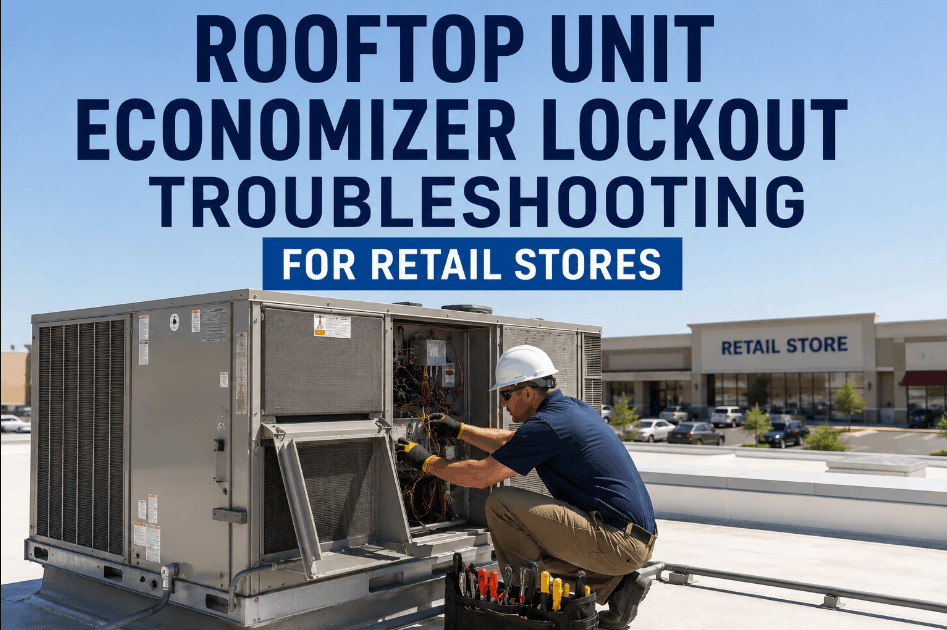
An economizer lockout on a retail rooftop unit forces the compressor to run even when outdoor conditions could provide free cooling, quietly driving up energy costs without tripping any alarm a store manager would notice. Sensor faults, stuck dampers, and control logic conflicts are the most common causes, but troubleshooting them store by store without a record of past faults wastes technician time and delays the fix. Facilities teams that Sign Up Free on Oxmaint can log economizer fault codes against each rooftop unit, building a troubleshooting path based on what has actually gone wrong before rather than starting from scratch on every visit. Retail operations managing RTUs across several locations can Book a Demo to see how Oxmaint speeds up economizer fault resolution across a store portfolio.
Oxmaint connects fault codes, sensor readings, and damper inspection history to each RTU so technicians troubleshoot economizer lockouts with context, not guesswork.
What Triggers an Economizer Lockout on a Retail Rooftop Unit
Economizer lockouts are rarely random. They tend to follow a small number of root causes that repeat across a retail RTU fleet. Teams that Sign Up Free on Oxmaint can use these as the starting checklist for a faster diagnosis.
A failed or drifting outdoor air temperature sensor feeds incorrect data to the controller, causing it to lock out the economizer even on mild days.
A damper actuator that fails to reach full position triggers a position-verification fault, which most controllers handle by locking the economizer mode out entirely.
A miscalibrated mixed air sensor can report temperatures outside expected range, prompting the controller to disable economizer operation as a safety response.
Firmware updates or setpoint changes that were not fully synced across the controller can create conflicting logic that defaults to a locked-out state.
A fault that has been reset multiple times without resolution typically points to a hardware issue, not a software glitch that a reset alone can fix.
Loose or corroded connections at the damper actuator or sensor terminal can intermittently trigger lockouts that are difficult to reproduce during a quick inspection.
Economizer Lockout Troubleshooting Path: Symptom, Cause, and Fix
This reference helps a technician move from symptom to fix without retracing every possible cause on each visit. Retail teams without a structured fault log can Book a Demo to see how Oxmaint builds that path automatically from prior service history.
| Symptom | Likely Cause | Diagnostic Step | Recommended Fix | Priority |
|---|---|---|---|---|
| Compressor runs in mild weather | Outdoor sensor fault | Compare sensor reading to actual temp | Replace outdoor air sensor | Critical |
| Damper position fault code | Stuck or slow actuator | Manual actuator cycle test | Service or replace actuator | Critical |
| Same fault clears and returns | Underlying hardware issue | Review fault history on RTU | Root cause inspection work order | Critical |
| Mixed air reading inconsistent | Sensor drift or miscalibration | Sensor calibration check | Recalibrate or replace sensor | Important |
| Lockout after firmware update | Control logic conflict | Review controller setpoints | Resync control logic and setpoints | Important |
| Intermittent, hard to reproduce | Wiring or connection fault | Inspect terminal connections | Tighten or replace connections | Important |
Managing Economizer Faults Across a Multi-Store Retail RTU Fleet
A single retail chain may operate hundreds of rooftop units, and economizer faults that look unrelated store to store often share the same root cause across the fleet. Teams can Sign Up Free on Oxmaint and map every RTU to its store location with fault history attached from the start.
- Fault codes logged against each RTU with store context
- Mobile checklist for sensor, damper, and wiring checks
- Repeat fault patterns surfaced automatically across stores
- Work orders generated from confirmed diagnostic steps
- Technician findings recorded at the rooftop unit
- Portfolio dashboard shows lockout trends across the fleet
Why Faster Economizer Troubleshooting Matters for Retail Energy Costs
A locked-out economizer keeps the compressor running even when free cooling is available, and that cost adds up across a fleet of stores. Teams can Sign Up Free to start logging RTU fault history today.
Restoring economizer function reduces unnecessary compressor operation during mild outdoor conditions, cutting associated energy use.
A documented fault history lets technicians skip steps already ruled out, reducing time spent on-site per service call.
Addressing the confirmed root cause instead of resetting the fault reduces the number of return visits for the same RTU.
Oxmaint helps retail facilities teams log RTU fault history and build a troubleshooting record that speeds up every future service visit.
Economizer Lockout Troubleshooting for Retail RTUs — Common Questions
A faulty outdoor air sensor or a damper actuator that fails to reach full position are the two most frequent causes seen in retail RTUs.
Yes, but the lockout typically returns. A recurring fault code is a strong signal that the root cause has not actually been resolved.
Oxmaint logs fault codes and diagnostic steps against each RTU, giving technicians a documented history to work from on every visit.
Yes. A portfolio dashboard shows economizer fault trends and RTU status across every store location in one view.
It can. Forcing the compressor to run continuously may strain capacity during peak demand, increasing the risk of comfort issues on the sales floor.
Oxmaint gives retail facilities teams a structured way to log, diagnose, and resolve economizer lockouts faster across every location.

-not-cooling-18-common-causes,-diagnostics-&-troubleshooting-guide.png)