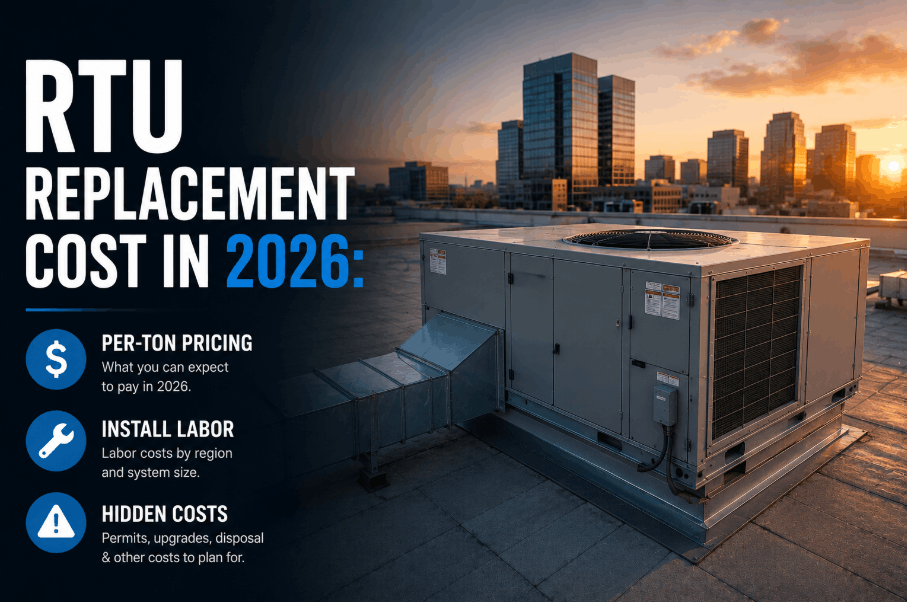
Replacing a rooftop unit in 2026 is one of the largest unplanned capital expenses a facility manager can face — with total project costs ranging from $8,000 for a small packaged unit to over $60,000 for a large commercial RTU installation. Understanding RTU replacement cost by tonnage, labor variables, and the hidden line items that inflate budgets is essential for accurate CapEx planning. Sign Up Free to connect your HVAC asset records, replacement schedules, and cost tracking into a single live maintenance platform with OxMaint.
Plan RTU Replacements Before They Become Emergencies
OxMaint tracks HVAC asset age, service history, and failure patterns — so your team sees RTU replacement need coming months in advance, not days before failure.
RTU Replacement Cost by Tonnage: 2026 Price Ranges
Scroll →
| Unit Size | Typical Application | Equipment Cost | Installation Labor | Total Installed Cost | Lifecycle (Years) |
|---|---|---|---|---|---|
| 2–3 Ton | Small retail, office suites | $3,500–$6,000 | $2,500–$4,000 | $6,000–$10,000 | 15–20 |
| 4–5 Ton | Mid-size commercial space | $5,500–$9,000 | $3,500–$5,500 | $9,000–$14,500 | 15–20 |
| 7.5–10 Ton | Restaurants, light industrial | $9,000–$16,000 | $5,000–$8,000 | $14,000–$24,000 | 15–18 |
| 15–20 Ton | Big-box retail, warehouses | $16,000–$28,000 | $8,000–$13,000 | $24,000–$41,000 | 12–18 |
| 25–30 Ton | Large commercial, manufacturing | $26,000–$42,000 | $12,000–$20,000 | $38,000–$62,000 | 12–16 |
What Drives RTU Installation Labor Costs
Crane and Rigging Requirements
Units above 10 tons almost always require crane mobilization — adding $1,500 to $4,500 to your project cost depending on roof height and site access.
Curb Adapter or New Curb
If the replacement RTU footprint doesn't match the existing curb, a custom adapter or full curb replacement adds $800–$3,000 in materials and labor.
Electrical Upgrades
Newer high-efficiency RTUs often require electrical panel upgrades or new disconnect runs — a common hidden cost ranging from $500 to $3,500.
Ductwork Modification
Differing supply and return configurations between old and new units can require duct modifications — adding $600–$2,500 depending on complexity.
Controls and BAS Integration
Modern RTUs with variable speed drives or BMS compatibility may require controls reprogramming — budgeting $500–$2,000 for integration work is prudent.
Refrigerant Recovery and Disposal
R-22 recovery and certified refrigerant disposal on older units adds $300–$900 — a regulatory cost that surprises many first-time replacement buyers.
Hidden RTU Replacement Costs Most Budgets Miss
Cost 01
Emergency Premium
Reactive replacements outside business hours carry 20–40% labor surcharges. Planned replacements eliminate emergency premiums entirely.
Cost 02
Lead Time Downtime
Equipment lead times of 4–12 weeks without a tracked replacement plan translate directly into tenant complaints, productivity loss, or lease exposure.
Cost 03
Roof Penetration Repair
Removing old curb flashing and re-sealing roof penetrations adds $400–$1,200 — a cost often excluded from HVAC contractor quotes.
Cost 04
Permit and Inspection Fees
Commercial HVAC permits in most jurisdictions run $150–$600. In dense urban markets, mechanical permit fees can reach $1,200 or more.
Cost 05
Temporary Cooling Rental
Portable spot cooler or temporary chiller rental during replacement periods runs $500–$2,500 per week depending on load size and duration.
RTU Replacement vs. Repair: When to Replace
Repair Makes Sense
Unit is under 10 years old with documented service history
Single component failure — compressor, economizer, or motor
Repair cost is less than 30% of replacement cost
Unit is running within 85%+ of rated efficiency
No refrigerant phase-out compliance pressure
Replacement lead time would cause unacceptable downtime
VS
Replace Now
Unit is 15+ years old with recurring failure history
Multiple system failures within 12–18 months
Repair cost exceeds 40–50% of a new unit installed
Running R-22 refrigerant with costly recharge exposure
SEER rating significantly below current code requirements
Energy cost differential justifies accelerated payback period
How CMMS Reduces Total RTU Lifecycle Cost
1
Asset Age Tracking
Proactive Planning
OxMaint tracks installation date, warranty status, and remaining useful life for every RTU — so replacement triggers are planned, not reactive. Sign Up Free to start tracking today.
2
PM Compliance History
Failure Prevention
Documented filter changes, coil cleanings, and belt replacements extend RTU life by 20–35% — and OxMaint automates every scheduled task and tracks completion.
3
Repair Cost Accumulation
Replace/Repair Decision
OxMaint aggregates all work order costs per asset — giving facility managers real data to make the replace-vs-repair call before the next emergency strikes. Book a Demo to see how.
4
CapEx Forecasting
Budget Confidence
With asset age, failure history, and replacement cost data in one platform, OxMaint enables accurate 3–5 year HVAC CapEx forecasts for finance and facilities leadership.
RTU Replacement ROI: What the Numbers Look Like
25–40%
Energy savings replacing a 15+ year old RTU with a current high-efficiency unit at the same tonnage
3–6 yrs
Typical energy-cost payback period on planned RTU replacements when utility incentives and rebates are applied
20–35%
RTU lifecycle extension achievable through structured preventive maintenance tracked and scheduled in a CMMS
$4,200+
Average emergency HVAC premium cost avoided per incident when replacements are planned rather than reactive
Stop Budgeting RTU Replacements in the Dark
OxMaint gives facilities teams a live view of every HVAC asset's age, service cost, and replacement timeline — so CapEx decisions are driven by data, not guesswork. Book a Demo to see HVAC asset lifecycle planning in action, or Sign Up Free and connect your RTU records to OxMaint today.
Frequently Asked Questions
What is the average RTU replacement cost per ton in 2026?
Installed RTU costs range from $2,800–$3,500 per ton for smaller units and $1,800–$2,500 per ton for larger commercial units, with crane, electrical, and curb costs added on top.
How long does a commercial rooftop unit last?
A well-maintained commercial RTU typically lasts 15–20 years. Units with poor PM history often fail at 10–12 years, significantly accelerating replacement CapEx timelines.
What is the most common hidden cost in RTU replacement projects?
Crane mobilization, curb adapters, and electrical upgrades are the three most commonly missed line items — collectively adding $3,000–$8,000 to a project beyond the base equipment quote.
How does a CMMS help reduce RTU replacement costs?
A CMMS like OxMaint tracks PM compliance, repair cost accumulation, and asset age — enabling planned replacements that avoid emergency premiums and provide accurate CapEx forecasts.
Can OxMaint help manage commercial HVAC replacement scheduling?
Yes. OxMaint links HVAC asset records to PM schedules, work order cost history, and replacement planning workflows — giving facility managers the data needed to plan RTU replacements proactively.
Are utility rebates available for commercial RTU replacements in 2026?
Most utility providers offer commercial HVAC rebates of $50–$200 per ton for high-efficiency replacements. Federal tax incentives under Section 179D may also apply to qualifying commercial buildings.
Free to Start — No Credit Card Required
From RTU Asset Tracking to CapEx Planning — In One Platform
OxMaint connects commercial HVAC asset records, PM schedules, and repair cost history into a live replacement planning workflow — so every RTU decision is backed by real data.