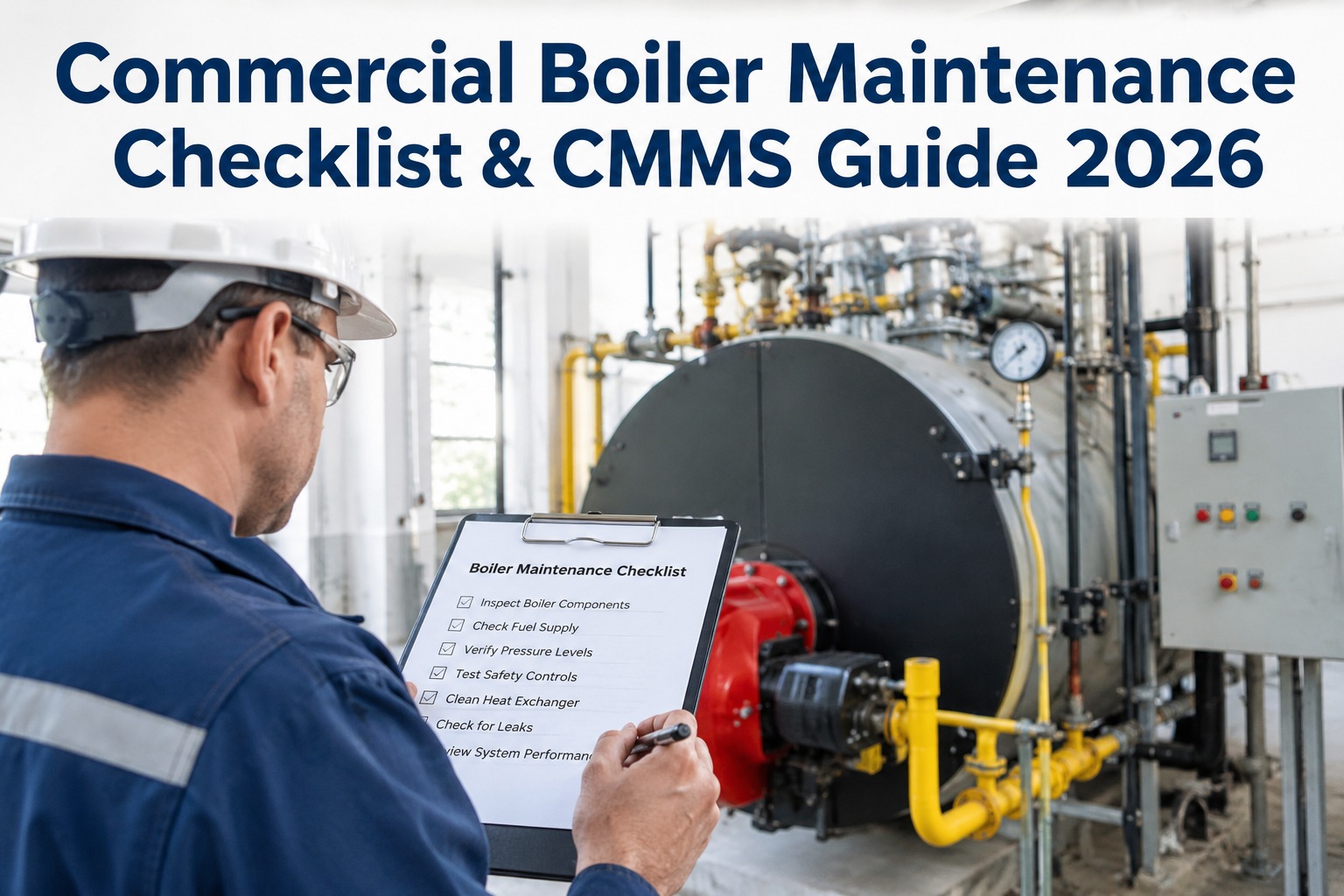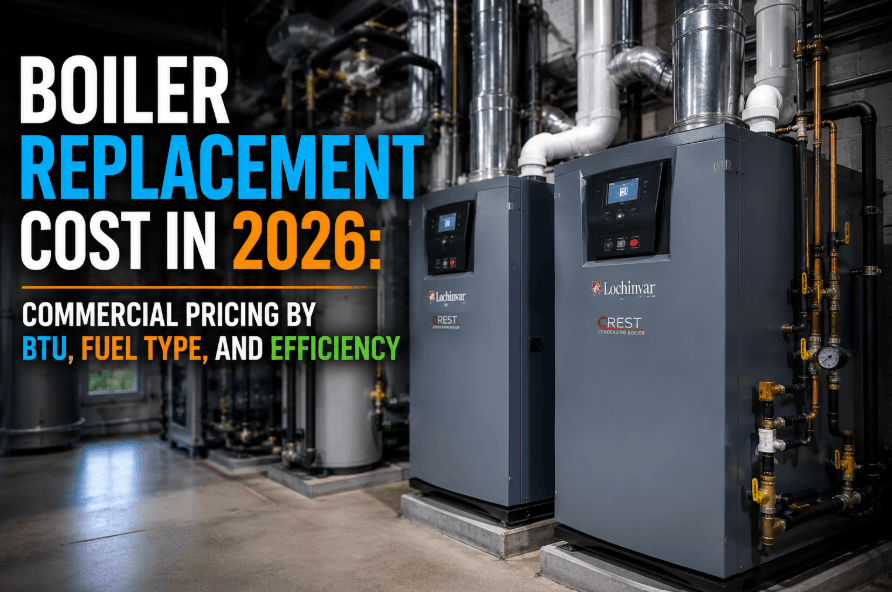
Commercial boiler replacement is one of the largest capital expenditures in facility management. Understanding boiler replacement cost in 2026 requires more than a single equipment quote — it depends on BTU capacity, fuel type, efficiency tier, system configuration, and installation scope. Sign Up Free to track your boiler's lifecycle cost and plan capital replacement inside OxMaint CMMS.
TOP CTA BANNERPlan Boiler Replacement with OxMaint CMMS
Track boiler asset health, calculate remaining useful life, and build capital replacement plans before equipment fails.
What Drives Commercial Boiler Replacement Cost in 2026
Five variables determine cost: BTU capacity, fuel type, efficiency tier, system configuration, and installation scope. Labor, permits, and rebates can shift the total by 20–40%. Book a Demo to centralize boiler lifecycle data for capital planning.
BTU Capacity & System Size
Cost scales directly with output. A 300K BTU/hr unit runs $4K–$12K in equipment; a 2M BTU/hr unit can exceed $60K. Oversizing wastes capital; undersizing shortens equipment life.
Fuel Type & Infrastructure
Natural gas is the lowest-cost option. Oil-fired units add $2K–$8K in tank and burner costs. Switching fuel types mid-replacement adds $5K–$25K in piping and utility connection work.
Efficiency Tier
Condensing units (90–98% AFUE) cost 30–50% more upfront than standard (80–84% AFUE) but typically pay back in 3–5 years via fuel savings in facilities with 3,000+ heating hours annually.
System Configuration
Hot water hydronic systems are simplest to replace. Steam systems add $5K–$20K for traps, condensate lines, and pressure controls. Combination units reduce total equipment count long-term.
Installation Scope
Like-for-like swaps in accessible rooms cost $3K–$8K in labor. New venting, gas line upgrades, BAS integration, or crane lifts can double or triple that figure.
Removal, Disposal & Permits
Demo and removal adds $1.5K–$6K. Permits run $500–$3.5K. Utility and IRA rebates of $2K–$15K are available for high-efficiency upgrades in qualifying facilities.
2026 Commercial Boiler Replacement Cost by BTU Capacity
Equipment cost is the most predictable budget component. Installed cost typically runs 1.8–2.5x the equipment-only price. Sign Up Free to log replacement cost estimates inside OxMaint for capital planning.
Commercial Boiler Cost by Fuel Type (2026)
Fuel type affects both upfront and 20-year ownership cost. Benchmarks below are for a 500K BTU/hr unit at 3,000 annual heating hours. Book a Demo to model lifecycle costs across fuel types in OxMaint.
*Based on 500K BTU/hr unit at 3,000 heating hours/year. Actual costs vary by local fuel rates and system design.
SECTION: EFFICIENCY TIERSStandard vs. Condensing Boilers: Cost & Efficiency
The efficiency tier decision is the most financially impactful variable in replacement planning. Sign Up Free to model condensing vs. standard ROI using your actual energy data in OxMaint.
Build Your Boiler Capital Replacement Plan in OxMaint
Track boiler age, maintenance history, and replacement cost benchmarks to justify capital budgets before equipment fails.
How to Calculate Commercial Boiler Replacement ROI
A complete capital justification models energy savings, avoided emergency repair cost, and residual asset value over the replacement unit's full service life.
Establish Current Operating Cost
Pull 12–24 months of fuel and maintenance spend. Separate planned PM from reactive repairs — reactive spend is the strongest signal of imminent replacement need.
Model Energy Savings
Calculate annual BTU consumption, then apply the efficiency improvement percentage to project fuel savings. Multiply by 20 years to compare lifetime savings against replacement cost.
Quantify Failure Avoidance Value
For boilers past 15–20 years, calculate the cost of an emergency mid-winter failure: service premiums, temporary heat rental, and occupancy disruption. This often exceeds planned replacement cost by 40–80%.
Net Against Available Incentives
In 2026, qualifying replacements may stack utility rebates ($2K–$15K), IRA Section 179D deductions, and accelerated depreciation. Confirm available incentives with your utility and a tax advisor.
Boiler Replacement Cost by Facility Type (2026 Benchmarks)
Total installed cost varies significantly by facility type. Benchmarks below reflect 2026 national averages for a primary boiler replacement. Book a Demo to compare your budget against OxMaint's asset cost reference database.
5 Signs Your Commercial Boiler Needs Replacement
Most boiler failures gave clear warning signs 12–36 months before the event. Tracking asset condition in a CMMS converts emergency replacements into planned procurements with competitive bidding and rebate lead time.
Age Beyond 20 Years With Increasing Repairs
Units past 20 years with two or more major repairs in the last 24 months are entering the steep failure curve of their lifecycle. Further repair investment typically yields diminishing returns against the cost of a new 25-year asset.
Annual Repairs Exceeding 25–30% of Replacement Value
This is the standard facilities benchmark: when annual repair spend crosses 25–30% of replacement cost, continued ownership is rarely optimal. For a $60K boiler, that means $15K–$18K/year is the trigger — regardless of age.
Heat Exchanger Cracking or Flue Gas Leakage
A cracked heat exchanger allows combustion gases (including CO) into occupied spaces. This is an end-of-life finding in most configurations — the economics and safety risk consistently favor full unit replacement over heat exchanger repair.
Significant Efficiency Degradation
A boiler running 10–15 points below nameplate AFUE wastes $5K–$20K/year in unnecessary fuel at commercial scale. Combined with rebates and the condensing premium, measurable efficiency loss frequently produces replacement ROI above most facility hurdle rates.
Parts Obsolescence
When OEM parts require 4–6 week lead times from specialty suppliers, the asset is effectively at end of serviceability. A mid-winter failure on a parts-obsolete unit forces emergency procurement at uncompetitive pricing with zero scheduling flexibility.
Boiler Replacement Planning: With vs. Without a CMMS
The gap between a planned replacement at budgeted cost and an emergency replacement at 1.5–2x cost is almost always a data gap. Book a Demo to see OxMaint's boiler asset management features in action.
- Asset history scattered across spreadsheets and paper logs
- No visibility into cumulative repair spend vs. replacement threshold
- Replacements triggered by failure, not lifecycle data
- Capital requests lack documentation to win finance approval
- Utility rebate windows and planned procurement timing missed
- Full asset record: install date, nameplate data, parts spend, service history
- Automated alert when repair cost crosses 25–30% of asset value
- Multi-year capital planning dashboard with replacement prioritization
- Board-ready lifecycle cost reports to justify replacement investment
- PM scheduling that extends life and supports rebate applications
Frequently Asked Questions: Commercial Boiler Replacement Cost 2026
How much does it cost to replace a commercial boiler in 2026?
Total installed cost ranges from ~$18,000 for small units (under 300K BTU/hr) to $350,000+ for large central plant systems. Mid-range replacements (300K–1.5M BTU/hr) most commonly fall between $28,000 and $120,000 installed.
Is a condensing boiler worth the extra cost?
For most facilities with 2,500+ annual heating hours, yes. The 30–50% equipment premium is typically recovered in 3–7 years through 15–30% fuel savings. Utility rebates of $2K–$15K further shorten payback.
What is the labor cost to install a commercial boiler?
Like-for-like replacements in accessible mechanical rooms run $3K–$8K in labor. Installations needing new venting, gas line upgrades, or crane lifts commonly run $8K–$25K. Labor represents roughly 30–45% of total project cost.
When should replacement be planned?
Begin capital planning at the 15-year mark. Target a planned replacement before 22–25 years of age to avoid the emergency replacement premium of 40–80% over planned procurement cost.
What utility rebates are available in 2026?
Condensing boiler replacements commonly qualify for $2K–$15K in utility rebates, plus IRA Section 179D deductions for qualifying commercial buildings. Contact your local utility's commercial programs desk to confirm current availability.
How does a CMMS help with boiler replacement planning?
A CMMS like OxMaint tracks install date, cumulative repair spend, and PM history. When repairs approach the 25–30% replacement cost threshold, it flags the asset — turning a reactive failure into a planned procurement with lead time for bidding and rebate applications.
What's the difference between repair cost and replacement cost?
Repair cost covers a specific failure ($800–$12K per incident). Replacement covers the full project: new unit, removal, materials, labor, venting, and controls. Replace when annual repair spend exceeds 25–30% of replacement value, or a single repair exceeds 50% of value on a unit past 15 years.
Stop Planning Boiler Replacement Without Asset Data
OxMaint gives facilities teams the lifecycle tracking, maintenance history, and capital planning tools to replace on schedule — not in a crisis.