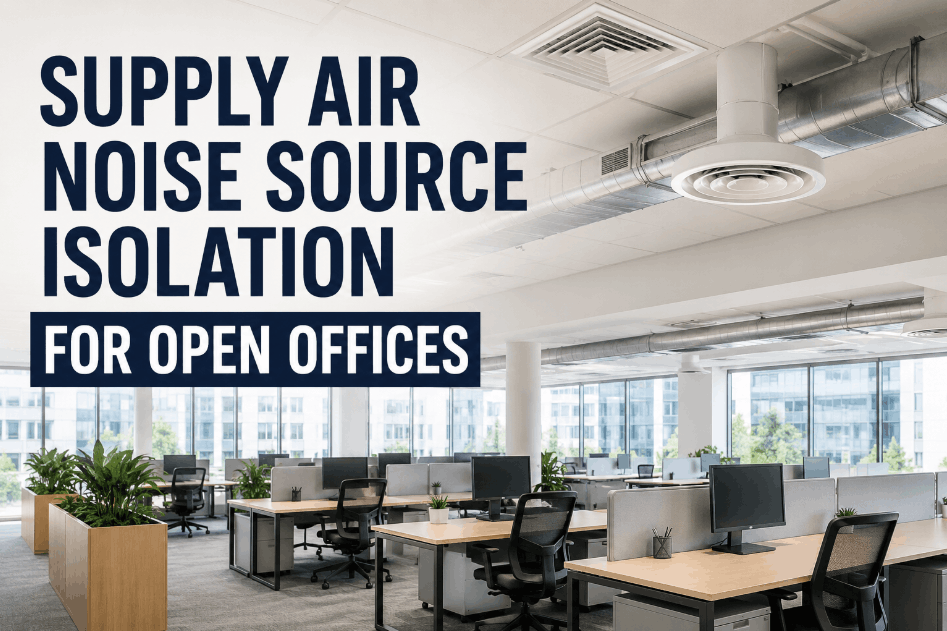
An open office that tests fine on airflow volume can still draw noise complaints if the actual source of the sound, whether it's a diffuser, a duct transition, or fan speed, never gets isolated from the rest of the system. Sign Up Free on Oxmaint to start logging acoustic complaints against the specific HVAC asset behind them, or Book a Demo to see how inspection checklists help facility teams trace supply air noise to its real source instead of treating the whole zone as the problem.
Why Supply Air Noise Is Hard to Isolate in Open Offices
Open-plan layouts amplify and carry sound in ways that make a noise complaint hard to trace back to a single piece of equipment. Book a Demo to see how Oxmaint helps teams document noise complaints by zone and link them to the asset most likely responsible.
Core Sources of Supply Air Noise
Supply air noise almost always traces back to one of a small set of mechanical causes rather than the system as a whole. Sign Up Free on Oxmaint to begin checking these sources systematically instead of guessing at the cause.
Diffuser Velocity & Throw
Air moving through a diffuser faster than its rated throw velocity generates audible turbulence at the outlet.
Duct Turbulence & Fitting Transitions
Sharp transitions, undersized ducts, or poorly sealed joints create turbulent flow noise that travels through the system.
Fan Speed & VFD Settings
Fan speeds set higher than zone demand requires can push noise output well above comfortable levels.
Structure-Borne Vibration Transfer
Vibration from fan or motor units can transmit through ductwork and building structure rather than through the air itself.
Balancing Damper Position
A damper stuck partially closed forces air through a smaller opening, raising velocity noise at that point.
Noise Source Review Priority by Zone Type
Acoustic sensitivity isn't the same across every part of an open office, so review priority should follow how the space is actually used. Book a Demo to see how Oxmaint applies zone-specific review priority across a facility's open-plan layout.
| Zone Type | Acoustic Sensitivity | Common Noise Source | Review Frequency | Oxmaint Management Lever |
|---|---|---|---|---|
| Focus / Quiet Work Zones | High | Diffuser velocity | Quarterly | Zone-specific inspection checklist |
| General Open-Plan Desking | Moderate | Duct turbulence | Semi-annual | Recurring PM tied to zone asset |
| Phone Booths & Huddle Rooms | High | Fan speed near supply run | Quarterly | Asset-linked complaint history |
| Collaboration / Lounge Areas | Low-Moderate | Balancing damper position | Annual | Routine round inspection |
| Perimeter Zones Near Mechanical Rooms | High | Structure-borne vibration | Quarterly | Vibration check linked to fan asset |
What Unisolated Noise Sources Cost Facility Teams
A noise complaint that never gets traced to its real source tends to come back, often louder, after a temporary fix. Sign Up Free to connect complaint history to the specific asset causing the noise before it becomes a recurring ticket.
Running a Noise Source Isolation Program with Oxmaint
Isolating supply air noise reliably takes a consistent way to log complaints, inspect the likely sources, and track what actually fixed the problem. Book a Demo to walk through how Oxmaint structures this across your open-plan zones.
Log Noise Complaints Against the Specific Zone Asset
Tie each complaint in Oxmaint to the diffuser, duct run, or fan unit serving that zone.
Standardize Inspection Checklists for Common Sources
Use digital checklists to check diffuser velocity, damper position, and fan speed consistently.
Convert Confirmed Sources Into Tracked Work Orders
Turn a confirmed root cause directly into a work order instead of a standalone note.
Track Recurrence by Zone Over Time
Compare complaint history by zone to see whether a fix actually resolved the source.
Maintain Asset History for Repeat Vendor Visits
Keep diagnostic and repair history attached to the asset so any technician can pick up where the last visit left off.
Frequently Asked Questions: Supply Air Noise Source Isolation
What causes supply air noise in open offices?
Common causes include diffuser velocity, duct turbulence, fan speed settings, and damper position rather than the HVAC system as a whole.
How can facility teams isolate the real source of HVAC noise?
Checking diffuser throw velocity, damper position, and duct transitions against complaint location helps narrow down the specific source.
How often should noise-related zones be reviewed?
High-sensitivity zones like focus areas and phone booths typically benefit from quarterly checks, while lower-sensitivity zones can run less frequently.
How does Oxmaint help track recurring noise complaints?
Oxmaint logs each complaint against the relevant zone and asset, making it possible to see if a noise issue keeps recurring after a fix.
Can fan speed adjustments alone solve open-office noise issues?
Fan speed is one factor, but diffuser condition, damper position, and duct transitions often need to be checked together for a lasting fix.


-troubleshooting-low-airflow,-strange-noises-&-coil-issues-guide.png)