Variable Refrigerant Flow and Variable Refrigerant Volume systems are among the most energy-efficient HVAC technologies available — and among the most complex to maintain. Unlike traditional split or central systems, VRF/VRV networks involve dozens of indoor units connected to shared outdoor condensers through a web of refrigerant piping, requiring precise charge balance, controller synchronization, and leak management that standard HVAC checklists simply do not cover. Facilities that manage VRF systems without a structured digital maintenance program lose up to 30% of system efficiency within two years and face refrigerant-related repair bills that dwarf the original installation cost. This checklist — aligned with Daikin, Mitsubishi, and Fujitsu OEM requirements — gives your team a complete VRF/VRV maintenance framework, and OxMaint's AI monitoring platform automates every task, alert, and compliance log at scale.
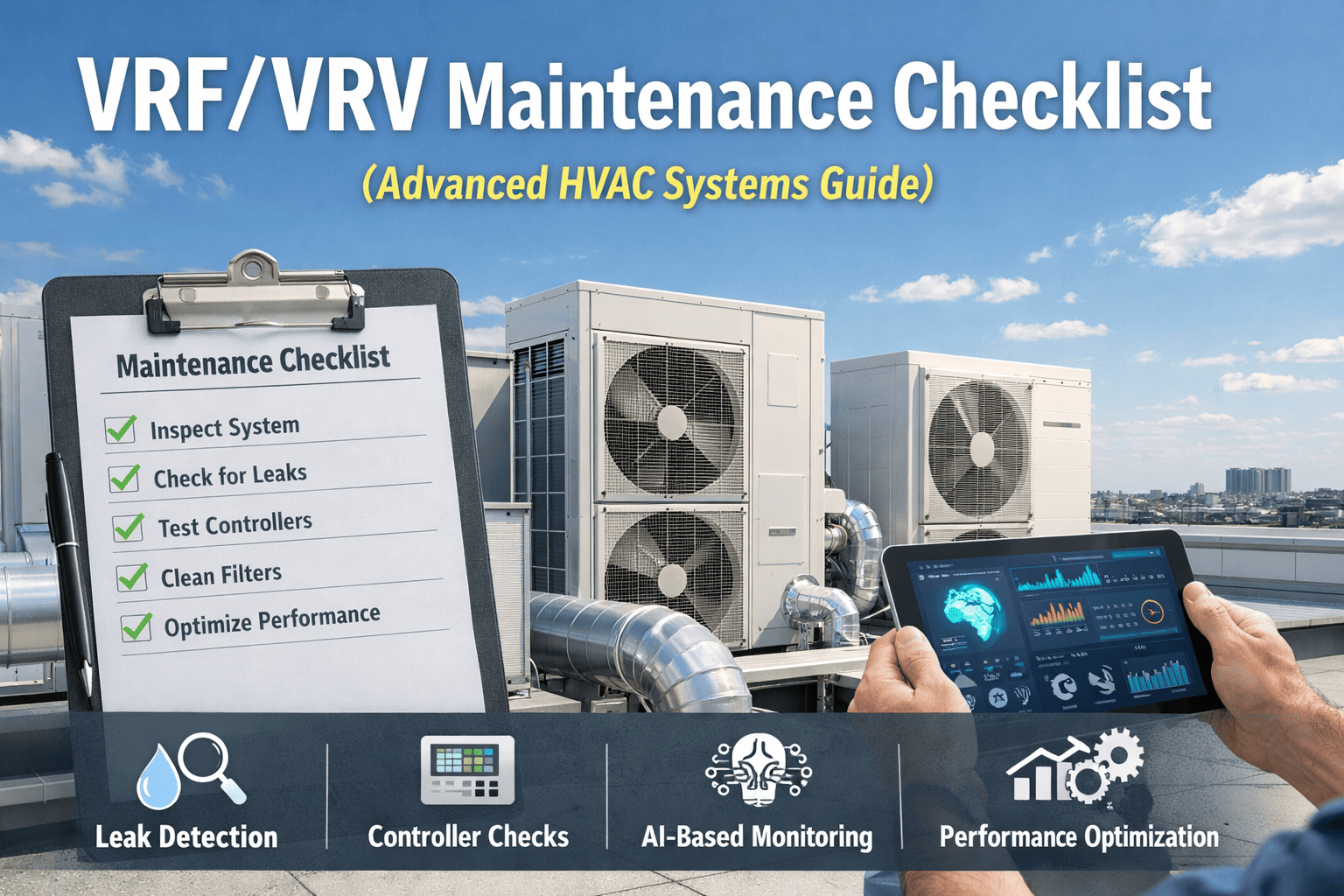
VRF/VRV Maintenance Checklist — Advanced HVAC Systems Guide
Complete inspection, leak detection, controller calibration, and performance optimization protocols for Variable Refrigerant Flow systems — from monthly field checks to annual refrigerant audits.
What Makes VRF Maintenance Different
VRF systems distribute refrigerant directly to each indoor unit through variable-speed compressors that modulate output in real time. This architecture delivers precision comfort and energy efficiency, but it means refrigerant integrity, oil distribution, and controller network health are maintenance-critical in ways that packaged systems are not. A single stuck branch controller valve silently starves entire zones while the system appears operational.
Houses compressor(s), inverter drive, and refrigerant controls. Requires vibration monitoring, coil cleaning, and compressor oil circuit checks unavailable on standard rooftop units.
Distribute refrigerant to indoor unit groups. Valve position accuracy and firmware must be verified — a stuck valve silently starves entire zones without triggering obvious alarms.
Each unit has its own expansion valve, thermistor array, and drain pan. With 20–60 units per system, systematic digital checklists are the only way to catch drift in individual units.
Copper piping with brazed joints spanning multiple floors. Even a 10% refrigerant undercharge reduces capacity 20–30%. Annual leak testing with electronic detectors is non-negotiable.
Monthly Inspection Checklist
Monthly VRF maintenance focuses on operational performance data — catching drift in refrigerant temperatures, airflow rates, and controller readings before they compound into system-wide faults. All readings should be entered digitally at point-of-work for trending analysis.
- Log discharge and suction pressure (all circuits)
- Record compressor operating current vs. nameplate
- Inspect condenser coil — clear debris and fouling
- Check inverter drive fan — verify no error codes
- Inspect refrigerant sight glass — no bubbles at full load
- Record ambient temp vs. rated capacity curve
- Record supply air temp and delta-T vs. setpoint
- Inspect and clean air filters — log static pressure drop
- Check drain pan — clear blockages, verify slope
- Inspect expansion valve — no ice formation
- Verify remote controller display and error code status
- Test auto-restart after simulated power interruption
- Verify all indoor units visible on central controller
- Check active and historic fault codes — log all
- Confirm BMS integration points are communicating
- Verify refrigerant leak detector alarm functionality
- Review energy monitoring trends — flag anomalies
- Confirm setpoint schedules are correct and active
Refrigerant Management & Leak Detection Protocol
Refrigerant management is the highest-stakes maintenance activity in any VRF system. EPA Section 608 regulations require documented leak inspection records for systems with charges above 50 lbs, and modern refrigerants carry significant GWP implications under evolving regulations. Every addition event must be logged with cylinder weights and technician certification.
| Leak Detection Task | Frequency | Regulatory Basis | Documentation Required |
|---|---|---|---|
| Electronic leak detector survey | Annually + after any repair | EPA 608 / ASHRAE 15 | Leak test report + technician cert |
| Refrigerant charge verification (weighing) | Annually | OEM requirement | Charge log vs. nameplate spec |
| Oil acid test (compressor oil sample) | Annually | OEM requirement | Lab report + corrective action |
| Fixed leak detector sensor calibration | Annually | ASHRAE 15 | Calibration certificate on file |
| Refrigerant addition log | Every addition event | EPA 608 mandatory | Cylinder weight in/out + technician |
| High-leak-rate system audit | If annual leak >125 lbs | EPA Section 608 | Leak repair verification within 30 days |
OxMaint's IoT integration connects to VRF system data streams — logging pressures, temperatures, and fault codes automatically. Your team gets predictive alerts before refrigerant loss or controller failure takes a zone offline.
Annual Performance Optimization Checklist
Annual VRF maintenance requires a system-level performance review comparing current operating data against commissioning baselines — best performed by a factory-certified technician using manufacturer diagnostic software.
- Full system pressurization test (nitrogen) for leak verification
- Refrigerant circuit rebalance — verify all branch circuits
- Compressor oil analysis and top-up if required
- Filter drier replacement if moisture is indicated
- Inverter drive inspection and firmware update
- All terminal connections — torque to OEM spec
- Controller address verification — all IDUs confirmed
- BMS integration point audit and recalibration
- COP measurement vs. rated performance at commissioning
- Heating/cooling capacity test under peak conditions
- Energy consumption comparison to prior year baseline
- Full system diagnostic run using OEM software
"VRF systems are the most maintenance-sensitive HVAC technology in commercial buildings today. The gap between a well-maintained and poorly maintained VRF system is not just efficiency — it is 5–8 years of compressor life. The facilities getting the most from their VRF investment all share one practice: they log operational data at every visit and trend it over time. Without trending, you are always reacting. With it, you predict problems 3–4 months before they occur."
— VRF Systems Specialist, Certified by Daikin and Mitsubishi Electric — 15 years in commercial HVAC commissioning
Per AHRI research, VRF systems operating with even a 10% refrigerant undercharge experience a 20–30% increase in compressor cycling frequency — directly accelerating wear and shortening equipment life below OEM projections.
Manage Your VRF Fleet With Precision — Not Guesswork
OxMaint's AI monitoring platform connects to your VRF systems, auto-logs operational data, and generates predictive alerts before faults escalate. Every checklist item becomes a scheduled digital work order — completed on mobile, signed by the technician, and filed automatically. Book a 30-minute demo to see VRF-specific monitoring live.