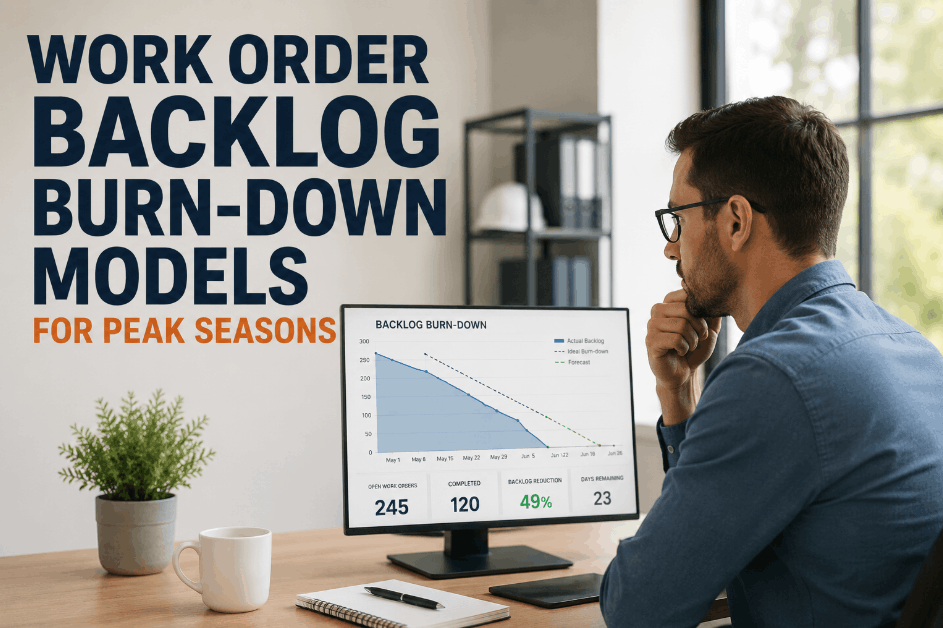
Work order backlog burn-down models help maintenance and operations teams forecast the labor and scheduling capacity needed to clear accumulated work orders before peak season demand arrives — preventing service backlogs from compounding when facility load is highest. Most maintenance teams enter peak periods without a structured view of their backlog depth, which asset categories are most overdue, or how many technician-hours are required to reduce the queue to a manageable level. Sign Up Free to start capturing your work order backlog data inside Oxmaint AI and build the burn-down model your operations team needs heading into peak season. Oxmaint centralizes work order history, technician capacity, and asset priority data into a planning view that supports backlog reduction before demand spikes. Book a Demo to see how Oxmaint supports backlog burn-down planning for peak-season maintenance operations.
Clear Your Maintenance Backlog Before Peak Season Arrives — Not During It
Oxmaint AI tracks work order backlog depth, labor capacity, and asset priority across your facility — so teams can model a burn-down plan that clears the right work before peak demand makes it impossible.
Gap #1
Backlog Depth Not Quantified
Most teams do not maintain a real-time count of open work orders by age, asset category, or priority — making it impossible to model how long a burn-down will actually take.
Gap #2
Labor Capacity Not Mapped to Backlog
Without a clear picture of available technician hours versus outstanding work order volume, planning a realistic burn-down schedule before peak season is guesswork.
Gap #3
Priority Ranking Not Applied
Backlog items are often addressed in the order they were opened rather than by the asset criticality or safety risk they represent during high-demand periods.
Gap #4
Peak Season Demand Not Forecasted
Teams enter peak periods without a load forecast, so new work orders created during peak overlap with uncleared backlog — accelerating service delivery failures.
Gap #5
No Burn-Down Progress Visibility
Without a tracking mechanism, managers cannot see whether the team is reducing backlog at the rate needed to be ready before peak season demand arrives.
Gap #6
Contractor Needs Identified Too Late
When external labor is needed to supplement the burn-down plan, the decision is often made after peak season has already started rather than weeks before it.
01
Backlog Inventory Capture
Oxmaint pulls all open work orders into a centralized view, categorized by asset, age, priority, and estimated labor hours needed for completion.
→
02
Labor Capacity Assessment
Available technician hours are mapped against the outstanding work order volume to calculate realistic daily and weekly burn-down rates for each trade.
→
03
Priority-Based Scheduling
Oxmaint ranks backlog items by asset criticality and safety risk, ensuring the most consequential work is scheduled earliest in the burn-down window.
→
04
Burn-Down Progress Tracking
Progress against the burn-down plan is tracked in real time, with variance flagged early enough to add capacity or adjust the schedule before peak demand arrives.
Backlog Data Layer
Open work orders logged with age, asset, and trade category
Estimated hours per work order recorded for capacity planning
Backlog depth tracked as a rolling count updated in real time
Labor Capacity
Available technician hours mapped by trade and schedule window
Burn-down rate calculated from capacity vs outstanding volume
Contractor need flagged when internal capacity is insufficient
Priority Analytics
Asset criticality score applied to each backlog work order
Safety and compliance risk items flagged for earliest scheduling
Backlog segmented by urgency tier for planning visibility
Operational Outcome
Backlog cleared to target level before peak season demand spikes
Labor decisions made weeks ahead of peak rather than during it
Service delivery protected at highest-demand periods of the year
94%
Prediction accuracy reported by teams using Oxmaint AI predictive models on connected asset data
62%
Less unplanned downtime among facilities managing work order backlog with Oxmaint before peak seasons
48hrs
Typical time from first login to a live backlog burn-down view in Oxmaint
1season
Time needed to build a reliable backlog and capacity baseline for peak-season modeling
Standard CMMS — Reactive Backlog Management
Open work orders tracked individually with no aggregate backlog depth view by age or priority
Labor capacity not mapped against outstanding volume, so burn-down timelines are not modeled
Work order priority determined by opening date rather than asset criticality or peak risk
Contractor needs identified only once peak season has already created a service delivery gap
No progress tracking against a burn-down target — managers check status manually
Peak season demand not forecasted, so backlog and new work orders compete for the same capacity
Oxmaint AI — Forecast-Driven Burn-Down Planning
Backlog depth quantified in real time by age, asset, priority, and estimated hours — Sign Up Free
Labor capacity mapped to backlog volume with a calculated daily burn-down rate per trade
Asset criticality scoring prioritizes which backlog items are scheduled first heading into peak
Contractor need flagged automatically when internal capacity cannot meet the burn-down timeline
Burn-down progress tracked against plan with variance surfaced before peak season begins
Peak demand forecast keeps new work order volume visible alongside the existing backlog
These KPIs give maintenance managers measurable evidence of backlog reduction speed, labor efficiency, and readiness heading into peak demand periods. Book a Demo to see Oxmaint track all six automatically.
KPI 01
Breakdown of open work orders by how long they have been outstanding. Aging backlog items in critical asset categories represent the highest risk entering peak season.
Backlog Health
KPI 02
Number of work orders closed per technician per day against the target needed to reach the burn-down goal before peak season starts. Variance flags when capacity adjustments are needed.
Closure Velocity
KPI 03
Percentage of high-criticality backlog items closed before peak season begins. Ensures the burn-down plan is addressing risk-weighted work rather than simply reducing volume.
Risk Reduction
KPI 04
Comparison of available technician hours against total estimated hours needed to clear the backlog by the target date. Gap quantifies the supplemental labor requirement.
Capacity Gap
KPI 05
Volume of new work orders added to the queue during the burn-down window. High intake rate offsets closure progress and signals whether the burn-down plan needs to be accelerated.
Queue Pressure
KPI 06
Total open work orders at the start of peak season compared to the target set during burn-down planning. The primary indicator of whether the team entered peak season prepared.
Readiness Score
Facility Management
Facility managers use Oxmaint to model a work order burn-down plan before cooling season, ensuring HVAC, electrical, and plumbing backlogs are cleared before heat-related demand spikes. Sign Up Free for your portfolio.
Hospitality
Hotel maintenance teams use Oxmaint to clear outstanding work orders before high-occupancy seasons, protecting guest experience when staffing pressure is highest. Book a Demo for your properties.
Manufacturing
Plant maintenance teams use Oxmaint to burn down work order backlogs before scheduled production increases, minimizing the risk of equipment failures during high-output periods.
Healthcare
Healthcare facilities use Oxmaint to track and prioritize compliance-related work order backlogs, ensuring regulatory maintenance is cleared before inspection windows open.
Model Your Backlog Burn-Down Before Peak Season Makes It Too Late
Oxmaint AI gives maintenance teams the backlog depth, labor capacity, and priority data they need to plan a realistic work order burn-down — well ahead of the peak demand window. Book a Demo to see how.
It is a structured plan that calculates how many work orders need to be closed per day — based on backlog depth and available labor — to reach a target backlog level before peak season demand arrives.
Oxmaint aggregates open work orders by age, asset, and priority, then maps them against available technician capacity to calculate a realistic daily closure rate and identify when supplemental labor is needed.
Yes. Oxmaint applies asset criticality scores to backlog work orders so the burn-down plan addresses the highest-risk items before peak season begins, not just the oldest ones.
Yes. Closure rate is tracked daily against the burn-down plan, with variance surfaced early enough for managers to adjust capacity or scheduling before peak season arrives.
Most teams have a live backlog burn-down view within 48 hours of setting up Oxmaint. A reliable capacity baseline for peak-season modeling typically builds within one season of use.
Start Your Peak-Season Backlog Burn-Down Plan in Oxmaint
Oxmaint AI gives operations teams a real-time view of backlog depth, labor capacity gaps, and priority sequencing — so the burn-down plan is built and underway before peak season pressure arrives.