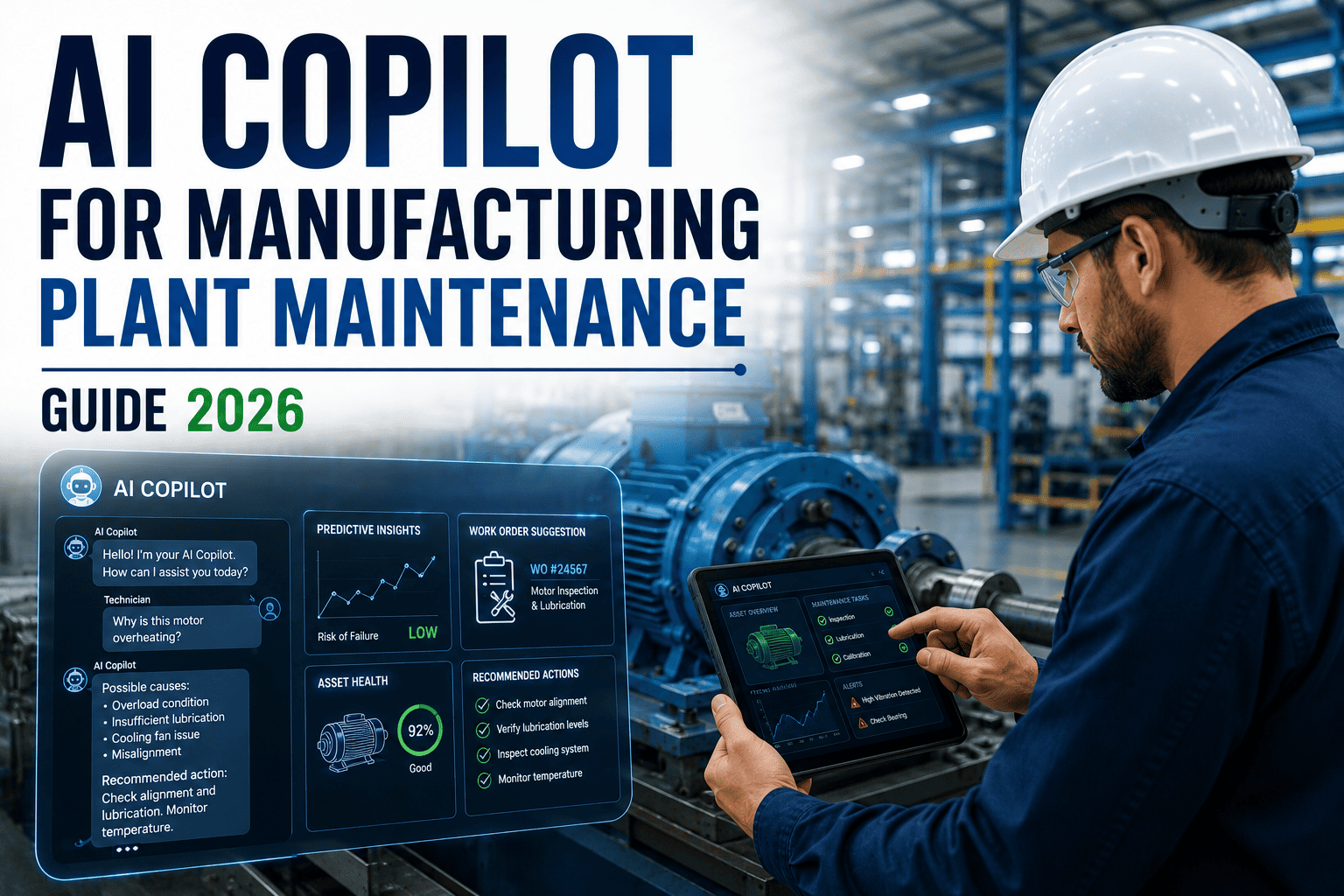
AI copilots have quietly become the most consequential maintenance hire of 2026 — not a replacement for technicians, but a second pair of eyes that reads vibration spectra, scans CMMS history, and drafts the work order before a wrench is lifted. Plants using copilots report diagnostic time dropping 40-60%, mean-time-to-repair falling by a third, and senior engineers finally freed from explaining the same fault codes to night shifts. This guide walks through the use cases, the CMMS integration pattern, prompt design, and the guardrails that separate a pilot from a production deployment. To put it on your floor in under two weeks, you can Start Free Trial today.
What if your next fault diagnosis took minutes — not a full shift?
An AI maintenance copilot reads sensor trends, CMMS history, OEM manuals, and prior work orders side by side, then surfaces the likely failure mode and the exact repair steps. Leading plants cut diagnostic time by 40-60% in the first 90 days.
The economics finally tipped in maintenance's favor
Unplanned downtime now costs discrete manufacturers roughly $260,000 per hour, and a single missed bearing failure on a critical extruder can wipe out a quarter's maintenance budget. The copilot layer — sitting between your SCADA, your CMMS, and your technicians — is the cheapest insurance policy a reliability team can buy.
Four capabilities that earn the copilot its seat on the floor
A maintenance copilot is not a chatbot bolted onto a search bar. It is a structured reasoning layer that turns scattered plant data into actionable repair guidance, ranked by confidence and grounded in your own asset history.
Automated Failure Diagnosis
The copilot ingests vibration spectra, motor current signatures, temperature trends, and alarm logs, then cross-references them against ISO 10816 thresholds and your failure-mode library to rank probable root causes within seconds.
ISO 10816 alignedSuggested Repair Actions
For each ranked failure mode, the copilot returns a step-by-step repair procedure pulled from OEM manuals and your own historical resolutions — including torque specs, lockout-tagout steps, and required spares.
OEM-groundedAI-Generated Work Orders
Diagnosis and repair plan auto-populate a structured CMMS work order — asset ID, priority, estimated labor hours, parts list, and safety permits — so the technician accepts, edits, or rejects rather than typing from scratch.
CMMS-nativeContinuous Knowledge Capture
Every technician correction feeds back into the copilot's asset-specific memory, so the retiring senior engineer's troubleshooting intuition does not walk out the door on their last day.
Retention engineHow the copilot plugs into the system you already run
The copilot does not replace your CMMS — it sits on top of it, reading asset hierarchies, work-order history, and parts inventory, and writing back structured records. Integration typically follows a four-stage path.
Asset registry and history ingest
Asset hierarchy, criticality ratings, and the last 24 months of work orders, failure codes, and parts usage are pulled via API or a read-only database view. No SCADA write access is granted at this stage.
OEM manuals and SOP layering
The copilot indexes OEM service manuals, P&IDs, lubrication charts, and your site-specific SOPs into a vector store so every suggested action can cite a source document and page number.
Shadow mode on 10-20 critical assets
The copilot runs alongside technicians without writing back, generating diagnoses and work-order drafts that reliability engineers compare against actual outcomes. Confidence thresholds are tuned here.
Write-back and floor-wide rollout
Once diagnostic accuracy clears the agreed threshold (typically 80%+ top-3 root-cause hit rate), the copilot gains write access to draft work orders directly into the CMMS queue, gated by technician approval.
A worked example: the 180-asset extrusion plant
Consider a mid-sized polymer extrusion facility with 180 critical assets, spending $42,000 annually on unplanned downtime labor and parts, plus an estimated $180,000 in lost throughput. Here is how the copilot payback stacks up in year one.
| Savings Lever | Baseline | With Copilot | Annual Value |
|---|---|---|---|
| Unplanned downtime hours | 420 hrs/yr | 344 hrs/yr | $19,760 |
| Diagnostic labor time | 2,600 hrs/yr | 1,300 hrs/yr | $84,500 |
| Repeat failures (misdiagnosis) | 38 events/yr | 11 events/yr | $22,400 |
| Spare parts expediting fees | $18,000/yr | $7,200/yr | $10,800 |
| Gross annual savings | — | — | $137,460 |
| Less: copilot license + integration | — | — | −$30,000 |
| Net year-one savings | — | — | $107,460 |
What separates a useful copilot from a confident hallucination
The copilot is only as trustworthy as the prompt architecture and guardrails wrapped around it. Best-practice deployments enforce retrieval grounding, confidence thresholds, and a hard human-approval gate before any work order hits the live queue.
Retrieval Grounding
Every diagnosis must cite a source — a work order, an OEM manual page, or a sensor reading. If the copilot cannot produce a citation, the output is suppressed and routed to a human.
Confidence Thresholds
Suggestions below a 75% confidence score are labeled "advisory only" and never auto-create work orders. Above 90%, the copilot may pre-fill a draft the technician accepts with a single tap.
Human-in-the-Loop Gate
No work order, parts requisition, or permit is ever submitted without an explicit technician approval. The copilot drafts; a human always releases. This is the single most important guardrail.
Audit Trail
Every copilot suggestion, acceptance, edit, and rejection is logged with timestamp, asset ID, and technician ID — producing an audit trail that satisfies ISO 55000 and most insurer requirements.
What a 90-day pilot actually looks like
In the first 90 days the copilot flagged a coupling misalignment on our main extruder three days before the vibration alarm would have tripped. That single catch paid for the entire annual license. Diagnostic time on repeat bearing faults dropped from 45 minutes to under 12.
Ready to put a copilot on your maintenance floor?
See a live diagnosis on one of your own assets in a 30-minute demo, or start a free 14-day trial connected to your CMMS today.
Questions plant managers ask before deploying a copilot
How long does it take to deploy a maintenance copilot on a live plant?
Most plants go from kickoff to shadow-mode pilot in 10-14 days. The bulk of the time is spent ingesting asset hierarchies, work-order history, and OEM manuals into the copilot's grounded retrieval layer — not on software installation. Full write-back to the CMMS typically follows after a one-week shadow validation period.
Does the copilot replace my technicians or my CMMS?
Neither. The copilot is an assistive layer that sits on top of your existing CMMS, drafting diagnoses, repair steps, and work orders that a human technician reviews and approves. It reduces typing, lookup time, and misdiagnosis — it does not remove the human from the loop or the CMMS from the workflow.
What data does the copilot need to be useful?
At minimum: your asset registry, 12-24 months of closed work orders with failure codes, and OEM service manuals for the critical assets. Sensor data from SCADA or condition-monitoring systems improves diagnostic accuracy significantly but is not required for the first pilot. You can connect your data source when you Start Free Trial.
How does the copilot avoid suggesting the wrong repair?
Three layers: retrieval grounding forces every suggestion to cite a source document or historical work order; confidence scoring labels outputs below 75% as advisory only; and a mandatory human-approval gate prevents any work order from entering the live queue without a technician's explicit sign-off. Every acceptance, edit, and rejection is logged for audit.
What does a typical pilot cost and when does it pay back?
For a 180-asset plant, expect roughly $24,000-30,000 per year including license and integration. Most sites recover that within the first 4-6 months on diagnostic-labor savings alone, before counting downtime avoidance. Book a walkthrough with your asset list via Book a Demo for a plant-specific payback model.
Cut diagnostic time by 40-60% this quarter
Deploy a maintenance copilot that reads your CMMS, diagnoses faults, and drafts work orders your technicians actually trust.
Free 14-day trial · No credit card