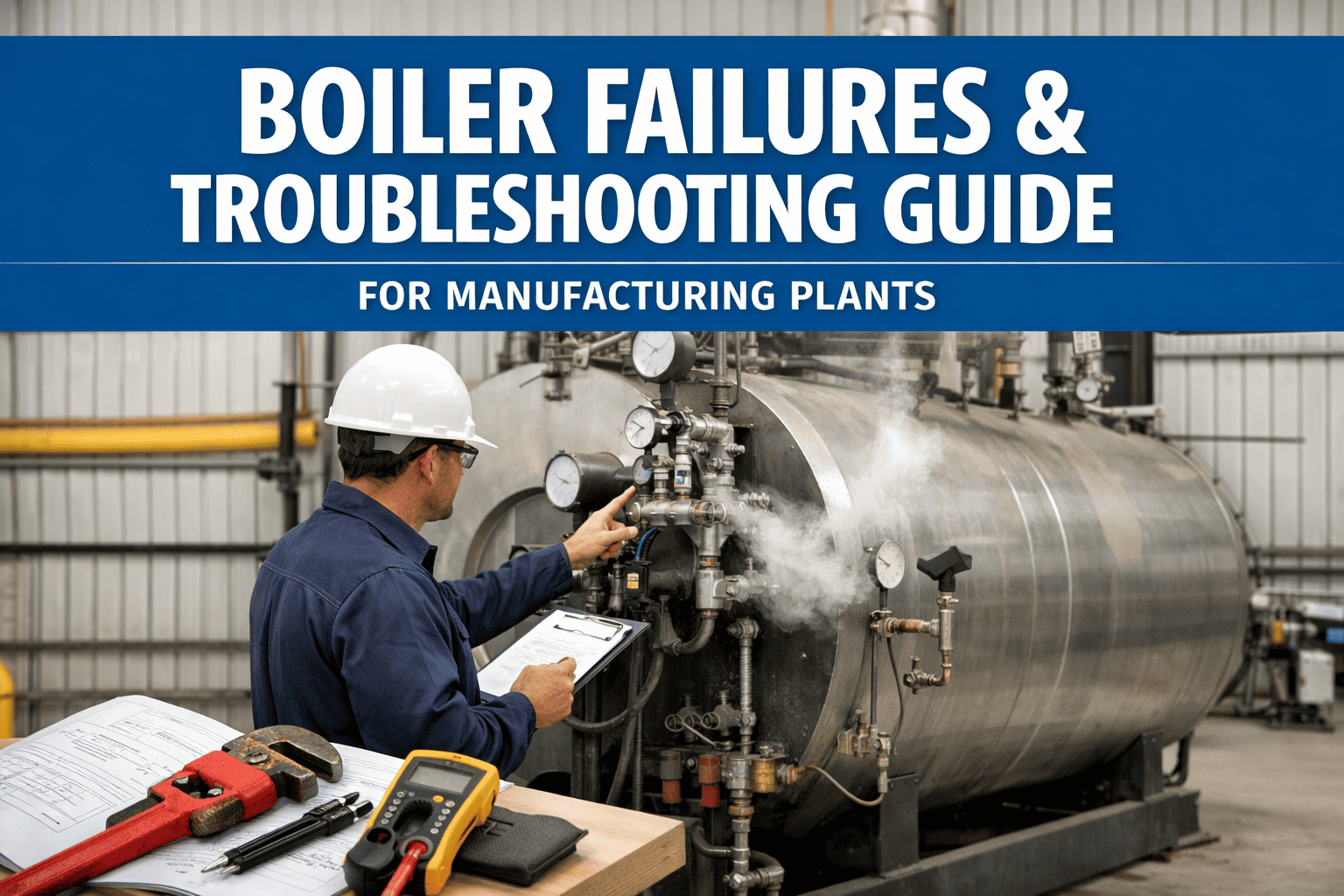
AI-Powered Predictive Maintenance for Boilers in Manufacturing Plants

By oxmaint on January 30, 2026

ai-powered-predictive-maintenance-for-boilers-in-manufacturing-plants

Boiler systems are the thermodynamic heart of manufacturing operations, powering critical processes from steam-driven turbines to high-pressure thermal applications. However, traditional calendar-based inspections often fail to detect internal degradation until a catastrophic failure occurs. AI-powered predictive maintenance transforms boiler management by analyzing real-time sensor streams to detect micro-anomalies—identifying tube thinning, burner instability, and scale buildup weeks before they impact production. Schedule a consultation to integrate precision boiler analytics into your reliability program.

Forensic Integration of Boiler Operational Data

A high-performance predictive system relies on the seamless capture of multi-modal sensor data. By integrating IoT transducers directly with machine learning models, facilities can move from "guessing" the internal state of a boiler to having a forensic, real-time digital twin of its health.

Thermal Pattern Analysis

Continuous monitoring of shell temperatures and flue gas heat profiles to detect refractory deterioration and heat transfer inefficiencies caused by internal scale formation.

Ultrasonic Tube Monitoring

AI-processed acoustic emission data identifies early-stage tube cracking and steam leaks invisible to the eye, allowing for planned localized repairs during scheduled downtime.

Burner Optimization

Real-time analysis of flame quality and air-fuel ratios. The system detects burner degradation and fuel-rich conditions that compromise OEE and increase carbon emissions.

Feedwater Pump Vibration

Spectral analysis of pump bearings and impellers to identify cavitation or misalignment, preventing a loss of circulation that could lead to dry-firing conditions.

Establish a permanent reliability record. QualiSight helps your team build a historical database to track boiler failure trends and optimize PM intervals based on real engineering data.
Sign Up Now

Advanced AI Failure Prediction Frameworks

AI models transition boiler maintenance from reacting to failure codes to predicting component lifespans. Using neural networks trained on historical data, these frameworks identify mechanical signatures of wear before they reach critical thresholds.

Framework 01

Predictive Remaining Useful Life (RUL)

By analyzing the rate of wall thinning and pressure variations, the system calculates the exact number of operating hours remaining for specific tube bundles. This allows for just-in-time procurement of spare parts.

Framework 02

Combustion Anomaly Detection

Machine learning clusters detect outliers in flue gas composition and draft pressure. It identifies if a boiler is drifting away from its efficiency baseline, automatically recommending trim adjustments.

Calculate your boiler efficiency gains. See how AI-driven predictive maintenance can reduce your annual fuel costs and unplanned downtime by over 30%.
Start Free Trial

Operational Impact of AI-Powered Boiler Management

14 Days
Average advance warning before potential tube failure
25%
Reduction in maintenance costs via condition-based repair
92%
Accuracy in detecting valve and burner malfunctions
Zero
Unplanned boiler failures on critical production lines

Technical Comparison: Maintenance Methodologies

Boiler Feature Traditional Maintenance AI Predictive Maintenance
Inspection Trigger Calendar or runtime interval Real-time component health index
Tube Health Manual NDT during shutdown Continuous thermal/acoustic modeling
Burner Control Fixed setpoints; manual tuning Dynamic AI-driven trim optimization
Risk Awareness High risk of "hidden" degradation Transparent, quantified failure probability
Experience a live boiler health walkthrough. Join our reliability engineers for a technical demo showing how AI detects anomalies in steam systems.
Book a Demo

Deployment Roadmap for Boiler AI Implementation

Successful deployment follows a high-velocity horizontal phased approach to move from legacy data silos to autonomous predictive insights.

01 PHASE 1
Assessment
Analyze sensor coverage Map failure modes
02 PHASE 2
Integration
Install IoT transducers Edge gateway setup
03 PHASE 3
Optimization
AI baseline training Auto-workorder sync
Modernize Your Boiler Reliability Strategy
Stop reacting to boiler alarms. QualiSight delivers the predictive intelligence you need to eliminate unplanned steam outages and protect your facility's production output.

Frequently Asked Question

How does AI handle boiler load variations and seasonal shifts?
The AI establishes dynamic baselines. It learns normal operating profiles across different load levels, ensuring that a spike in draft pressure due to a load increase is not incorrectly flagged as a blockage.
Does the system require replacing our existing SCADA?
No. Professional AI platforms integrate with your existing Historian via standard protocols like MQTT or OPC UA. We only recommend adding specialized sensors where critical data gaps exist.
Why is real-time sensor integration better than periodic manual testing?
Periodic testing only provides a "snapshot" of health. Real-time integration captures transient events and gradual degradation patterns that occur between manual inspections, providing a much higher probability of early detection.
What is the average setup time for AI boiler monitoring?
Basic integration using existing data historians can be achieved in 2-4 weeks. If new IoT hardware is required, a full deployment typically takes 8-12 weeks from initial assessment to live alerting.
Can the AI predict failures in high-pressure steam valves?
Yes. By analyzing acoustic emission levels and pressure differential deviations, the AI can detect internal seat leakage or mechanical sticking in steam valves before they reach a failure state.
Is the system compatible with multi-fuel boiler setups?
Absolutely. The AI models are configured to understand the different efficiency baselines for natural gas, oil, or biomass, automatically switching models when the fuel source is changed.
How are alerts delivered to the maintenance team?
Alerts are delivered via mobile push notifications, email, and synchronized dashboard updates. High-severity predictions can also trigger automatic high-priority work orders in your existing CMMS.
What cybersecurity standards does the system follow?
The platform utilizes industrial-grade encryption (TLS 1.3) and adheres to SOC2 and IEC 62443 standards to ensure your operational data remains secure during transmission and storage.

Share This Story, Choose Your Platform!