
AI Vision Inspection for Manufacturing Maintenance and Quality

By William Jerry on September 21, 2026

ai-vision-inspection-for-manufacturing-maintenance-and-quality

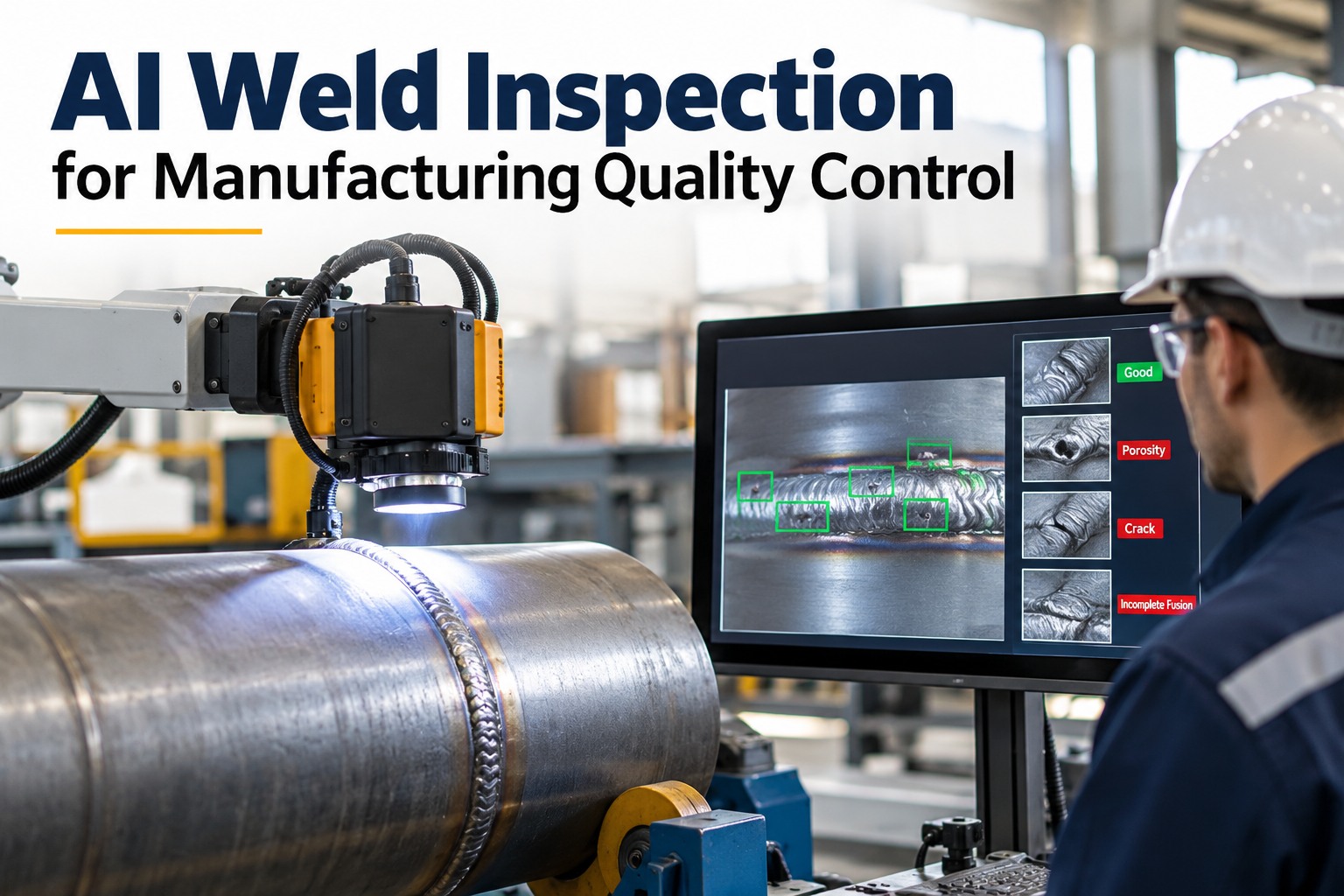
A camera on a production line usually earns its keep one way — catching defective parts before they ship. But the same frames that spot a scratch on a body panel also see the tool wearing, the nozzle drifting, the fixture losing alignment. When AI vision is wired to both quality and maintenance workflows, one imaging investment defends two P&L lines. This guide shows how to run that dual workflow using OXMAINT AI, the AI-powered CMMS that turns every vision event into either a scrap ticket or a maintenance work order.

Manufacturing · AI Vision · Quality & Maintenance

Every Frame Is a Data Point. Every Defect Is Either Scrap or a Work Order.

OXMAINT AI, the AI-powered CMMS/maintenance management software, connects the full workflow on one platform — vision detections in, classified as product or asset issues, defects raised and prioritised, work orders assigned, and preventive & predictive PM cadence tuned by what the cameras are seeing.

Quality + Asset Vision on One Feed Defect → Scrap or Work Order Predictive PM by Trend
95–99%
production-grade AI vision detection accuracy vs 70–80% human
2 hrs
after which human inspector accuracy drops 15–25%
24/7
consistent inspection across every shift, every product, every part
200–500
labelled images per class for production-ready transfer-learning models

The Dual-Use Insight — One Camera, Two P&L Lines

A scratch on a panel is a quality defect. But it's also a signal that a specific tool, roller or nozzle is failing — a maintenance defect waiting for a work order. Vision systems that only route to QC miss half their value. OXMAINT AI classifies every detection by root domain (product vs asset) and routes accordingly. Start free and wire your first vision feed for dual routing in OXMAINT AI.

AI Vision Frame
Every part imaged, every defect detected, every trend logged
← Quality
Maintenance →
QUALITY DOMAIN
Reject or downgrade the part
Log to scrap / rework ticket
Trigger SPC alarm if trend
Feed IATF / ISO evidence chain
MAINTENANCE DOMAIN
Attribute defect to tool / asset
Raise defect + open work order
Tighten PdM sampling window
Adjust PM cadence on evidence

The Vision-to-Action Stack — Hardware, Model, Edge, CMMS

A working system isn't one camera and a script — it's a four-layer stack. Get any layer wrong and either the detections don't land or they don't lead to action. OXMAINT AI is the top layer of that stack — the CMMS that turns detections into scheduled work. Book a demo to see the full stack live.

L4
CMMS Action Layer
Detections classified, defects raised, work orders scheduled, PM cadence tuned — the loop closes here in OXMAINT AI.
L3
Edge Processing
Inference on the line at cycle-time — no cloud round-trip. Defect + confidence + frame ID pushed upstream.
L2
Deep-Learning Model
Transfer-learning CNN or transformer trained on your defect classes. Retrains from active-learning captures without production stops.
L1
Imaging Hardware
Area-scan or line-scan cameras, structured light, UV/IR illumination, telecentric lenses — chosen to make the defect visible.

What AI Vision Sees That Humans Consistently Miss

Human inspectors are brilliant at novelty and terrible at repetition. AI vision is the opposite. The gains show up in the defects that need consistent attention across every part on every shift — surface, dimensional, assembly, and the subtle drift that signals a machine is walking out of spec. Sign up free and map your defect classes in OXMAINT AI.

Defect ClassExamplesHuman Weak PointAI Vision Strength
SURFACE Scratches, porosity, coating voids, colour drift Fatigue after 2 hrs, lighting-dependent Sub-mm resolution, invariant to shift
DIMENSIONAL Feature-to-feature distance, hole size, gap Gauge handling variability 100% parts measured at cycle time
ASSEMBLY Missing screws, wrong orientation, mis-seated part Muscle memory, "seen a thousand" Every part treated as first
DRIFT Slow trend in defect rate or dimension Not perceivable in real time Statistical trending across thousands
NOVEL Never-seen defect signature Recognised — humans are good here Active learning captures + retrains

A Defect the Camera Sees That Never Becomes a Work Order Is a Signal Wasted.

OXMAINT AI closes the loop between vision hardware and maintenance action — every asset-attributable defect becomes a scheduled WO, every trend tunes a PM cadence.

Vision as Condition Monitoring — Reading the Asset Through the Part

Every defect a camera catches carries a fingerprint. A recurring scratch at the same panel coordinate points at one specific guide rail. A dimensional drift over 400 parts points at a warming tool. OXMAINT AI attributes recurring defects back to the asset producing them, then tightens PdM sampling or brings forward the next PM before the defect rate crosses the scrap threshold. Book a demo to see defect-to-asset attribution live.

Recurring Defect Pattern
Same defect · same coordinate · same product · repeated across parts
Asset Attribution
Traced to specific tool / roller / nozzle / fixture through station mapping
Maintenance Response
Defect opened · PdM cadence tightened · PM brought forward · WO scheduled

Where the Value Actually Lands — 6 Line Types, 6 Wins

The dual-use pattern plays out differently by industry. What stays constant is the shape: cameras earning back their capex from both scrap avoidance and unplanned-downtime reduction, not one or the other. OXMAINT AI holds the maintenance side of every one of these use cases. Start free and configure your line type in OXMAINT AI.

Stamping / Forming
Cracks, roll marks, dimensional
Die wear, guide-rail drift, press ram alignment
Electronics / PCB
Solder bridging, missing components
Placement head wear, nozzle clogging, feeder faults
Automotive Body
Panel gap, paint defects, weld porosity
Robot repeatability, tip dressing, servo drift
Food / Packaging
Fill level, seal integrity, label misalign
Filler valve wear, seal-jaw temp drift, conveyor tension
Metals / Rolling
Surface scale, inclusions, edge cracks
Roll surface wear, coolant nozzle fouling, bearing runout
Plastics / Extrusion
Colour, gloss, dimensional profile
Screw wear, die build-up, cooling drift

Deploying Without Blowing Up Production — A Staged Rollout

The failed AI vision projects almost all share one pattern — a big-bang deployment on the highest-value line first. The successful ones start on one station, prove the pattern, then scale. OXMAINT AI supports both the pilot and the scale-out with the same defect/WO workflow. Book a demo to plan your first pilot station.

WEEK 1
Station Setup & Baseline
Camera and lighting installed on one high-impact station. Baseline defect rate captured from a shadow run — no rejections yet.
WEEK 2
Model Training & Shadow Mode
200–500 labelled images per class. Model runs alongside human inspectors for validation — false positives and misses reviewed daily.
WEEK 3
Go-Live + CMMS Integration
Live rejections start; detections routed into OXMAINT AI. Asset-attribution rules configured so defects raise WOs, not just scrap tickets.
WEEK 4
Trend View & PM Tuning
First trend patterns land in the dashboard. PM cadence adjustments recommended by evidence — extend where clean, contract where drifting.

What OXMAINT AI Gives an AI Vision Deployment

OXMAINT AI sits at the top of the vision stack — the layer that turns detections into scheduled maintenance work and long-term PM tuning. Below are the capabilities that make dual-use vision operational instead of aspirational. Start free and put your vision alerts on OXMAINT AI today.

Vision-Feed Ingestion
API integration with major vision platforms — every detection lands in one defect stream with frame ID, confidence and station tag.
Defect Classifier
Rules-based routing splits vision events into quality-only, asset-only or dual-domain — no defect gets lost between teams.
Asset Attribution
Station mapping links recurring defect coordinates to specific tools, rollers and fixtures — root cause visible without a war-room.
PM Cadence Tuner
PM intervals adjustable by defect-rate trend — extend where the camera confirms clean operation, contract where drift is starting.
Live Defect Dashboards
Live rate, Pareto by class and asset, trend charts by shift — the numbers Ops and Reliability need on one screen.
Audit Evidence Chain
Every defect, every WO, every closeout tied to the frame that raised it — IATF/ISO evidence built as a by-product of the workflow.
"

We spent 18 months treating our vision system as a QC investment — it caught defects, we rejected parts. What we missed was that every recurring defect coordinate was pointing at a specific fixture. Once we routed the defect stream into the CMMS and let it attribute back to assets, we found a robot repeatability drift on our right-side welding cell that had been quietly costing us 4% of scrap for a year. The camera had been screaming about it the whole time.

Continuous Improvement Manager · Tier-1 Automotive Body-in-White

Frequently Asked Questions

Do we replace our existing vision hardware to use OXMAINT AI?
No — OXMAINT AI integrates with the vision platforms already on your line via API. The value is in the CMMS action layer on top: classification, WO routing and PM tuning from what your cameras already see. Sign up free and connect your first vision feed.
How much labelled data do we need to start?
Modern transfer-learning models reach production-grade accuracy with 200–500 labelled images per defect class. Active learning captures new patterns after go-live so the dataset grows without a big up-front labelling sprint. Book a demo to see the active-learning loop.
Does dual-use routing complicate our quality workflow?
No — the QC team still gets the same scrap/rework tickets they always did. The change is that maintenance also gets the asset-attributable defects as a separate, silent stream — nothing added to the QC workload. Start free and see the two streams side by side.
What if the model flags a new defect type it wasn't trained on?
Active learning captures the anomaly, flags it for operator review, and adds it to the training dataset after confirmation. Model retraining runs in the background without stopping production. Book a demo to walk through the active-learning workflow.
How long before the maintenance side of the value shows up?
Asset-attribution patterns usually surface within 4–6 weeks of go-live — long enough for enough defect frames to accumulate. PM cadence tuning follows in the second quarter as trend data stabilises. Sign up free and start the clock on your first pilot.

Same Camera. Two Wins. One Platform Behind Both.

Move your vision detections onto OXMAINT AI — classified, attributed, converted into work orders and used to tune PM cadence. The camera earns its capex from both the scrap side and the reliability side.

Share This Story, Choose Your Platform!