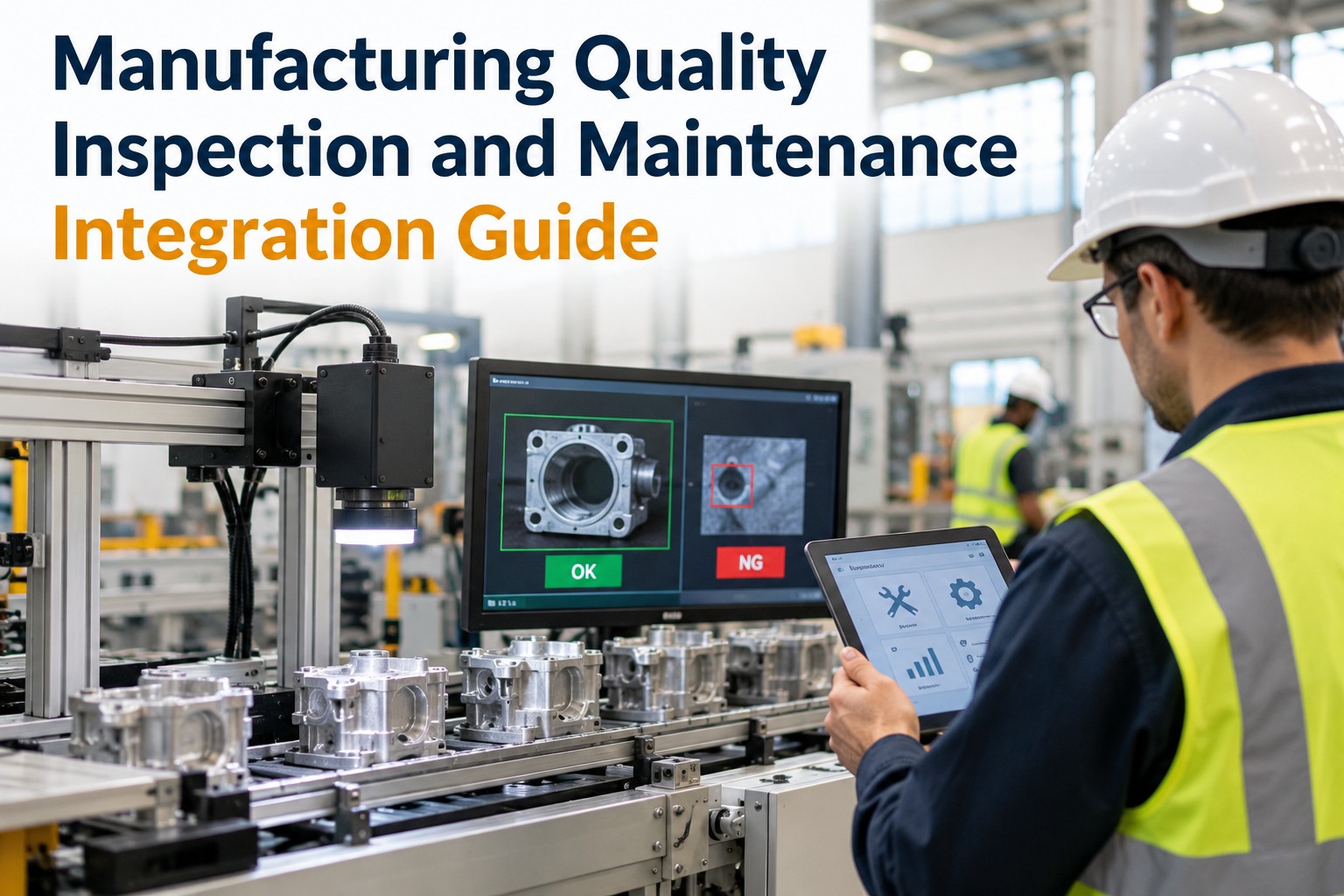
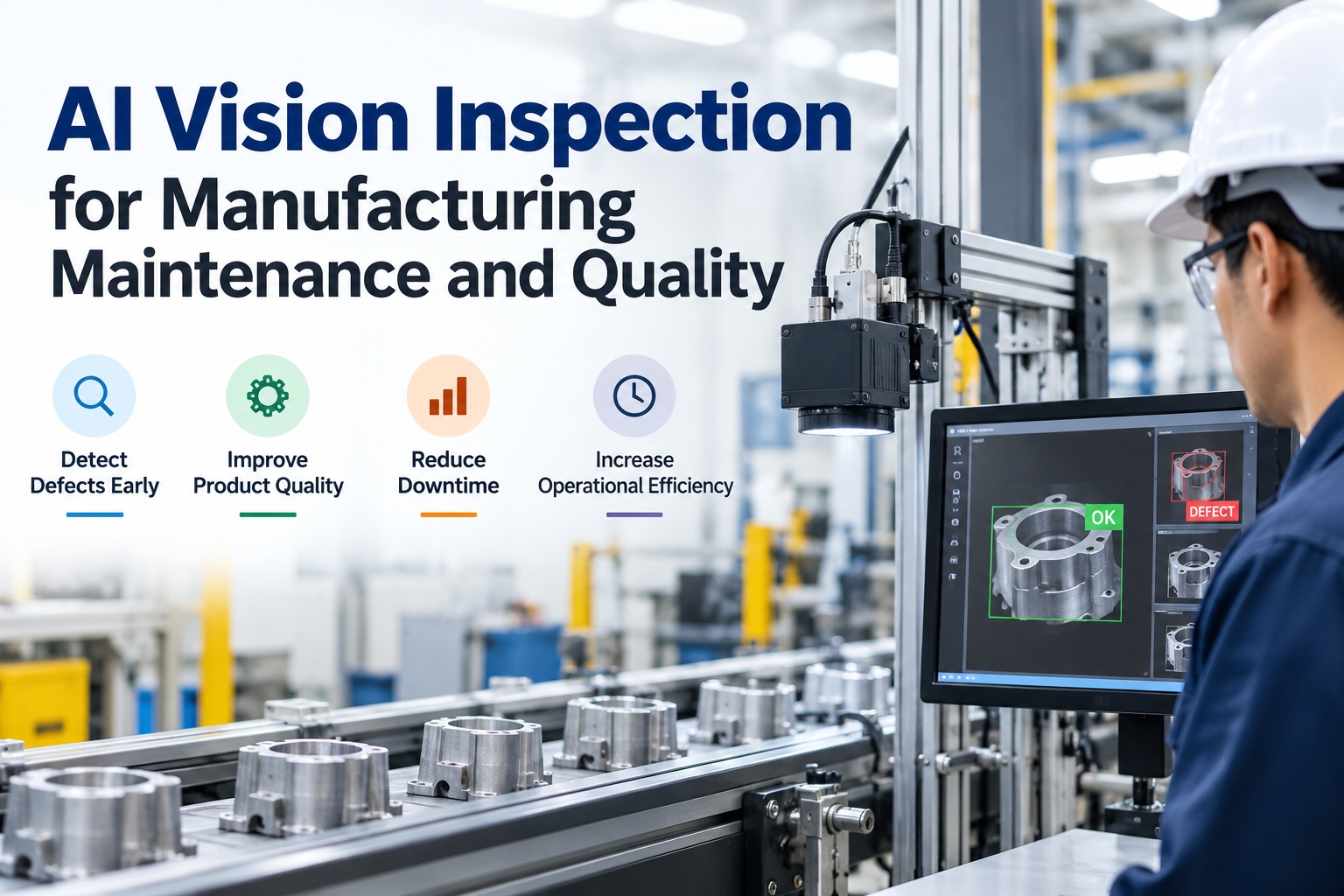
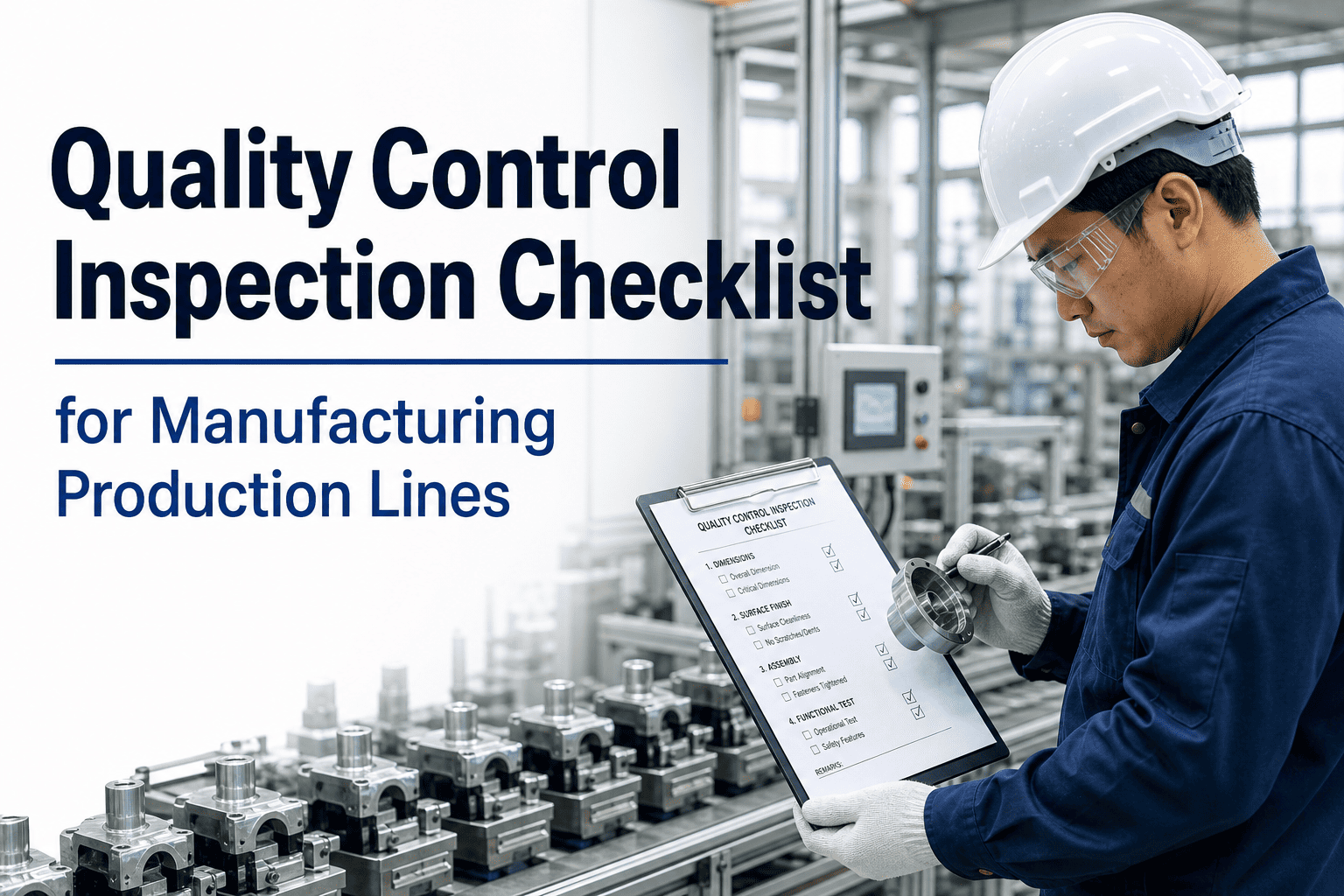
Manufacturing quality failures cost the global industry over $2.9 trillion annually — and most of it traces back to one unsolved problem: human inspection cannot keep pace with modern production. AI vision systems change that equation permanently. Start your AI vision implementation with OxMaint free — no hardware dependency, no consultant required, first defect detection active within days.
AI & Vision Quality · OxMaint
AI Vision Systems in Manufacturing:
Implementation & Quality Inspection Guide
From camera selection to deep learning deployment — a practical guide to achieving 99.9% defect detection accuracy, 60% quality cost reduction, and full production line integration without months of downtime.
99.9%
Defect detection accuracy vs 85% human average
60%
Reduction in quality-related production costs
100×
Faster inspection speed than manual line workers
14 mo
Average ROI payback period after deployment
The Manufacturing Quality Crisis
Why Manual Inspection Is Failing Your Production Line
Every second a defect passes undetected, rework costs compound, customer returns increase, and your brand takes a measurable hit. These are the four inspection failures that AI vision directly eliminates.
15–30%
Miss Rate
Human inspectors miss 15–30% of surface defects during high-speed line operation — not because of poor skill, but because the human eye was never designed for 800 parts-per-minute inspection cycles.
3× cost
Rework Multiplier
A defect caught at final inspection costs 3× more to fix than one caught at source. AI vision detects at the point of production — not at the shipping dock.
40%
Inspector Fatigue Effect
Accuracy drops by up to 40% after 20 minutes of continuous visual inspection. AI vision maintains the same sensitivity at minute one and minute four hundred.
$2.9T
Global Annual Cost
Poor product quality costs global manufacturing $2.9 trillion per year — roughly 20% of total manufacturing revenue. AI vision is the single highest-ROI intervention available.
How It Works
The AI Vision Inspection Stack: 4 Layers That Work Together
AI vision is not a single product — it is a four-layer system. Understanding each layer prevents the most common implementation mistake: investing in cameras before defining the detection model.
01
Image Capture Layer
Industrial cameras (area scan, line scan, or 3D depth) capture part images at line speed. Camera resolution, frame rate, and lighting geometry are determined by defect size and surface type. A 5MP area-scan camera under structured LED illumination is the starting point for 90% of surface inspection applications.
Resolution 2–25MP · Frame rate 30–500fps · LED/laser illumination
02
Preprocessing Pipeline
Raw images are normalised for brightness variation, lens distortion corrected, and regions of interest cropped before reaching the model. This step is frequently skipped by first-time implementations — and it is the most common reason for poor model performance on the production line despite strong lab accuracy.
Normalisation · Distortion correction · ROI cropping · Augmentation
03
Deep Learning Model
A convolutional neural network (CNN) — typically a ResNet or EfficientNet variant — is trained on labelled defect images. The model outputs a pass/fail decision and a confidence score. 500–2,000 labelled images per defect class is sufficient for most industrial inspection tasks with transfer learning from a pre-trained backbone.
CNN · Transfer learning · 500+ labelled images · Confidence threshold
04
Integration & Action Layer
Model output triggers a physical action: a reject gate opens, a work order is automatically generated in OxMaint for root-cause review, or a line stop signal is sent to the PLC. This layer connects AI vision from a standalone camera to an integrated quality management system — the step that converts detection into corrective action.
PLC signal · Reject gate · CMMS work order · Dashboard alert
Implementation Roadmap
5 Implementation Phases: From Assessment to Active Inspection
Most AI vision projects fail at phase 3 — model training — because teams attempt to train on too few images or skip the preprocessing pipeline. This roadmap is sequenced to prevent that failure.
Application Assessment
Define the defect types, part geometry, line speed, and throughput requirements. Photograph 50–100 representative good parts and 50+ defective parts under current lighting. This image set drives hardware selection — you cannot choose a camera without knowing the smallest defect you need to detect.
Output: Defect catalogue · Hardware specification · Image dataset draft
Hardware Setup & Calibration
Install cameras, lighting, and mounting fixtures at the inspection station. Calibrate lighting angles to maximise defect contrast. Collect the full training dataset — minimum 500 images per defect class, captured under production conditions, not in a lab. Lighting accounts for 70% of model performance — allocate budget accordingly.
Output: Live image capture · Training dataset collected · Lighting validated
Model Training & Validation
Label the training dataset and fine-tune a pre-trained CNN backbone. Validate on a held-out test set — target above 99% precision and 98% recall before production deployment. Adjust confidence thresholds based on the cost of false positives vs false negatives for your product. A too-aggressive threshold creates excessive false rejects; a too-lenient threshold misses defects.
Output: Trained model · Validation report · Threshold calibration
Line Integration & Shadow Mode
Deploy the model in shadow mode — running alongside existing inspection without triggering actions — for one to two weeks. Compare AI decisions against human inspector decisions. Investigate every disagreement. This step surfaces lighting variation, part presentation issues, and edge-case defect types that were not in the training set before they cause production problems.
Output: Shadow mode agreement rate · Edge case catalogue · Integration tested
Live Deployment & Continuous Improvement
Go live. AI vision takes over primary inspection. All reject events generate a work order in OxMaint with the defect image attached — creating a closed loop between detection and root-cause investigation. Review false reject rate and false accept rate weekly for the first month, and add new defect types to the training dataset as they are discovered.
Output: Active inspection · CMMS-linked work orders · Continuous model improvement
Connect AI vision detection directly to your maintenance workflow.
OxMaint closes the loop — every defect detected triggers a traceable work order automatically.
Hardware Selection Guide
Camera & Sensor Selection: Matching Hardware to Application
Camera selection is the most consequential hardware decision — and the most commonly over-engineered. Use this matrix to match camera type to your inspection requirements.
Most Common
Area Scan Camera
2MP – 25MP
Best for: Discrete parts, stationary or slow-moving objects, PCB inspection, label verification, packaging
Lower cost per unit
Simple integration
Works with most deep learning frameworks
Covers 90% of industrial inspection applications
Not suited for continuous web/sheet material inspection
Line Scan Camera
2K – 16K pixels per line
Best for: Continuous web materials, textiles, sheet metal, film, paper, solar panels
Inspects continuous material at any speed
Very high resolution across full width
No motion blur on high-speed lines
Requires encoder synchronisation and more complex setup
3D Vision / Depth Sensor
Structured light / ToF / Laser triangulation
Best for: Dimensional measurement, weld bead inspection, assembly presence/absence, surface height mapping
Measures Z-height, not just 2D surface
Detects dents, protrusions, missing components
Lighting-independent depth data
Higher cost; slower cycle time than 2D; more complex model training
The Lighting Rule That Most Implementations Ignore
Lighting configuration accounts for 60–70% of AI vision model performance — yet most implementation budgets allocate less than 10% to lighting. The principle: defects become visible when illumination geometry maximises contrast between the defect and the surrounding surface. Dark-field illumination (light at a shallow angle) reveals scratches and surface texture. Bright-field illumination (on-axis light) reveals colour and print defects. Diffuse dome lighting reveals reflective surface variations. Select illumination type before selecting camera resolution.
ROI & Business Case
The Financial Case for AI Vision in Manufacturing
AI vision is not a technology investment — it is a quality cost reduction programme. These benchmarks are drawn from documented deployments across automotive, electronics, food, and pharmaceutical manufacturing.
30–60%
Quality Cost Reduction
Scrap, rework, warranty claims, and customer returns fall by 30–60% within the first 12 months of full AI vision deployment across the production line.
8–18 mo
Payback Period
Median payback period for a single-station AI vision system is 8–18 months. High-volume automotive and electronics lines recover investment in under 6 months.
3–5×
Throughput Inspection Increase
AI vision inspects 3–5× more parts per shift than a dedicated human inspector — without overtime costs, breaks, or fatigue-related accuracy degradation.
99.7%
Consistent Uptime
AI vision systems run continuously without the 10–15% uptime loss associated with human inspector shift handovers, breaks, and rotation requirements.
Manual Inspection vs AI Vision: Side-by-Side Cost Comparison
Defect miss rate
15–30%
0.1–0.5%
Inspection speed
5–15 parts/min
200–800 parts/min
Cost per 1,000 inspections
$18–$45
$0.80–$2.50
Consistency across shifts
Varies ±40%
Consistent ±0.2%
Traceability data
Manual log or none
Full image record + CMMS link
Frequently Asked Questions
AI Vision Implementation: Common Questions
How many defect images do I need to train an AI vision model?
For most industrial inspection tasks using transfer learning from a pre-trained backbone (ResNet50, EfficientNetB3), 500–2,000 labelled images per defect class is sufficient to achieve production-ready accuracy. You do not need tens of thousands of images if you use data augmentation (rotation, brightness variation, minor cropping) and a pre-trained model. Fewer than 200 images per class will produce unreliable results regardless of model architecture — if you have limited defect images, prioritise collecting more data before training, not tuning hyperparameters.
Can AI vision work on an existing production line without stopping production?
Yes — AI vision systems are installed at existing inspection stations or at new check points without requiring line shutdown beyond the camera mounting period (typically 2–4 hours per station). The shadow mode deployment approach means the system runs in parallel with existing inspection for 1–2 weeks before taking over as the primary inspection method. Production is never fully stopped for the AI vision deployment itself; the line stop occurs only during the physical camera installation window.
How does OxMaint integrate with AI vision inspection systems?
OxMaint connects to AI vision systems through its work order API and webhook integration. When the vision system generates a reject event or detects a quality anomaly above a defined threshold, OxMaint automatically creates a work order with the defect image, location, timestamp, and defect classification attached. This creates a direct link between a detected defect and the maintenance corrective action — eliminating the manual step of translating inspection data into maintenance tasks. The integration requires no custom development; OxMaint provides a pre-built webhook template for the most common vision system outputs.
Book a demo to see the integration in action.
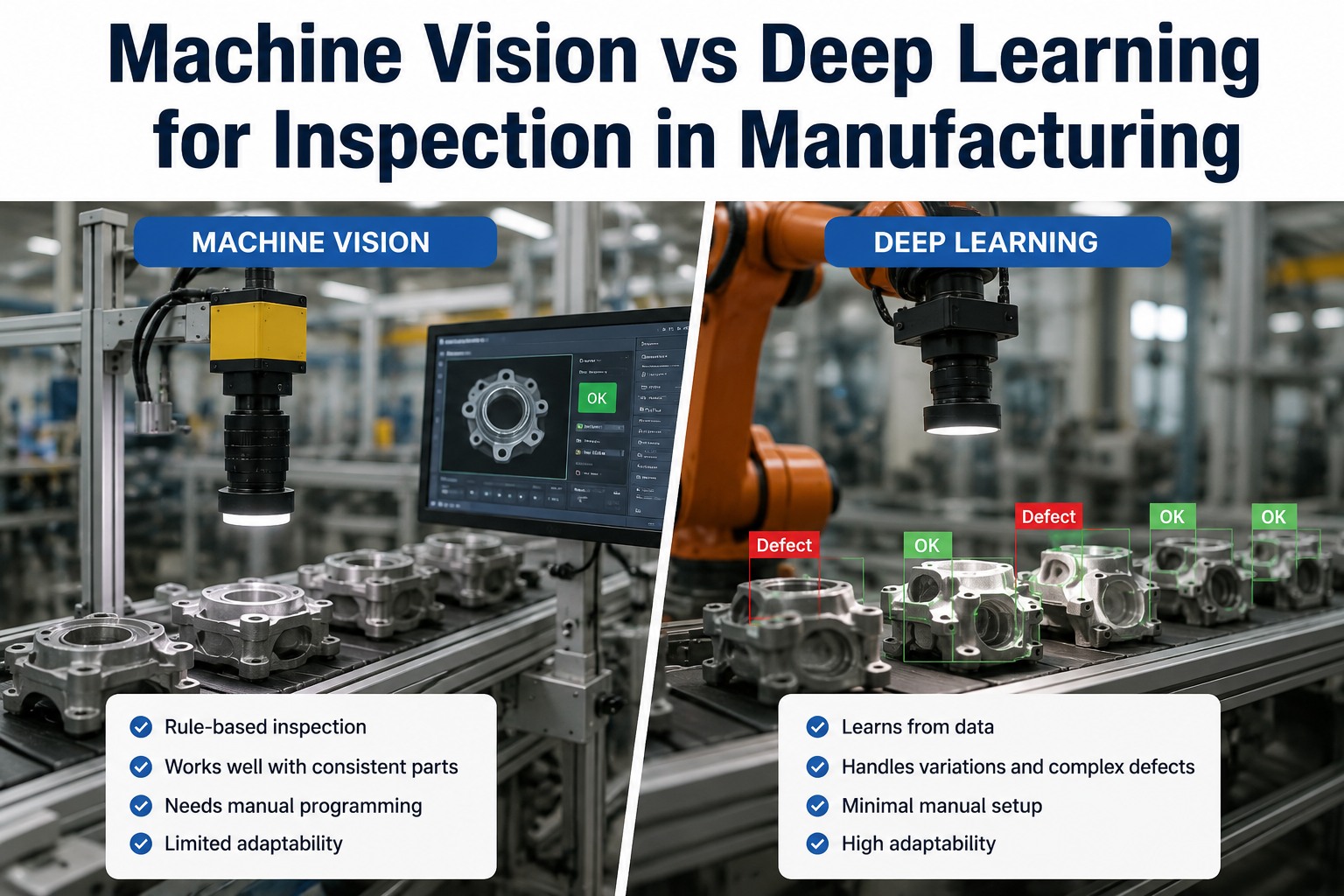
What is the difference between rule-based machine vision and AI vision?
Rule-based machine vision uses predefined geometric or colour thresholds to classify a part — for example, "reject if the measured diameter is outside 24.5–25.5mm." It works well for dimensional inspection with tight tolerances but fails on surface defects with variable appearance, because no two scratches, inclusions, or discolourations look exactly the same. AI vision (deep learning) learns what defects look like from examples, allowing it to generalise across the wide appearance variation of real-world defects. AI vision is superior for surface inspection, assembly verification, and any application where defect appearance is not fully predictable. Rule-based systems remain appropriate for pure dimensional measurement where variability is low and tolerances are fixed.
AI Vision · OxMaint · Quality Automation
From Manual Inspection to 99.9% AI Accuracy — With Every Defect Linked to a Corrective Work Order
OxMaint bridges AI vision detection and maintenance execution — the closed loop that turns quality data into corrective action, automatically.