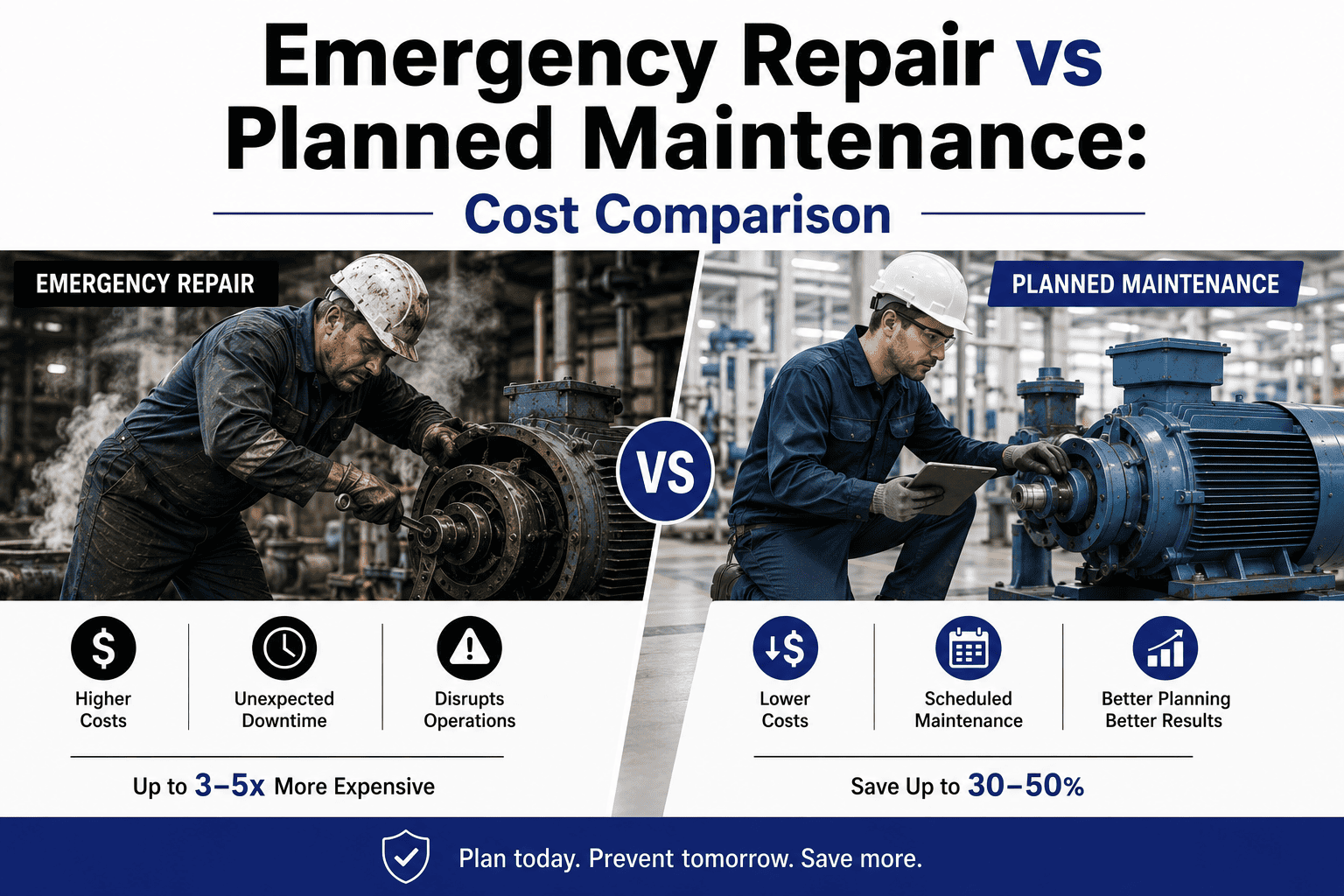
Breakdown maintenance vs preventive maintenance — this is the central cost decision every plant manager, maintenance director, and operations leader faces. Run equipment until it fails, or invest proactively in keeping it running? The answer isn't theoretical. It's measurable in downtime hours, repair invoices, production loss, and regulatory exposure. This guide provides a real cost comparison for 2026, with formulas, benchmarks, and a practical decision framework that manufacturing and industrial maintenance teams can apply immediately. Explore OxMaint's PM scheduling tools and see how the right platform makes preventive maintenance cost-effective at any scale.
Stop Choosing Between Reactive and Preventive — Let OxMaint Optimize Both
OxMaint's automated PM scheduling, real-time work order tracking, and cost analytics give maintenance teams the data to justify every maintenance dollar — and eliminate the hidden costs of breakdown maintenance.
Defining the Two Strategies: What They Actually Mean
Before comparing costs, it's important to establish precise definitions — because in practice, both terms get used loosely, and that imprecision leads to poor strategy decisions.
Also called reactive maintenance or run-to-failure: equipment is operated until it fails, and repair action is taken only after the failure occurs. No scheduled inspections, no proactive interventions. The failure itself triggers the work order.
Subtypes include immediate breakdown maintenance (urgent, equipment must be restored immediately) and deferred breakdown maintenance (failure is noted but repair is scheduled for later without immediate production impact).
Scheduled maintenance tasks — inspections, lubrication, part replacements, calibrations — performed at defined intervals based on time, usage, or condition. The goal is to prevent failures before they occur and extend asset useful life.
Subtypes include time-based PM (calendar intervals), usage-based PM (triggered by operating hours or cycles), and condition-based PM (triggered by sensor or inspection readings).
Neither strategy is universally superior. The cost comparison — and the right strategy choice — depends on the asset, the failure mode, the operational context, and the cost structure of your facility. What this guide provides is the framework to make that determination rigorously, not intuitively.
The True Cost of Breakdown Maintenance: A Full Accounting
The surface cost of a breakdown is the repair invoice. The true cost is 3–8 times larger. Maintenance managers who evaluate reactive maintenance only by parts and labor cost are systematically underestimating its financial impact — and making strategy decisions on incomplete data.
Emergency Labor Premium
Breakdown repairs almost always involve overtime, after-hours call-out rates, or emergency contractor fees. In unionized manufacturing environments, emergency call-out can cost 1.5–2.5× standard hourly rates. A repair that costs $800 in planned labor costs $1,600–$2,000 when triggered by an unplanned failure at 2 AM on a Saturday. For facilities running multiple shifts, this premium compounds throughout the year.
Production Downtime Loss
This is the largest single cost in most breakdown events. The formula is straightforward: Downtime Hours × Throughput Value Per Hour. For a production line generating $40,000/hour in output, a 4-hour breakdown costs $160,000 in lost production — before a single repair dollar is spent. Industry benchmarks from the Manufacturing Institute place average unplanned downtime costs at $125,000–$260,000 per hour in discrete manufacturing. Process industries (chemicals, oil & gas, food) frequently exceed $500,000/hour.
Secondary and Collateral Equipment Damage
Run-to-failure rarely affects a single component. A bearing failure that could have been caught in a PM inspection often damages the shaft, housing, and connected components by the time the failure becomes apparent. A $200 bearing becomes a $3,500 repair. A seized pump motor becomes a pump overhaul. Studies across industrial facilities consistently find that secondary damage multiplies the direct repair cost by 2–4×, particularly in rotating equipment and hydraulic systems.
Emergency Parts and Expedite Premiums
Planned maintenance allows parts to be procured at standard lead times and pricing. Breakdown maintenance forces emergency procurement — overnight shipping, spot purchases at premium prices, or the use of non-preferred suppliers. Expedite premiums of 30–80% above standard parts cost are common. For facilities without stocked critical spares, a breakdown can extend downtime by 24–72 hours while waiting for parts, multiplying the production loss cost dramatically.
Quality and Scrap Losses
Equipment that is degrading before its failure often produces off-spec output — scrap, rework, and quality holds — before the failure event itself. These quality costs precede the visible breakdown and are rarely attributed to maintenance strategy in cost accounting. Post-breakdown restart also generates scrap during equipment warm-up and recalibration, adding further material cost that belongs in the true breakdown cost total.
Safety Incidents and Regulatory Liability
Equipment failures are a leading cause of workplace injuries. OSHA penalties, worker compensation claims, incident investigation costs, and potential litigation from breakdown-related injuries add a liability tail that can dwarf the direct repair cost. In regulated industries — food processing, pharmaceuticals, oil & gas — a breakdown-triggered environmental or safety event can result in facility shutdowns, consent orders, and fines that reach six or seven figures. These costs are rarely included in maintenance cost comparisons but belong in any honest total cost of ownership analysis.
Most facilities track only the first three items. The remaining components typically represent 60–80% of the true event cost.
The True Cost of Preventive Maintenance: What You're Actually Paying
Preventive maintenance is not free — and the instinct to undercount PM costs is just as distorting as underestimating breakdown costs. An honest comparison requires accounting for every cost component on both sides.
Planned Labor Cost
PM labor is performed at standard rates during scheduled windows — typically far below emergency call-out cost. For a well-structured PM program, planned labor cost is 40–60% lower per task than the equivalent reactive repair labor, because work is planned, parts are staged, and technicians are not racing against a production shutdown.
Parts and Materials (Standard Cost)
PM parts are purchased on planned schedules, allowing competitive procurement, volume pricing, and stocking strategies that eliminate expedite premiums. Planned parts spend for a given asset is typically 30–50% below the equivalent reactive repair parts cost.
Planned Production Impact
PM windows are scheduled during planned shutdowns, low-demand periods, or shift transitions — minimizing production impact. The cost of planned downtime for PM is typically 10–20% of equivalent unplanned breakdown downtime, because the schedule is known and production is managed around it.
Over-Maintenance Risk
A poorly calibrated PM program can generate unnecessary work — replacing parts before end of life, performing inspections more frequently than failure modes require. Over-maintenance is a real cost that a good PM program must be designed to minimize through RCM (Reliability-Centered Maintenance) analysis and failure mode review.
CMMS and Program Management Cost
Running a PM program requires scheduling infrastructure, work order management, and record-keeping. Modern CMMS platforms like OxMaint make this cost marginal — typically $3–8 per asset per month — but it belongs in the full cost comparison. Manual PM management through spreadsheets carries hidden labor cost that often exceeds the software alternative.
Training and Procedure Development
A structured PM program requires documented procedures and technician training. This is a one-time investment that pays dividends over the life of the program — but it is a real upfront cost that should be captured in ROI calculations, particularly when comparing against a purely reactive alternative.
Direct Cost Comparison: Breakdown vs Preventive Maintenance by Scenario
Abstract comparisons don't drive decisions. The table below presents side-by-side cost modeling across four real-world asset scenarios that manufacturing maintenance managers encounter regularly. All figures reflect 2025–2026 industry benchmarks.
| Asset Scenario | Breakdown Maintenance Total Cost | Preventive Maintenance Annual Cost | Cost Ratio (BM ÷ PM) | Primary Driver of Difference |
|---|---|---|---|---|
| Mid-size centrifugal pump (process plant, critical line) | $28,000–$45,000 per failure event | $3,200–$5,500/year | 6–8× | Secondary impeller/shaft damage + 6–12 hr downtime |
| Production line conveyor motor (discrete manufacturing) | $12,000–$22,000 per failure event | $800–$1,400/year | 10–15× | Line stoppage at $40K+/hr production value |
| HVAC chiller unit (commercial facility, 200-ton) | $18,000–$35,000 per compressor failure | $2,400–$4,200/year | 5–8× | Compressor replacement vs. refrigerant/bearing PM |
| CNC machining center (aerospace/auto supplier) | $35,000–$80,000 per spindle failure | $4,500–$8,000/year | 5–12× | Spindle rebuild + scrap/rework + customer delivery impact |
| Forklift fleet (warehouse, 10 units) | $3,500–$6,000 per breakdown (fleet avg.) | $900–$1,500/unit/year | 2–4× | Lower downtime cost; lower BM/PM ratio but still unfavorable |
| Non-critical office HVAC fan unit | $400–$900 per failure | $280–$450/year | 1–2× | Low consequence — run-to-failure may be appropriate here |
The final row is deliberately included to illustrate a critical point: not every asset justifies preventive maintenance. For non-critical, low-consequence assets with cheap failure costs and no safety implications, run-to-failure can be the rational economic choice. The decision framework in the next section provides a structured method for making this determination asset by asset.
Breakdown vs Preventive Maintenance: Full KPI and Performance Comparison
Cost is only one dimension of the comparison. Maintenance strategy affects equipment reliability, workforce efficiency, safety performance, and organizational predictability. The table below provides a complete side-by-side across every performance dimension that matters to a maintenance leader.
| Performance Dimension | Breakdown / Reactive Maintenance | Preventive Maintenance |
|---|---|---|
| Direct repair cost per event | High — emergency labor, expedite parts, secondary damage | Low — planned labor, standard parts, no secondary damage |
| Downtime duration per event | Unpredictable; typically 3–10× longer than planned PM window | Planned and controlled; typically 30–90 min per task |
| Equipment lifespan | Reduced; run-to-failure accelerates wear on connected components | Extended; proactive intervention preserves asset useful life |
| Safety incident risk | Higher; equipment failures are a leading cause of workplace injuries | Lower; degradation is caught before failure mode reaches safety threshold |
| Production planning reliability | Poor; breakdowns disrupt schedules, commitments, and customer delivery | High; maintenance windows are planned around production requirements |
| Maintenance labor utilization | Reactive, crisis-driven; technicians spend time waiting or scrambling | Planned and predictable; labor is scheduled for optimal utilization |
| Inventory and parts management | Expensive emergency stocking or costly expedite; no demand visibility | Planned procurement; predictable parts demand; volume pricing possible |
| Regulatory and audit readiness | Reactive record-keeping; documentation gaps; citation exposure | Systematic documentation; full audit trail; inspection readiness |
| Maintenance cost predictability | Highly variable; budget accuracy typically ±40–60% | Highly predictable; budget accuracy typically ±10–15% |
| Energy efficiency | Deteriorating equipment consumes 10–25% more energy before failure | Maintained equipment operates at design efficiency |
The ROI of Switching from Breakdown to Preventive Maintenance
For maintenance managers building the business case for a PM program — or justifying continued investment in one — the ROI calculation must be structured around the specific cost drivers in your facility. The framework below provides the standard methodology used by operations leaders in manufacturing, utilities, and industrial facilities. Sign up free to start capturing the data that makes this calculation precise for your operation.
A well-structured PM program for a mid-size facility (50–200 critical assets) typically delivers 200–400% first-year ROI once all avoided cost categories are captured.
When Breakdown Maintenance IS the Right Choice
A rigorous cost comparison must include the cases where reactive maintenance is the economically correct answer. Not every asset belongs on a PM schedule — and adding non-critical assets to a PM program creates administrative overhead without delivering commensurate value.
Assets whose failure does not affect production output, safety, quality, or compliance — a break room refrigerator, a secondary office fan, a non-critical lighting circuit — are often best managed reactively. The PM cost exceeds the avoided failure cost.
Some failure modes are random and not detectable in advance — certain electronic component failures, for example. For these assets, PM inspection adds cost without meaningfully reducing failure probability. Condition-based or run-to-failure may be more appropriate.
Where fully redundant backup equipment exists and failover is automatic, a failure in the primary asset may have zero production impact. In these configurations, running the primary to failure while maintaining the backup on PM may be the optimal total cost strategy.
For assets already approaching end of planned life and scheduled for capital replacement within 12–18 months, the ROI of a PM investment may be negative. Managed run-to-failure with a replacement plan can be the correct economic choice for end-of-life assets.
The discipline here is applying the decision rigorously — not defaulting to run-to-failure for convenience, and not adding every asset to a PM schedule reflexively. The decision framework in the next section provides the structured tool for this analysis.
Asset-Level Decision Framework: Breakdown or Preventive?
The most effective maintenance organizations don't apply a single strategy across their entire asset base. They classify assets systematically and assign the appropriate maintenance strategy to each class. Use the five-factor framework below to make that determination for any asset in your facility. Book a demo to see how OxMaint's asset classification module supports this analysis at scale.
Failure Consequence Score — What happens when this asset fails?
Score each asset on failure consequence: Safety impact (0–3), Production impact (0–3), Quality impact (0–2), Regulatory/compliance impact (0–2). Assets scoring 7–10 are candidates for PM or predictive maintenance. Assets scoring 0–3 are candidates for run-to-failure. The consequence score is the most important input in the framework — no other factor overrides a high safety or regulatory consequence rating.
Failure Mode Detectability — Can degradation be found before failure?
PM is most cost-effective when degradation has a detectable pattern before failure. Vibration, temperature, oil analysis, visual wear — these are detectable. For assets with detectable degradation and high consequence scores, condition-based PM is typically the optimal strategy. For assets with random, undetectable failure modes, run-to-failure (with redundancy) may be more appropriate regardless of consequence.
Failure Cost Ratio — What is the BM cost ÷ PM cost ratio?
Calculate the estimated total breakdown cost (using the full formula from Section 2) and divide by the annual PM cost for that asset. A ratio above 2.5× strongly favors PM. A ratio below 1.5× warrants a more careful analysis — the economic case for PM may be marginal for that specific asset. Use the scenario data from the comparison table as benchmarks if you don't yet have your own historical data.
Failure Frequency — How often does this asset fail without PM?
Historical MTBF (Mean Time Between Failures) data is the most reliable input here. For assets with MTBF under 12 months, PM's avoided cost compounds significantly over time. For assets that have run 3–5 years without failure, the calculus is different. If you don't have MTBF data, start tracking it now — it's the single most valuable data point for maintenance strategy decisions, and OxMaint's work order history module generates it automatically.
Redundancy and Recovery Speed — How quickly can failure be absorbed?
Assets with full redundancy and sub-30-minute recovery time have a lower PM imperative than single-point-of-failure assets with 4–8 hour recovery requirements. Document the recovery path for each asset — not just whether backup exists, but how long actual switchover and restart takes. Assets whose failure recovery time exceeds your acceptable production disruption threshold belong on a PM program regardless of how reliable they appear.
How Preventive Maintenance Software Changes the Cost Equation
The single most common reason maintenance teams underperform on PM is administrative overhead — scheduling tasks, tracking completion, managing records, chasing technician sign-offs. A PM program that depends on spreadsheets and manual calendars leaks compliance constantly, and those leaks show up as breakdown events that should have been prevented.
| PM Program Element | Manual / Spreadsheet Approach | OxMaint Automated PM Platform | Cost Impact of Automation |
|---|---|---|---|
| PM Schedule Generation | Manual calendar entries; prone to omission during staff transitions | Auto-generated from asset register; interval-driven; never missed | Eliminates missed PM events — each missed event carries full breakdown cost risk |
| Technician Task Assignment | Manual dispatch via phone/whiteboard; coordination lag | Automated assignment with mobile notification; instant acknowledgment | Reduces PM labor overhead by 20–30%; eliminates dispatch coordination time |
| Work Order Documentation | Paper forms; retroactive data entry; frequent gaps | Mobile completion with mandatory fields; photo capture; real-time upload | Documentation completeness from ~60% (paper) to 98%+; audit exposure eliminated |
| PM Completion Tracking | Weekly manual review; overdue items discovered late | Real-time dashboard; overdue alerts triggered automatically | Overdue PM rate reduced by 70–85%; breakdown events from missed PM near-eliminated |
| Asset Failure History / MTBF | Rarely captured; strategy decisions made on intuition | Automatically generated from work order history; drives PM interval optimization | PM interval optimization reduces over-maintenance by 15–25% while maintaining reliability |
| Cost Reporting and ROI Tracking | Not available; maintenance strategy defended by anecdote | Per-asset cost tracking; PM vs reactive cost comparison; ROI dashboard | Enables data-driven budget justification; surfaces over-maintained assets |
OxMaint: The Platform That Makes Preventive Maintenance Cost-Effective
Automated PM scheduling, real-time work order tracking, asset cost history, and compliance documentation — everything your maintenance team needs to shift from reactive to planned, and prove the ROI of every maintenance dollar.
Frequently Asked Questions
For critical assets, breakdown costs are typically 3-10x higher than PM. However, for non-critical assets with low failure impact, run-to-failure can be a rational economic choice.
Unplanned downtime is the largest hidden cost, often exceeding $200,000 per hour in lost output. Secondary equipment damage and emergency labor premiums also significantly multiply the total expense.
ROI is calculated by comparing avoided breakdown costs (downtime, emergency labor) against the PM program cost. Most facilities see a 200-400% ROI within the first 12-24 months.
World-class facilities target 80% or more planned work. Shifting from reactive to PM-driven strategies typically reduces total maintenance spend by 30-40% while improving reliability.
Run-to-failure strategies accelerate wear on connected components due to unplanned breakdowns. Proactive PM intervention catches issues early, extending asset useful life by 25-50% and deferring expensive capital replacements.
Modern CMMS platforms make PM scheduling affordable for operations of any size. By automating inspections and tracking asset history, small teams can eliminate the high costs of emergency repairs and unplanned production outages.
Ready to Reduce Maintenance Costs?
Join thousands of maintenance leaders using OxMaint to automate PM schedules and eliminate unplanned downtime.

![maintenance-cost-tracking-template-for-plant-managers-[free-excel-2026]](./manage-post-2k26/uploads/maintenance-cost-tracking-template-for-plant-managers-[free-excel-2026].png)
.png)