Vibration analysis is one of the most powerful techniques in predictive maintenance — yet most manufacturing teams either underuse it or rely on outdated manual methods. Whether you're a maintenance technician stepping into condition monitoring for the first time or a reliability engineer building a formal vibration monitoring program, understanding the fundamentals of how machines vibrate, what those patterns mean, and how to act on them can prevent catastrophic equipment failures before they happen. When integrated with a modern Sign Up Free CMMS platform like OxMaint, vibration data transforms from raw readings into actionable work orders — automatically, in real time, without waiting for a specialist to interpret a chart.
Start Monitoring Machine Health with OxMaint
Connect vibration sensors, log condition data, and auto-generate predictive maintenance work orders — all in one platform.
Why Unmonitored Vibration Leads to Costly Failures
Rotating equipment — motors, pumps, compressors, fans, gearboxes — all generate vibration signatures. When those signatures change, something is wrong. Without a structured vibration monitoring program, maintenance teams only discover problems after equipment fails: bearings seize, shafts crack, imbalance worsens into catastrophic damage. The result is unplanned downtime that costs manufacturers an average of $260,000 per hour in lost production. Book a Demo to see how OxMaint helps teams act on vibration data before failure occurs.
Vibration Analysis Basics: What Every Technician Should Know
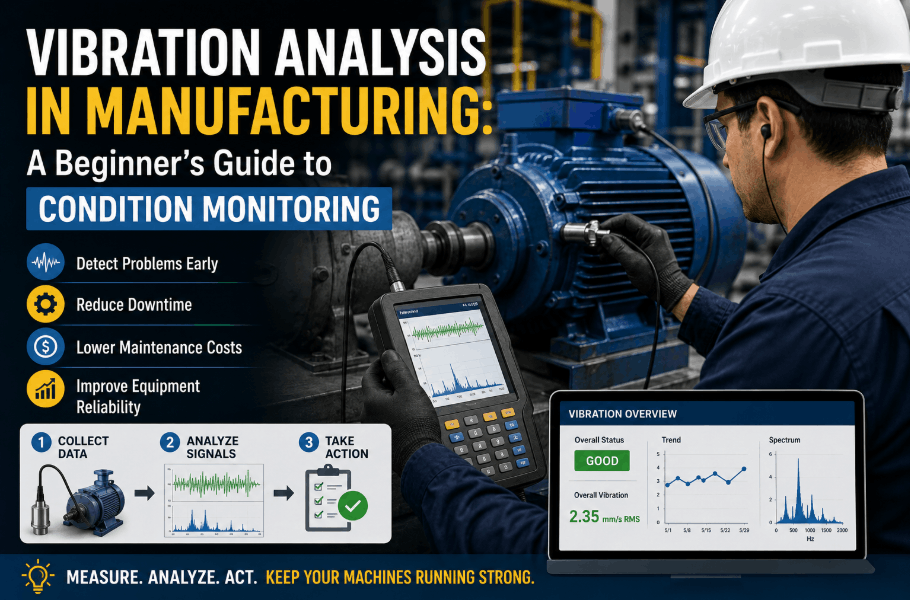
Vibration analysis works by measuring how a machine moves and comparing those movements to known healthy baselines. Three fundamental parameters define every vibration measurement: Sign Up Free to track all three automatically inside OxMaint's condition monitoring module.
Amplitude (Severity)
Amplitude measures how much a machine is vibrating — expressed in displacement (mils/microns), velocity (in/s or mm/s), or acceleration (g). Velocity is most commonly used for general machine health assessment because it correlates directly with energy and damage potential.
Frequency (Source Identification)
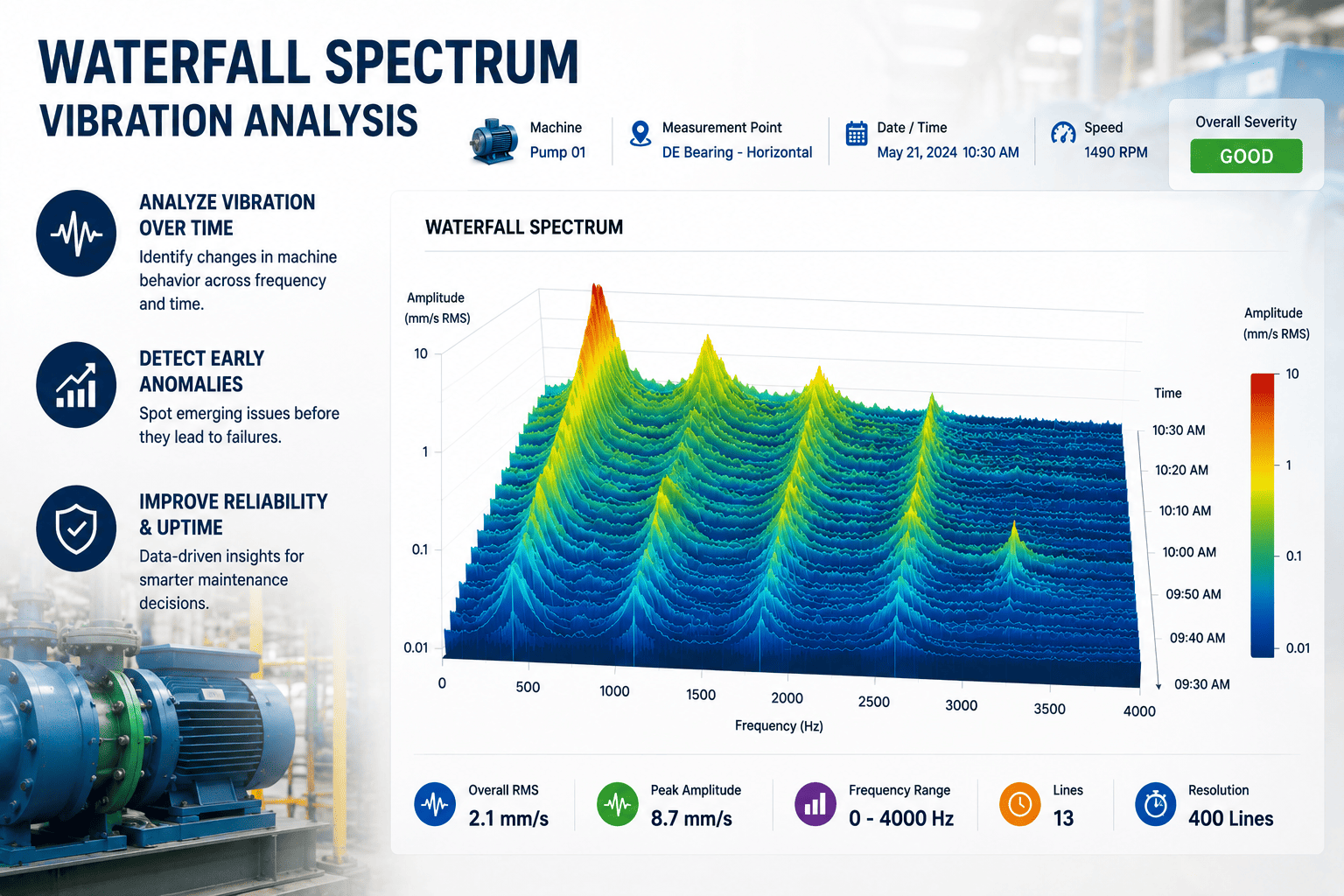
Frequency tells you what is causing the vibration. Imbalance appears at 1x running speed. Misalignment shows at 1x and 2x. Bearing defects produce high-frequency signals at specific defect frequencies. Reading a vibration spectrum (FFT) is the core skill in fault diagnosis.
Phase (Directional Behavior)
Phase analysis compares the timing of vibration at different measurement points. It is essential for distinguishing between imbalance and misalignment, and for confirming structural resonance — helping technicians pinpoint the exact source and direction of a problem.
Waveform (Time Domain)
The time waveform shows raw vibration over time. Impacting events — like a chipped gear tooth or a loose component striking a surface — appear clearly in the time waveform even when the frequency spectrum looks normal, making it a critical companion analysis tool.
Overall Vibration (RMS)
RMS (root mean square) overall vibration is the simplest health indicator — a single number representing total vibration energy. ISO 10816 defines severity thresholds by machine class. Trending overall vibration over time is the fastest way to detect when a machine's condition is deteriorating.
Bearing Defect Frequencies
Each bearing has four defect frequencies: BPFO (outer race), BPFI (inner race), BSF (ball spin), and FTF (cage). These are calculated from bearing geometry and shaft speed. When measured vibration matches these frequencies, bearing replacement can be scheduled before failure.
How to Set Up a Vibration Monitoring Program: Step by Step
Identify Critical Assets
Prioritize rotating equipment whose failure would cause production stoppage, safety risk, or high repair cost. Use your CMMS asset registry to rank by criticality score, failure history, and replacement lead time. OxMaint's asset management module lets you assign criticality tiers and filter which machines enter your vibration program first.
Define Measurement Points
For each machine, mark standard measurement locations: bearing housings (horizontal, vertical, axial), drive-end and non-drive-end positions. Consistent measurement points are critical — readings taken at different locations across routes cannot be trended accurately. Mark physical points with paint or stud mounts for repeatability.
Establish Baselines
Take initial vibration readings on healthy machines operating at normal load and speed. These baseline spectra and overall values become your reference. Without a baseline, you cannot identify what "normal" looks like for each specific asset in your environment — generic alarm thresholds alone are insufficient for reliable fault detection.
Set Alert Thresholds
Define alert and danger thresholds based on ISO 10816 guidelines and your baseline readings. Use two-tier alarming: a warning level (typically 2x baseline) that triggers inspection scheduling, and a danger level (typically 4x baseline or ISO danger zone) that triggers immediate action. OxMaint lets you configure asset-specific thresholds that auto-generate work orders when breached.
Choose Collection Method
Select between periodic route-based collection (handheld analyzer, monthly or quarterly) and continuous online monitoring (permanently mounted sensors with real-time data transmission). High-criticality machines benefit from continuous monitoring; route-based collection works well for secondary equipment. OxMaint supports both — routes for scheduled inspections, sensor integration for continuous data streams.
Integrate with CMMS and Act
Vibration data without a workflow to act on it delivers no value. Connect your condition monitoring system to your CMMS so that alarm breaches automatically create work orders with asset context, fault diagnosis, and recommended corrective actions. This closes the loop from detection to repair — the step most programs miss. Book a Demo to see OxMaint's predictive maintenance workflow in action.
Common Vibration Fault Patterns and What They Indicate
| Fault Type | Frequency Signature | Measurement Direction | Recommended Action |
|---|---|---|---|
| Mass Imbalance | Dominant 1x RPM | Radial (H & V) | Dynamic balancing of rotating element |
| Misalignment (Angular) | High 1x and 2x axial | Axial | Realign coupling; check for soft foot |
| Misalignment (Parallel) | High 2x radial | Radial | Laser alignment; check baseplate |
| Bearing Outer Race Defect | BPFO and harmonics | Radial | Plan bearing replacement within 4–6 weeks |
| Bearing Inner Race Defect | BPFI ± sidebands at 1x | Radial | Urgent bearing replacement; check lubrication |
| Looseness (Mechanical) | Sub-harmonics and truncated waveform | Radial | Inspect and torque all fasteners and mounts |
| Gear Mesh Fault | GMF = teeth × RPM, with sidebands | Radial, housing | Inspect gear tooth condition; check lubrication |
| Resonance | Natural frequency excited by operating speed | All directions | Structural modification or speed change to detune |
What Vibration Analysis Delivers for Manufacturing Operations
Build Your Vibration Monitoring Program on OxMaint
Configure measurement routes, set custom alert thresholds, and connect vibration alarms directly to your work order workflow — all in one platform built for manufacturing maintenance teams.
Choosing the Right Vibration Sensors for Your Equipment
Sensor selection is one of the most consequential decisions in a vibration program. The wrong transducer produces misleading data that leads to bad decisions. Sign Up Free and use OxMaint's asset configuration tools to log sensor types, mounting methods, and calibration records for every measurement point in your facility.
Vibration Analysis Maturity Model: From Reactive to Predictive
Most manufacturing facilities don't go from zero to a full predictive maintenance program overnight. Vibration analysis capability develops in stages — and each stage delivers measurable value. Book a Demo to see how OxMaint supports teams at every stage of this journey, from basic inspection logging to fully automated condition-based work order generation.
Reactive — No Monitoring
Equipment runs until failure. No vibration data collected. Maintenance is entirely corrective. Downtime is unplanned and expensive. Most facilities start here without realizing they have an alternative.
Basic Condition Checks
Technicians take informal "touch checks" or use basic handheld meters to assess machine temperature and overall vibration. Data is not recorded systematically. Improvements are noticed but trends cannot be established without historical records.
Route-Based Periodic Measurement
Formal measurement routes established. Technicians collect overall vibration readings on a monthly or quarterly schedule using handheld analyzers. Data is logged and trended. Alarm thresholds trigger inspection recommendations. This is where most teams see their first major reduction in unexpected failures.
Spectrum Analysis and Fault Diagnosis
Teams move beyond overall levels to analyze FFT spectra and identify specific fault types: imbalance, misalignment, bearing defects, looseness. Fault diagnosis is documented in the CMMS. Corrective work orders are linked to condition readings for full traceability and reliability analysis.
Continuous Online Monitoring and Automation
Permanently mounted sensors stream real-time vibration data to cloud analytics platforms. Alarm breaches automatically generate prioritized work orders in the CMMS. AI-assisted pattern recognition flags developing faults weeks in advance. Maintenance shifts from time-based to fully condition-based, eliminating unnecessary PM labor while maximizing equipment uptime.
Vibration Analysis Applications Across Manufacturing Environments
Pump and Motor Health
Pumps and motors are the most common monitored assets. Vibration analysis detects bearing wear, cavitation signatures, impeller imbalance, and shaft misalignment — the four leading causes of pump failure in process industries.
Gearbox Condition Monitoring
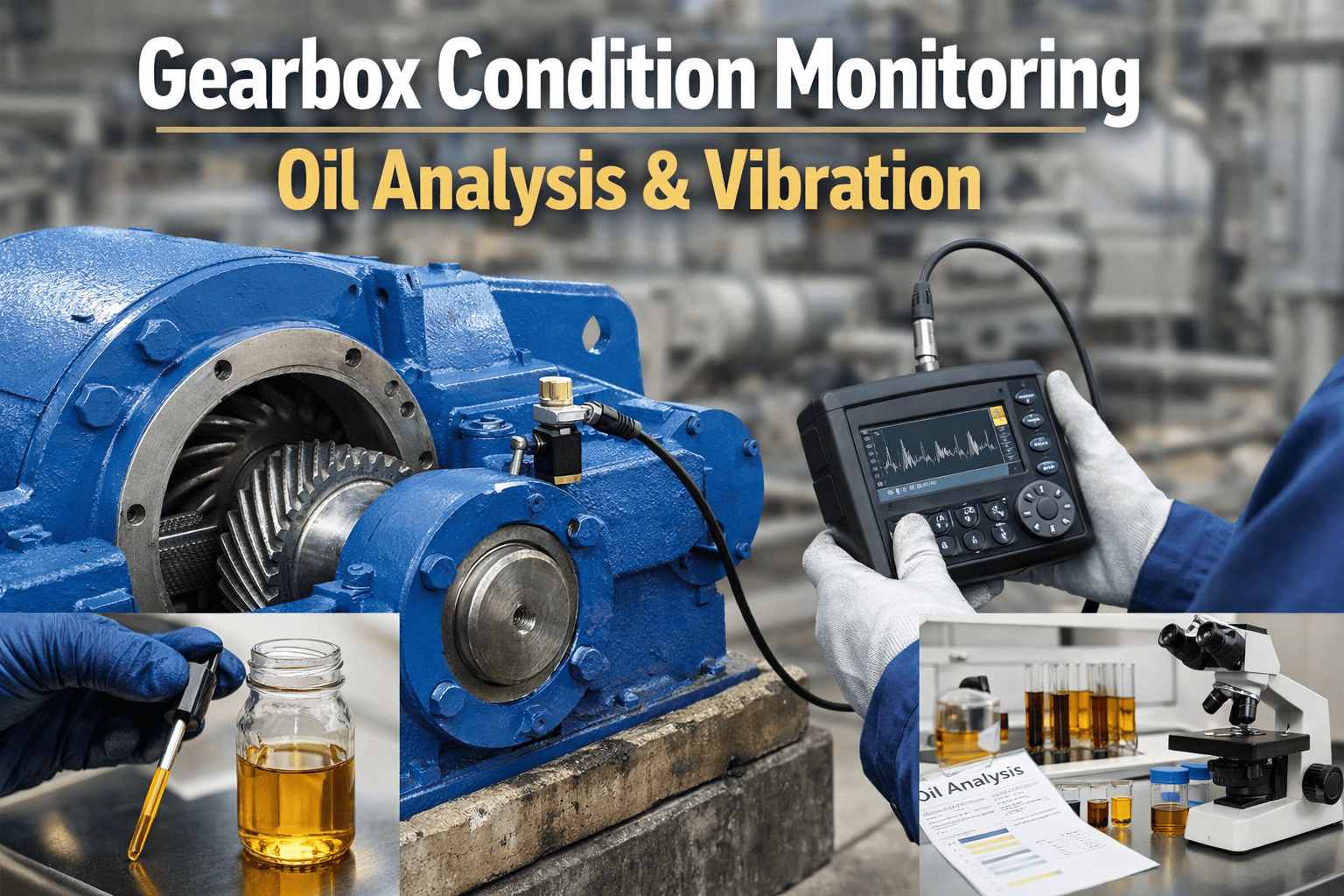
Gear mesh frequencies and their sidebands reveal tooth wear, eccentricity, and lubrication breakdown weeks before audible noise or temperature rise. Gearbox replacement costs $50K–$500K; monitoring saves significantly.
Fan and Blower Systems
Cooling fans and HVAC blowers are highly susceptible to aerodynamic imbalance from dirt buildup and blade erosion. Vibration routes on fan bearings catch deterioration before blade loss causes housing damage or safety incidents.
Compressor Monitoring
Reciprocating and centrifugal compressors carry significant vibration complexity. Vibration analysis combined with process parameter monitoring identifies valve wear, rotor rub, surge conditions, and foundation looseness in compressed air and gas systems.
How OxMaint Connects Vibration Data to Maintenance Workflows
Collecting vibration data is only half the job. The value is realized when that data drives faster, smarter maintenance decisions. OxMaint is built to close the loop between condition monitoring and corrective action — automatically. Sign Up Free and connect your vibration monitoring program to a CMMS that acts on what the data tells you.
Condition Data Logging
Log vibration readings — overall levels, peak values, and spectrum notes — directly against asset records in OxMaint's CMMS. Every measurement is timestamped and associated with the specific measurement point, creating a complete condition history that supports trend analysis and audit compliance.
Automated Work Order Triggers
Configure threshold rules so that when a vibration reading exceeds your warning or danger levels, OxMaint automatically creates a prioritized work order with asset context, measurement history, and recommended corrective action pre-populated — eliminating manual data entry and ensuring nothing falls through the cracks.
Predictive Maintenance Scheduling
OxMaint's predictive maintenance module uses condition data trends to calculate remaining useful life estimates and project optimal intervention windows. Instead of replacing components on fixed time intervals, teams replace them when condition data says they need it — reducing both failure risk and unnecessary PM cost.
Mobile Inspection Routes
Technicians execute vibration measurement routes on mobile devices — scanning asset QR codes, entering readings, and capturing photos of measurement setups. OxMaint's mobile app works offline and syncs when connectivity returns, making route-based programs viable even in facilities with poor network coverage.
Reliability Reporting and Analytics
OxMaint's reliability dashboard surfaces MTBF trends, asset-level failure rates, and maintenance cost per asset — allowing reliability engineers to demonstrate the ROI of the vibration program, justify capital investment in sensors, and prioritize which assets need closer monitoring based on failure history.
Parts and Inventory Coordination
When a vibration alarm triggers a work order, OxMaint automatically checks inventory for required parts and flags shortages. Bearing replacements, seal kits, and coupling components can be requisitioned directly from the work order — ensuring technicians have what they need before they arrive at the machine.
Vibration Analysis in Manufacturing — Common Questions
Ready to Start Your Vibration Monitoring Program?
OxMaint gives your team the tools to log condition data, set alarm thresholds, and automatically convert vibration alerts into prioritized work orders — getting your predictive maintenance program off the ground in days, not months.