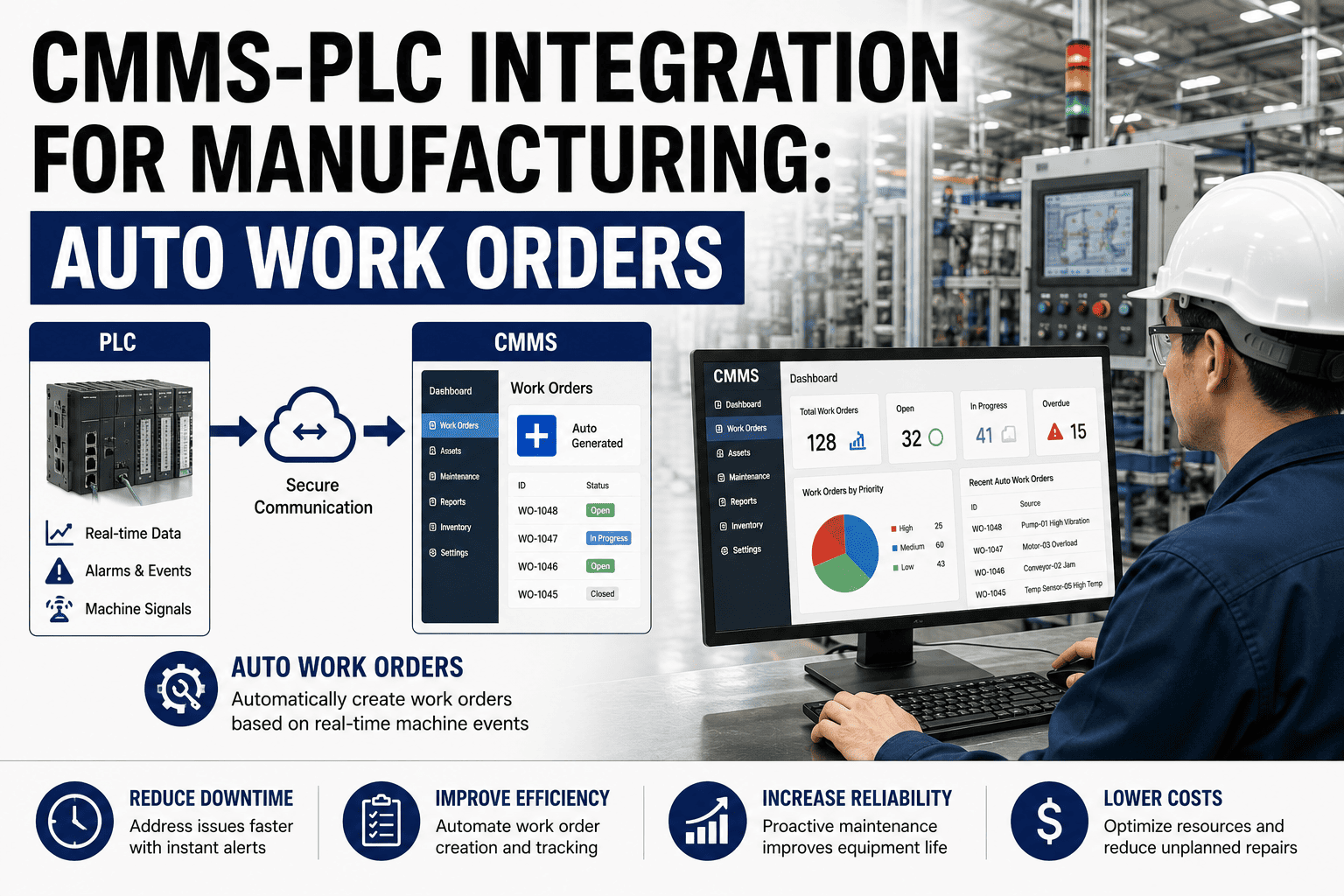
A maintenance work order is the operational core of every structured maintenance program — it is the formal document or digital record that authorizes, defines, and tracks a specific maintenance task from request to completion. In manufacturing and facility operations, work orders govern everything from emergency breakdowns to routine preventive checks, ensuring that every job is planned, assigned, resourced, and documented. Sign Up Free on OxMaint to replace manual work order processes with a digital CMMS that auto-creates, assigns, and tracks every work order across your asset fleet in real time. Whether you manage a single plant floor or a multi-site operation, understanding the types, lifecycle stages, and best practices of maintenance work orders is the first step toward building a reliability program that actually performs.
What Is a Maintenance Work Order?
A maintenance work order (WO) is a formally issued instruction that authorizes a technician or maintenance team to perform a defined task on a specific asset. It captures all information needed to plan, execute, and close a maintenance job — including asset identification, task description, required trade, parts and materials, estimated labor hours, priority level, safety requirements, and completion documentation. Book a Demo with OxMaint to see how digital work orders replace disconnected paper systems with a single trackable record per job.
Links each job to a specific machine or asset ID — enabling accurate maintenance history, cost tracking, and failure analysis per asset rather than per department.
Formally approves work to be performed, preventing unauthorized repairs and ensuring every maintenance activity is planned, budgeted, and documented.
Specifies required trade skills, estimated labor hours, spare parts, and tools — giving planners everything needed to schedule and resource the job before dispatch.
Creates a timestamped, signed-off audit trail for every completed job — supporting ISO, OSHA, and regulatory compliance requirements across manufacturing environments.
Types of Maintenance Work Orders in Manufacturing
Not all work orders are the same — each type serves a distinct operational purpose and demands different planning, priority, and resourcing approaches. Misclassifying work order types is one of the most common causes of poor maintenance planning, leading to reactive firefighting and inflated costs. Sign Up Free on OxMaint to classify, route, and track all work order types from a single digital platform.
Scheduled, recurring work orders generated automatically based on calendar intervals or meter-based triggers (runtime hours, cycles, production count). PM work orders represent the backbone of a proactive maintenance program — executed before failure to extend asset life, reduce breakdown frequency, and maintain rated equipment performance.
Issued when an inspection, operator report, or sensor alert identifies a fault condition that must be repaired — but without production-stopping urgency. Corrective WOs are planned and scheduled within normal maintenance windows, allowing proper resourcing with parts, labor, and permit preparation before work begins.
Unplanned work orders triggered by sudden equipment failure, safety incidents, or production-stopping breakdowns requiring immediate response. Emergency WOs bypass standard scheduling queues and demand instant technician dispatch, on-hand parts availability, and real-time status communication — capabilities that paper-based systems consistently fail to deliver under pressure.
Condition-triggered work orders generated when sensor data, vibration analysis, thermal imaging, or oil sample results indicate an asset is trending toward a failure threshold. Predictive WOs represent the highest-value maintenance strategy — intervening exactly when needed based on actual equipment condition rather than fixed time intervals.
Structured observation and measurement tasks that verify asset condition, operating parameters, and compliance status without performing physical repairs. Inspection WOs feed findings into corrective or predictive workflows — acting as the data collection layer that drives condition-based maintenance decisions. Book a Demo to see how OxMaint's mobile inspection checklists feed findings directly into corrective work order creation.
Planned work orders executed during scheduled equipment downtime, production shutdowns, or annual turnarounds — covering overhauls, major component replacements, and tasks that cannot be performed while the asset is operating. Shutdown WOs require the most intensive pre-planning: parts kitting, contractor coordination, permit preparation, and detailed task sequencing weeks in advance.
Core Fields Every Maintenance Work Order Must Contain
A work order that is missing critical fields becomes a source of delay, mis-assignment, and compliance gaps. The following fields are the minimum required data structure for a work order to be actionable and auditable in a manufacturing environment.
| Work Order Field | Purpose | Example Value |
|---|---|---|
| WO Number | Unique identifier for tracking, reporting, and audit reference | WO-2026-04817 |
| Asset ID / Equipment Tag | Links work to specific physical asset for history and cost tracking | PKG-Line3-Filler-02 |
| Work Order Type | Classifies job for scheduling, routing, and KPI reporting | Preventive / Corrective / Emergency |
| Task Description | Specific maintenance action to be performed | Replace worn conveyor belt drive chain |
| Priority Level | Drives dispatch queue order and response time SLA | Critical / High / Medium / Low |
| Assigned Technician / Trade | Named accountability and skill matching for the job | R. Verma — Mechanical |
| Estimated Labor Hours | Supports shift planning and maintenance labor budget allocation | 2.5 hrs |
| Parts / Materials Required | Enables pre-kitting and parts reservation before dispatch | Chain P/N 8821, Grease 500g |
| Safety / LOTO Requirements | Flags permit and isolation needs before technician arrives | LOTO Required / PPE Level 2 |
| Requested / Due Date | Controls scheduling priority and SLA compliance tracking | 2026-05-22 |
| Completion Sign-Off | Documents verified task completion with technician and supervisor signature | Completed — R. Verma 2026-05-21 |
The Maintenance Work Order Lifecycle: 7 Stages
Understanding the full work order lifecycle is essential to identifying where delays, data gaps, and compliance failures enter your maintenance process. Each stage has defined inputs, outputs, and responsible roles — and each stage is a potential failure point when managed manually. Sign Up Free on OxMaint to digitize and automate every stage of the WO lifecycle across your maintenance team.
A maintenance need is identified — by an operator, inspection finding, PM trigger, sensor alert, or supervisor observation — and a work request is submitted describing the asset, symptom, and urgency. This is the entry point to the WO lifecycle and the stage where most requests are lost or delayed in paper-based systems.
The maintenance planner or system reviews the request, assigns a WO number, classifies the work type (PM, corrective, emergency), sets priority level, and links the job to the correct asset record. For recurring PM tasks, CMMS systems like OxMaint auto-generate WOs on schedule without manual creation.
The planner defines task scope, identifies required parts and materials, estimates labor hours, assigns the required trade skill, maps any safety or permit requirements, and confirms parts availability in the storeroom. Thorough planning at this stage eliminates the most common causes of work order delay: missing parts and unprepared permits.
The planned work order is scheduled into a technician's work queue based on priority, crew availability, and production window constraints. For planned maintenance, scheduling is done days or weeks ahead; for emergency WOs, dispatch is immediate. OxMaint's mobile dispatch notifies technicians instantly with full job details on their device.
The technician performs the work, completes checklist steps, records actual labor time, documents parts consumed, captures meter readings, and logs any findings or additional defects identified during the job. Mobile work order execution on OxMaint captures this data in real time — eliminating transcription delays and lost paper records. Book a Demo to see the mobile execution workflow live.
The completed work order is reviewed by the supervisor or planner — verifying task completion, parts usage, labor time accuracy, and any follow-up actions required. Upon approval, the WO is formally closed, triggering cost allocation to the asset record and updating the PM compliance tracker.
Closed work order data feeds into KPI dashboards — tracking mean time between failures (MTBF), mean time to repair (MTTR), PM compliance rates, labor cost per asset, and reactive-to-planned maintenance ratios. This analysis layer is where maintenance programs shift from reactive to predictive — but only when WO data is consistently captured and digitally accessible.
Work Order Priority Classification System
Effective work order management depends on a consistent priority system that routes jobs to the right technician at the right time — preventing both overreaction to routine issues and delayed response to critical failures. The following four-tier priority framework is the industry standard for manufacturing maintenance operations.
Production-stopping failure, safety hazard, or environmental incident. Immediate dispatch required — response target under 1 hour. Bypass standard scheduling queue.
Degraded equipment performance with imminent failure risk. Significant production impact if unaddressed. Schedule within current or next shift window.
Known fault condition with manageable production impact. Can be planned and resourced properly before execution. Schedule within current week's maintenance window.
Preventive, inspection, and non-urgent improvement tasks. Scheduled based on crew availability and production windows. Tracked for PM compliance rate reporting.
Work Order Management KPIs for 2026
Use these industry benchmarks to evaluate whether your work order management system is delivering the reliability and cost outcomes a structured maintenance program should produce.
Work Order Management Best Practices for Manufacturing Operations
The gap between a work order system that exists and one that actually improves equipment reliability comes down to execution discipline and data quality. These best practices reflect how top-performing maintenance teams in manufacturing manage work orders to drive measurable reliability and cost outcomes. Book a Demo with OxMaint to see how these practices are built directly into the platform workflow.
Maintenance work performed outside the work order system is invisible to planners, cost accountants, and reliability engineers. Every job — no matter how small — must have a WO number. This discipline is the single most important factor in building the asset history and failure data that drives PM optimization and failure analysis.
Work orders dispatched without completed planning (parts confirmed, permits identified, scope defined) create technician delays, wasted trips, and extended downtime. The planning step is non-negotiable for all but true emergency work. Facilities that plan 100% of planned work before scheduling achieve 20–30% higher wrench-time efficiency than those that plan reactively.
Paper-based work order completion relies on technicians transcribing notes hours or days after the job — introducing errors, omissions, and delays that corrupt your asset history database. Mobile work order execution on OxMaint captures labor time, parts used, meter readings, findings, and photos at the point of work — creating accurate, timestamped records without additional administrative burden.
Corrective work orders that capture only the repair performed — without recording the failure mode, root cause, and detected condition — build no analytical value over time. Requiring failure code capture on every corrective and emergency WO gives reliability engineers the data needed to identify repeat failures, optimize PM tasks, and justify condition monitoring investments.
An unmanaged work order backlog is a leading indicator of a maintenance program under resource strain. Review the full WO backlog weekly — monitoring aging P1/P2 orders, backlog trend by trade, and planned-to-reactive ratio shifts. Deteriorating trends in these metrics signal capacity constraints before they manifest as increased breakdown frequency. Sign Up Free on OxMaint to access live backlog dashboards with aging alerts built in.
The most underutilized asset in most maintenance programs is the historical work order database. Analyzing closed WO data — failure patterns, repeat repair frequency, parts consumption by asset, and MTBF trends — provides the evidence base for PM frequency optimization, spare parts stocking decisions, and capital replacement planning. A CMMS that captures consistent WO data over 12–24 months gives maintenance leaders a fact-based tool for program improvement that spreadsheet tracking cannot replicate.