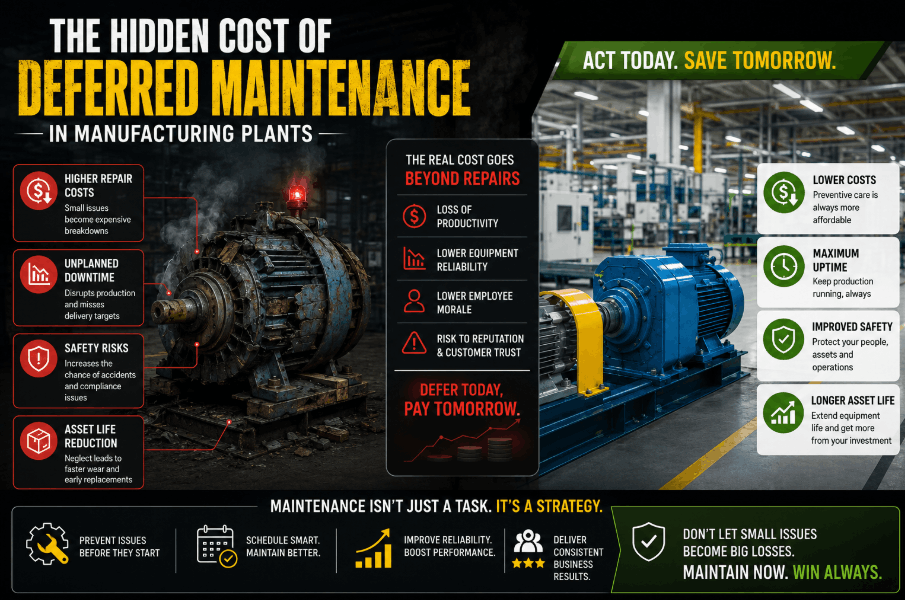
Deferred maintenance is one of the most expensive decisions a manufacturing plant can make — yet most facilities don't realize the true cost until equipment fails at the worst possible moment. Every repair that gets pushed to next quarter silently compounds into a liability that drains capital budgets, endangers workers, and accelerates asset deterioration. Sign Up Free to start quantifying your deferred maintenance backlog and reclaim control of your facility's financial health.
Eliminate Deferred Maintenance Backlog with OxMaint CMMS
OxMaint helps plant managers track every overdue task, calculate backlog cost, and build data-driven PM schedules that prevent deferred maintenance from compounding into capital failures.
What Is Deferred Maintenance — and Why It's Dangerous
Deferred maintenance occurs when a known maintenance task — inspection, lubrication, component replacement, or corrective repair — is postponed beyond its scheduled window due to budget constraints, labor shortages, or production pressure. Unlike planned preventive maintenance, deferred tasks don't disappear: they accumulate into a liability that grows with every passing shift. In manufacturing plants, deferred maintenance is rarely a single oversight — it's a pattern that quietly erodes equipment reliability, inflates repair costs, and creates cascading failure risk across entire production lines. Book a Demo to see how OxMaint surfaces and prioritizes your deferred maintenance backlog in real time.
The Real Financial Cost of Deferred Maintenance
The visible cost of a deferred repair is the invoice — but the true cost includes lost production, emergency labor premiums, expedited parts, regulatory penalties, and accelerated asset replacement. Most maintenance managers underestimate deferred maintenance liability by 300–400% because they only account for the repair itself, not the downstream financial impact. Sign Up Free to track deferred maintenance backlog value and its projected risk exposure inside OxMaint.
Emergency Repair Premiums
Reactive repairs triggered by deferred maintenance failures cost 4–5x more than planned interventions — factoring in emergency labor rates, expedited shipping, and unplanned production stoppage that compounds every hour the line is down.
Accelerated Asset Degradation
Each deferred lubrication, alignment check, or seal replacement shortens asset service life. Equipment running beyond its maintenance window degrades at 2–3x the normal wear rate, moving asset replacement timelines forward by years.
Production Revenue Loss
Unplanned downtime from deferred maintenance failures costs manufacturing plants an average of $260,000 per hour across high-throughput operations. One deferred repair on a critical conveyor or press line can wipe out an entire quarter's maintenance budget savings.
Regulatory and Compliance Liability
In regulated environments — food processing, pharmaceuticals, heavy industry — deferred safety and compliance-related maintenance creates audit exposure, potential OSHA violations, and insurance premium escalation that far outweighs the original deferral savings.
Compounding Backlog Growth
Deferred maintenance backlogs grow exponentially, not linearly. A single deferred PM creates downstream failures that generate 3–5 additional corrective work orders — each competing for the same constrained maintenance labor and parts inventory.
Safety Incident Exposure
Deferred safety-critical maintenance — guards, interlocks, pressure relief, electrical insulation — exponentially increases workplace injury risk. A single recordable incident from neglected equipment can cost $40,000–$150,000 in direct and indirect costs.
Deferred Maintenance vs. Planned Maintenance: The Cost Gap
Understanding the cost differential between deferred and planned maintenance is the single most persuasive argument for CMMS investment. Book a Demo to see how OxMaint's work order and PM scheduling tools close the gap between reactive and proactive maintenance programs.
How to Calculate Your Deferred Maintenance Backlog Cost
Quantifying your deferred maintenance liability turns an invisible budget risk into a boardroom-ready capital justification. The calculation requires four data inputs — most of which a CMMS can surface automatically. Sign Up Free to automate backlog cost tracking in OxMaint without manual spreadsheet work.
Inventory All Open Deferred Tasks
List every overdue PM, inspection, and corrective work order that has been postponed. A CMMS work order system makes this instant — manual tracking routinely undercounts deferred backlog by 20–30%.
Assign Repair Cost Estimates
Attach a planned repair cost to each deferred task. Then apply a 4x emergency multiplier to any task with a confirmed failure risk — this captures the realistic cost if the deferral results in an unplanned breakdown.
Estimate Production Loss Exposure
For each deferred task on a critical asset, calculate your hourly production revenue and multiply by the estimated failure-induced downtime. This is typically the largest component of true deferred maintenance cost.
Prioritize by Risk-Weighted Cost
Rank deferred tasks by total risk-weighted cost — not just repair cost. High-revenue production lines with aging equipment carry disproportionate liability. Address the highest-cost-risk items first to maximize immediate backlog reduction ROI.
Industry Benchmarks: Deferred Maintenance Cost by Sector
Deferred maintenance cost profiles vary by industry, asset intensity, and regulatory environment. Benchmarking your backlog against sector norms reveals whether your maintenance investment gap is average — or dangerously above peer facilities. Book a Demo to benchmark your facility's deferred maintenance exposure against OxMaint's industry reference database.
5 Strategies to Eliminate Deferred Maintenance Backlog
Reducing deferred maintenance backlog is not a single budget decision — it requires a systematic approach that combines prioritization, scheduling, data visibility, and consistent execution. The following strategies represent the highest-impact methods for manufacturing plants to close their maintenance investment gap within 12 months.
Centralize All Deferred Tasks in a CMMS Work Order System
You cannot manage what you cannot see. A CMMS that captures every overdue task, assigns priority scores, and calculates backlog cost per asset gives maintenance managers the visibility to make defensible capital allocation decisions — replacing gut-feel deferral with data-backed prioritization.
Rank Backlog by Risk-Weighted Financial Exposure
Not all deferred maintenance is equal. Prioritize backlog items by their combined repair cost, failure probability, and production revenue exposure. A $500 deferred bearing replacement on a $200K/hr production line carries far greater urgency than a $2,000 deferred task on a non-critical support system.
Use Condition Monitoring to Validate Deferral Safety Windows
When deferred maintenance is unavoidable, condition-based monitoring — vibration analysis, thermal imaging, oil sampling — provides data-validated evidence of how long deferral can safely continue. This replaces assumption-based deferral with risk-quantified scheduling and reduces emergency failure probability.
Build Backlog Reduction Into Annual Maintenance Budgets
Treat deferred maintenance backlog as a funded liability, not an invisible cost. Allocating 10–15% of the annual maintenance budget to systematic backlog reduction prevents year-over-year compounding that eventually forces emergency capital expenditure at multiples of the original deferral value.
Implement Predictive PM Scheduling to Prevent Future Deferral
The most effective way to eliminate deferred maintenance is to prevent its formation. PM schedules built on actual MTBF data — rather than fixed calendar intervals — optimize task frequency, reduce unnecessary maintenance load, and create realistic schedules that technicians can execute without chronic deferral patterns.
How OxMaint CMMS Reduces Deferred Maintenance Liability
OxMaint is a purpose-built CMMS platform that gives manufacturing maintenance teams the tools to identify, quantify, and systematically eliminate deferred maintenance backlog. From work order automation and PM scheduling to real-time asset health dashboards and mobile technician workflows, OxMaint closes the data gap that allows deferred maintenance to accumulate invisibly. Book a Demo to see OxMaint's deferred maintenance tracking and backlog management features in action.
- Deferred tasks tracked in disconnected spreadsheets
- No visibility into total backlog cost or risk exposure
- PM schedules based on fixed intervals, not asset data
- Failure root causes undocumented, repeat failures unchecked
- Budget justification for maintenance investment impossible
- Every deferred task logged, prioritized, and costed in real time
- Risk-weighted backlog dashboard for capital allocation decisions
- MTBF-driven PM schedules that prevent future deferral
- Failure mode tracking and RCA workflows built into work orders
- Maintenance ROI reports that justify investment to leadership
Quantify Your Deferred Maintenance Backlog Today
OxMaint surfaces every overdue task, calculates your total deferred maintenance liability, and builds the PM schedule that prevents it from growing — starting from day one.
Frequently Asked Questions: Deferred Maintenance in Manufacturing
What is the true cost of deferred maintenance in manufacturing?
The true cost includes emergency repair premiums (4–5x planned rates), production revenue loss, accelerated asset degradation, compliance penalties, and safety incident exposure. Most plants underestimate deferred maintenance liability by 300–400% by counting only repair invoices.
How do you calculate deferred maintenance backlog cost?
Multiply all deferred tasks by their estimated repair cost, apply a failure risk multiplier for critical assets, and add production loss exposure per hour of potential downtime. A CMMS like OxMaint automates this calculation across your full asset registry.
How long can maintenance safely be deferred on rotating equipment?
Safe deferral windows depend on asset condition, load profile, and failure consequence. Condition monitoring (vibration, thermal, oil analysis) is the only reliable way to extend deferral safely — calendar-based assumptions regularly lead to unexpected failures.
How does a CMMS help reduce deferred maintenance?
A CMMS prevents deferred maintenance by creating visibility into every overdue task, automating PM scheduling based on asset data, and flagging backlog accumulation before it compounds into emergency failures and capital replacement events.
What is the ROI of addressing deferred maintenance backlog?
Facilities that systematically reduce deferred maintenance backlog typically see 40% lower reactive maintenance costs, 2.4x longer asset service life, and $260K+ in annual savings per facility within 12 months of implementing structured PM programs.
Is deferred maintenance always avoidable?
Not always — but it should be deliberate, documented, and risk-quantified rather than invisible. When deferral is necessary, a CMMS ensures the task remains visible, prioritized, and scheduled for the earliest available maintenance window with risk controls in place.
Stop Letting Deferred Maintenance Cost You Millions
OxMaint gives your maintenance team the backlog visibility, PM automation, and reliability analytics to eliminate deferred maintenance liability and protect your plant's production capacity — from day one.


![oee-calculation-template-for-manufacturing-plants-[excel---dashboard]](./manage-post-2k26/uploads/oee-calculation-template-for-manufacturing-plants-[excel---dashboard].png)

.png)