The moment an attack crosses from your business network into the plant floor, every instinct your IT incident response plan trained into your team becomes wrong. IT's first move is to isolate and shut down the infected machine. On the plant floor, shutting down the wrong PLC can breach a reactor, wreck a batch, or put an operator in danger. OT systems run on different hardware, different clocks, and different consequences — and 22% of industrial organizations reported an OT cyber incident in the past year, 40% of which disrupted operations. Improvising when it happens is how a containable event becomes a plant-wide outage. This guide shows how to build an OT incident response plan that keeps your manufacturing plant safe and recoverable. Sign up free or book a demo.
OT / ICS Cybersecurity · Manufacturing · Incident Response · 2026
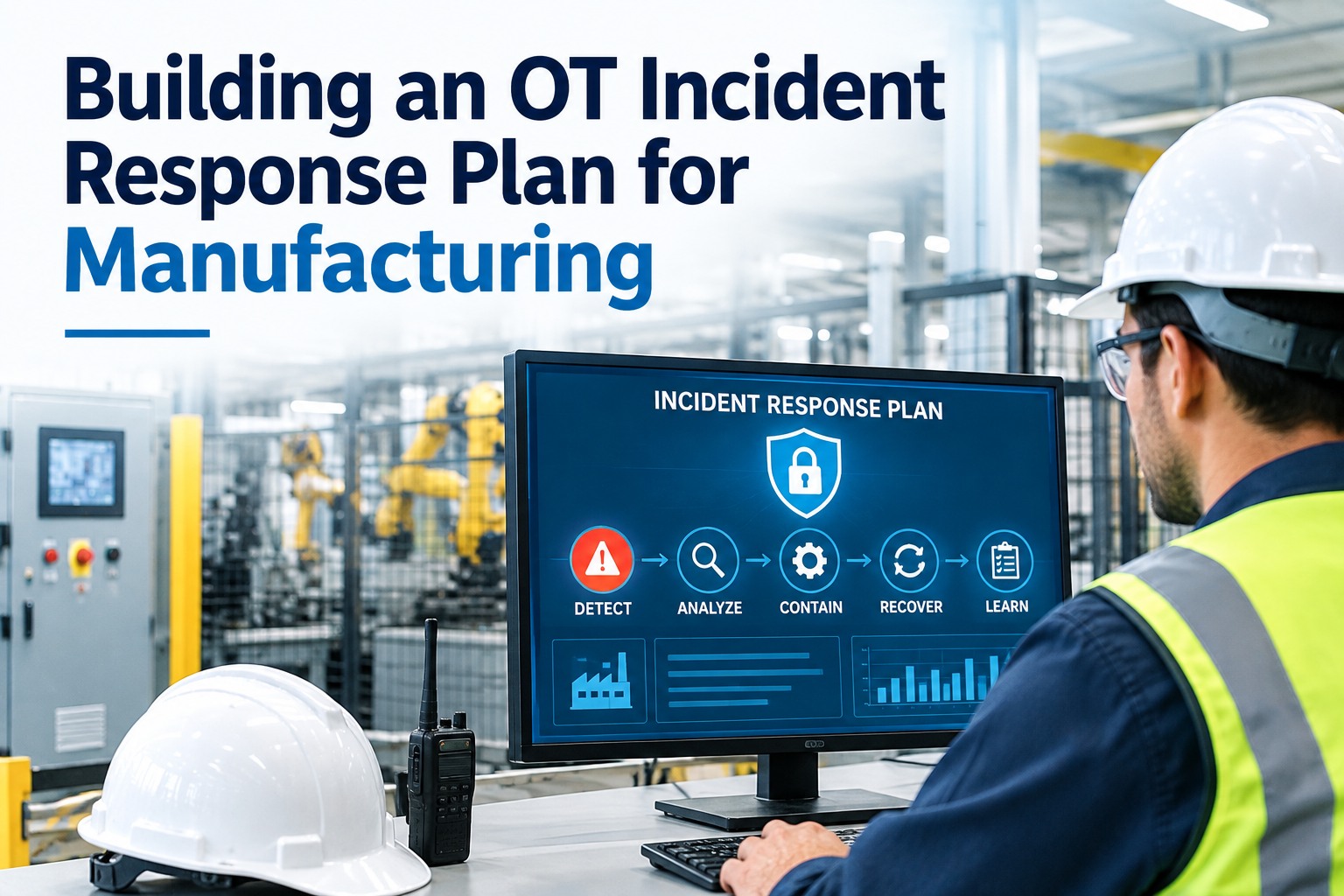
Building an OT Incident Response Plan for Manufacturing
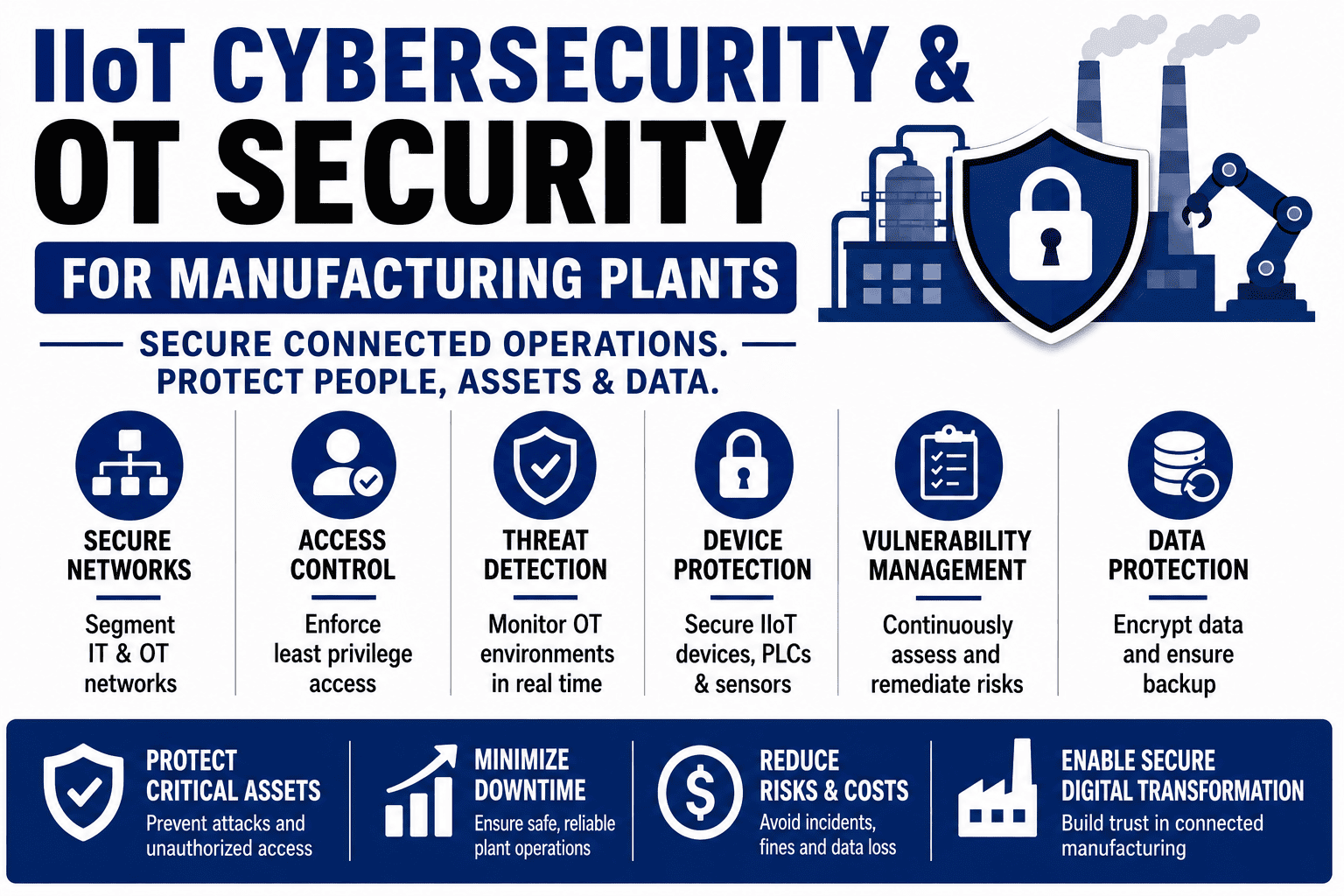
When an OT attack hits, improvising costs you. A plan written for IT will do the wrong thing on the plant floor — because on the floor, availability and safety outrank confidentiality, and pulling the plug can be the most dangerous move of all. Here's how to build a plan that fits how a plant actually runs.
22%
of OT organizations had a cyber incident in the past year
40%
of those incidents disrupted physical operations
~20%
took more than a month to fully remediate
50%
began with unauthorized external or remote access
Why an IT Playbook Fails on the Plant Floor
The single most common mistake in industrial incident response is bringing an IT playbook one-to-one into the OT environment. It fails because the two worlds invert each other's priorities. IT defends the confidentiality of data; OT defends the availability and safety of a physical process. IT can quarantine and reimage a laptop in minutes; an OT device may be a decade-old PLC that supports no security agent and cannot be taken offline without halting a production line. Get that inversion wrong under pressure and the response itself becomes the incident.
IT Incident Response Assumes
- PriorityConfidentiality first — protect the data
- ReflexIsolate and shut down the infected host
- PatchingRegular cycles, agents on every endpoint
- DowntimeTolerable, often invisible to customers
- RecoveryReimage from a known-good gold image
OT Reality Demands
- PrioritySafety and availability first — protect the process
- ReflexShutting the wrong node can be the dangerous act
- PatchingRare — a PLC offline can stop the whole line
- DowntimeDirectly costs product, throughput, and safety
- RecoveryRestore controller configs and operator images
The Five Phases, Re-Read for OT
A sound OT plan follows the same lifecycle NIST defines for IT — but each phase carries a different weight when the asset under attack controls a physical process. This is the backbone every framework agrees on; the difference is entirely in how you execute it. Book a demo to map these phases to your own zones and lines.
1
Prepare
Build the asset inventory, define zones and conduits, write OT-specific playbooks, and set the chain of command before anything happens. Preparation is where OT response is won — you cannot improvise a safe shutdown sequence mid-attack.
2
Detect & Analyze
OT-aware monitoring watches Purdue Levels 1–2 for anomalies IT tools never see. The analysis question is unique: is this a data breach, or a threat to the physical process — loss of view, loss of control?
3
Contain
Isolate the affected zone using the segmentation you built in advance — not by yanking cables. Containment must preserve safe process state, which sometimes means keeping a compromised-but-stable system running under watch.
4
Eradicate & Recover
Restore from validated backups of controller configurations, operator station images, and historians. Recovery in OT is reconstitution of a control system, not a laptop reimage — and it must be verified safe before reconnection.
5
Post-Incident
Report to the sectoral authority within required windows, capture lessons, and feed them back into the playbooks and the next tabletop. The loop only closes when the plan gets better because of what happened.
The Four Things Every OT Plan Must Contain
Frameworks are abstract; a plan an operator can execute at 3 a.m. is concrete. Across NIST SP 800-82 and IEC 62443, four elements consistently separate a plan that holds up from a binder that gathers dust. Sign up free about building these into your operation.
Playbooks
OT-Specific Scenarios, Not Generic Ones
Write for the incidents that actually happen in a plant: "Ransomware on the HMI network," "Loss of view / loss of control," "Compromised third-party remote session." Each with concrete first moves — because generic advice evaporates under pressure.
Chain of Command
Who Can Authorize a Shutdown
Define, in writing, who has the authority to physically isolate a production zone and who can order the transition to manual operation. In a crisis there can be no ambiguity about who makes the call to stop the line.
Safe Mode
A Manual Fail-Safe for Every Critical Process
For each critical process, document how it runs — or safely stops — without its digital controls. Safe-mode operation is what lets you contain a threat without gambling the physical safety of the plant.
Communication
Who You Tell, and How Fast
An emergency contact list, internal escalation path, and the regulatory reporting clock — often a 24 / 72-hour notification window to a sectoral CSIRT. Decide the message and the messenger before the phones start ringing.
The Plan You Never Rehearsed Is a Plan You Don't Have.
A binder that has never survived a tabletop is a guess. OxMaint helps manufacturers turn OT incident response from a document into a drilled capability — mapped to NIST SP 800-82 and IEC 62443, grounded in your real asset inventory and zone architecture.
The Tabletop Is Where the Plan Becomes Real
A plan proves itself only when a cross-functional team runs it against a scenario before a real attacker does. A proper OT tabletop puts the CISO, plant manager, control engineers, and communications lead in one room and plays out a scenario end to end. What good looks like: during the crisis there's no panic — the team executes a practiced playbook that isolates the threat while keeping the physical process safe or bringing it down deliberately. The exercise surfaces the gaps a document never will — an unreachable decision-maker, a backup nobody tested, an authority nobody defined.
01
Pick a Plausible Scenario
Ransomware spillover from IT into the HMI network — the most common real path — or a compromised vendor remote session.
02
Get the Right People in the Room
CISO, plant manager, control engineers, and PR — the same people who'd be paged for real, making the same calls.
03
Run It to a Decision, Not a Discussion
Force the hard calls: who isolates the zone, who authorizes manual operation, when you notify the regulator.
04
Feed the Gaps Back In
Every gap the exercise exposes becomes a playbook edit. Run tabletops on a schedule — capability decays without them.
Aligning to NIST and IEC 62443 Without Drowning in Them
You don't have to choose between the two major frameworks — most mature manufacturers use both, because they answer different questions. Here's the practical division of labor, and where incident response lives in each. Book a demo to see how OxMaint maps your plant to both.
NIST SP 800-82 Rev 3
The practitioner baseline
The US federal guide to OT security, widely adopted globally. It provides the technical baseline for asset inventory, network segmentation, compensating controls for legacy systems, and an incident-response process adapted from NIST 800-61 to OT constraints.
Answers: how do I secure and respond in practice?
ISA / IEC 62443
The prescriptive standard
The international standard for industrial control system security. It defines the zone-and-conduit segmentation model, Security Levels SL1–SL4, and — in 62443-2-1 — explicit requirements for incident response policies, procedures, and training you can certify against.
Answers: what must my program formally require?
Build the plan once, drill it on a schedule, and align it to both frameworks — and an OT incident becomes something your plant executes through, not something that executes your plant. Book a demo or Sign up free to get started.
Frequently Asked Questions
Why can't we just use our IT incident response plan for OT?
Because the priorities invert. IT protects data confidentiality and can isolate or reimage a host freely; OT protects process safety and availability, where shutting down the wrong controller can be the dangerous act. An IT playbook run on the plant floor often makes the incident worse.
What is "safe mode" in an OT incident response plan?
It's a documented way to run — or safely stop — each critical process without its digital controls. Manual fail-safe procedures let you contain a cyber threat without gambling the physical safety of the plant or losing control of the process.
How often should we run OT tabletop exercises?
On a regular schedule, not once. Response capability decays as people, systems, and threats change. Cross-functional tabletops with the CISO, plant managers, and control engineers keep the plan current and the team practiced — many programs run them quarterly.
Do we need both NIST SP 800-82 and IEC 62443?
Most mature manufacturers use both. NIST SP 800-82 gives the practical technical baseline for OT security and response; IEC 62443 provides the prescriptive, certifiable program requirements — including 62443-2-1 for incident response policies and training.
Where do most OT incidents actually start?
Roughly half begin with unauthorized external or remote access, and USB drives and contractor laptops account for a large share. Secure remote access, asset visibility, and segmentation are the controls with the biggest gap between need and current capability.
How does OxMaint help with OT incident response?
OxMaint helps manufacturers ground their plan in a real asset inventory and zone architecture, align it to NIST and IEC 62443, and turn it into a drilled capability rather than a static binder.
Sign up free to start.
Don't Write the Plan During the Attack.
Build an OT incident response plan that fits how your plant actually runs — safety-first containment, manual fail-safes, a clear chain of command, and tabletops that turn a document into a capability. OxMaint maps it to NIST SP 800-82 and IEC 62443, grounded in your real assets and zones.