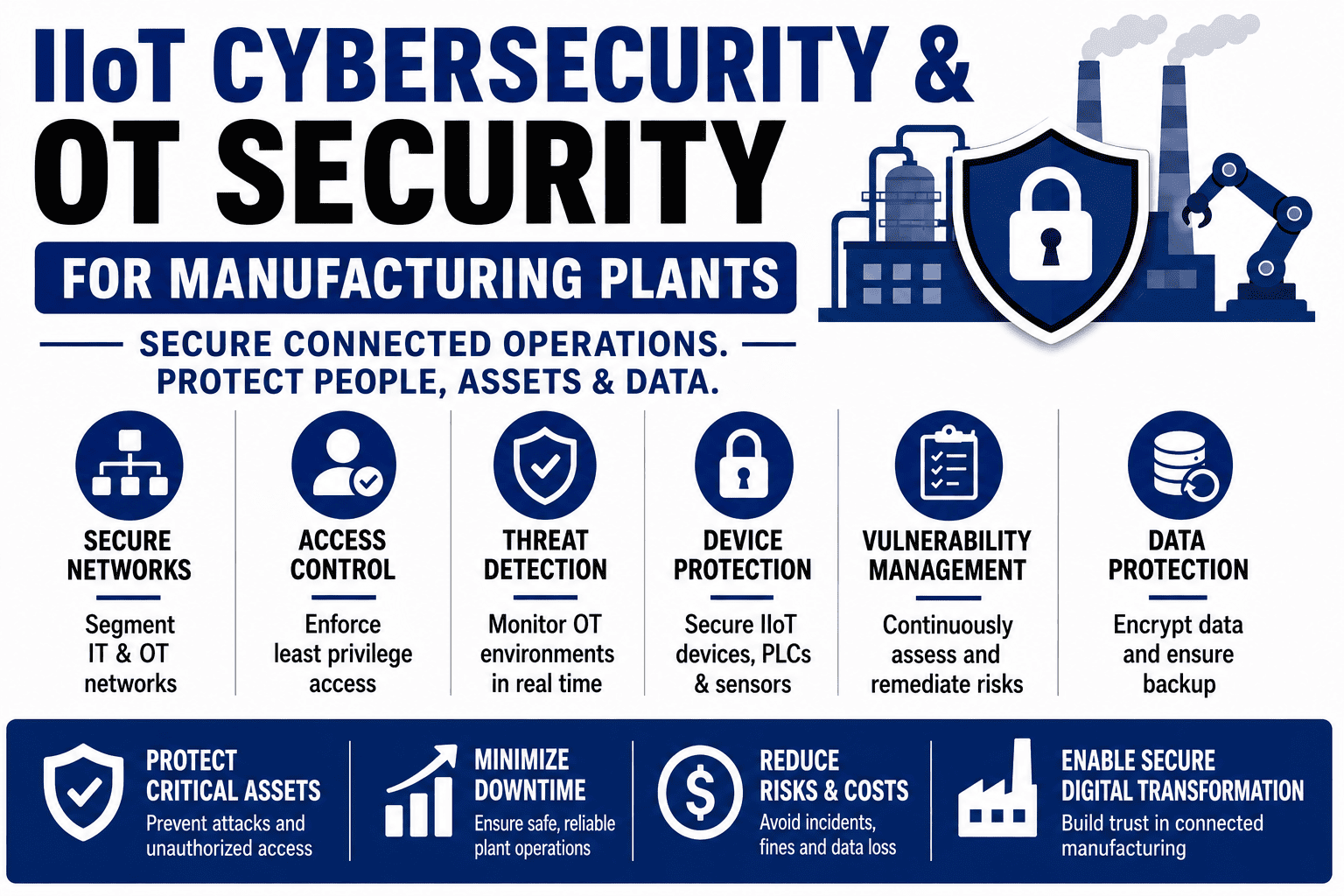
IIoT cybersecurity for manufacturing is no longer optional — every connected sensor, PLC, and edge gateway expands the attack surface of your plant floor, and IEC 62443 has become the global benchmark for defending operational technology environments. OT security in manufacturing plants demands a structured approach: network segmentation into zones and conduits, continuous asset inventory, rigorous patch management, and secure connectivity between maintenance systems and industrial control systems. This guide walks maintenance and reliability leaders through the core pillars of manufacturing OT security, maps them to the IEC 62443 framework, and shows how a secure CMMS like OxMaint closes the gap between IT governance and maintenance execution. Ready to modernize your maintenance operations? Start Free Trial and see the difference.
OT Security Guide for Manufacturing
Is Your Connected Plant a Soft Target for Cyberattacks?
The average industrial breach costs manufacturers $4.7M and causes 18 days of production downtime. Securing IIoT and OT assets under IEC 62443 is the fastest path to defensible, audit-ready operations — and OxMaint makes secure maintenance execution the backbone of that posture.
IEC 62443 Foundations
What IEC 62443 Means for Manufacturing OT Security
IEC 62443 is the internationally recognized standard for industrial automation and control systems (IACS) cybersecurity. For a manufacturing plant, it defines four security levels (SL 1–4) and requires you to partition your network into zones and conduits — grouping assets by risk and strictly controlling the data that flows between them.
Security Levels (SL 1–4)
SL 1 guards against casual violation; SL 2 against intentional violation using low resources; SL 3 against sophisticated attackers; SL 4 against nation-state actors. Most plants target SL 2–3 for their core OT environment, requiring role-based access, intrusion detection, and audit logging.
Zones & Conduits
A zone groups assets sharing the same security requirements — e.g., the cell-level PLCs on an assembly line. Conduits are the controlled communication paths between zones. Proper segmentation prevents a compromised sensor from becoming a gateway to your historian or SCADA layer.
IT/OT Convergence Risk
When CMMS data, work orders, and condition-monitoring dashboards flow from OT to IT networks, each integration point is a potential ingress. IEC 62443-3-3 requires authentication, encryption, and non-repudiation on every conduit crossing the IT/OT boundary.
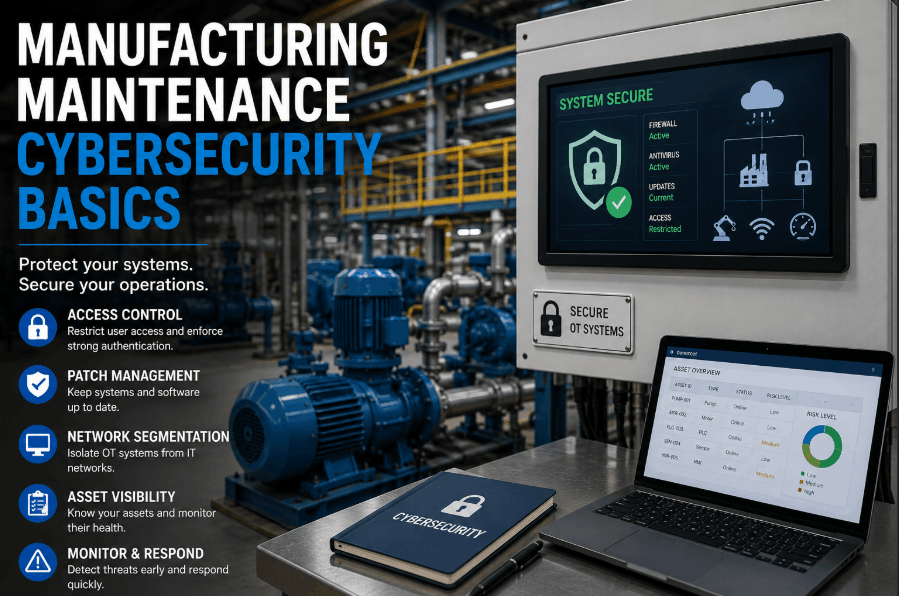
A defensible IIoT security posture starts not with firewalls, but with a complete, continuously updated inventory of every connected asset — because you cannot protect what you cannot see.
Attack Surface Audit
Manufacturing IoT Security Checklist: 8 Controls Every Plant Needs
Before investing in new tooling, benchmark your current plant against these eight foundational controls. Most facilities we audit meet fewer than four of them on the first pass — and each gap is a potential entry point for ransomware or sabotage.
Complete Asset Inventory
Every PLC, RTU, HMI, sensor, and edge gateway catalogued with firmware version, IP address, owner, and criticality rating — refreshed weekly, not annually.
Network Segmentation (Purdue Model)
DMZ between Levels 3 and 4, no direct internet access from PLCs, firewalls or data diodes on every inter-zone conduit.
Patch & Vulnerability Management
Monthly CVE scanning of all IIoT assets; prioritized patch windows tied to maintenance shutdowns; documented exceptions with compensating controls.
Role-Based Access Control (RBAC)
Unique credentials per user; least-privilege roles for operators, technicians, and vendors; MFA on every remote or vendor access session.
Secure CMMS Connectivity
Your maintenance system connects to OT assets via encrypted, authenticated APIs — never flat-network RDP or shared service accounts.
Continuous Monitoring & Logging
SIEM ingestion of PLC config changes, login events, and CMMS work-order modifications; alerts on off-hours access or firmware drift.
Incident Response & Recovery Plan
Documented runbooks for ransomware isolation, verified offline backups of PLC logic and HMI projects, and quarterly tabletop exercises.
Vendor & Supply-Chain Security
SBOM (software bill of materials) requested from OEMs; vendor access time-boxed and recorded; legacy equipment isolated behind firewalls.
Worked Example
The Real Cost of Skipping OT Cybersecurity — A 180-Asset Plant Scenario
Consider a mid-sized food-and-beverage facility running 180 networked assets — mixers, conveyors, HVAC, and packaging lines — managed on spreadsheets and a legacy on-premise CMMS with flat-network access. A single phishing email compromises an engineering workstation, and within 6 hours ransomware has encrypted the historian and disabled three packaging lines.
Downtime: 11 days of partial production at $28K/day lost output
Ransom & Recovery: $180K negotiated settlement + $95K IR consultant fees
Lost Inventory: $42K of perishable work-in-progress scrapped
Overtime: $23K in emergency maintenance and cleanup labor
Total Impact: ~$548K
Blast Radius: Incident isolated to one cell — 2 lines keep running
Detection: SIEM flags firmware drift in 12 minutes; MFA blocks lateral move
Downtime: 9 hours of isolated repair on a single packaging line
Audit Trail: Full work-order and access logs ready for compliance in 1 click
Total Impact: ~$14K
OxMaint + OT Security
How OxMaint Strengthens IIoT OT Security for Maintenance Teams
OxMaint is built so that maintenance and reliability teams become a pillar of your IEC 62443 posture — not a gap. By replacing paper work orders, unmanaged spreadsheets, and flat-network remote access with a secure, audited, AI-powered CMMS, OxMaint gives you four concrete security advantages:
Secure, Audited Asset Registry
Every asset — PLC, motor, heat exchanger — lives in a single encrypted registry with firmware version, zone assignment, criticality, and full change history. You always know what is on the network and who touched it last, satisfying IEC 62443-3-3 asset inventory requirements.
Role-Based Access & MFA
Granular RBAC ensures technicians, contractors, and supervisors see only the assets and actions their role permits — with mandatory MFA on every login and time-boxed vendor access tokens. No more shared passwords or untraceable admin accounts.
Patch-Linked Preventive Maintenance
Automatically generate work orders for firmware updates and security patches, scheduled into your shutdown windows. OxMaint tracks completion, verifies patch level, and flags unpatched critical assets on the maintenance dashboard.
Encrypted IT/OT Data Conduit
OxMaint exchanges condition-monitoring data, work-order status, and sensor readings with your OT layer via TLS-encrypted, token-authenticated APIs — never flat RDP. Every data crossing is logged and tamper-evident for audit.
See OxMaint Secure Your Plant's Maintenance Operations
Book a 30-minute demo and we'll map your asset inventory, zone structure, and patch workflow to IEC 62443 controls — live on your data.
Frequently Asked Questions
IIoT & OT Security for Manufacturing — Your Questions Answered
What is IEC 62443 and why does it matter for manufacturing plants?
IEC 62443 is the global cybersecurity standard for industrial automation and control systems. It matters for manufacturing because it provides a structured, auditable framework — security levels, zones, conduits, and access controls — that plants can implement to protect IIoT and OT assets from both external attackers and insider threats, while satisfying insurer and regulatory requirements.
How does a CMMS improve OT cybersecurity?
A secure CMMS like OxMaint improves OT cybersecurity by maintaining a real-time, authenticated asset inventory, enforcing role-based access and MFA, automating patch-linked work orders, and creating a tamper-evident audit trail of every maintenance action. This closes the visibility and accountability gaps that attackers exploit. You can explore the platform with a Start Free Trial.
What is the difference between IT and OT security in a manufacturing plant?
IT security prioritizes data confidentiality and is measured in seconds of detection. OT security prioritizes safety and availability — a PLC must not be interrupted during a production run — and is measured in days of sustained uptime. OT systems often run legacy protocols and cannot be patched on a standard monthly cycle, requiring network segmentation and compensating controls instead.
How do zones and conduits work in IEC 62443?
Zones are logical groupings of assets that share the same security requirements — for example, all robots in a welding cell. Conduits are the controlled, authenticated communication paths that allow data to move between zones. By segmenting the plant into zones and tightening conduits with firewalls or data diodes, you limit the blast radius of any single compromised device.
How long does it take to implement IEC 62443 controls in a manufacturing plant?
A focused implementation targeting SL 2 typically takes 4–8 months for a mid-sized plant: 4–6 weeks for asset discovery and zone design, 8–12 weeks for network segmentation and access-control rollout, and ongoing cycles for patch management and monitoring. Using OxMaint to digitize asset inventory and work-order governance can compress the discovery and documentation phase by 50–60%. Book a Demo to see your tailored timeline.
Build a Defensible OT Security Posture with OxMaint
From asset inventory to patch-linked work orders to encrypted IT/OT conduits, OxMaint turns your maintenance team into your strongest cybersecurity layer. Start your free trial or book a personalized demo today.
Free 14-day trial · No credit card