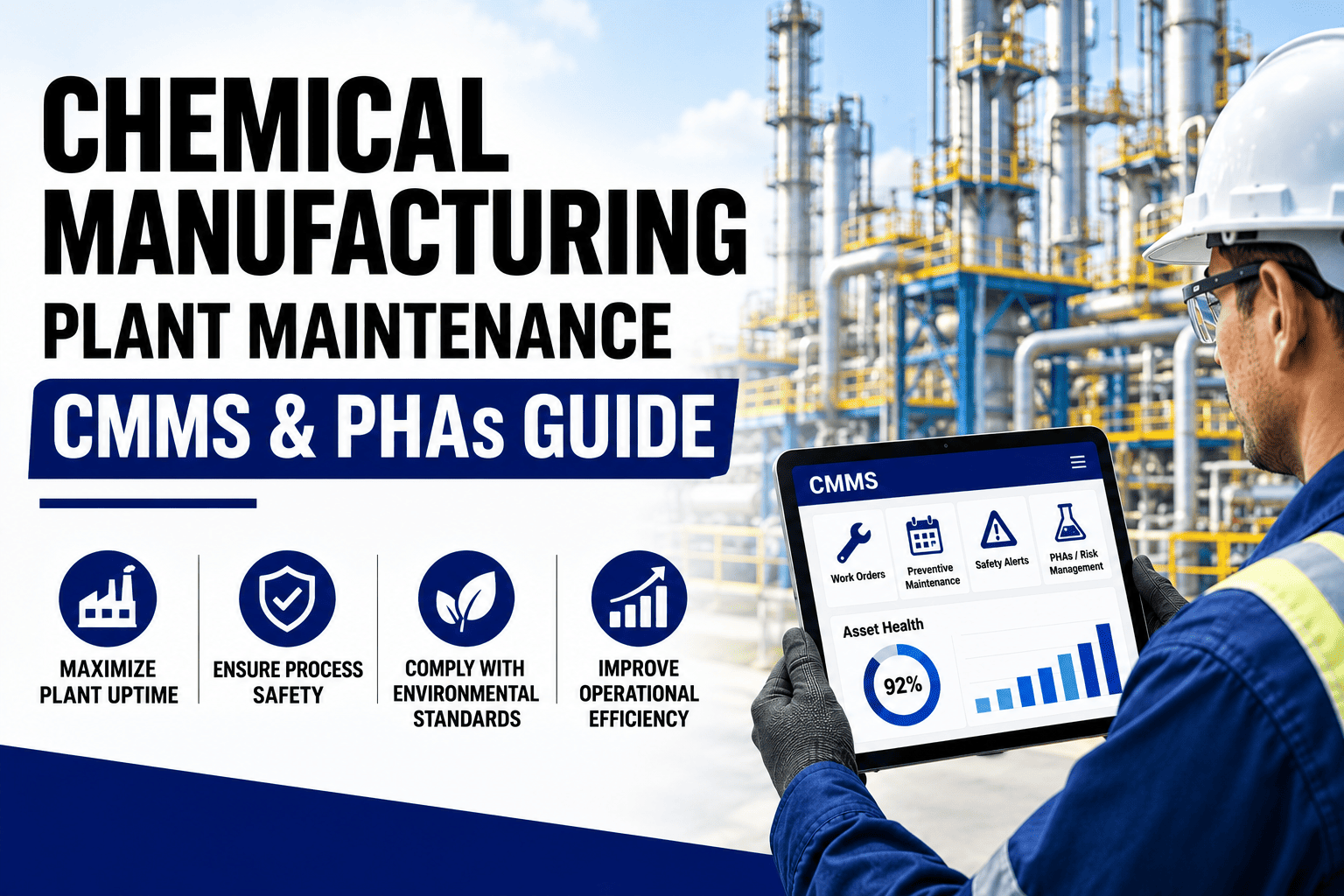
Chemical manufacturing plant maintenance carries stakes that no other industry faces: a missed preventive task on a pressure vessel or relief valve can trigger a catastrophic release, OSHA citation, or worse. This guide shows how a purpose-built chemical plant CMMS structures PHA action tracking, mechanical integrity programs, MOC integration, PSSR, and LOPA support so your maintenance team satisfies OSHA PSM 1910.119 and EPA RMP audits without drowning in spreadsheets. Whether you run a 180-asset batch plant or a 2,000-asset continuous operation, the right chemical manufacturing CMMS turns process safety obligations into scheduled, traceable work. Ready to see it on your assets? Start Free Trial or read on for the full framework.
CHEMICAL PLANT MAINTENANCE GUIDE 2026
Can your CMMS survive an OSHA PSM audit tomorrow?
Most chemical plants discover maintenance gaps during a PHA revalidation or post-incident investigation — not before. A chemical manufacturing CMMS that ties every work order to PHA actions, mechanical integrity inspections, and MOC records means you walk into every audit with a defensible, time-stamped trail.
OSHA PSM + EPA RMP ALIGNMENT
Why chemical plant maintenance needs a PSM-driven CMMS
OSHA's Process Safety Management standard (29 CFR 1910.119) requires 14 elements, and four of them — Mechanical Integrity, Management of Change, Pre-Startup Safety Review, and Incident Investigation — land directly on the maintenance department's plate. EPA's Risk Management Program (40 CFR Part 68) mirrors most of these obligations for regulated substances. A generic CMMS that simply schedules oil changes and tracks labor hours cannot satisfy an auditor who asks to see inspection records for every relief device in a covered process.
A chemical plant CMMS built for PSM closes that gap by linking each asset to its process safety role, each inspection to its code requirement (API 510, API 570, API 653, NBIC, ASME B31.3), and each corrective action to the PHA or LOPA recommendation that generated it. The result: fewer surprises, fewer citations, and a maintenance program that performs under pressure.
Mechanical Integrity (1910.119(j))
Equipment used to process, store, or handle highly hazardous chemicals must be inspected and tested on a documented schedule. A PSM maintenance CMMS assigns each asset an MI category, inspection frequency, and code basis — then generates work orders automatically.
Management of Change (1910.119(l))
Every change to process equipment, procedures, or operating limits requires an MOC review before implementation. Your CMMS should flag assets under active MOC and block PM modifications until the review is signed off.
Pre-Startup Safety Review (1910.119(i))
Before introducing highly hazardous chemicals to new or modified equipment, a PSSR confirms construction matches design, safety systems are in place, and training is complete. A chemical manufacturing CMMS generates PSSR checklists and ties them to the MOC that triggered the change.
PHA Action Tracking
Every Process Hazard Analysis generates recommendations — relief valve sizing, added interlocks, updated operating procedures. Without a CMMS that tracks each recommendation to closure with an owner and due date, actions stall and recertification deadlines slip.
STRUCTURING YOUR CMMS
Chemical plant PM: building a mechanical integrity program that audits well
A defensible mechanical integrity program starts with an asset hierarchy that mirrors your P&IDs and includes every piece of equipment in a covered process — pressure vessels, storage tanks, piping, relief and vent systems, emergency shutdown systems, controls, and pumps. Each asset record in your chemical plant CMMS should carry its MI inspection category, applicable code, last inspection date, next due date, and the qualified inspector who signed off.
| MI Asset Category | Applicable Code | Typical Inspection Frequency | CMMS Trigger |
|---|---|---|---|
| Pressure Vessels | API 510 / NBIC | External 5 yrs · Internal 10 yrs | Time-based PM + condition-based |
| Process Piping | API 570 / ASME B31.3 | Visual 5 yrs · CML UT 5–10 yrs | CML-based inspection route |
| Aboveground Storage Tanks | API 653 | External 5 yrs · Internal 10–20 yrs | RBI-adjusted PM |
| Relief Devices (PSV/PRV) | API 510 / ASME VIII | Bench test 1–5 yrs (service-dependent) | Pop-test PM per service severity |
| Flare & Vent Systems | API 521 / API 537 | Visual quarterly · Full inspect 5 yrs | Route-based inspection PM |
| Emergency Shutdown Systems | IEC 61511 / OSHA PSM | Proof test per SIL rating (1–3 yrs) | SIL-linked proof-test PM |
A mid-sized specialty chemical plant (approximately 180 covered-process assets) typically spends $35,000–$55,000 per year managing MI inspections on spreadsheets — labor for scheduling, field data collection, report assembly, and audit response. When a single missed relief valve test can yield an OSHA citation of $15,625 per violation (2026 penalty level) and potentially ten times that for repeat or willful violations, the ROI of a chemical plant CMMS that never lets an inspection lapse becomes self-evident.
WORKED EXAMPLE
From spreadsheet chaos to audit-ready in 90 days
Consider a 180-asset batch chemical plant spending $42,000 annually on a paper-and-spreadsheet maintenance program. During their last PHA revalidation, the team identified 37 open PHA recommendations, 12 overdue relief valve tests, and 3 pressure vessels past their API 510 internal inspection window — all because due dates lived in separate Excel files maintained by different people.
HOW OXMAINT HELPS
Chemical manufacturing CMMS capabilities that cut risk and downtime
OxMaint is an AI-powered CMMS and EAM platform built for maintenance and reliability teams in process industries. For chemical manufacturing, it maps directly to the PSM and MI obligations that generic maintenance software ignores — turning compliance burden into a competitive advantage.
PHA & LOPA Action Tracking
Import every PHA and LOPA recommendation as a tracked work order with owner, due date, and resolution evidence. OxMaint auto-escalates overdue actions and generates closure reports for your next revalidation.
MI Inspection Scheduling by Code
Assign each asset an MI category (API 510, API 570, API 653, NBIC) and OxMaint generates inspection PMs at the correct frequency, routes them to qualified inspectors, and stores results with digital signatures.
MOC Integration & PSSR
Block PM changes and equipment modifications until an MOC review is signed off. Auto-generate PSSR checklists linked to the triggering MOC so no new process goes online without safety verification.
AI Predictive Failure Alerts
OxMaint's AI analyzes vibration, temperature, and pressure trends from sensors and inspection history to predict asset failures weeks before they occur — prioritizing work orders by risk to process safety and production.
SPREADSHEET VS. CMMS
The hidden cost of running chemical plant maintenance on spreadsheets
Many chemical plants still manage mechanical integrity and PM scheduling with Excel workbooks, shared drives, and paper work orders. The approach feels inexpensive until an audit, a near-miss, or a forced shutdown exposes the gaps. Below is a side-by-side comparison of what changes when you move to a purpose-built chemical manufacturing CMMS.
| Capability | Spreadsheets & Paper | OxMaint CMMS |
|---|---|---|
| PM & MI inspection scheduling | Manual date tracking; overdue items easily missed | Auto-generated PMs by code; real-time overdue alerts |
| PHA action tracking | Separate log; no link to work orders | Each recommendation becomes a tracked, closed-loop work order |
| MOC workflow | Email approvals; no system block on changes | MOC gate blocks PM/equipment changes until signed off |
| Audit evidence package | Days of report assembly across multiple files | One-click MI compliance report with full traceability |
| Spare parts for critical assets | No link between BOM and inspection findings | Auto-reorder triggered by inspection deficiency flags |
| Predictive maintenance | Not possible with static spreadsheets | AI predicts failures from sensor + inspection data |
See OxMaint on your assets — book a 30-min demo
Walk through a live chemical plant CMMS configured for PSM compliance, MI inspections, and PHA action tracking. We will show you exactly how your team would use it on day one.
FAQ
Chemical plant maintenance & CMMS: frequently asked questions
What is a chemical plant CMMS and how does it support PSM compliance?
A chemical plant CMMS is a computerized maintenance management system configured to manage the mechanical integrity, inspection, and work-order obligations under OSHA PSM 1910.119 and EPA RMP. It supports PSM compliance by scheduling code-based inspections (API 510, API 570, API 653), tracking PHA and LOPA recommendations to closure, integrating MOC workflows, and generating audit-ready evidence packages with time-stamped records. You can see how OxMaint handles this by booking a demo at calendly.com/oxmaintapp/30min.
How often should relief devices be inspected in a chemical plant?
Relief devices (PSVs and PRVs) should be bench-tested or replaced on a service-dependent interval — typically every 1 to 5 years. Clean services may extend to 5 years, while fouling, corrosive, or coking services require annual testing. Your chemical plant CMMS should assign each relief device a service-severity rating and auto-generate pop-test PMs at the correct frequency.
What is the difference between PM and mechanical integrity under PSM?
Preventive maintenance (PM) is the broader practice of scheduling routine tasks — lubrication, filter changes, calibration — to keep equipment running. Mechanical integrity (MI) is the PSM-mandated subset that specifically covers inspection and testing of equipment used to process, store, or handle highly hazardous chemicals, governed by recognized engineering codes. A PSM maintenance CMMS manages both, but MI inspections carry additional documentation and code-traceability requirements.
How does a CMMS support Management of Change (MOC) in chemical manufacturing?
A CMMS supports MOC by gating equipment and PM modifications behind a formal review-and-approval workflow. When a change is proposed, the CMMS blocks edits to the asset record or PM schedule until the MOC is reviewed for safety, training, and procedure impacts, then signed off by authorized personnel. After approval, it can auto-generate a PSSR checklist to verify readiness before startup.
How long does it take to implement a CMMS in a chemical plant?
A typical chemical plant CMMS implementation for a 180-asset facility takes 60 to 90 days, including asset hierarchy loading, MI baseline import, PM schedule configuration, and team training. Larger continuous-process plants with 1,000+ assets may take 4 to 6 months. OxMaint's AI-assisted onboarding accelerates this by auto-categorizing assets and suggesting PM templates — you can start a free trial at app.oxmaint.ai to evaluate the platform on your own data.
START YOUR PSM-READY CMMS TODAY
Stop guessing. Start auditing with confidence.
Join the chemical manufacturing teams using OxMaint to cut unplanned downtime 30–50%, eliminate paper work orders, and walk into every OSHA PSM audit with a defensible, time-stamped trail.
Free 14-day trial · No credit card