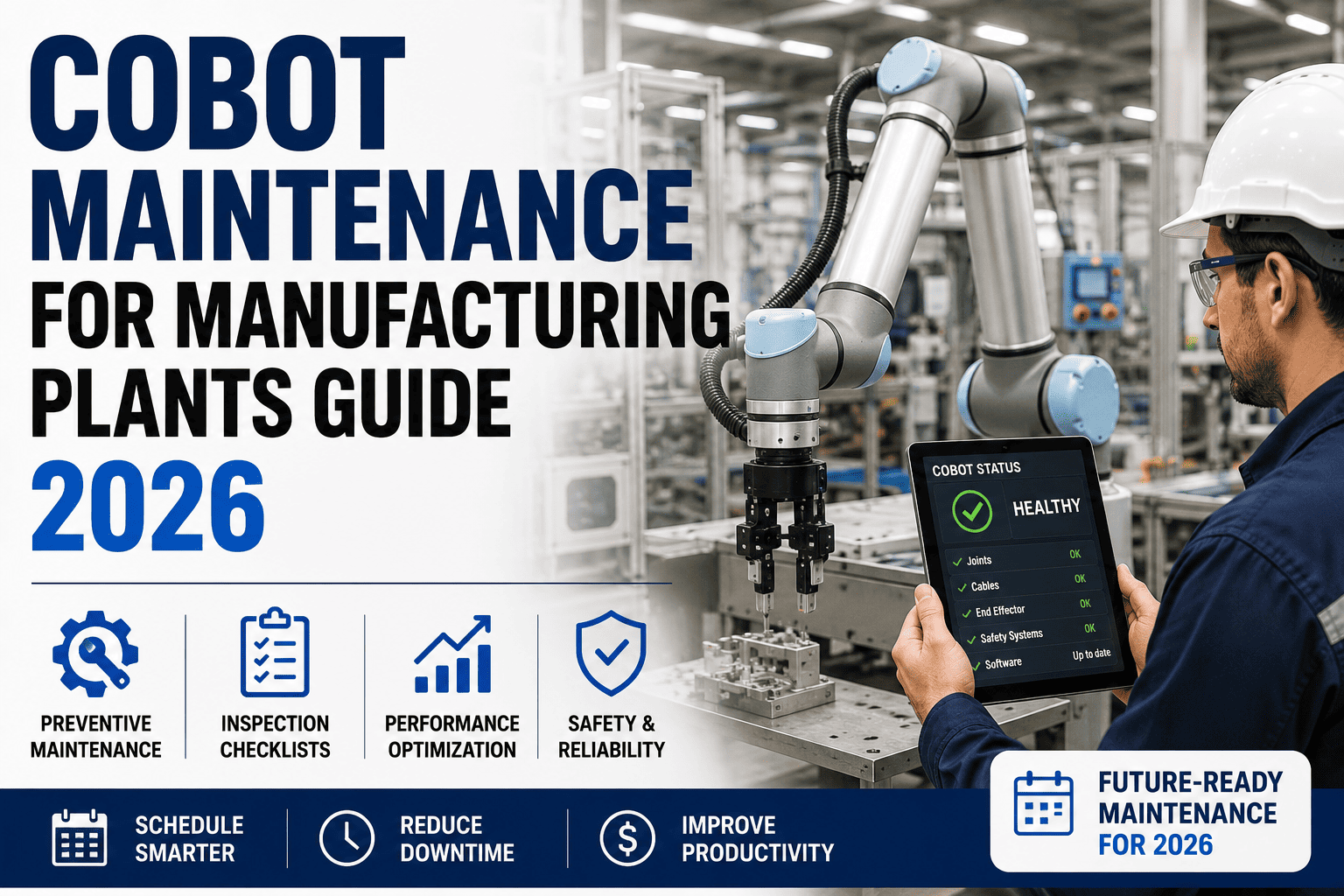
Cobot maintenance for manufacturing plants is no longer optional as collaborative robots move from lab demos to line workhorses running 16–20 hour shifts. A structured cobot PM program covering joint lubrication, force-torque sensor calibration, safety-rated component checks and program version control keeps unplanned downtime below 2% while extending mean time between failures by 30–40%. This 2026 guide walks maintenance and reliability teams through the inspection cadences, CMMS work-order structures and predictive signals that make collaborative robot maintenance repeatable — and shows how OxMaint automates the entire workflow. Ready to modernize your program? Start Free Trial and configure your first cobot PM plan in under an hour.
Is your cobot fleet protected by a maintenance plan built for 2026 — or still running on sticky notes?
Collaborative robots now average 40,000+ operating cycles per year on manufacturing lines. Without a structured cobot PM program, sensor drift, joint wear and safety-rated component fatigue quietly erode OEE — until an unplanned outage costs you $4,200 per hour.
Why cobot maintenance in manufacturing demands a new playbook
Unlike traditional industrial robots caged behind fences, collaborative robots operate alongside humans — which means their failure modes directly impact both production uptime and worker safety. ISO/TS 15066 compliance, force-limited joint architecture and power-and-force monitoring sensors introduce maintenance touchpoints that conventional robot PM checklists never covered.
A mid-sized auto-components plant running 12 cobots across assembly and machine-tending cells was losing 18 hours per month to unplanned stoppages — sensor recalibrations, joint backlash events and cable failures — costing roughly $904K annually in lost throughput. After implementing a CMMS-driven cobot maintenance program with weekly safety inspections and quarterly force-torque calibration, unplanned events dropped 62% within four months.
Cobot inspection and PM checklist for manufacturing plants
A complete cobot PM guide breaks maintenance into four tiers: daily safety checks, weekly mechanical inspections, monthly calibration verification and quarterly deep-service routines. Each tier maps to specific safety-rated components, wear parts and software states that a CMMS should track as automated work orders.
- Verify emergency stop function on teach pendant and external safety circuit
- Inspect power-and-force monitoring — trigger a calibrated contact event
- Check collaborative workspace for obstructions within the safety-rated zone
- Confirm teach pendant responsiveness and error-log review for overnight faults
- Visually inspect end-effector, tooling and cable management for wear or snags
- Joint lubrication verification — check grease levels on J1–J6 actuators per OEM spec
- Inspect joint backlash and repeatability using a calibration target test
- Torque-check mounting bolts and base plate to specified values
- Examine cable bundles, energy chains and connector strain relief
- Clean vision sensors, force-torque sensor faces and gripper contact pads
- Force-torque sensor calibration verification against a reference weight set
- Tool-center-point (TCP) accuracy validation — target ≤0.05 mm deviation
- Program version control audit — confirm production logic matches golden version
- Controller firmware and safety-function patch review
- Review cycle-count trend data and flag joints approaching OEM life threshold
- Full joint lubrication renewal and gear-train inspection per OEM cycle
- Safety-rated component certification — relays, light curtains, area scanners
- Controller backup, battery replacement and log archiving for audit trail
- Vibration and current-draw baseline rebuild for predictive trend comparison
- Spare-parts inventory reconciliation — harmonic drives, belts, sensor modules
Manufacturing cobot PM schedule: frequency, tasks and standards
This cadence table gives maintenance managers a defensible cobot service schedule aligned with ISO 10218 (robot safety), ISO/TS 15066 (collaborative operation) and ISO 55000 (asset management). Each row becomes a recurring work order in OxMaint — with digital checklists, photo capture and sign-off traceability.
| Frequency | Maintenance Task | Standard / Reference | Downtime Window | Typical Cost if Skipped |
|---|---|---|---|---|
| Daily | E-stop test, force-monitoring check, workspace inspection | ISO/TS 15066 | 5 min / start of shift | $4.2K per safety event |
| Weekly | Joint lubrication check, cable inspection, bolt torque | OEM manual + ISO 10218 | 20–30 min | $1.8K per joint failure |
| Monthly | Force-torque calibration, TCP validation, version control audit | ISO 10218-1 | 45–60 min | $3.5K per drift-related defect |
| Quarterly | Gear inspection, safety certification, predictive baseline | ISO 55000 + OEM | 2–4 hours | $12K+ per unplanned overhaul |
| Annually | Full joint lubrication renewal, controller battery, firmware audit | OEM + ISO 10218-2 | 4–8 hours | $22K+ per major failure |
What a 12-cobot plant loses without a maintenance program
A worked example: a 180-asset electronics assembly plant runs 12 collaborative robots across soldering, pick-and-place and screwdriving cells. Without a CMMS-driven cobot maintenance program, the plant averages 2.4 unplanned stoppages per cobot per month — each lasting 55 minutes at $4,200/hour in lost throughput.
How OxMaint streamlines cobot maintenance for manufacturing teams
OxMaint turns this checklist into an automated, auditable CMMS workflow — so your cobot PM program runs itself. AI-generated work orders, predictive analytics and real-time asset tracking eliminate the spreadsheets and whiteboards that let calibration deadlines slip.
Automated PM Scheduling
Auto-generate daily, weekly, monthly and quarterly cobot work orders based on cycle counts, runtime hours or calendar triggers. Cut missed PMs by 95% and eliminate paper work orders entirely.
Predictive Failure Alerts
OxMaint AI analyzes joint current draw, vibration baselines and cycle-count trends to flag degrading components 7–21 days before failure — reducing unplanned downtime 30–50%.
Safety & Compliance Audit Trail
Every inspection, calibration and sign-off is timestamped, photo-documented and archived — ISO/TS 15066 and ISO 10218 audit-ready in seconds, not weeks.
Spare-Parts Inventory Sync
Harmonic drives, belts and sensor modules auto-reorder when stock hits reorder points tied to your PM schedule — preventing 96% of parts-stockout delays during cobot service.
"We went from 22 hours of monthly cobot downtime to 7 hours within a quarter. OxMaint's automated PM scheduling meant our technicians never missed a force-torque calibration again — and the audit trail paid for itself during our ISO 10218 review."
See OxMaint manage your cobot fleet — book a 30-minute demo
Watch how OxMaint auto-schedules cobot PM work orders, predicts joint failures and keeps you audit-ready. Bring your asset list — we'll configure a live PM plan during the call.
Cobot maintenance FAQs for manufacturing teams
How often should collaborative robots be inspected in a manufacturing plant?
Daily safety checks (E-stop, force monitoring, workspace clearance) take 5 minutes at shift start, while weekly mechanical inspections cover joint lubrication, cable integrity and bolt torque. Monthly calibration verification — force-torque sensor, TCP accuracy and program version control — takes 45–60 minutes. Quarterly deep service includes full gear inspection, safety-rated component certification and predictive baseline rebuilds. A CMMS like OxMaint automates every tier as recurring work orders so nothing slips.
What does a cobot PM program include for manufacturing plants?
A complete cobot PM program includes joint lubrication schedules, force-torque sensor calibration, safety-rated component checks per ISO/TS 15066, program version control, spare-parts inventory management and predictive monitoring of joint current draw and cycle counts. OxMaint structures all of these into automated, auditable work orders with photo capture and digital sign-off — see it in action when you Book a Demo.
How does cobot maintenance differ from traditional industrial robot maintenance?
Cobots operate alongside humans without safety fences, which means power-and-force monitoring sensors, collaborative workspace boundaries and safety-rated stops require daily verification — not just annual checks. Force-torque sensor calibration is critical because collaborative operation depends on accurate force detection. Additionally, cobots typically run higher cycle counts in light-payload applications, accelerating joint and gripper wear compared to caged robots running heavier cycles.
What CMMS features are essential for managing cobot maintenance?
Look for cycle-count-based PM triggers, digital checklists with photo capture, predictive analytics for joint wear and sensor drift, spare-parts auto-reorder tied to PM schedules and a full audit trail for ISO 10218 and ISO/TS 15066 compliance. OxMaint delivers all of these plus AI-generated work orders that cut manual scheduling by 90% — Start Free Trial to configure your first plan today.
How much can a manufacturing plant save with a structured cobot maintenance program?
Plants typically reduce unplanned cobot downtime by 30–62% within the first quarter, recovering $50K–$825K annually depending on fleet size and line value. A 12-cobot plant averaging 2.4 stoppages per unit per month at $4,200/hour can save over $825K per year. Additional savings come from 28% lower spare-parts spend through predictive inventory and eliminated audit-preparation labor.
Turn cobot maintenance from reactive to predictive in 2026
Deploy a complete cobot PM program with automated work orders, predictive alerts and full audit trails — built for manufacturing maintenance and reliability teams.
Free 14-day trial · No credit card


.png)


