Critical asset identification is the process of ranking equipment by the severity of its failure impact on production, safety, and cost — so maintenance teams can focus preventive maintenance where it matters most. Not every pump, motor, or conveyor deserves the same attention; applying uniform PM intervals across all assets wastes budget on low-impact machines while leaving high-impact ones vulnerable. A structured asset criticality analysis method gives reliability engineers a defensible way to build a critical asset list, score failure impact, and load those rankings directly into a CMMS like OxMaint to drive smarter, data-backed maintenance decisions. Ready to shift from reactive to prioritized maintenance? Start Free Trial and see your asset hierarchy come alive.
Asset Criticality Analysis Guide
What if 20% of your assets are quietly carrying 80% of your downtime risk?
Most plants treat all machines equally — and equally wrong. Asset criticality analysis reveals which failures actually hurt production, safety, and margin, so your PM hours land where they count. The result: less unplanned downtime, leaner maintenance spend, and a defensible audit trail.
The Cost of Equal Treatment
Why equipment criticality ranking changes everything
When every asset gets the same PM frequency, two things happen simultaneously: low-criticality machines are over-maintained (wasting labor hours and spare parts), and high-criticality machines are under-maintained (absorbing surprise failures, overtime, and lost production). A 2023 maintenance industry benchmark found that plants without a formal asset criticality ranking spend up to 40% of their PM budget on assets whose failure would have minimal operational impact.
The Method
How to identify critical assets: a 4-step scoring method
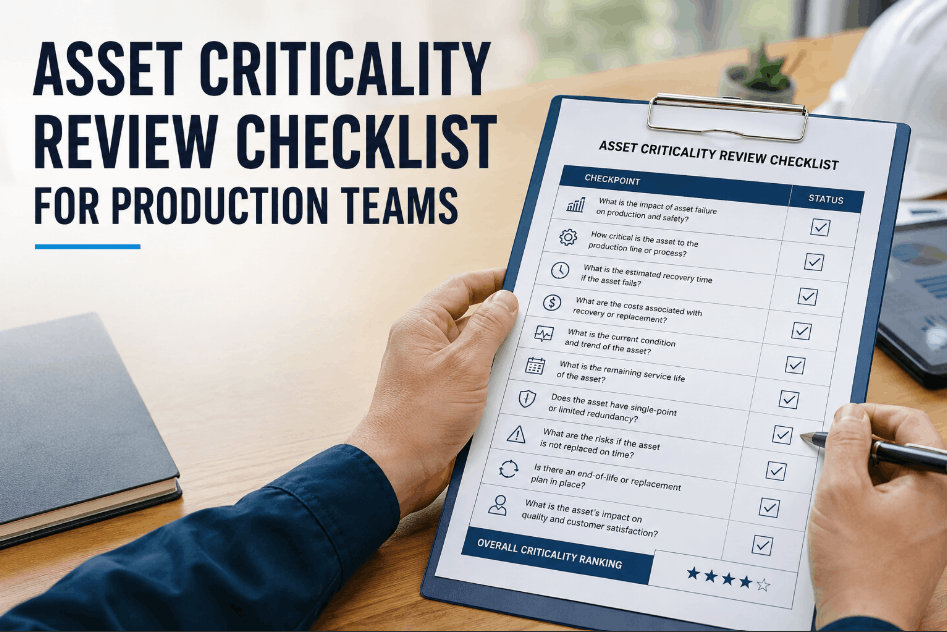
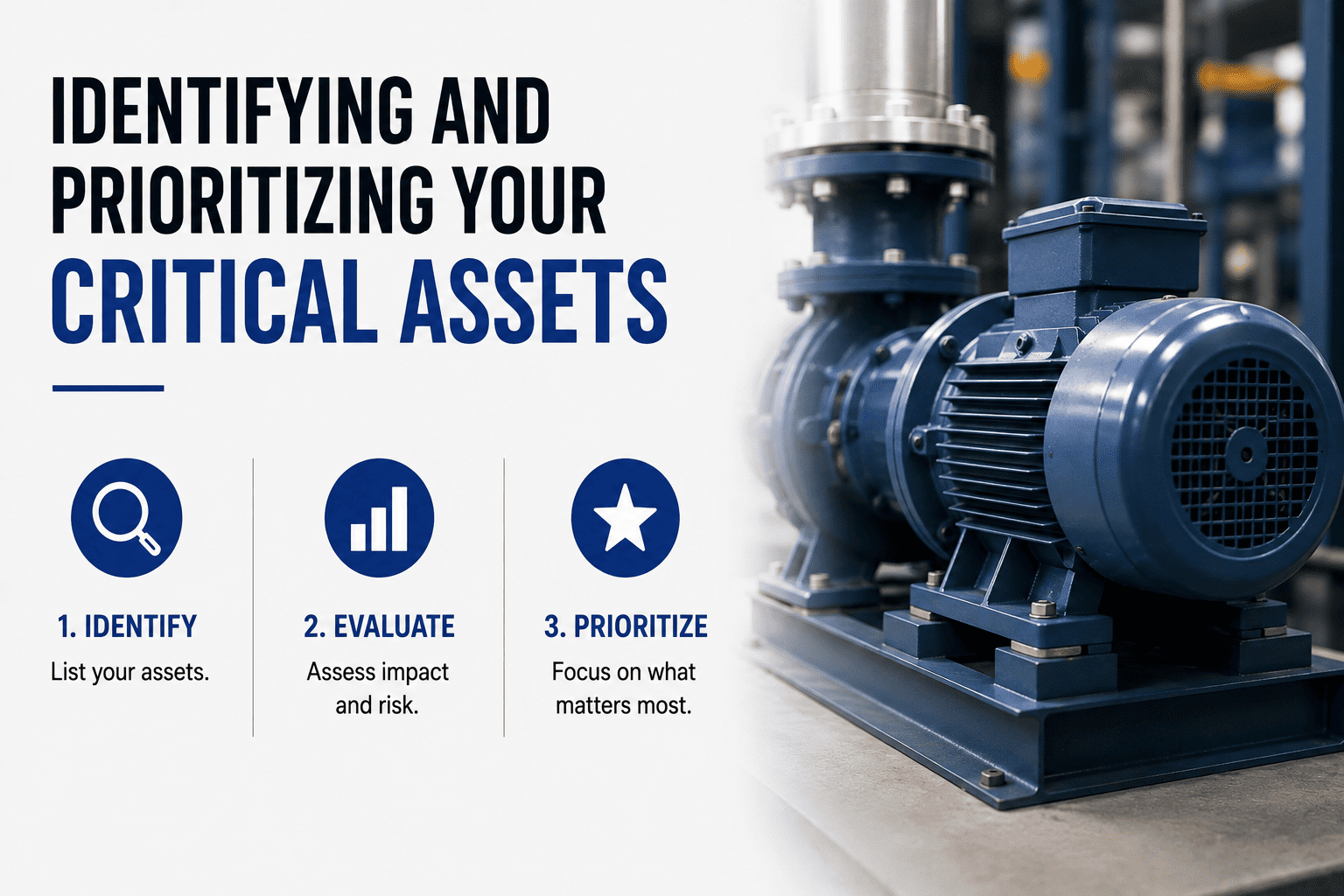
Critical asset identification doesn't require guesswork. Reliability engineers use a structured criticality analysis — grounded in RCM and ISO 55000 principles — to score each asset on the consequences of its failure. Below is a practical four-step method you can apply to a plant of any size.
Score production impact (1–5)
Rate how much a failure degrades throughput. A 5 means the line stops immediately (e.g., a bottleneck extruder with zero redundancy); a 1 means negligible impact (e.g., a standby fan with a hot spare). Use historical MTTR and production-loss data to calibrate the scale — don't rely on gut feel.
Factor in redundancy and spare capacity
An asset's criticality drops if a redundant unit or bypass path keeps production running. A 2-of-3 pump station where one pump can fail without throughput loss scores lower than a single-line compressor with no backup. Document redundancy in your asset register so the CMMS can adjust criticality automatically.
Apply safety, environmental & regulatory weight
Some failures don't just stop production — they trigger OSHA recordables, EPA violations, or FMCSA non-compliance. Weight these consequences at 1.5× or 2× the production score. A pressure vessel on a hazardous line may rank critical even if a spare exists, because a rupture carries catastrophic HSE risk.
Calculate total criticality & rank
Multiply the weighted scores, then sort assets high-to-low. The top 20–30% form your critical asset list — the machines that deserve condition monitoring, predictive maintenance, and spare-parts buffer stock. Load the final ranking into your CMMS so PM frequency, escalation rules, and work-order priority codes all reference it.
Worked Example
Asset criticality analysis in action: a 180-asset plant
Consider a mid-sized food packaging plant with 180 assets and an annual maintenance budget of $42,000. Before criticality analysis, every machine received a generic monthly PM. After scoring, the reliability team found that 34 assets (19%) accounted for 78% of downtime cost. They reallocated PM hours, added condition-based monitoring to the top 15, and let 40 low-criticality assets move to run-to-failure. Result: unplanned downtime dropped 31% in six months, and PM labor costs fell 22%.
| Asset | Production (1–5) | Redundancy | HSE Weight | Score | Tier |
|---|---|---|---|---|---|
| Main extruder motor | 5 | None (×1.0) | ×1.5 | 18.5 | A — Critical |
| Hydraulic press #1 | 4 | None (×1.0) | ×1.5 | 15.0 | A — Critical |
| Boiler feed pump A | 4 | Backup (×0.6) | ×1.0 | 9.4 | B — Essential |
| Warehouse HVAC unit | 2 | Backup (×0.6) | ×1.0 | 4.2 | C — Non-Critical |
| Office water cooler | 1 | None (×1.0) | ×0.5 | 1.5 | C — Non-Critical |
Prioritize Maintenance Assets
From critical asset list to smarter PM strategy
Once your assets are ranked, the real work begins: translating criticality into maintenance strategy. Tier A assets deserve predictive maintenance — vibration analysis, oil analysis, thermal imaging — plus buffer stock of critical spares and a documented escalation path. Tier B assets get time-based PMs with quarterly review. Tier C assets shift to run-to-failure with a simple repair-or-replace decision at breakdown. This tiered approach, aligned with TPM and RCM principles, typically cuts unplanned downtime 30–50% while reducing total maintenance spend 15–25%.
Predictive + condition-based
- Continuous condition monitoring (vibration, temp, oil)
- Buffer stock for top-5 critical spares
- Weekly reliability review, 24/7 escalation
- Failure Mode & Effects Analysis (FMEA) documented
Preventive + periodic inspection
- Scheduled PMs (monthly / quarterly)
- Standard spare-parts stocking
- Monthly KPI review
- RCM-based task optimization annually
Run-to-failure
- Minimal scheduled maintenance
- Repair or replace on failure
- No buffer stock — purchase on demand
- Quarterly cost review to confirm tier
How OxMaint Helps
Turn asset criticality into automated maintenance decisions
Identifying critical assets is only half the battle — operationalizing those rankings is where most plants stall. OxMaint's AI-powered CMMS and EAM platform closes the loop: criticality scores drive PM frequency, work-order priority, spare-part reorder points, and predictive alerts automatically. No spreadsheets, no manual cross-referencing, no audit panic.
Criticality-driven PM scheduling
Load your criticality scores into OxMaint and the platform auto-generates PM frequency by tier — weekly for Tier A, monthly for Tier B, run-to-failure for Tier C. Cut unplanned downtime 30–50% without adding headcount.
AI predictive failure alerts
OxMaint's AI analyzes vibration, temperature, and run-time data on Tier A assets to flag developing failures 7–21 days before breakdown — so you schedule repairs during planned downtime, not mid-shift.
Spare-parts buffer by criticality
OxMaint ties min/max reorder points to asset tier — auto-stocking critical spares for Tier A while letting Tier C parts stay on a purchase-on-demand basis. Reduce inventory carrying cost 20–35%.
ISO 55000 audit trail built in
Every criticality score, PM change, and work-order decision is logged with a timestamp and user ID. Walk into any ISO 55000, OSHA, or FMCSA audit with a defensible, exportable record in two clicks.
Stop Guessing. Start Prioritizing.
See your asset criticality scores drive smarter PMs in 30 minutes
Book a personalized demo and we'll load a sample of your asset register into OxMaint — showing exactly how criticality rankings reshape your PM schedule, spare-parts strategy, and downtime risk.
Frequently Asked Questions
Critical asset identification, answered
What is asset criticality analysis?
Asset criticality analysis is a structured method of ranking equipment by the consequences of its failure — measuring impact on production, safety, environment, and cost. Each asset receives a numerical score, and the resulting ranking lets maintenance teams focus preventive effort where failure hurts most. It's a foundational step in RCM, TPM, and ISO 55000-aligned maintenance programs.
How do you identify critical assets in a manufacturing plant?
Score each asset on production impact (1–5), apply a redundancy factor, weight safety and environmental consequences at 1.5×, and add downtime cost. Assets scoring above your critical threshold (typically 12+ on a weighted scale) form your critical asset list. You can automate scoring and recalibration inside a CMMS — Start Free Trial on OxMaint to see it live.
How often should asset criticality rankings be reviewed?
Review criticality scores at least annually, or whenever a major change occurs — new equipment installation, process redesign, regulatory shift, or a significant failure event. Production mix changes and capacity expansions can alter redundancy factors and downtime costs, shifting an asset's tier. OxMaint flags assets whose usage patterns have changed since the last review.
What's the difference between asset criticality and asset risk?
Criticality measures the consequence of failure — how bad it is if the asset goes down. Risk combines consequence with probability: Risk = Criticality × Likelihood of Failure. An asset can be highly critical but low risk (if it rarely fails), or low criticality but high risk (if it fails often but impact is minor). Both metrics belong in your maintenance strategy, but criticality drives PM prioritization first.
Can a CMMS automatically prioritize maintenance by asset criticality?
Yes — modern CMMS platforms like OxMaint store criticality scores in the asset register and use them to auto-set PM frequency, work-order priority codes, spare-part reorder thresholds, and escalation rules. When a criticality score changes, the CMMS updates downstream maintenance logic automatically, eliminating manual spreadsheet tracking. Book a 30-minute demo to see it on your assets.
Your Critical Assets Deserve Smarter Maintenance
Stop spreading maintenance thin. Start prioritizing what matters.
Join reliability teams using OxMaint to cut unplanned downtime 30–50%, reduce PM waste, and build a defensible critical-asset strategy — all in one AI-powered CMMS.
Free 14-day trial · No credit card