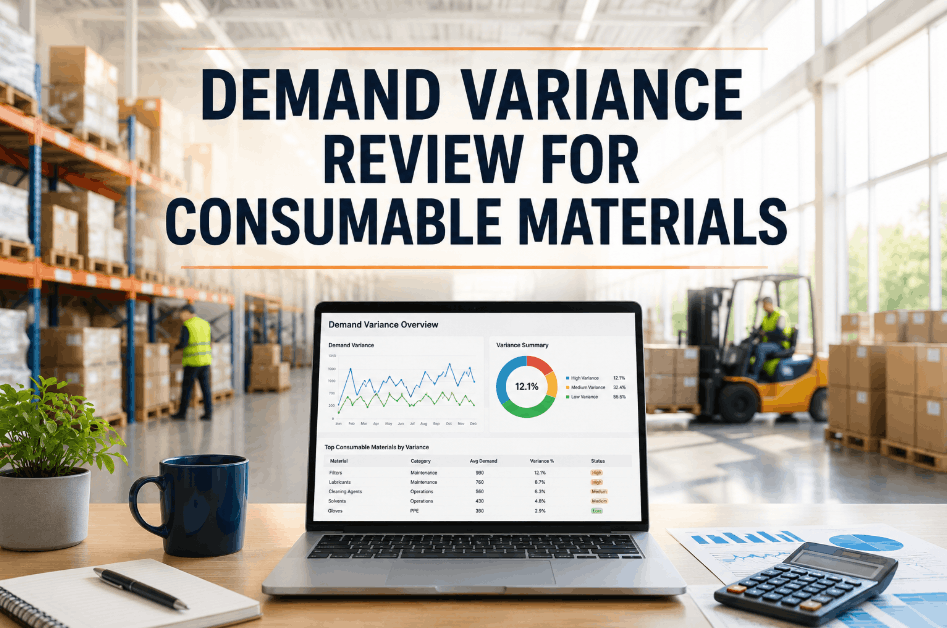
Consumable materials sit at the intersection of production variability and procurement planning — and when demand swings unpredictably, purchasing teams are left choosing between costly overstocking and dangerous stockouts. Lubricants, filters, fasteners, seals, and cleaning materials consumed irregularly across production shifts create demand patterns that standard min-max reorder models cannot adequately serve. A structured demand variance review reveals which consumables swing too wide for stable purchasing plans, which items need dynamic reorder logic, and where safety stock buffers are calibrated against outdated assumptions. Oxmaint's inventory and procurement analytics module connects consumption data from work orders directly to purchasing intelligence — so teams can Sign Up Free and begin measuring consumable demand variance against real issue history from day one. For plants managing consumable procurement across multiple shifts and lines, Book a Demo to see how cross-location demand analytics consolidates purchasing decisions inside a single view.
Oxmaint tracks consumable issue history per work order and asset — surfacing demand variance so procurement teams can right-size safety stock and stabilise purchasing plans across every plant location.
6 Consumable Demand Variance Patterns MRO Teams Must Identify
Effective demand variance analysis goes beyond average monthly consumption. Oxmaint captures issue data at work order closure — linking consumable usage to specific assets, maintenance types, and operational events — so procurement teams can Sign Up Free and classify demand behaviour across every consumable category without manual spreadsheet consolidation.
Identify consumables whose demand surges during specific operational seasons — such as coolants in summer or heating-related consumables in winter — enabling pre-season procurement buffers rather than reactive emergency orders.
Surface consumables whose usage spikes during shutdown events, planned overhauls, or equipment commissioning phases — consumption patterns that a steady-state reorder model will always under-serve.
Link consumable issue frequency to specific equipment IDs — identifying assets that drive disproportionate consumable demand and calibrating stock levels to equipment schedules rather than facility averages.
Flag consumables used too infrequently to sustain a predictable reorder model — items better managed through just-in-time purchasing or consolidated vendor replenishment than perpetual inventory stocking.
Separate consumable usage tied to emergency repairs from planned PM consumption — variance concentrated in reactive work orders signals maintenance programme instability rather than genuine demand unpredictability.
Compare consumable consumption rates across sites running identical equipment — significant variance between locations often reveals process differences, over-issue habits, or non-standard maintenance practices that inflate demand.
Consumable Demand Analytics KPIs: What Procurement Teams Should Measure
Most CMMS platforms record stock movements but don't surface the statistical variance that makes consumable purchasing unpredictable. Oxmaint's analytics layer connects issue history to procurement records — giving operations and supply chain teams the KPIs needed to rationalise safety stock levels, stabilise purchase orders, and reduce both stockouts and overbuying. Teams evaluating CMMS platforms for consumable procurement intelligence should Book a Demo to review the full inventory analytics capability before shortlisting.
| KPI | What It Measures | Decision It Supports | Review Frequency | Priority |
|---|---|---|---|---|
| Demand Coefficient of Variation | Consumption spread vs average usage | Safety stock and reorder model selection | Monthly | Critical |
| Stockout Frequency per SKU | Issues blocked by zero-stock events | Safety stock level recalibration | Monthly | Critical |
| Consumption per Asset Class | Consumable usage by equipment type | Asset-linked procurement planning | Monthly | Critical |
| Reactive vs Planned Issue Ratio | Emergency vs PM-driven consumption | Maintenance programme stability review | Monthly | Important |
| Purchase Order Accuracy | Ordered vs actual consumed quantity | Overbuy and procurement waste reduction | Monthly | Important |
| Lead Time vs Demand Window | Supplier lead time vs average demand cycle | Reorder point and buffer sizing | Quarterly | Important |
| Cross-Site Consumption Variance | Usage rate differences across locations | Process standardisation and over-issue control | Quarterly | Routine |
| Inventory Turns by Consumable | Annual issues vs average stock held | Holding level and budget allocation | Quarterly | Routine |
How Facilities Activate Consumable Demand Analytics Without a BI Project
The challenge is not data scarcity — it is a platform that connects maintenance execution to purchasing intelligence automatically. Oxmaint embeds consumable issue logging into every work order template and links usage data to asset records and procurement history at closure. Procurement and stores teams can Sign Up Free and begin analysing consumable demand patterns from their first work order cycle without custom configuration or BI tool integration.
- Consumable usage logged at work order closure against specific asset records
- Issue type tagged at closure — planned PM vs reactive repair vs shutdown event
- Demand history accumulated per SKU with date-stamped consumption records
- Variance flags generated automatically when consumption deviates from baseline
- Purchase triggers recalculated dynamically as issue history accumulates
- Role-based access: technicians log usage, procurement teams see demand analytics
- Spreadsheet-based stores? Real-time consumption tracking replaces manual ledgers
- No work order linkage? Every issue tied to maintenance type and asset automatically
- Multi-site purchasing complexity? Consolidated demand view across all locations
- No analytics team? Out-of-the-box variance KPIs require zero custom reporting
- Overbuy justification challenges? Purchase accuracy reports formatted for review
- Audit readiness? Every issue is timestamped, user-attributed, and exportable
Consumable Demand Variance Management: Investment vs Procurement Savings
Per-user pricing with no BI licences, no integration project fees, and no infrastructure overhead. Consumable demand analytics go live within the first 30 days of deployment.
Unplanned stockouts driven by demand variance typically generate 20–40% cost premiums on urgent replenishment orders — a pattern Oxmaint's variance flags eliminate through early demand signal detection.
Safety stock calibrated against outdated demand averages consistently over-funds consumable inventory — capital Oxmaint's dynamic demand analytics redirects toward critical spares and capital priorities.
Plants using demand-linked procurement analytics report 15–30% reductions in purchase order frequency and emergency buying within the first 12 months of deploying consumption-based reorder logic.
Variance-calibrated safety stock models reduce total consumable holding value by 10–20% while simultaneously improving service levels — replacing static buffers with dynamic, demand-responsive stocking logic.
Consolidated demand data across sites enables volume-aggregated purchasing — converting fragmented location-level orders into coordinated procurement programmes with stronger vendor negotiation positions.
Why Procurement Teams Choose Oxmaint for Consumable Demand Variance Review
Oxmaint is not a standalone procurement tool — it is a maintenance execution platform with inventory and purchasing intelligence embedded into every workflow. Demand data is generated at the point of maintenance execution, not assembled manually from disparate exports. Procurement teams can Book a Demo to see how consumable demand analytics integrates with work order execution and asset management in a single operational view.
Every consumable issue is logged at work order closure and tagged to a maintenance type and asset — giving procurement teams demand signals rooted in actual operational events, not averaged estimates.
Reorder points update as issue history accumulates — preventing purchasing teams from running static min-max models against consumables with genuinely variable demand patterns.
Demand coefficient of variation, stockout frequency, reactive vs planned consumption split, and purchase accuracy available without custom reporting configuration or BI tool licensing.
Aggregate consumable demand across all plant locations — enabling centralised procurement decisions backed by site-level variance data rather than location-level purchasing fragmentation.
Oxmaint's shutdown management module links planned outage events to consumable demand forecasts — ensuring procurement teams prepare accurate material lists before scheduled maintenance windows open.
Every consumable issue is timestamped, user-attributed, and linked to a work order — supporting procurement audits, inventory reconciliation, and cost allocation reporting without manual data assembly.
Oxmaint captures consumable issue data at the point of maintenance execution — giving procurement teams asset-level demand analytics, variance flags, and purchase accuracy reporting without spreadsheet work.
Consumable Demand Variance — Questions Procurement and MRO Teams Ask
Consumable usage is logged directly inside each work order at closure — automatically attributed to the issuing asset and maintenance type without requiring a separate stores entry step or spreadsheet update.
Yes. Oxmaint tags every consumable issue by work order type — separating emergency repair consumption from planned PM usage to identify whether demand variance is driven by maintenance instability or genuine operational variability.
Reorder triggers in Oxmaint are tied to actual issue history — as demand patterns accumulate, procurement teams can calibrate safety stock and reorder quantities against real consumption variance rather than static estimates.
Yes. Oxmaint's multi-site inventory hierarchy consolidates consumable demand data across all locations — enabling procurement teams to identify cross-site consumption inconsistencies and centralise purchasing decisions.
Oxmaint's shutdown management module links planned maintenance events to consumable requirements — giving procurement teams advance demand signals for outage-driven material needs before purchase windows close.
Most teams see actionable demand KPIs within 30–45 days once work orders begin logging consumable issues. Initial variance patterns — stockout frequency, high-consumption assets — typically appear within the first two reporting cycles.
Oxmaint gives procurement and MRO teams embedded demand capture, out-of-the-box variance KPIs, and multi-site consumable analytics — no BI projects, no spreadsheets, no manual consolidation.