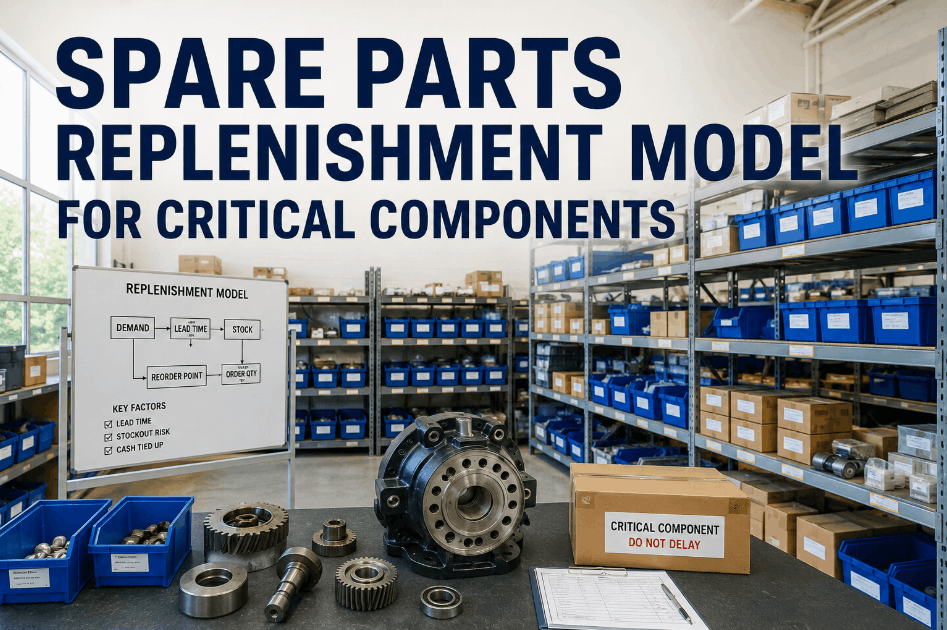
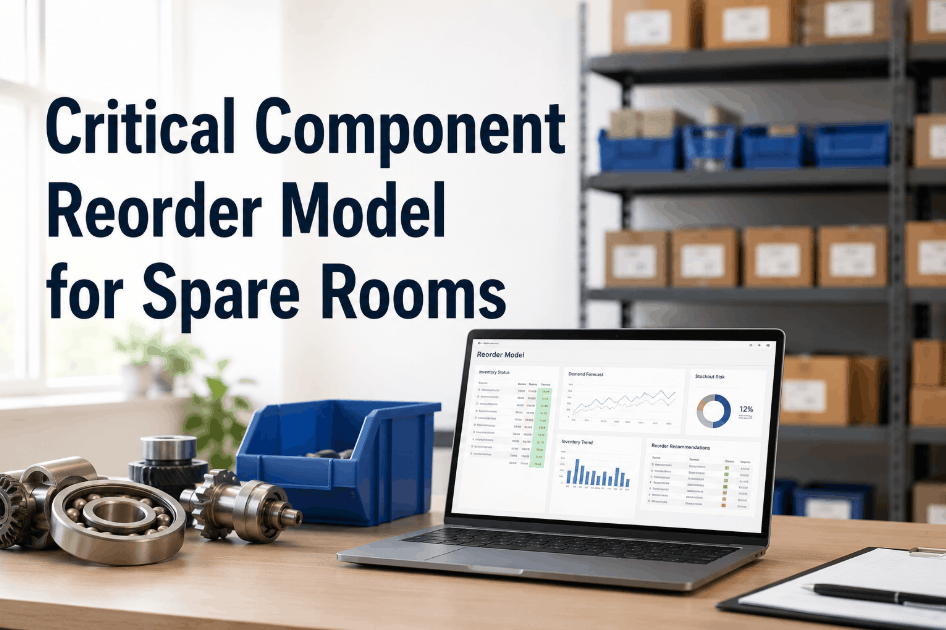
A spare parts replenishment model for critical components is the inventory discipline that prevents two equally damaging outcomes in manufacturing operations — production stoppages caused by stockouts on critical parts, and cash tied up in slow-moving inventory that never gets consumed. Getting this balance right requires a replenishment framework that accounts for vendor lead time, consumption variance, failure recurrence patterns, and the financial consequence of being out of stock on the components that keep critical production equipment running. Sign Up Free to see how OxMaint's parts management and work order integration supports data-driven replenishment decisions for your critical component inventory. Operations teams that design replenishment models around actual consumption data and reorder point analytics — rather than gut feel or annual budget cycles — typically reduce parts-related downtime by 20–35% while simultaneously cutting inventory carrying costs by 15–25%.
Build Your Spare Parts Replenishment Model with OxMaint
Reorder point analytics. Consumption variance tracking. Vendor lead time management. Parts visibility across locations. OxMaint gives maintenance teams the inventory data needed to replenish critical components with precision.
Why Spare Parts Replenishment Fails for Critical Components
Most spare parts replenishment failures are not procurement failures — they are data failures. When consumption history is not tracked per part number, when vendor lead times are not recorded, and when reorder points are set by tradition rather than analytics, critical component availability is left to chance rather than managed by design. Book a Demo to see how OxMaint's parts management module builds the consumption data foundation that replenishment models depend on.
Reorder Points Set Without Consumption Data
Parts reorder triggers based on arbitrary minimums rather than actual consumption rates and lead time analysis create stockouts on fast-moving critical parts while generating overstock on components rarely consumed.
Vendor Lead Time Not Factored into Safety Stock
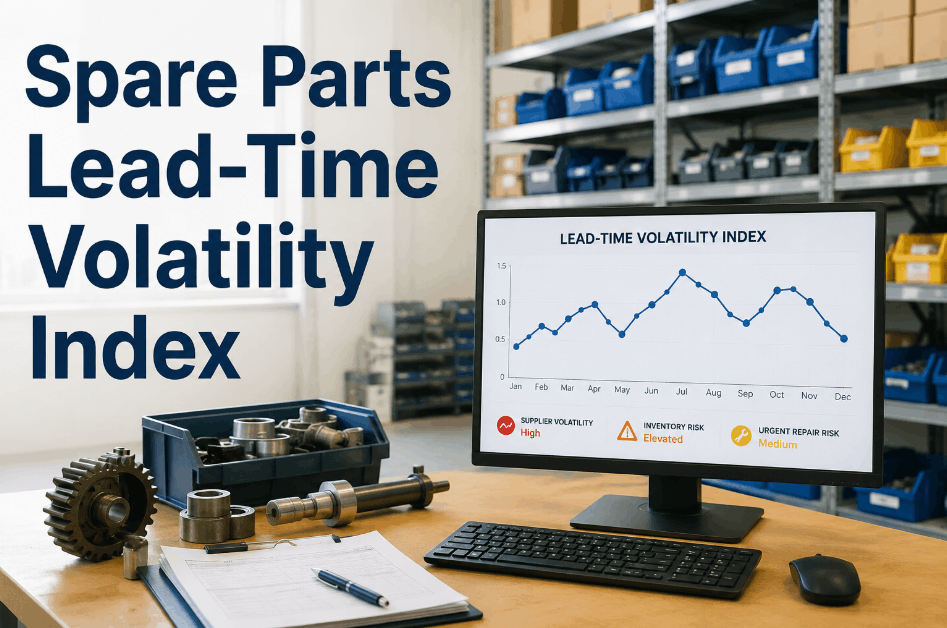
Safety stock calculations that ignore vendor response time and delivery variability leave facilities exposed to stockout risk during periods of supply chain disruption or demand spikes from equipment failure recurrence.
No Parts Visibility Across Multiple Storerooms
Multi-site operations where spare parts are tracked in separate spreadsheets or local systems cannot leverage inventory across locations — creating simultaneous stockouts and overstock for identical part numbers at different facilities.
Consumption Variance Not Driving Replenishment Adjustment
When actual parts consumption is not compared against forecast demand regularly, replenishment models drift out of calibration — failing to reflect seasonal failure patterns, aging equipment consuming more parts, or process changes reducing consumption.
Cash Tied Up in Non-Critical Inventory
Inventory investment concentrated in non-critical parts based on purchasing momentum rather than criticality classification ties up working capital that should be held against fast-moving components on critical production equipment.
Shutdown Sequences Not Informing Stock Planning
Planned shutdowns that consume predictable high quantities of specific critical components are not pre-positioned in the replenishment model — creating procurement scrambles and premium freight costs during planned maintenance windows.
Spare Parts Replenishment Model — 6 Core Design Elements
A robust replenishment model for critical components integrates six design elements — from lead time profiling through shutdown sequence planning — that together eliminate both stockout risk and excess inventory accumulation. Sign Up Free to implement this model using OxMaint's parts management and work order analytics modules.
| Model Element |
What It Controls |
OxMaint Feature |
Inventory Outcome |
| Lead Time Profiling |
Vendor delivery time by part number and supplier |
Parts Catalogue + Vendor Records |
Safety stock sized to actual lead time exposure |
| Consumption Rate Analysis |
Average and peak parts usage per period per asset class |
Parts Consumption History |
Reorder points calibrated to real demand patterns |
| Criticality-Weighted Stock Levels |
Minimum stock quantity based on asset criticality and stockout consequence |
Criticality Matrix + Parts Module |
Capital concentrated on highest-consequence parts |
| Reorder Point Automation |
Automatic procurement trigger when stock falls to reorder threshold |
Auto-Reorder Alerts |
No manual monitoring required for replenishment |
| Consumption Variance Tracking |
Actual vs. forecast consumption per part number per period |
Inventory Analytics Dashboard |
Model recalibration when demand patterns shift |
| Shutdown Sequence Pre-Positioning |
Planned shutdown parts requirements loaded in advance |
Work Order Parts Planning |
Zero procurement scrambles during planned maintenance |
How OxMaint Supports Spare Parts Replenishment for Critical Components
01
Consumption History and Reorder Point Analytics
OxMaint tracks all parts consumption against work orders — building a per-part-number consumption history that reflects actual maintenance demand rather than procurement estimates. This history drives statistically grounded reorder point calculations that replace arbitrary minimums with data-calibrated replenishment triggers.
Book a Demo to see consumption-driven reorder point configuration in OxMaint.
02
Multi-Location Parts Visibility
OxMaint provides real-time visibility into parts stock levels across all storerooms and warehouses from a single platform — allowing maintenance planners to identify available stock at other sites before raising a procurement order and eliminating simultaneous stockout and overstock for identical part numbers across locations.
03
Criticality-Weighted Inventory Investment
OxMaint links parts records to asset criticality ratings — allowing maintenance and procurement teams to rank inventory investment decisions by the production consequence of stockout rather than purchase price or historical order volume.
Sign Up Free to configure criticality-weighted parts management for your facility.
04
Work Order Parts Planning and Shutdown Pre-Positioning
OxMaint's planned maintenance module links anticipated parts requirements to scheduled work orders — enabling procurement to pre-position critical components before shutdown windows open rather than responding to demand after the shutdown sequence begins and premium freight becomes unavoidable.
Spare Parts Replenishment Results in Manufacturing Operations
The following examples show how manufacturing operations teams used OxMaint's parts management and consumption analytics to build replenishment models that reduced stockout-driven downtime and optimized inventory investment in critical components.
Discrete Manufacturing
Stockout-Driven Downtime Reduced 67%
Challenge12 stockout events per year on critical bearings and seals — average 4.2 hours production loss per event
AppliedOxMaint consumption history analysis; reorder points recalibrated using 18-month rolling average demand with lead time buffer
ResultStockout events reduced from 12 to 4 per year; production loss hours down 67% year-over-year
Process Industry
Inventory Carrying Costs Reduced $340K
ChallengeWarehouse audit revealed $1.2M in slow-moving parts inventory — 60% with no consumption in 24 months
AppliedOxMaint consumption variance analysis identified non-moving stock; criticality review triggered inventory rationalization
Result$340K reduction in carrying costs; freed capital redirected to fast-moving critical component stock levels
Multi-Site Operations
Cross-Site Parts Visibility Eliminated Duplicate Orders
ChallengeThree plants ordering identical critical parts independently — combined overstock of $420K across locations
AppliedOxMaint multi-site parts visibility with centralized inventory view and inter-site transfer workflow
ResultInter-site transfers replaced 31% of external procurement orders; $140K annual procurement saving achieved
Food and Beverage
Shutdown Parts Pre-Positioned with Zero Premium Freight
ChallengeAnnual shutdown generating $85K in premium freight costs for parts not identified until shutdown sequence began
AppliedOxMaint shutdown work order parts planning; procurement triggered 8 weeks before shutdown window
ResultPremium freight costs eliminated in two consecutive shutdowns; standard lead time procurement achieved
Step-by-Step: Building a Spare Parts Replenishment Model in OxMaint
Step 1
Run a Warehouse Audit Against Asset Criticality
Compare every stocked part number against the criticality rating of the assets it supports in OxMaint. Parts stocked for non-critical equipment and parts with no consumption in 24 months are candidates for inventory reduction — freeing capital for critical component safety stock.
Book a Demo to see how OxMaint supports inventory rationalization analysis.
↓
Step 2
Build Consumption Rate Profiles Per Critical Part
Extract consumption history per part number from OxMaint work order records — calculating average monthly consumption, peak demand periods, and consumption variance. These profiles replace estimate-based reorder points with data-grounded replenishment triggers calibrated to actual maintenance demand.
↓
Step 3
Profile Vendor Lead Times and Set Safety Stock
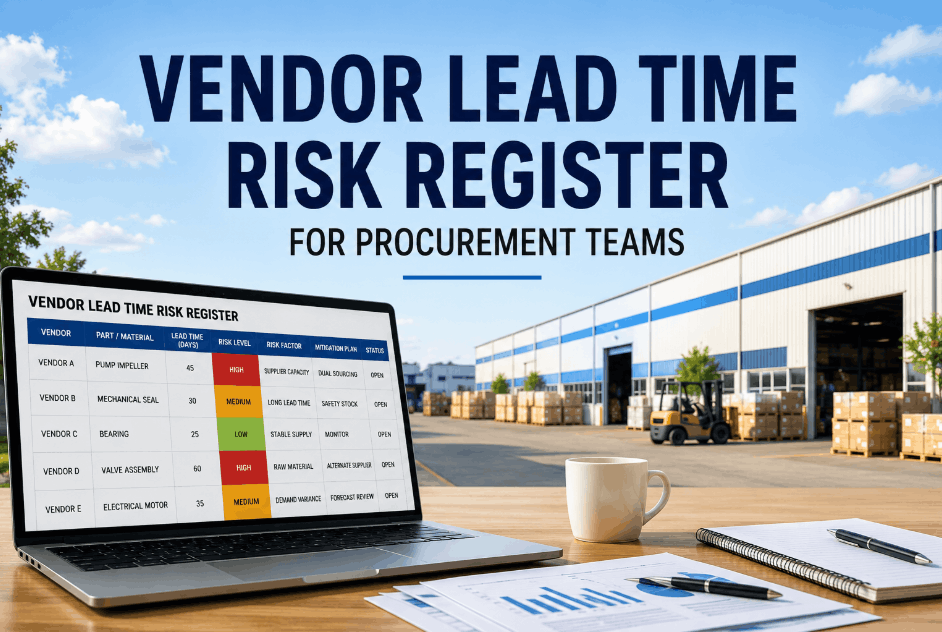
Record verified vendor lead times per part number and supplier in OxMaint — and set safety stock levels that cover demand during the lead time period plus a buffer for delivery variance. Safety stock for critical components on long lead-time vendors must reflect the full stockout consequence, not just the average demand rate.
Sign Up Free to configure vendor lead time profiles in OxMaint.
↓
Step 4
Activate Reorder Point Automation
Configure OxMaint's automatic reorder alerts so that procurement requests are generated when stock reaches the reorder threshold — eliminating manual monitoring across hundreds of part numbers and ensuring replenishment happens before stockout risk materializes rather than after a job is delayed.
↓
Step 5
Review Consumption Variance Quarterly and Recalibrate
Run a quarterly consumption variance review in OxMaint — comparing actual parts usage against forecast demand per part number. Parts where actual consumption has shifted more than 20% from forecast trigger reorder point recalibration, keeping the replenishment model current as equipment age, production volumes, and process configurations change.
Sign Up Free to activate consumption variance reporting in OxMaint.
Key KPIs for Spare Parts Replenishment Performance
These metrics give maintenance and procurement leaders the visibility needed to evaluate replenishment model accuracy, inventory health, and the financial efficiency of critical component stocking decisions. Book a Demo to see how OxMaint tracks parts replenishment KPIs across your production facilities.
Stockout Rate (Critical Parts)
Frequency of zero-stock events on parts classified as critical. Each critical stockout event directly threatens production continuity and is the primary measure of replenishment model adequacy.
Fill Rate
Percentage of work order parts requests fulfilled from existing stock without procurement delay. Target 95%+ for critical component classifications — indicating that reorder points and safety stock levels are correctly calibrated.
Reorder Point Accuracy
Percentage of automated reorder triggers that fire before stock reaches zero. High accuracy indicates consumption profiles and lead time buffers are correctly sized; low accuracy signals demand patterns have shifted.
Inventory Turnover Rate
Annual consumption value divided by average inventory investment. Low turnover on critical parts signals excessive safety stock; high turnover near the stockout boundary signals insufficient buffer for demand variance.
Consumption Variance
Difference between forecast and actual parts consumption per period. Tracking variance per part number over time identifies when replenishment model recalibration is needed before stockout risk increases.
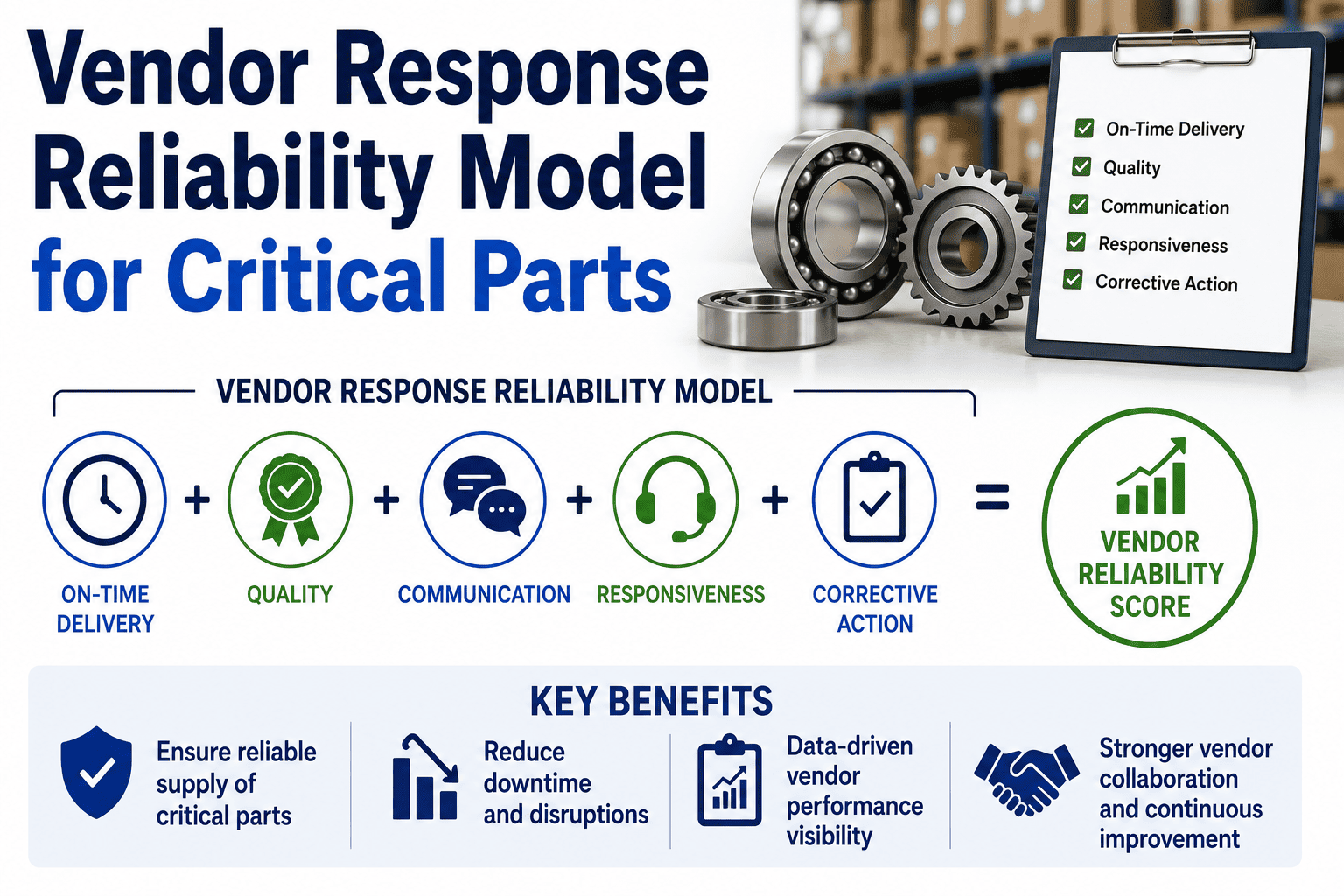
Vendor Response Rate
Percentage of procurement orders fulfilled within the agreed lead time by vendor and part category. Chronic lead time overrun by specific suppliers requires safety stock adjustment or vendor diversification to maintain critical component availability.
Optimize Critical Component Replenishment with OxMaint
Consumption history analytics. Reorder point automation. Multi-site parts visibility. Shutdown pre-positioning. OxMaint gives maintenance and procurement teams the data needed to eliminate stockout risk and reduce inventory carrying costs simultaneously.
Frequently Asked Questions
What is a spare parts replenishment model for critical components?
It is a data-driven framework that sets reorder points, safety stock levels, and procurement triggers based on actual consumption history, vendor lead times, and asset criticality — balancing stockout risk against the cost of excess inventory investment.
How does OxMaint support spare parts replenishment?
OxMaint tracks parts consumption per work order, builds reorder point analytics from consumption history, automates replenishment alerts, and provides multi-site inventory visibility — giving procurement and maintenance teams the data to manage critical component availability proactively.
What is the reorder point and how should it be calculated?
The reorder point is the stock level at which a replenishment order is triggered. It should be calculated as average daily consumption multiplied by vendor lead time, plus a safety stock buffer sized to cover demand variance during lead time.
How does asset criticality affect spare parts stocking decisions?
Critical assets justify higher safety stock, lower stockout tolerance, and primary vendor relationships for the components they require — while non-critical assets can tolerate lower stock levels and longer procurement lead times without production consequence.
What causes excess inventory accumulation on spare parts?
Excess inventory typically results from reorder points set higher than consumption data justifies, discontinued equipment still holding associated stock, or bulk purchasing decisions made without consumption rate analysis at the part-number level.
What KPIs measure spare parts replenishment performance?
Core KPIs include stockout rate on critical parts, fill rate, reorder point accuracy, inventory turnover rate, consumption variance, and vendor response rate — all trackable within OxMaint's inventory and procurement analytics module.
Give Your Maintenance Team the Parts Replenishment Tools They Need
OxMaint delivers consumption history analytics, automated reorder triggers, multi-location stock visibility, and criticality-weighted inventory management — purpose-built for manufacturing operations that cannot afford critical component stockouts.