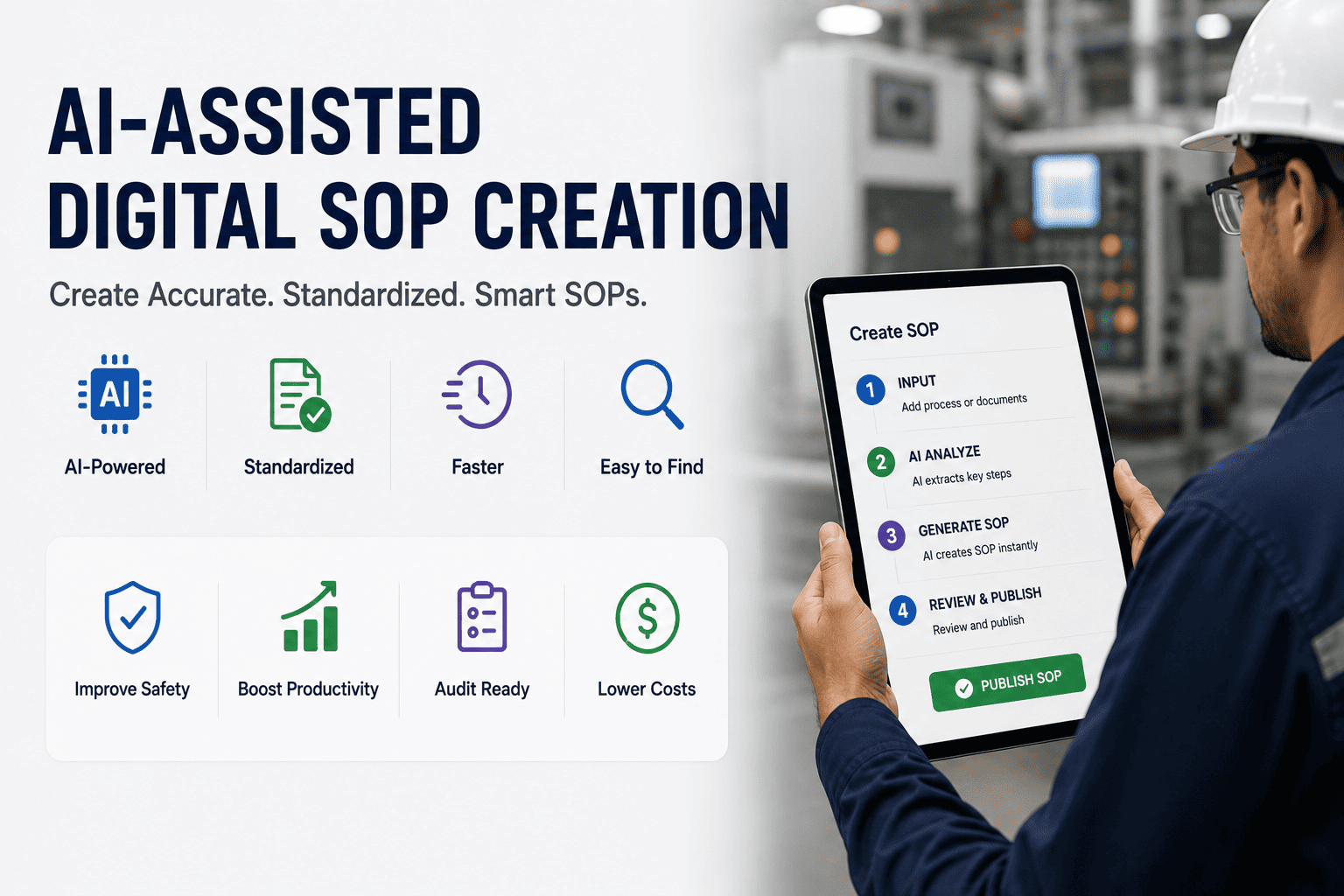
Manufacturing plants lose an estimated $50 billion annually to downtime tied to procedural gaps — yet 70% of standard operating procedures still live in binders or scattered PDFs that technicians ignore on the floor. AI-assisted digital SOP creation compresses what used to be a 40-hour authoring cycle into a same-shift draft, pulling structure from maintenance history, embedding photos at each step, and pushing the finished procedure straight into CMMS work orders. The result is a 60–80% reduction in authoring time and, more importantly, work instructions technicians actually follow. Start Free Trial to convert one critical procedure this week and see the difference on the floor.
Can your technicians actually follow the SOPs you published last quarter?
Most plants spend 40+ hours drafting a single equipment SOP — then lose it the moment a technician steps onto the floor with a clipboard. AI-assisted digital SOPs flip that equation: capture a procedure once, and the system generates a step-by-step, photo-rich, safety-annotated work instruction ready to push into CMMS in under an hour.
authoring time
The hidden cost of paper SOPs nobody reads
A 600-asset plant typically maintains 1,200–1,800 procedures across pumps, motors, conveyors, and packaging lines. Industry studies show 55% of technicians abandon the official SOP when it is more than two clicks away from the work order, and each undocumented step adds an average of 9 minutes to a 45-minute task. That drift is what turns a routine PM into an 8-hour breakdown.
From maintenance history to a reviewable draft in one shift
The AI-assisted workflow does not replace your maintenance engineers — it removes the blank-page problem. Feed it work-order notes, OEM manuals, and a few smartphone photos, and within minutes you have a structured, numbered draft ready for review, revision, and publication.
Pull from CMMS history and OEM docs
The AI reads completed work orders, failure codes, and attached OEM manuals for a given asset class. Within 5–10 minutes it surfaces the most common task sequences and flags steps that technicians have historically skipped or rewritten — the exact friction points your current SOPs ignore.
AI drafts a numbered procedure with safety callouts
The system produces a step-by-step draft — every step numbered, every tool listed, every torque value or tolerance pulled from the source material. LOTO points, PPE requirements, and critical safety warnings are auto-inserted based on equipment class, not left to the author's memory.
Embed photos, diagrams, and short video clips
Drop in smartphone photos of the actual asset, annotated diagrams, or a 15-second clip of a technician performing the step. Visual SOPs improve first-time-right completion by 35–45% on complex tasks like bearing replacement or VFD commissioning.
Engineer approves, then it ships to mobile at the work order
A senior technician or reliability engineer reviews the draft — typically a 15-minute pass — approves it, and the SOP is live. The next time that work order triggers in CMMS, the technician sees the full procedure on their phone or tablet, step by step, with photos at every stage.
Every SOP becomes a visual, safety-enforced work instruction
A digital SOP is not a PDF scrolled on a phone. It is a structured, interactive document built for the floor — photos at every step, mandatory safety acknowledgments, and revision control that prevents the wrong version from ever reaching a technician.
Photo & video at every step
Attach a photo of the exact component, an annotated diagram, or a 15-second clip showing the correct technique. Technicians perform tasks 35–45% faster on first attempt when visual cues are embedded directly in the step.
Enforced safety warnings & LOTO
The AI auto-inserts lockout/tagout points, PPE requirements, and critical hazard callouts based on equipment class. Technicians must acknowledge each warning before advancing — creating a verifiable safety trail inside the SOP itself.
Revision control & audit trail
Every change is versioned, timestamped, and attributed. When an OEM updates a torque spec, the revision flows through approval and republishes — old versions are archived but never disappear, giving auditors a complete history for ISO 9001 and OSHA compliance.
Mobile delivery at the work order
SOPs open directly inside the CMMS work order on a phone or tablet — no separate app, no PDF download, no login dance. The technician taps the task and the full procedure loads in under two seconds, online or offline.
Manual SOP authoring vs AI-assisted digital SOPs
The gap is not incremental. A 180-asset plant with 450 active procedures spends roughly 1,800 engineer-hours per year keeping paper SOPs current — if they keep them current at all. AI-assisted authoring reclaims 1,200+ of those hours and produces a better document.
| Dimension | Manual / Paper SOP | AI-Assisted Digital SOP |
|---|---|---|
| Authoring time per procedure | 30–40 engineer-hours | 4–8 hours (review & approve draft) |
| Photo / video embedding | Rare — requires desktop publishing | Drag-and-drop at every step |
| Safety warning insertion | Author remembers (or does not) | Auto-inserted by equipment class & hazard |
| Technician adherence rate | ~30–45% (clipboard or memory) | 85–95% (mobile, step-by-step, visual) |
| Revision control | Manual version tracking, often lost | Automatic, timestamped, auditable |
| CMMS integration | Printed and clipped to work order | Delivered inside the work order on mobile |
| Annual cost (180-asset plant) | ~$108K in engineering time | ~$28K — savings of $80K/year |
A 180-asset food packaging plant cuts SOP cycle time by 73%
A Midwest food packaging operation with 180 assets and 470 active procedures was spending $108,000 per year in reliability-engineer time just keeping paper SOPs current — and still failing internal audits because 22% of procedures had not been updated in over three years.
The reliability team ingested five years of CMMS work-order history and OEM manuals, let the AI generate drafts for all 470 procedures, then reviewed and published in batches of 30–50 over four weeks. Within 90 days of go-live, first-time-right completion on preventive maintenance tasks rose from 68% to 89%, and audit findings dropped to zero.
See your first AI-assisted SOP in under 60 minutes
Pick one critical asset, feed it your work-order history, and watch the AI generate a step-by-step, photo-ready, safety-annotated procedure you can publish to mobile today.
What manufacturing teams ask before adopting AI SOPs
How does the AI generate procedures from our existing data?
The system ingests your CMMS work-order history, failure codes, and attached OEM manuals for a given asset class. It identifies the most common task sequences, pulls torque values and tolerances from source documents, and structures everything into a numbered, review-ready draft. Your engineers then review and approve — the AI does the drafting, not the signing off. You can Start Free Trial and run one asset through the pipeline in under an hour.
Can we embed our own photos and video clips?
Yes. Drag-and-drop photos, annotated diagrams, or short video clips (15–30 seconds) directly onto any step. The media is stored with the procedure and rendered inline on the technician's mobile device at the work order. Plants that add visual media see 35–45% improvement in first-time-right task completion compared to text-only SOPs.
How are safety warnings and LOTO points handled?
The AI auto-inserts lockout/tagout points, PPE requirements, and critical hazard callouts based on the equipment class — pumps, motors, conveyors, pressure vessels, and so on. Technicians must acknowledge each safety warning before advancing to the next step, creating a verifiable, timestamped audit trail inside the SOP itself for OSHA and ISO compliance.
Does this integrate with our existing CMMS?
The system connects to common CMMS platforms so that when a work order triggers, the corresponding digital SOP opens directly on the technician's phone or tablet — no separate login, no PDF download. If you want to see the integration flow on your specific stack, Book a Demo and we will walk through it live.
What happens to version control when procedures change?
Every revision is versioned, timestamped, and attributed to the approving engineer. When an OEM updates a spec or a technician flags a missing step, the change flows through an approval workflow and republishes instantly to all mobile devices. Previous versions are archived but never deleted, giving auditors a complete revision history for ISO 9001 and internal quality reviews.
Turn 40 hours of SOP authoring into a same-shift draft
Join the manufacturing plants cutting authoring time by 60–80% and finally giving technicians procedures they will actually follow on the floor.
Free 14-day trial · No credit card