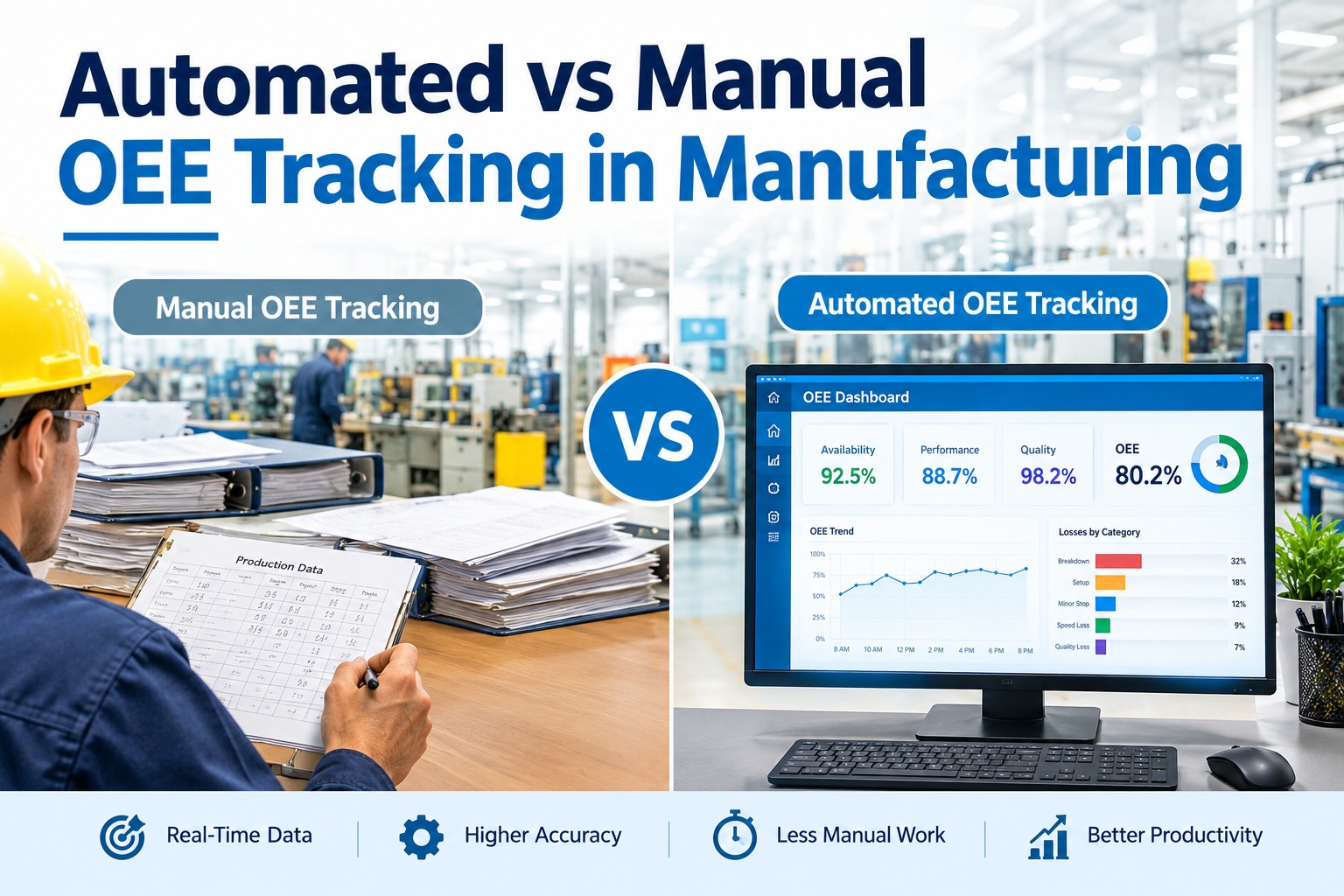
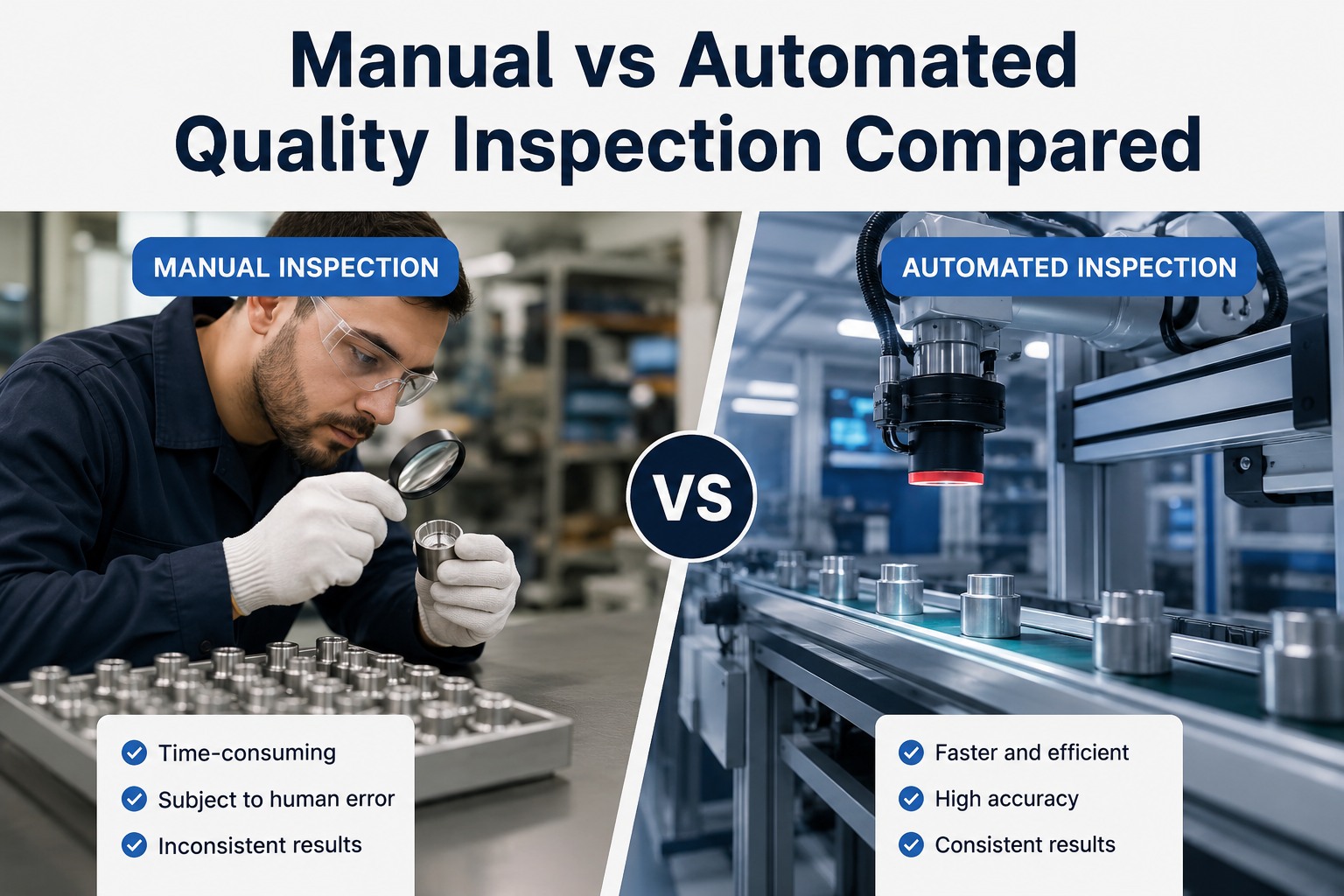
A tier-1 automotive supplier running 14 production lines discovered that 0.3mm dimensional drift in a turned shaft component had passed 6-monthly gauge calibration checks undetected for 22 weeks — because their gauging was calendar-driven, not process-driven. The downstream warranty cost exceeded $870,000. Sign in to OxMaint to connect your AI gauging and dimensional inspection equipment to maintenance-triggered workflows, or book a demo to see how precision manufacturers are closing the gap between measurement data and maintenance action.
AI Vision & Quality Control / Manufacturing Metrology
Dimensional Measurement & AI Gauging in Manufacturing
AI-powered non-contact measurement, GD&T verification, and automated tolerance checking are redefining what precision manufacturing can deliver — and which facilities are falling behind.
98.6%
First-pass measurement accuracy with AI vision gauging vs 94.2% with manual CMM
4.2x
Faster throughput vs contact CMM for high-mix production lines
$0
Scrap cost when tolerance drift is caught at the machine vs at final inspection
62%
Reduction in dimensional escapes reported by AI-gauging early adopters
Why Traditional Gauging Is a Quality Liability in Modern Manufacturing
Manual measurement, periodic CMM sampling, and paper-based GD&T records are not quality systems — they are audit artefacts. By the time a dimensional excursion appears in a monthly report, hundreds or thousands of out-of-tolerance parts may have already moved downstream.
01
Sampling is not inspection
Most facilities measure 1–5% of production volume. The remaining 95–99% ships on statistical inference. AI inline gauging eliminates sampling error by measuring every part.
02
Calendar gauge calibration misses process drift
A gauge calibrated on Monday does not account for thermal expansion, tool wear, or fixture shift on Friday afternoon. Condition-based recalibration triggered by process data catches drift before it causes non-conformance.
03
Measurement data is disconnected from maintenance
Out-of-tolerance readings logged in quality software rarely trigger automatic maintenance work orders. The dimensional signal and the corrective action live in different systems — often different departments.
04
GD&T verification is manual and slow
Complex geometric tolerances — flatness, cylindricity, true position — require skilled CMM operators and hours of setup time. AI vision systems verify full GD&T feature sets in seconds per part.
What AI Dimensional Measurement Actually Measures
Modern AI gauging systems are not single-metric tools. They capture and evaluate the complete geometric state of a part against CAD-defined tolerances in a single scan cycle.
Linear & Angular
External and internal diameters
Bore depth and step height
Thread pitch and form
Chamfer angle and radius
Edge-to-edge spacing
GD&T Geometric
Flatness and straightness
Circularity and cylindricity
True position and concentricity
Parallelism and perpendicularity
Runout (total and circular)
Surface & Form
Surface roughness (Ra, Rz)
Warp and twist in sheet metal
Profile of a surface
Burr detection and height
Cosmetic defect mapping
Assembly Fit
Clearance and interference fit
Press-fit force prediction
Gasket sealing surface check
Datum feature verification
Multi-component stack-up
Contact CMM vs AI Vision Gauging: When to Use Which
Both technologies have a place in a mature metrology programme. The error is treating them as equivalent — or defaulting to CMM for all applications because it is familiar.
| Factor |
Contact CMM |
AI Vision / Non-Contact |
Recommendation |
| Measurement speed |
2–20 min per part |
3–45 sec per part |
Vision for inline; CMM for first-article |
| Accuracy |
±0.001mm (sub-micron possible) |
±0.005–0.02mm typical |
CMM for tight-tolerance critical features |
| Throughput compatibility |
Offline / off-line sampling only |
100% inline, every part |
Vision for volume production lines |
| Soft/flexible parts |
Contact force causes deformation |
No contact, no deformation |
Vision required for rubber, foam, film |
| Surface finish measurement |
Requires stylus profilometer |
Structured light / confocal integrated |
Vision for combined dimensional + surface |
| Operator dependency |
High — setup, fixturing, programming |
Low — part loading only |
Vision for high-mix, low operator skill |
| Data volume |
Sampled — sparse dataset |
100% population — full SPC dataset |
Vision for real-time SPC and drift detection |
Connect Your Dimensional Gauging Data to Maintenance Action
OxMaint bridges the gap between quality measurement systems and maintenance — automatically converting out-of-tolerance signals into calibration alerts, PM triggers, and corrective work orders before dimensional drift becomes production loss.
How OxMaint Closes the Loop Between Measurement and Maintenance
Most facilities have measurement data in their quality system and maintenance records in their CMMS — and no connection between them. OxMaint integrates both into a single triggered workflow.
1
Out-of-tolerance signal received
AI gauging system or CMM flags a dimensional measurement outside the defined tolerance band. Signal transmitted to OxMaint via API or direct integration.
2
Root cause classification
OxMaint compares the signal against historical patterns — tool wear curves, gauge calibration dates, fixturing history — to classify probable root cause automatically.
3
Automatic work order generation
A corrective maintenance work order is created and assigned — gauge recalibration, tool change, fixture inspection — with full dimensional context attached for the technician.
4
Production line hold or continue decision
Based on configurable severity rules, OxMaint notifies quality and production supervisors with a recommended hold/continue decision and the dimensional data supporting it.
5
Closed-loop verification
Post-correction dimensional measurements are logged against the work order, confirming the corrective action resolved the tolerance excursion. Full traceability for IATF 16949 and AS9100.
Dimensional Measurement Technologies at a Glance
Selecting the right measurement technology depends on part geometry, material, required accuracy, and cycle time constraints. Here is the current production-ready landscape.
Structured Light
3D Fringe Projection
Full-surface point cloud in one scan. Best for complex free-form geometry, sheet metal panels, and cast components requiring profile-of-a-surface verification.
Cycle time: 3–15 sec
Laser Triangulation
Line-Scan Profilometry
High-speed inline measurement of height, step, and gap. Ideal for extruded profiles, weld seams, and continuous web products at production line speeds.
Cycle time: <1 sec per profile
Machine Vision
2D AI Dimensional Gauging
Camera-based measurement of diameter, pitch, true position, and edge features. Fastest and most cost-effective for stamped, turned, and ground components with defined 2D critical features.
Cycle time: 0.5–3 sec
CT Scanning
Industrial X-ray CT
Internal and external dimensional verification including hidden features, wall thickness, and assembly gaps. Used for first-article inspection of cast and moulded components.
Cycle time: 2–20 min
SPC Integration: From Measurement to Process Control
100% inline measurement only delivers value when the data drives process decisions. AI dimensional gauging generates the population data that makes real-time SPC actionable — not just reportable.
Cpk Performance: Manual Sampling vs AI 100% Inspection
Manual sampling
AI 100% inline
Early drift detection
SPC control limits set at 70% of tolerance — not 100%. AI inline data detects the beginning of a trend before any part goes out of tolerance.
Tool wear compensation
100% population data reveals tool wear curves in real time. OxMaint triggers tool change PM when Cpk trend reaches the configurable threshold.
Shift and fixture variation
Full population data stratified by shift, machine, fixture, and operator identifies systematic variation sources invisible to sampled CMM data.
Frequently Asked Questions
How does AI dimensional gauging integrate with our existing CMM and ERP systems?
Most AI gauging platforms output measurement data via standard protocols — OPC-UA, REST API, CSV export, or direct database write. OxMaint connects to these outputs and routes measurement events to maintenance workflows without replacing your quality software.
Book a demo to walk through your specific integration stack.
What tolerance level can AI vision gauging reliably achieve in a production environment?
Production-grade AI vision systems consistently achieve ±0.005–0.020mm on controlled industrial installations. For features tighter than ±0.005mm, contact CMM or laser interferometry remains the appropriate technology. Most high-volume machining and stamping tolerances fall well within AI vision capability.
Can OxMaint automatically generate corrective work orders when a dimensional alert fires?
Yes — this is the core maintenance integration capability. When a measurement breach is received, OxMaint classifies root cause, creates a work order with full dimensional context, assigns it to the responsible technician, and notifies supervisors.
Start a free trial to configure your alert-to-work-order rules.
Does 100% inline measurement replace first-article inspection (FAI)?
No — FAI and inline measurement serve different purposes. FAI validates the production process against the full engineering specification before volume production. Inline AI gauging monitors the critical features in the control plan during production. Both are required for IATF 16949 and AS9100 compliance; they are complementary, not substitutes.
How does OxMaint support gauge R&R and calibration management?
OxMaint maintains the calibration schedule for all measurement assets — CMMs, air gauges, vision systems, hand tools — with condition-based recalibration triggers layered on top of interval-based schedules. Gauge R&R study results are stored and trend-tracked, with automatic alerts when measurement system capability degrades below an acceptable threshold.
Dimensional Data Should Drive Maintenance — Not Just Reports
OxMaint connects your AI gauging systems, CMMs, and measurement assets to automated maintenance workflows — turning dimensional excursions into corrective work orders before they become scrap, rework, or warranty claims.