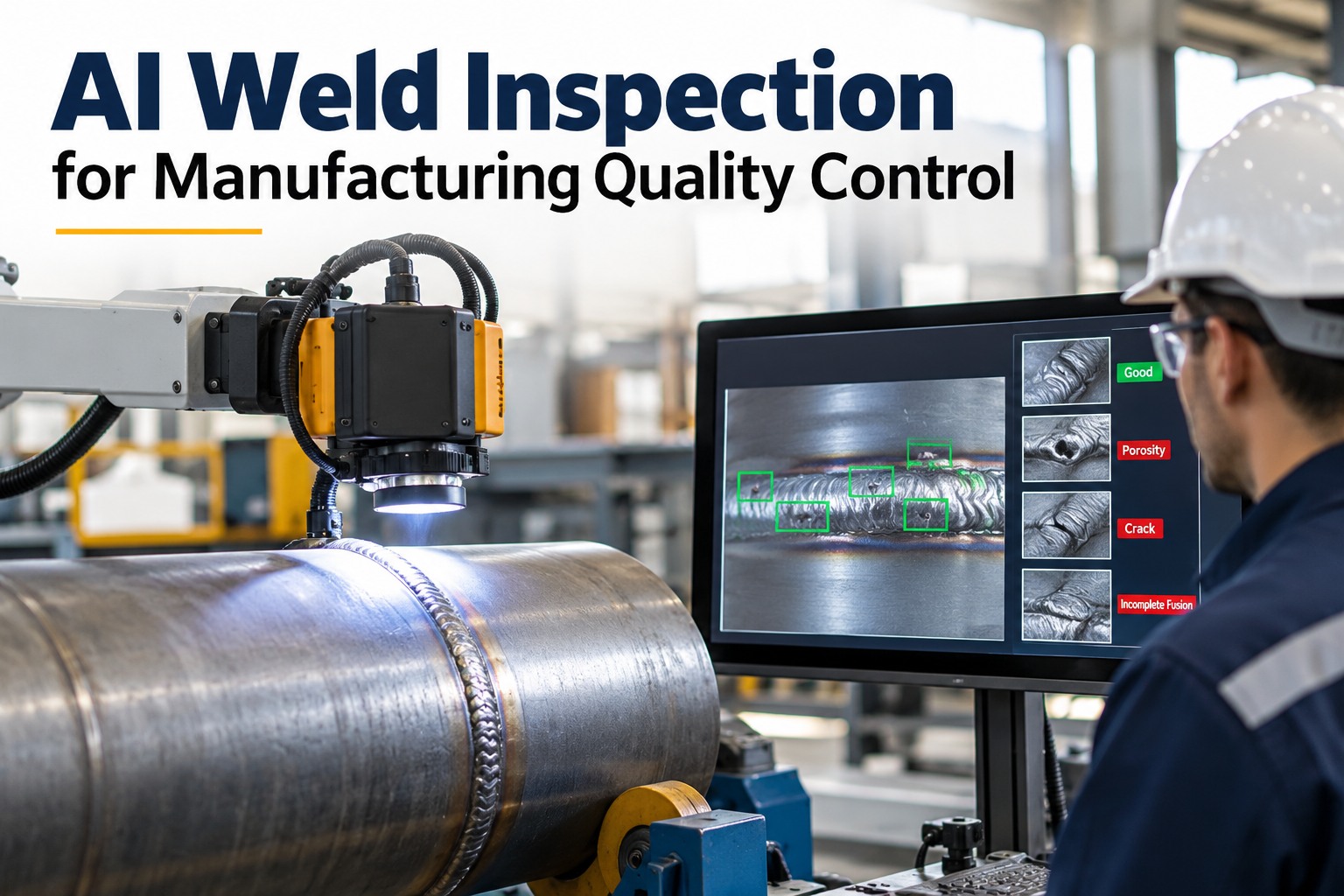
Every weld your production line makes is either conforming or a liability — and in manual inspection regimes, the average inspector misses 12–23% of critical defects including subsurface porosity, micro-cracks, and incomplete fusion that are invisible to the naked eye until they fail in service. OxMaint's AI weld inspection module deploys vision cameras and machine learning models directly at the weld station — detecting porosity, undercutting, cracks, spatter, and burn-through in real time, per weld, per joint type, at line speed — without slowing production or requiring a quality technician at every station. The manufacturers moving from manual to automated weld inspection are not replacing human judgment — they are giving human quality engineers data that was never visible before: 100% weld coverage, defect coordinates mapped to joint ID, and process parameter correlation that tells you which machine setting, wire feed deviation, or shielding gas variation produced each defect class.
AI Weld Inspection: Catch Every Defect at Line Speed, Not at the Scrap Bin
Real-time porosity, crack, undercut, and fusion defect detection — automatically classified, logged to joint ID, and correlated to process parameters before the next weld begins.
The 6 Weld Defects AI Inspection Detects — and What Causes Each One
Understanding what AI weld inspection actually detects — and the process conditions that generate each defect class — is the foundation of using automated inspection data for process improvement rather than just pass/fail sorting. Each defect type has a distinct visual signature, a set of root cause parameters, and a different consequence severity for structural or pressure-containing welds.
Detect All 6 Defect Classes in Real Time — Per Weld, Per Joint, at Line Speed
OxMaint's AI weld inspection logs every defect with coordinates, classification, severity, and process parameters — giving your quality engineers the data to fix the process, not just sort the parts.
How AI Weld Inspection Works: From Camera Frame to Defect Log
AI weld inspection is not a single technology — it is a pipeline from image or sensor capture through classification to process feedback. Understanding each stage clarifies what system architecture is appropriate for your weld type, production speed, and quality standard.
High-resolution cameras — typically 5–12 megapixel industrial sensors — capture weld bead images immediately after weld completion or during welding (in-process). Structured light and laser profilometry add 3D surface topology data, enabling depth measurement of undercuts and porosity that 2D imaging alone cannot quantify. For MIG/MAG welding, cameras are shielded from arc light with optical filters; for laser welding, coaxial imaging through the beam path captures weld pool dynamics in real time.
Raw weld images are normalised for lighting variation, camera angle, and material surface finish differences — conditions that make raw images difficult for AI models to interpret consistently. Segmentation models isolate the weld bead region from the base metal, enabling defect detection algorithms to focus computational resources on the relevant image area and reducing false positive rates from surface reflections and fixturing shadows.
Convolutional neural network (CNN) models trained on labelled weld defect image datasets classify defect type, location, and severity for each weld image. Models trained on broad datasets achieve general defect detection; models fine-tuned on your specific joint geometry, material, and weld process achieve the highest accuracy — typically 94–99% classification accuracy on well-defined defect classes when the training dataset includes sufficient examples from your production conditions.
OxMaint correlates each defect classification with the process parameters recorded during that weld — amperage, voltage, wire feed speed, travel speed, shielding gas flow rate, and preheat temperature. This correlation layer converts inspection data from a sorting tool into a process improvement tool: instead of knowing "12 porosity defects this shift," your engineers see "porosity rate increases 340% when shielding gas flow drops below 14 L/min on Joint Type B."
Welds classified as defective above a configurable severity threshold trigger automatic disposition actions: reject flag on the part, rework work order with defect type and location pre-populated, and quality hold notification to the supervisor. Defect records are stored against joint ID, operator, machine, material heat number, and shift — creating the traceability record required for welding procedure qualification records (WPQRs) and customer quality submissions.
AI vs Manual vs NDT: Choosing the Right Weld Inspection Method
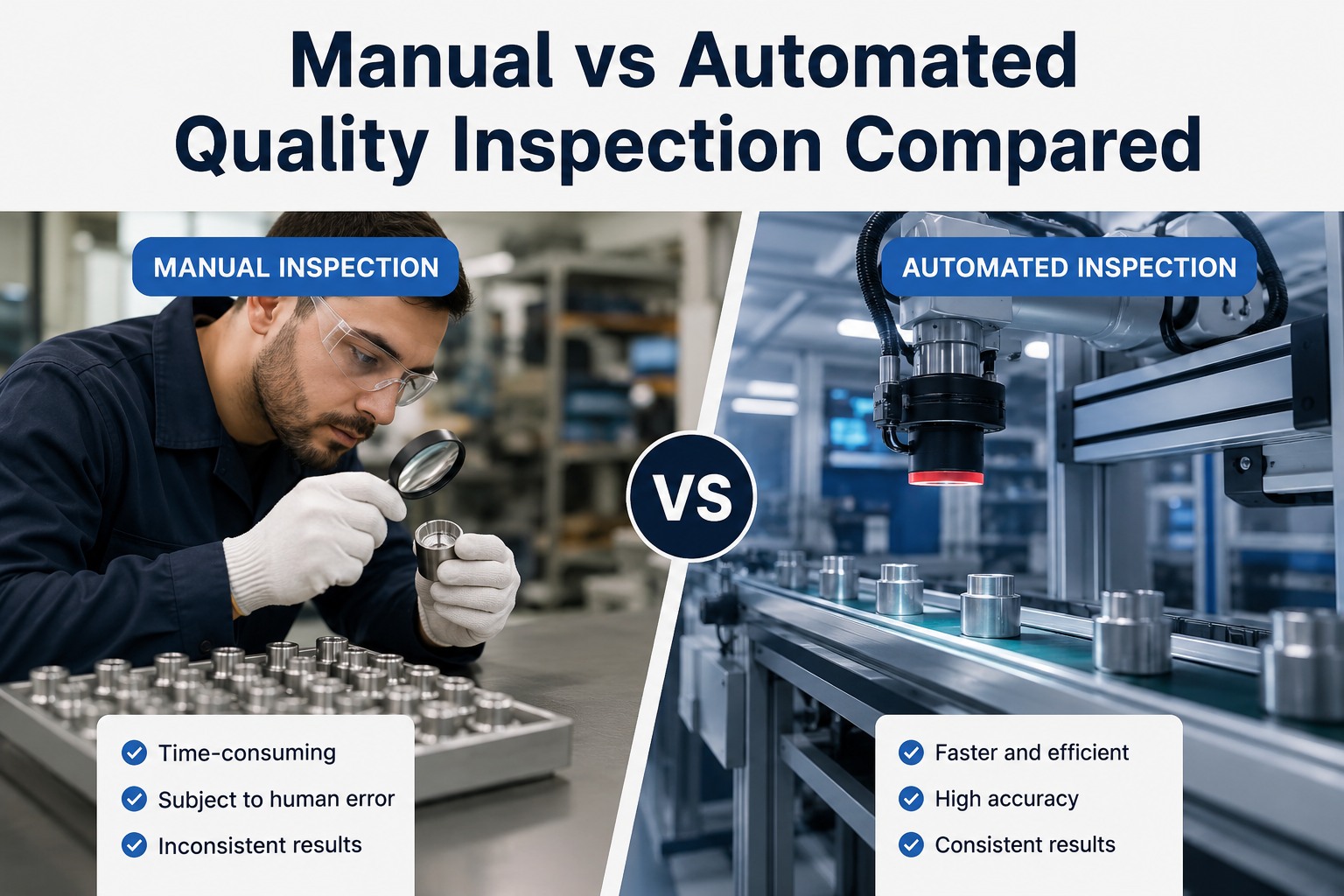
No single weld inspection method covers every defect type for every application. The table below compares the primary methods across the dimensions that matter for production quality decisions — detection capability, throughput impact, cost, and data output.
| Method | Coverage | Surface Defects | Subsurface | Speed | Process Data | Cost/Weld |
|---|---|---|---|---|---|---|
| Manual Visual | 8–12% sampled | 68–77% | None | Slow | None | $2.80–$6.00 |
| AI Vision (Surface) | 100% | 94–99% | Limited | Real-time | Full correlation | $0.08–$0.35 |
| Radiographic (X-ray) | Sampled | High | High | Very slow | None | $45–$180 |
| Ultrasonic (UT) | Sampled | Moderate | Very high | Slow | None | $28–$95 |
| Magnetic Particle (MPI) | Sampled | High | Near-surface | Moderate | None | $12–$40 |
| AI + Phased Array UT | 100% | 99%+ | Very high | Near real-time | Full correlation | $0.90–$2.40 |
Where AI Weld Inspection Delivers the Highest ROI by Application
The business case for AI weld inspection varies significantly by application — not because the technology performs differently, but because the cost of an escaped defect and the current inspection cost both vary. The four application profiles below represent the highest-ROI deployment scenarios.
High-volume robotic MIG/MAG welding of chassis, sub-frame, and safety-critical structural components. 100% inspection at line speed is the only viable approach — sampled manual inspection on 2,000+ welds per shift is not operationally feasible. Defect escape cost: $4,200–$18,000 per recalled vehicle per weld location.
Circumferential and longitudinal welds on pressure-containing equipment where weld failure consequences include catastrophic release. AI pre-screens 100% of welds; high-confidence pass results reduce the NDT sampling burden — cutting X-ray and UT inspection volume by 60–75% while maintaining or improving overall defect escape rates.
Large-section weld seams where manual inspection is physically difficult and rework costs are extremely high due to inaccessibility and structural complexity. Early defect detection at weld completion prevents the scenario where a defective weld is discovered after 40 hours of downstream assembly work has been built on top of it.
Precision TIG and laser welds on airframe, engine, and structural components where defect tolerance is near-zero and traceability requirements demand per-weld documentation. AI inspection generates the digital quality record — defect type, location, severity, and process parameters — that replaces manual inspection sign-off in AS9100 quality management systems.
The question I hear most often from welding quality managers is whether AI inspection can replace their certified welding inspectors. That is the wrong question. The right question is: what can a certified welding inspector do in a day if they are not spending six hours per shift looking at weld beads that are almost certainly conforming? AI inspection handles the 94% of welds that are straightforward. It flags the 6% that need a qualified human decision — with image evidence, measurement data, and process correlation already attached. The inspector becomes a quality engineer who uses data to fix processes rather than an inspector who documents defects after they occur. That shift in role is where the real value is. I have seen plants reduce their total quality cost by 38% in twelve months not by cutting inspection headcount, but by redirecting it toward process improvement work that the AI data now makes possible.
Frequently Asked Questions
Surface-only AI vision systems cannot detect subsurface defects directly. However, AI models trained on weld pool thermal signatures and acoustic emission data captured during welding can identify process conditions that correlate strongly with incomplete fusion — providing a predictive signal rather than direct detection. For confirmed subsurface inspection, AI vision is combined with phased array ultrasonic testing. OxMaint supports hybrid inspection workflows that route AI-flagged welds to NDT automatically.
Pre-trained base models covering common defect classes on standard joint geometries are deployable immediately with minimal site-specific tuning — typically requiring 200–500 labelled weld images from your production for fine-tuning, achievable in 2–4 weeks. Novel joint geometries or unusual material combinations require more training data: 1,000–3,000 labelled examples and 4–8 weeks for a model reaching production-grade accuracy. Book a demo to review model deployment timelines for your weld types.
AI vision inspection can satisfy the visual examination requirements of AWS D1.1, ISO 5817, and ASME Section IX when the system is validated and the detection thresholds meet the applicable acceptance criteria. Qualification documentation — including system validation records, defect detection performance data, and calibration certificates — is required for regulatory acceptance. OxMaint generates the inspection records and system performance reports required for welding procedure and qualification submissions.
Production-grade AI weld inspection systems achieve false positive rates of 1–4% on well-trained models for common defect classes. At a 2% false positive rate on 500 welds per shift, approximately 10 conforming welds per shift are flagged for human review — a manageable review load that preserves 98% throughput efficiency. False positive rates above 8% typically indicate insufficient training data or inconsistent lighting/fixturing, not fundamental model limitations. Schedule a demo to review false positive benchmarks for your weld application.
OxMaint integrates with robotic welding controllers via OPC-UA, Modbus, and standard industrial protocols — receiving weld parameter data from the controller and returning pass/fail signals that trigger part disposition or robot parameter adjustment. MES integration via REST API or direct database connection enables defect records to be written against the production order and serial number in real time. Start your free trial to explore the integration architecture for your welding cell configuration.
Stop Discovering Weld Defects at the Scrap Bin. Catch Them at the Weld Station.
OxMaint's AI weld inspection detects porosity, undercutting, cracks, burn-through, and incomplete fusion in real time — per weld, per joint, correlated to process parameters — giving your quality engineers the data to fix the process before the next shift, not after the next customer return.