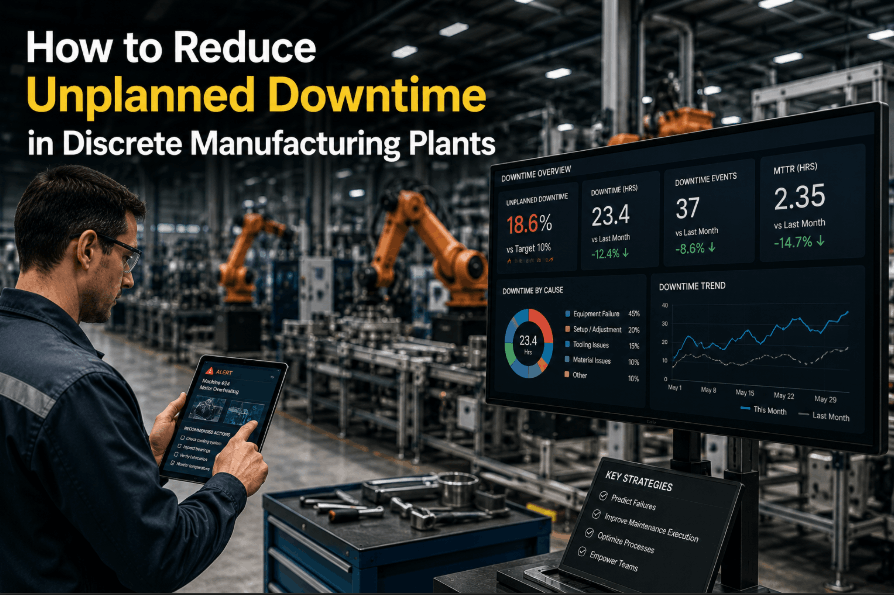
The production manager receives the daily operations report showing 82% equipment effectiveness—a number that seems acceptable until the plant controller calculates lost production value: $147,000 this week alone from unplanned stoppages that "only" totaled 47 hours. The maintenance team insists downtime is "unavoidable," yet when asked which specific failures caused the most losses, nobody can answer with data. Downtime logs show cryptic entries like "machine issue" and "awaiting parts" without root cause, duration breakdown, or financial impact—making improvement impossible because the facility lacks visibility into what's actually costing money.
This downtime blindness plagues discrete manufacturing operations—automotive component suppliers, aerospace fabricators, electronics assemblers, industrial equipment manufacturers, and precision machining shops—where every minute of lost production directly impacts profitability. The average discrete manufacturing facility experiences 400-800 hours of unplanned downtime annually yet properly accounts for only 40-55% of losses because inadequate tracking systems fail to capture comprehensive downtime data. Without systematic downtime accounting, facilities cannot prioritize improvement efforts, justify preventive maintenance manufacturing & plants investments, or demonstrate downtime reduction progress.
Discrete manufacturers implementing comprehensive downtime accounting with work order automation, AI analytics, and condition monitoring achieve 45-65% downtime reductions within 12-18 months by systematically identifying, troubleshooting, and eliminating top loss contributors. This transformation requires understanding downtime categories, implementing proper tracking systems, and following structured troubleshooting methodologies. Organizations ready to convert downtime chaos into actionable improvement data can explore how Oxmaint CMMS transforms downtime tracking.
What if you could identify the exact 5 failure modes causing 60% of your production losses—and systematically eliminate them over the next 6 months?
While other discrete manufacturers accept downtime as "unavoidable cost," data-driven facilities use comprehensive downtime accounting to identify improvement opportunities worth $500,000-$2M annually. Discover why 300+ manufacturing operations trust Oxmaint to track and reduce production losses.
Downtime Classification Framework
Effective downtime accounting begins with proper categorization. Generic labels like "breakdown" or "maintenance" provide zero actionable insight. This standardized framework enables consistent classification across shifts, lines, and facilities—creating comparable data that reveals patterns and priorities.
Unplanned Downtime (Target: <15% of Total)
Unexpected breakdowns requiring repair. Examples: bearing seizure, motor failure, hydraulic leak, control system fault, sensor malfunction.
Production stopped due to defects. Examples: dimensional drift, surface finish problems, material contamination, calibration issues.
Tool breakage or premature wear. Examples: drill bit failure, cutting insert breakage, die wear, fixture damage, jig misalignment.
Planned Downtime (Target: 8-12% of Total)
Scheduled maintenance activities. Examples: lubrication, filter changes, belt replacement, calibration, inspection.
Product or process changes. Examples: setup adjustments, tooling changes, program uploads, first article inspection.
Planned upgrades or retrofits. Examples: control system updates, safety improvements, capacity expansions, efficiency projects.
Operational Downtime (Target: <10% of Total)
Waiting for raw materials or components. Examples: supplier delays, inventory stockouts, logistics issues, receiving problems.
Operator unavailability. Examples: absenteeism, training gaps, shift coverage problems, certification requirements.
Insufficient orders to run production. Examples: schedule gaps, customer reschedules, demand fluctuations, inventory constraints.
Minor Stoppages (<10 min events)
Brief interruptions not classified as downtime. Examples: part jams, sensor trips, temporary obstructions, quick resets.
The Hidden Cost: True Financial Impact
Most facilities dramatically underestimate downtime costs by only calculating direct production losses while ignoring cascading impacts. Comprehensive accounting reveals total financial burden—enabling accurate ROI calculations for improvement initiatives.
Comprehensive Downtime Cost Formula
Root Cause Troubleshooting Framework
Systematic troubleshooting follows structured methodology—not random part replacement hoping to fix problems. This decision tree guides technicians and engineers through logical fault isolation for the most common discrete manufacturing downtime causes.
5-Step Troubleshooting Protocol
Document Initial Symptoms
Action: Capture detailed symptom description before touching equipment. Use barcode/QR scanning to verify correct asset, photograph evidence, record error codes, note environmental conditions.
- Exact failure symptoms (noise, vibration, error messages, output quality)
- When failure occurred (date, time, shift, operator, production run)
- What changed recently (PM activities, process adjustments, material lot)
- Failure frequency (first occurrence vs. recurring issue)
Review Equipment History
Action: Access Oxmaint CMMS work order history identifying past failures, recent maintenance, modification records, and chronic issues. Historical patterns often reveal root causes.
- Has this exact failure happened before? What was the root cause then?
- What maintenance was performed in the last 30 days?
- Are there recurring issues on this equipment every X cycles/days?
- Did recent modifications or improvements create new problems?
Isolate Failure Mode
Action: Use condition monitoring data (vibration, thermal, electrical) and diagnostic tests to narrow failure location. Avoid shotgun part replacement—isolate specific component failure first.
- Vibration analysis identifying bearing/alignment issues
- Thermal imaging detecting electrical/mechanical hot spots
- Electrical measurements (voltage, current, resistance, phase)
- Hydraulic/pneumatic pressure and flow testing
Identify Root Cause (5 Whys)
Action: Ask "why" five times drilling from symptom to underlying cause. Document root cause analysis in work order—not just "replaced bearing" but "bearing failed due to contaminated lubricant from inadequate seal."
- Why did motor fail? Bearing seized.
- Why did bearing seize? Lack of lubrication.
- Why was it not lubricated? PM task not completed.
- Why wasn't PM completed? Technician couldn't access grease fitting.
- Why couldn't he access it? Safety guard blocks access—design flaw.
- Root Cause: Inadequate PM accessibility—modify guard or relocate fitting.
Implement Corrective & Preventive Actions
Action: Fix immediate problem AND address root cause to prevent recurrence. Update PM procedures, training, parts specifications, or design as needed. Document in CMMS for future reference.
- Immediate: Repair/replace failed component, restore operation
- Corrective: Modify process/procedure preventing recurrence
- Preventive: Update PM tasks catching early warning signs
- Predictive: Add condition monitoring for proactive intervention
Common Downtime Causes & Quick Fixes
These recurring failure modes cause 70-80% of unplanned downtime in discrete manufacturing. Understanding symptoms, root causes, and solutions accelerates troubleshooting while preventing future occurrences.
Issue: Bearing Failures
- Implement vibration monitoring detecting bearing degradation 30-60 days early
- Standardize lubrication procedures with proper intervals and grease types
- Perform precision alignment during installation and after repairs
- Add sealing improvements in contaminated environments
Issue: Electrical/Control Failures
- Quarterly thermal imaging of electrical panels identifying hot connections
- Environmental controls (cooling, sealing) for sensitive electronics
- Preventive replacement of time-sensitive components (contactors, relays)
- Power quality monitoring and correction (harmonics, voltage stability)
Issue: Hydraulic/Pneumatic Problems
- Fluid cleanliness monitoring and filtration improvements
- Seal replacement based on cycle counts rather than failure
- Pressure monitoring identifying leaks and performance degradation
- Temperature control preventing fluid breakdown
Issue: Mechanical Wear & Misalignment
- Precision alignment tools and procedures for critical equipment
- Vibration analysis identifying misalignment and imbalance
- Load monitoring preventing overload conditions
- Dimensional inspection schedules catching wear before quality impact
Modernize Manufacturing & Plants Service Quality via Digital Work Orders
Paper-based downtime tracking fails because technicians shortcut documentation during pressure situations—writing "machine fixed" instead of comprehensive root cause analysis. Digital work order automation with mobile apps transforms data capture from burden to systematic process generating the information needed for effective troubleshooting.
Automated Downtime Capture
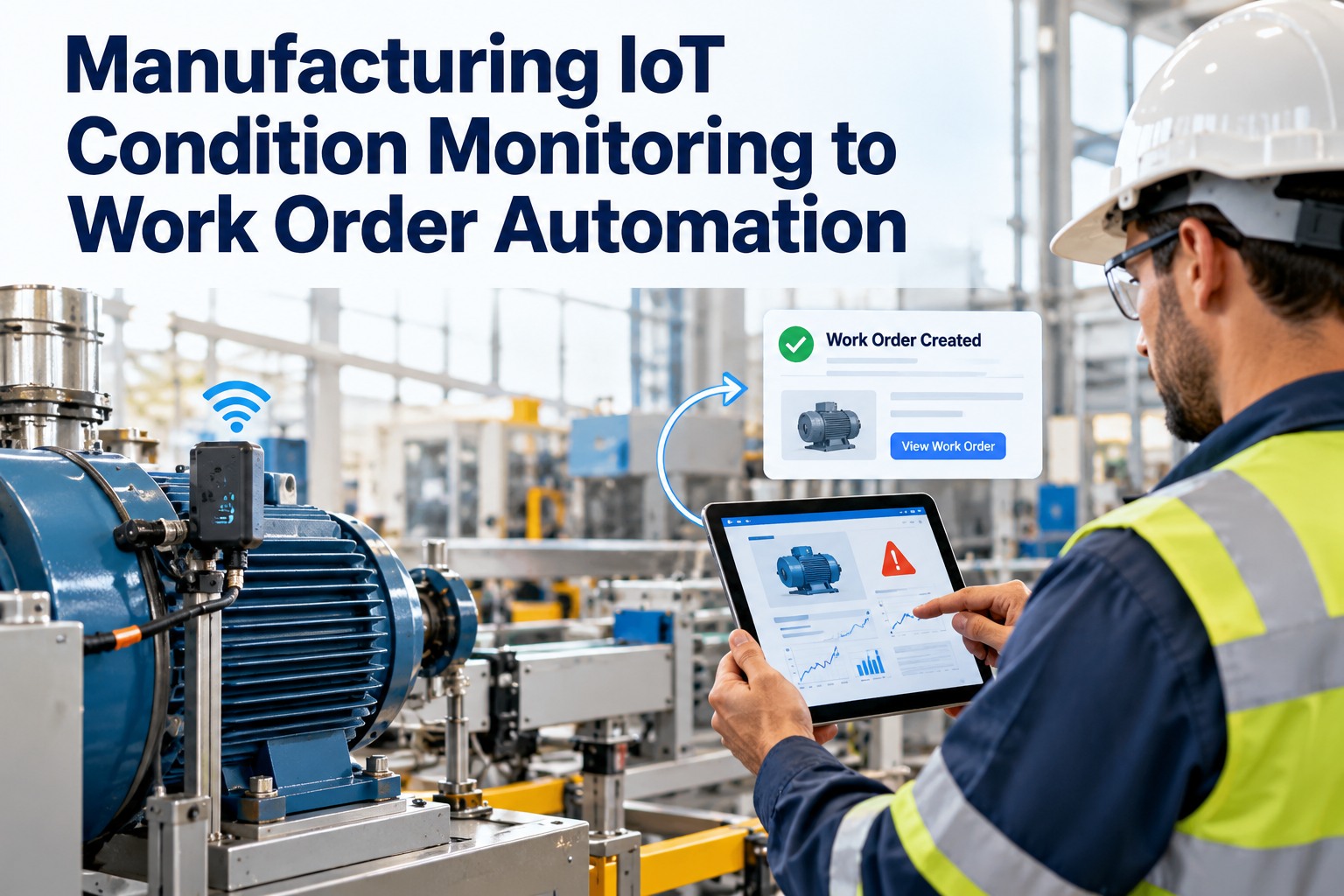
Production system integration automatically creates downtime work orders when equipment stops—no manual logging required. System captures exact start time, duration, and production impact eliminating human error and reporting gaps.
Mandatory Classification Fields
Technicians cannot close work orders without selecting standardized downtime category, specific failure mode, and root cause from dropdown menus. Barcode/QR scanning verifies correct equipment preventing data entry errors.
Photo Documentation Requirements
Mobile work orders require technicians to photograph failed components, thermal/vibration readings, and repair completion. Visual evidence supports root cause analysis and knowledge transfer to other shifts.
AI Pattern Recognition
AI analytics analyze work order history identifying recurring failure patterns, high-loss equipment, and correlations between maintenance activities and downtime. System automatically flags chronic issues requiring engineering investigation.
Real-Time Dashboards
Management accesses live downtime metrics: current events, historical trends, top loss contributors, MTBF/MTTR by equipment. Financial impact calculated automatically using configurable cost formulas.
Corrective Action Tracking
System tracks corrective actions from identification through implementation and effectiveness verification. Prevents chronic issues from being "fixed" repeatedly without addressing root causes.
Standardizing Compliance at Scale — A Manufacturing & Plants Playbook with AI
Multi-site discrete manufacturers face the challenge of implementing consistent downtime accounting across facilities with different equipment, cultures, and maturity levels. This playbook provides phased rollout strategy achieving standardization while respecting site-specific needs.
Objective: Establish corporate-wide downtime classification system ensuring consistency across all sites.
- Form cross-site team defining standardized downtime categories and subcategories
- Build comprehensive cause code library with clear definitions and examples
- Configure Oxmaint CMMS with mandatory classification fields
- Create visual reference guides posted at each line
Objective: Deploy complete solution at one site, refine processes, build success stories for broader rollout.
- Select pilot site with engaged leadership and representative equipment
- Deploy barcode/QR tags, mobile devices, and production system integration
- Train technicians and supervisors on troubleshooting protocols
- Run parallel systems for 30 days, then full digital cutover
Objective: Deploy to remaining facilities using proven playbook while maintaining standardization.
- Implement 2-3 sites simultaneously using pilot site lessons learned
- Pilot site technicians support rollout as subject matter experts
- Weekly cross-site meetings sharing best practices and challenges
- Corporate dashboard comparing site performance driving healthy competition
Objective: Leverage 6+ months of quality data for predictive maintenance manufacturing & plants and automated improvement identification.
- AI algorithms analyze patterns identifying top loss contributors across enterprise
- Predictive models forecast equipment failures 30-90 days in advance
- Automated alerts flag emerging chronic issues for engineering review
- Corporate improvement team prioritizes initiatives based on total enterprise impact
Measuring Success: Key Metrics
Effective downtime reduction programs track leading and lagging indicators revealing both results and process health. Monitor these KPIs monthly to assess progress and identify intervention needs.
Quick-Start Action Plan
Organizations can begin downtime reduction immediately without waiting for complete CMMS implementation. This 30-day quick-start generates early wins building momentum for comprehensive transformation.
Establish Baseline & Classification
Implement Enhanced Tracking
Focus on Top 3 Losers
Measure & Communicate Results
Conclusion
Downtime accounting and lost production troubleshooting for discrete manufacturing transforms from reactive firefighting to systematic improvement when organizations implement proper classification frameworks, comprehensive cost accounting, and structured troubleshooting methodologies. The case for change is compelling: facilities properly tracking downtime discover actual losses are 2-3x higher than estimated, with the top 20% of failure modes causing 80% of financial impact—creating concentrated improvement opportunities worth $500,000-$2M annually for typical operations.
Success requires three foundational elements: standardized downtime taxonomy enabling consistent classification across shifts and facilities, digital work order automation capturing comprehensive data without administrative burden, and AI analytics identifying patterns invisible to manual review. Organizations implementing these capabilities systematically—following proven playbooks rather than rushed deployments—consistently achieve 45-65% downtime reductions within 12-18 months while building sustainable continuous improvement cultures.
The competitive advantage belongs to discrete manufacturers that view downtime not as unavoidable cost but as visible improvement opportunity. Every unplanned stoppage contains lessons about equipment reliability, maintenance effectiveness, and process capability—but only for organizations with systems capturing and analyzing that information. The handbook approach outlined here—combining classification discipline, troubleshooting rigor, and digital automation—provides the proven framework converting downtime tracking from administrative burden to strategic asset driving measurable operational excellence.
Imagine presenting your next operations review showing 50% downtime reduction and $850,000 recovered production value—what credibility would that build with executive leadership?
Every month without systematic downtime accounting is another month accumulating preventable losses. Join the 300+ discrete manufacturers that transformed production reliability from reactive chaos to predictive excellence with Oxmaint's proven CMMS platform—the same technology delivering results across automotive, aerospace, electronics, and industrial equipment operations.