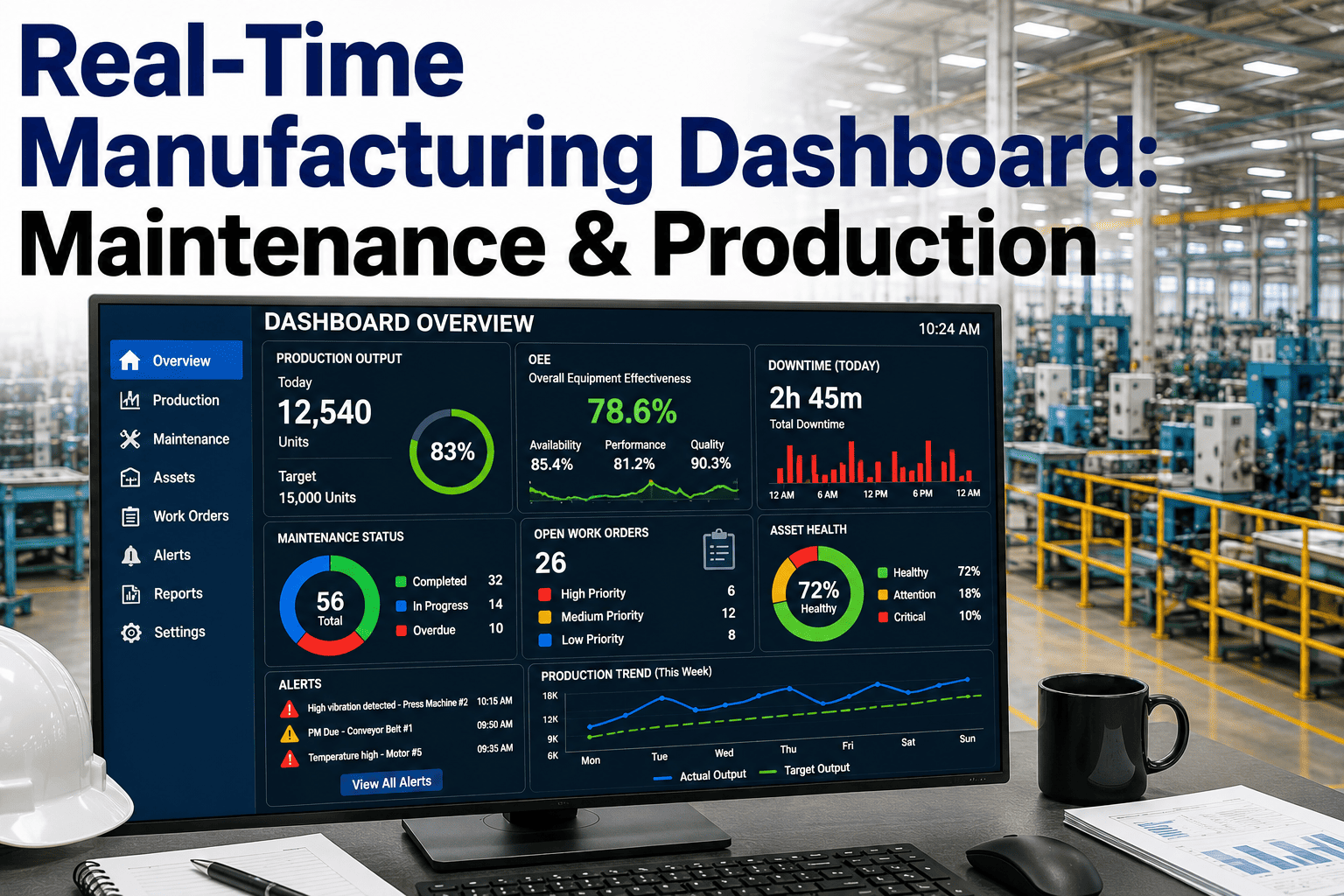
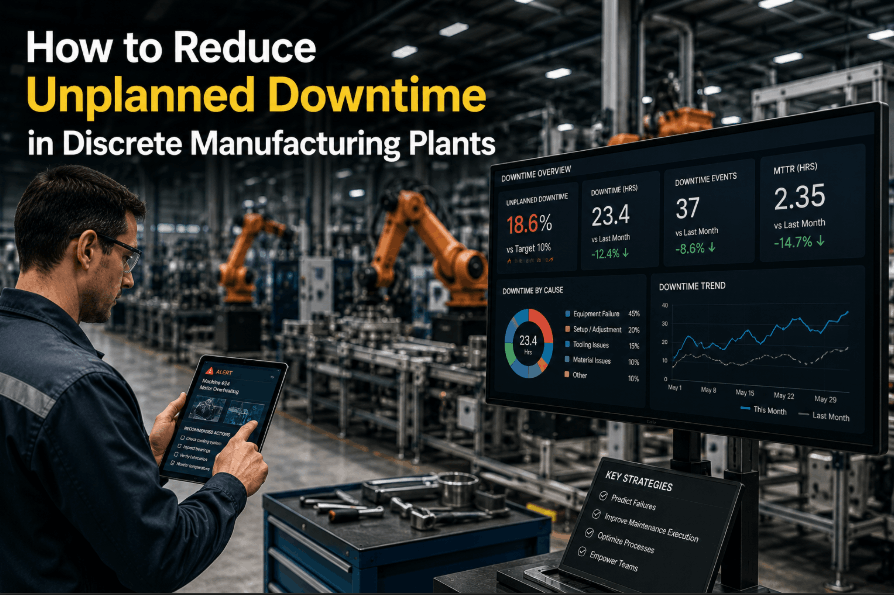
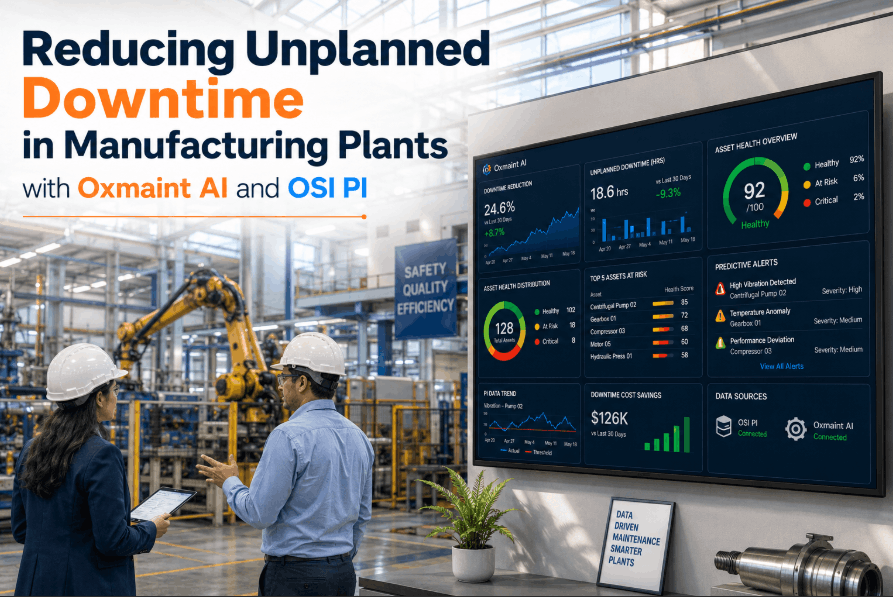
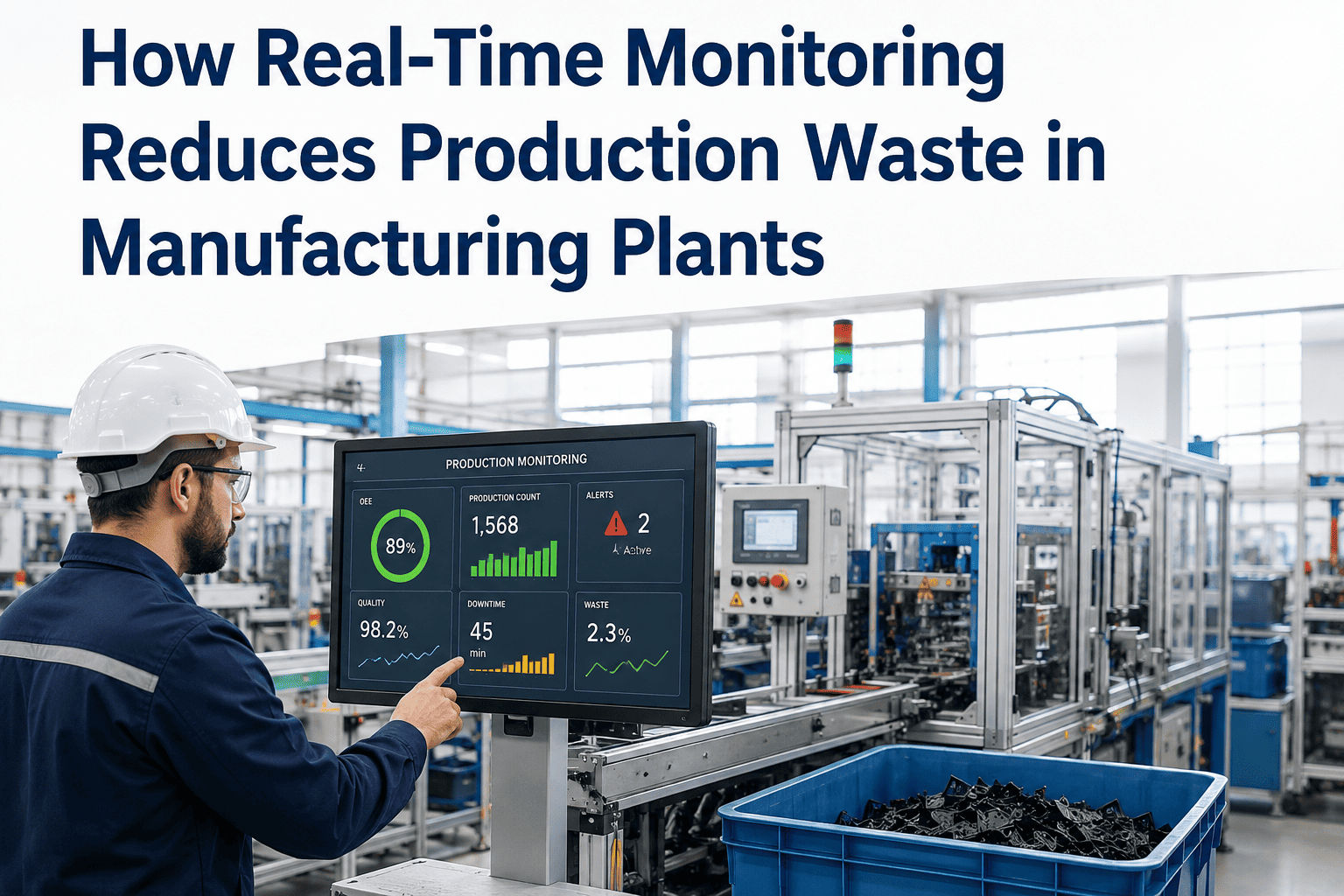
The production manager walks the factory floor at 7:45 AM, clipboard in hand, asking line supervisors: "What's the status on Line 3's CNC machine?" "When was the last PM on the assembly robot?" "Which equipment is due for maintenance this week?" Responses vary by shift and supervisor—some accurate, others guesses—because the facility operates without real-time asset visibility. When a critical stamping press fails at 10:30 AM, maintenance discovers it's been vibrating abnormally for three weeks (information the operator mentioned casually but never formally reported), operated 847 hours past its scheduled PM interval, and requires a $47,000 bearing assembly that procurement never ordered because nobody knew the part was approaching end-of-life. The 14-hour emergency repair costs $385,000 in lost production—entirely preventable with systems providing real-time equipment status, predictive failure warnings, and automated maintenance scheduling.
This visibility gap plagues discrete manufacturing operations—automotive component suppliers, aerospace fabricators, electronics assemblers, precision machining shops, industrial equipment manufacturers—where production depends on coordinated performance of 200-800 critical assets across multiple production lines. Without real-time visibility integrating IoT sensors, barcode/QR asset tracking, and AI predictive analytics, facilities operate reactively: discovering problems after they impact production, scheduling maintenance based on calendar intervals rather than actual equipment condition, and making resource allocation decisions using incomplete or outdated information.
Discrete manufacturers implementing comprehensive real-time asset visibility achieve 40-60% downtime reduction within 12-18 months while improving preventive maintenance manufacturing & plants compliance from typical 65-75% to 95-98%. This transformation requires understanding visibility architecture, implementing proper IoT sensor infrastructure, leveraging AI analytics for predictive insights, and operationalizing intelligence through smart scheduling and clear KPIs. Organizations ready to eliminate visibility gaps can explore how Oxmaint CMMS enables real-time asset visibility.
What if you could monitor every critical asset in real-time, predict failures 30-60 days in advance, and automatically schedule maintenance during planned downtime—would that transform your operations?
While other discrete manufacturers struggle with reactive maintenance and surprise failures, operations leveraging real-time visibility reduce unplanned downtime by 40-60% while achieving 95%+ PM compliance. Discover why 280+ manufacturing facilities trust Oxmaint for asset visibility and predictive analytics.
The Real-Time Visibility Framework
Real-time asset visibility integrates four technology layers creating comprehensive equipment intelligence impossible with traditional maintenance systems. Understanding each layer and their integration is essential for effective implementation.
Asset Identification & Tracking
Technology: Barcode/QR code labels on every asset linking to digital equipment records in Oxmaint CMMS. Mobile scanning verifies asset identity during inspections, maintenance activities, and status updates.
- Deploy unique identifiers on all 200-800 critical assets
- Import equipment specifications, OEM manuals, maintenance histories
- Establish asset hierarchy matching production line organization
- Enable mobile inspection workflows with mandatory scanning
Real-Time Condition Monitoring
Technology: IoT sensors continuously monitoring critical parameters—vibration (rotating equipment), temperature (motors/bearings), power consumption (electrical systems), pressure/flow (hydraulics/pneumatics), cycle counts (production equipment).
- Install 60-120 IoT sensors on highest-criticality assets (20-30% of equipment base)
- Configure alert thresholds based on OEM specifications and baseline operation
- Integrate sensor data with CMMS for automated work order generation
- Establish condition monitoring dashboards for real-time status visibility
AI Predictive Analytics
Technology: Machine learning algorithms analyzing historical failure patterns, current condition data, production schedules, and environmental factors to predict specific failure modes with 70-85% accuracy 30-90 days in advance.
- Configure AI analytics after collecting 3-6 months of baseline sensor data
- Train models on equipment-specific failure patterns and maintenance outcomes
- Establish risk scoring methodology prioritizing intervention timing
- Enable automated predictive maintenance manufacturing & plants work order creation
Intelligent Maintenance Orchestration
Technology: Smart scheduling engine coordinating predictive maintenance, preventive maintenance manufacturing & plants, production schedules, parts availability, technician skills, and equipment criticality to optimize maintenance timing minimizing production impact.
- Integrate production schedule providing planned downtime windows
- Configure intelligent parts ordering triggered by failure predictions
- Establish technician skill matrix for automated work assignment
- Enable compliance automation generating audit-ready compliance logs
AI & Predictive Analytics: From Data to Decisions
Real-time sensor data provides visibility into current equipment condition, but AI analytics transform that data into actionable intelligence predicting future failures and recommending specific interventions. Understanding how AI generates predictions helps operations teams trust and effectively use predictive insights.
How AI Predicts Equipment Failures
Pattern Learning from Historical Data
AI analyzes past failures identifying "signatures"—specific combinations of sensor readings, operating conditions, and timelines preceding breakdowns. Example: CNC spindle bearing failures typically show 0.15mm vibration increase + 8°C temperature rise + 12% power consumption increase over 35-50 days before complete failure.
Continuous Real-Time Comparison
System compares current sensor readings against learned failure signatures. When equipment behavior starts matching historical failure patterns, AI calculates probability of specific failure mode occurring within defined timeframe.
Risk Scoring & Prioritization
AI calculates maintenance priority considering failure probability, production impact, safety consequences, parts availability, and maintenance complexity. Generates prioritized action list ensuring critical interventions occur before less important tasks.
Prescriptive Recommendations
Beyond predicting failures, AI recommends specific actions based on similar historical situations: required parts, estimated labor hours, recommended technician skills, optimal timing based on production schedule.
Continuous Learning & Improvement
Every maintenance outcome feeds back into AI models. If predicted failure occurs as expected, confidence increases. If prediction proves incorrect, model adjusts reducing future false positives. Accuracy improves from initial 70-75% to mature 85-92% over 12-18 months.
Elevate Manufacturing & Plants Compliance with Smart Scheduling
Preventive maintenance compliance represents persistent challenge in discrete manufacturing where production pressure consistently trumps scheduled maintenance. Traditional calendar-based PM scheduling achieves only 65-75% completion because PMs conflict with production deadlines, required parts aren't available, or technicians lack necessary skills. Smart scheduling solves this through intelligent coordination of maintenance needs, production schedules, resource availability, and regulatory requirements.
The Traditional Scheduling Problem
Calendar-Based Rigidity
"Robot requires PM every 90 days per schedule." But 90-day mark falls during critical production run. PM gets delayed 2 weeks, then 4 weeks, eventually forgotten until failure. Compliance drops to 68%.
Resource Conflicts
Five PMs scheduled for Tuesday but only two technicians available, three critical parts on backorder, and production running overtime. Three PMs postponed indefinitely.
Production-Maintenance Battles
Operations manager: "We can't stop Line 2 for PM today—customer shipment due tomorrow." Maintenance supervisor: "It's 10 days overdue already." Equipment runs until failure during shipment run.
Compliance Documentation Gaps
Auditor: "Show me PM completion records for safety-critical equipment." 12-hour document hunt reveals 18 missing records, unclear if PMs occurred and weren't documented or truly skipped. Audit finding issued.
Smart Scheduling Solution Framework
Dynamic PM Windows vs. Fixed Dates
Traditional: "PM due September 15th"—inflexible date creates conflicts
Smart Scheduling: "PM due between September 10-20, optimal execution September 13th based on production schedule, parts delivery September 11th, and technician availability"
Production Schedule Integration
System imports production schedule identifying planned downtime windows, changeover periods, and low-demand periods. Automatically schedules maintenance during these opportune moments minimizing production impact.
Parts & Skills Coordination
Before scheduling PM, system verifies parts availability and required technician skills. If parts on backorder or no qualified technician available, PM automatically reschedules preventing maintenance delays due to resource gaps.
Regulatory Requirement Enforcement
Safety-critical equipment and regulatory mandated inspections get priority scheduling with escalation workflows. If PM approaches compliance deadline without scheduling, system alerts management and prevents further delays.
Automated Compliance Documentation
Every scheduled PM generates work order with mobile inspection checklist. Technicians cannot close work order without completing all tasks, capturing photos, and scanning asset barcode. System automatically generates audit-ready compliance logs.
Operationalizing AI Insights — A Manufacturing & Plants Framework with KPIs
AI predictions provide valuable intelligence, but only when effectively operationalized into daily workflows and measured through appropriate KPIs. Many facilities implement predictive analytics but fail to achieve results because they don't establish clear processes for acting on insights or measuring outcomes. This framework ensures AI recommendations translate into tangible operational improvements.
Five-Stage Operationalization Model
Stage 1: Alert Generation & Triage
Process: AI generates predictive alerts with risk scores. Automated triage separates critical (require immediate action), high (action within 1 week), moderate (action within 2-4 weeks), and low (monitor) priorities.
- Alert volume by priority level (target: 15-25 critical alerts monthly for 500-asset facility)
- Alert accuracy rate (target: >80% of alerts result in confirmed issues)
- False positive rate (target: <20% of alerts prove unfounded)
Stage 2: Investigation & Validation
Process: Maintenance team investigates AI alerts through physical inspection, additional diagnostic testing, or OEM manual consultation. Validates whether predicted issue actually exists and determines appropriate intervention.
- Average investigation time (target: <4 hours for critical, <2 days for high priority)
- Investigation completion rate (target: 100% of critical alerts investigated within SLA)
- Validation accuracy (tracks AI prediction accuracy through investigation outcomes)
Stage 3: Planning & Scheduling
Process: Validated issues get scheduled for intervention. Smart scheduling determines optimal timing considering production schedule, parts availability, technician skills, and urgency. Work orders automatically created with required resources.
- Planning lead time (target: interventions scheduled within 3 days of validation)
- Parts availability at intervention time (target: 95%+ first-time availability)
- Schedule adherence (target: 90%+ interventions occur as planned)
Stage 4: Execution & Documentation
Process: Technicians execute planned maintenance using mobile inspections with barcode/QR verification, photo documentation, and digital signatures. Real-time status updates provide visibility into intervention progress.
- First-time completion rate (target: 95%+ interventions completed without rework)
- Documentation compliance (target: 100% work orders with photos and verification)
- Average intervention duration vs. planned (target: within 10% of estimate)
Stage 5: Outcome Measurement & Learning
Process: Track whether predicted failure was prevented, intervention cost vs. avoided failure cost, equipment performance post-intervention. Feedback loop improves AI prediction accuracy and operational processes.
- Failure prevention rate (target: 80-90% of predicted failures successfully prevented)
- ROI per intervention (target: 5-10x intervention cost in avoided failure value)
- Equipment reliability improvement (target: 40-60% reduction in unplanned downtime)
Master KPI Dashboard for Real-Time Visibility Operations
Equipment Health Metrics
Predictive Maintenance Performance
Maintenance Compliance
Operational Efficiency
Implementation Roadmap: 90-Day Quick Start
While comprehensive real-time visibility requires 12-18 months for full maturity, organizations can achieve significant quick wins within 90 days following this accelerated implementation approach focused on highest-impact assets and most critical capabilities.
Foundation: Asset Registry & Critical Equipment Identification
- Conduct comprehensive equipment audit identifying all production assets
- Establish criticality ranking: Critical (production bottlenecks, safety-critical), High (primary production), Moderate (supporting), Low (redundant/backup)
- Select top 30-50 critical assets for initial IoT deployment
- Deploy barcode/QR tags on ALL assets (200-800 total)
- Import equipment specifications, OEM manuals, maintenance histories
- Configure asset hierarchy matching production line structure
- Train maintenance team on mobile inspections manufacturing & plants and barcode scanning
Monitoring: IoT Sensors & Baseline Data Collection
- Install 30-50 IoT sensors on critical assets prioritizing: vibration sensors on rotating equipment, temperature sensors on motors, power monitors on high-consumption equipment
- Configure baseline thresholds using OEM specifications
- Establish real-time condition monitoring dashboards
- Convert top 50 critical equipment PMs to digital checklists
- Enable smart scheduling with production calendar integration
- Implement automated PM reminders and escalation workflows
- Track PM compliance trending toward 95%+ target
Intelligence: AI Analytics Activation & Quick Wins
- Activate AI analytics using 30-60 days of baseline sensor data
- Configure risk scoring methodology and alert thresholds
- Establish investigation workflows for predictive alerts
- Train operations and maintenance teams on AI insight interpretation
- Address initial AI-identified issues (typically 8-15 equipment needing attention)
- Measure baseline vs. current downtime reduction (typically 15-25% improvement visible)
- Calculate early ROI demonstrating value to justify expansion
- Plan Phase 2 expansion to additional assets and production lines
Real-World Quick Win Examples
Understanding how real-time visibility delivers value requires examining specific examples of issues detected and prevented. These six scenarios represent common situations that occur repeatedly across discrete manufacturing operations.
CNC Spindle Bearing Degradation
Detection: Vibration sensor on CNC machining center detected 0.18mm increase in spindle vibration over 3 weeks, concurrent with 9% power consumption increase and 6°C bearing temperature rise.
AI Prediction: "85% probability of spindle bearing failure within 30-45 days based on pattern matching 12 historical failures. Estimated failure cost: $95,000 (47-hour emergency repair + lost production)."
Action Taken: Scheduled bearing replacement during planned weekend maintenance. Actual intervention: 8 hours, $12,000 total cost including parts and labor.
Assembly Robot Servo Motor Overheating
Detection: Temperature sensor on robot joint servo motor showed gradual temperature increase from normal 68°C to 89°C over 10 days. Power consumption up 14%.
AI Prediction: "Motor operating outside thermal envelope. 72% probability of thermal shutdown within 15-25 days. Previous similar cases: brake assembly wear causing drag."
Action Taken: Investigation revealed brake assembly degradation confirmed by AI hypothesis. Replaced brake assembly ($2,800) during next shift changeover (4 hours).
Hydraulic Pump Cavitation
Detection: Pressure sensor on hydraulic stamping press showed 8% pressure drop over 2 weeks. Vibration pattern changed indicating cavitation. Cycle time increased 12 seconds per part.
AI Prediction: "Hydraulic pump degradation detected. 68% probability complete failure within 20-35 days. Immediate investigation recommended—cavitation accelerates damage exponentially."
Action Taken: Discovered hydraulic fluid contamination from worn seal. Replaced seal, flushed system, restored pressure. Total intervention: $3,400, 6 hours.
Dimensional Drift from Tool Wear
Detection: Power monitoring on drilling station showed 7% consumption increase over 5 days. Quality system flagged 3 parts approaching dimensional tolerance limits.
AI Correlation: System correlated power increase with quality drift identifying drill bit wear as root cause. "Replace drill bit before next production batch to prevent scrap."
Action Taken: Replaced drill bit ($380) during lunch break preventing dimensional failures that would have scrapped 180-unit production batch.
Conveyor Belt Misalignment
Detection: Motor current sensor on conveyor drive showed 11% increase. No vibration issues, no temperature problems—power consumption only indicator of developing problem.
AI Alert: "Abnormal power consumption pattern on Conveyor 3 consistent with belt misalignment or drive tension issues. Investigate before motor damage occurs."
Action Taken: Found belt tracking 2 inches off center causing drag. Realigned belt and adjusted tensioning. Total cost: $0 parts, 45 minutes labor.
Compressed Air Leak Detection
Detection: Compressor runtime monitoring showed 23% increase over 6 weeks despite production volume remaining constant. Power consumption up $840 monthly.
AI Analysis: "Compressor efficiency degradation indicates system leak development. Estimated 18-25 CFM loss costing $10,000+ annually in wasted energy."
Action Taken: Conducted ultrasonic leak survey finding 7 significant leaks. Repaired all leaks over 2 days ($1,200 total cost). Compressor runtime decreased 21%.
Conclusion
Real-time asset visibility across production lines represents transformational capability for discrete manufacturing operations where equipment coordination determines production success. The integration of barcode/QR asset tracking, IoT sensors, AI predictive analytics, and smart scheduling creates operational intelligence impossible with traditional maintenance approaches—enabling facilities to predict failures weeks before occurrence, optimize maintenance timing around production schedules, and achieve 95%+ PM compliance while simultaneously reducing unplanned downtime by 40-60%.
Success requires systematic implementation following proven frameworks: establishing comprehensive asset registries with digital tracking, deploying IoT sensors on critical equipment, activating AI analytics with proper baseline data, and operationalizing predictive insights through clear workflows and measurable KPIs. Organizations that view implementation as phased journey rather than single project consistently achieve better outcomes—starting with 30-50 critical assets generating quick wins that fund broader deployment while building organizational capability to effectively use advanced technology.
The competitive advantage belongs to discrete manufacturers that leverage technology converting equipment data into actionable intelligence. Real-time visibility makes the invisible visible—revealing equipment condition before failures occur, optimizing maintenance timing to minimize production disruption, and providing compliance documentation eliminating audit stress. The framework outlined here provides proven roadmap for discrete manufacturers ready to achieve world-class reliability and operational excellence through asset intelligence and predictive analytics.
Imagine presenting your next operations review showing 50% downtime reduction and 97% PM compliance—what credibility would that build with executive leadership?
Every month without real-time asset visibility is another month of surprise failures and reactive firefighting. Join the 280+ discrete manufacturers that transformed operations from reactive chaos to predictive excellence with Oxmaint's proven real-time visibility platform—the same technology delivering results across automotive, aerospace, electronics, and industrial equipment operations.