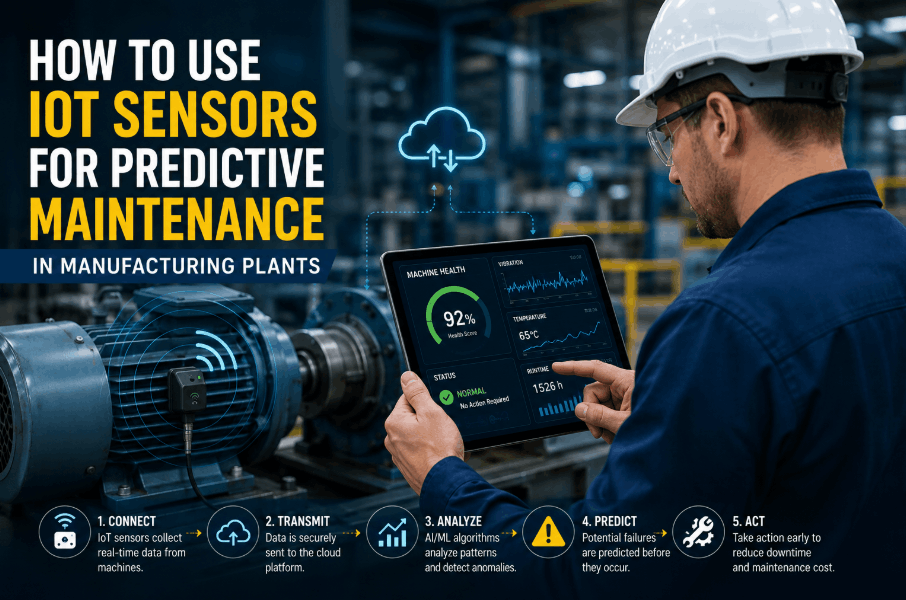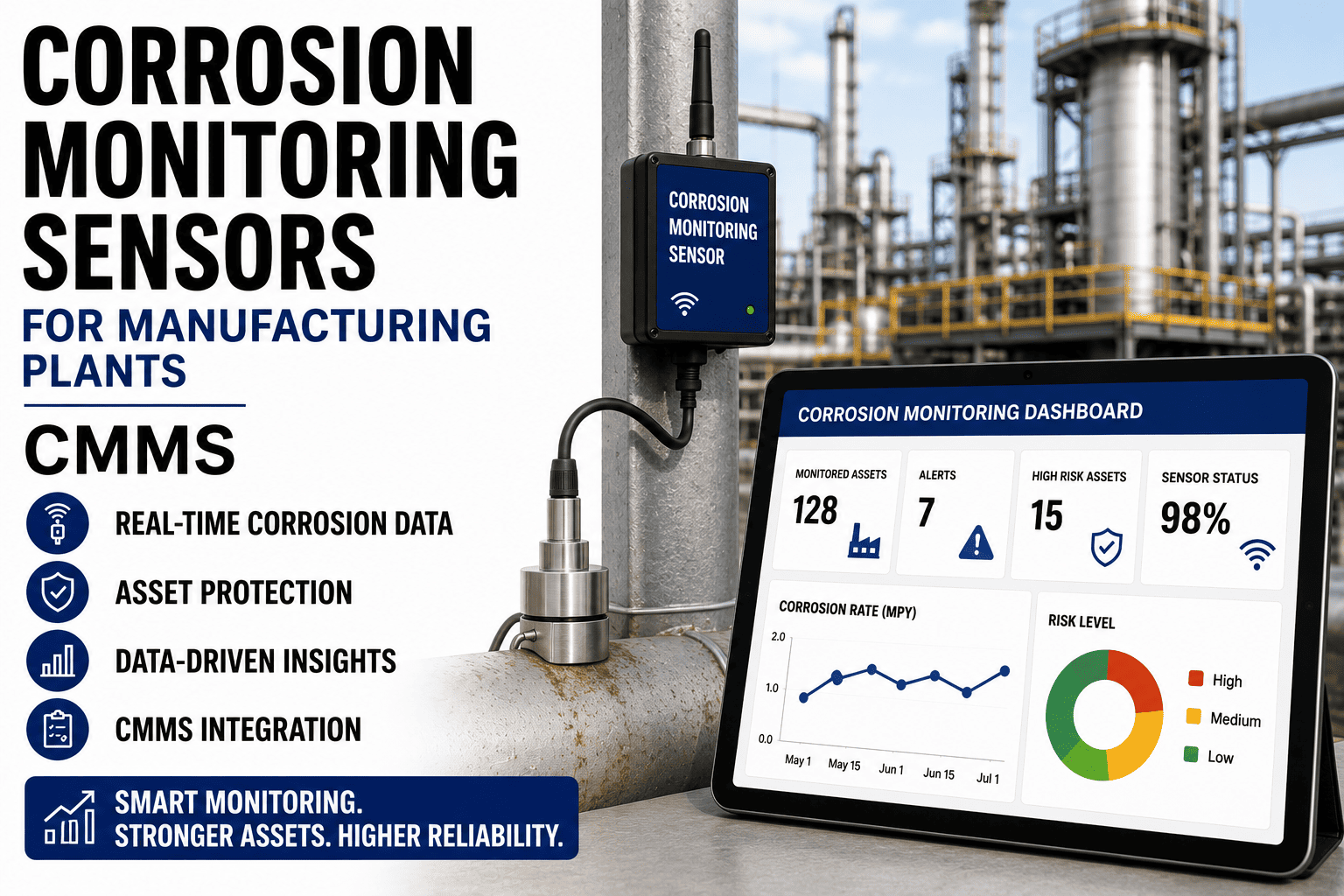
Corrosion monitoring sensors for manufacturing plants provide real-time wall-thickness and corrosion-rate data that integrates directly with a CMMS to trigger predictive maintenance before catastrophic asset failure occurs. By deploying IoT corrosion monitoring technologies like ultrasonic thickness sensors, electrical resistance (ER) probes, and linear polarization resistance (LPR) sensors across critical pipes, tanks, and pressure vessels, reliability teams can eliminate manual inspection blind spots and reduce unplanned downtime by up to 45%. Manufacturing corrosion costs the global economy over $2.5 trillion annually, but continuous plant corrosion monitoring shifts maintenance from reactive repairs to condition-based intervention. See how OxMaint turns raw sensor data into automated work orders when you Start Free Trial or explore the platform in a live demo.
How much hidden wall loss is silently eating your maintenance budget?
Corrosion in manufacturing plants rarely gives a warning—until a pipe bursts or a vessel fails. By the time a manual ultrasonic inspection catches a 40% wall-thinning defect, you are already in emergency-repair mode. Integrating IoT corrosion sensors with a CMMS changes the math: catch degradation early, schedule repairs during planned downtime, and extend asset life by years.
Types of Corrosion Monitoring Sensors for Plant Assets
Selecting the right IIoT corrosion monitoring technology depends on your asset class, environment, and required data resolution. Here is how the four most common plant corrosion sensors compare.
Ultrasonic Thickness (UT) Sensors
Permanently mounted piezoelectric transducers measure remaining wall thickness to an accuracy of ±0.1 mm. Best for fixed assets like pipelines, storage tanks, and pressure vessels where internal corrosion is a risk.
Electrical Resistance (ER) Probes
Measures the increase in electrical resistance of a sensing element as its cross-sectional area is reduced by uniform corrosion. Ideal for oil and gas, chemical processing, and harsh environments where direct metal loss needs tracking.
Linear Polarization Resistance (LPR)
Instantaneously measures corrosion rate in aqueous, conductive environments using electrochemical principles. Perfect for cooling water systems, boiler feedwater, and fire-water loops where localized pitting is a threat.
Corrosion Coupons
Pre-weighed metal specimens are exposed to the process environment for 30–90 days, then removed for lab analysis. The foundational baseline method, now automated with IoT retrieval tracking and CMMS lab-result logging.
The Cost of Reactive vs. Predictive Corrosion Management
Consider a mid-sized chemical manufacturing plant operating 180 critical assets (tanks, heat exchangers, and 3,000+ feet of pipework). Historically relying on manual annual UT inspections, the plant spent $42,000 annually on contractor labor alone, while still suffering an average of 2.3 unexpected corrosion-driven leaks per year.
Each leak resulted in $15,000 in emergency repair labor, $30,000 in lost production, and unquantified safety and environmental risks. By deploying 65 IoT corrosion monitoring sensors integrated with a CMMS, the plant shifted to condition-based maintenance—dropping unplanned downtime by 38% and achieving a full ROI in just 11 months.
Where to Install Plant Corrosion Sensors & How to Set Alerts
Effective manufacturing corrosion monitoring requires placing sensors at high-risk locations—dead legs, injection points, elbow bends, and areas with flow turbulence. Once installed, setting the right CMMS alert thresholds prevents both missed failures and alarm fatigue.
| Asset / Location | Recommended Sensor | Warning Threshold | Critical Alert | CMMS Action |
|---|---|---|---|---|
| Pressure Vessels & Storage Tanks | Ultrasonic Thickness (UT) | 10% wall loss | 25% wall loss | Auto-generate predictive work order |
| Cooling Water Pipelines | LPR Probe | 0.2 mm/yr rate | 0.5 mm/yr rate | Dispatch chemical dosing task |
| High-Temperature Process Lines | Electrical Resistance (ER) | 5% cross-section loss | 15% cross-section loss | Schedule isolated inspection |
| Injection & Dead-Leg Points | Corrosion Coupon + UT | Visual pitting on coupon | 0.3 mm/yr localized rate | Escalate to reliability engineer |
Stop reacting to leaks. Start predicting wall loss.
See how OxMaint ingests live IIoT sensor data, automatically triggers work orders at your exact corrosion thresholds, and gives your reliability team full asset history at their fingertips.
CMMS Corrosion Monitoring Integration with OxMaint
Sensors only provide value if the data drives action. OxMaint bridges the gap between raw IIoT data and maintenance execution, transforming alerts into automated, trackable workflows.
Automated Predictive Work Orders
When a UT or ER sensor hits a critical threshold, OxMaint instantly generates a work order with asset history, parts required, and safety procedures—reducing emergency repair response time by 60%.
Unified Asset Health Tracking
Map every sensor to its parent asset in the EAM hierarchy. View wall-thickness trends, past inspections, and repair costs side-by-side to prioritize capital replacement vs. continuous maintenance.
Spare Parts Pre-Alerting
If a warning threshold triggers a future repair, OxMaint automatically checks spare-parts inventory for gaskets, pipe spools, and clamps—alerting storeroom managers to reserve parts before the breakdown.
Reliability Analytics & Reporting
Leverage AI-driven analytics to calculate asset remaining useful life (RUL) based on actual corrosion rates. Export compliance reports for ISO 55000 and API 510 audits in one click.
Corrosion Monitoring & CMMS Integration FAQs
What is a corrosion monitoring sensor in manufacturing?
A corrosion monitoring sensor is an IoT device—such as an ultrasonic thickness probe or electrical resistance sensor—permanently installed on plant equipment to continuously measure wall thickness or corrosion rate in real time, feeding data directly into a CMMS for predictive maintenance.
How does a CMMS use corrosion sensor data?
When a sensor detects wall loss exceeding a predefined threshold, the CMMS automatically generates a work order, alerts the reliability team, and reserves necessary spare parts. To see live sensor-to-work-order automation in action, book a 30-minute OxMaint demo.
What is the difference between LPR and ER corrosion sensors?
LPR (Linear Polarization Resistance) sensors measure instantaneous corrosion rate in conductive, aqueous environments like cooling water. ER (Electrical Resistance) probes measure cumulative metal loss over time and are better suited for non-aqueous, high-temperature, or gaseous environments.
Where should corrosion sensors be placed in a plant?
Install sensors at high-risk locations prone to flow turbulence, dead legs, injection points, and elbow bends. Mapping these locations against historical failure data in your EAM ensures optimal sensor placement for maximum coverage.
How much does an IoT corrosion monitoring system cost?
A typical industrial corrosion sensor costs $500 to $3,000 per point, plus gateway and integration costs. Most manufacturing plants achieve full ROI within 11 to 14 months by avoiding just one or two catastrophic pressure vessel or pipeline failures. Start building your sensor network today with a Free OxMaint Trial.
Ready to connect your corrosion sensors to a true CMMS?
Join the reliability teams using OxMaint to predict failures, automate work orders, and extend asset life across their manufacturing plants.
Free 14-day trial · No credit card required