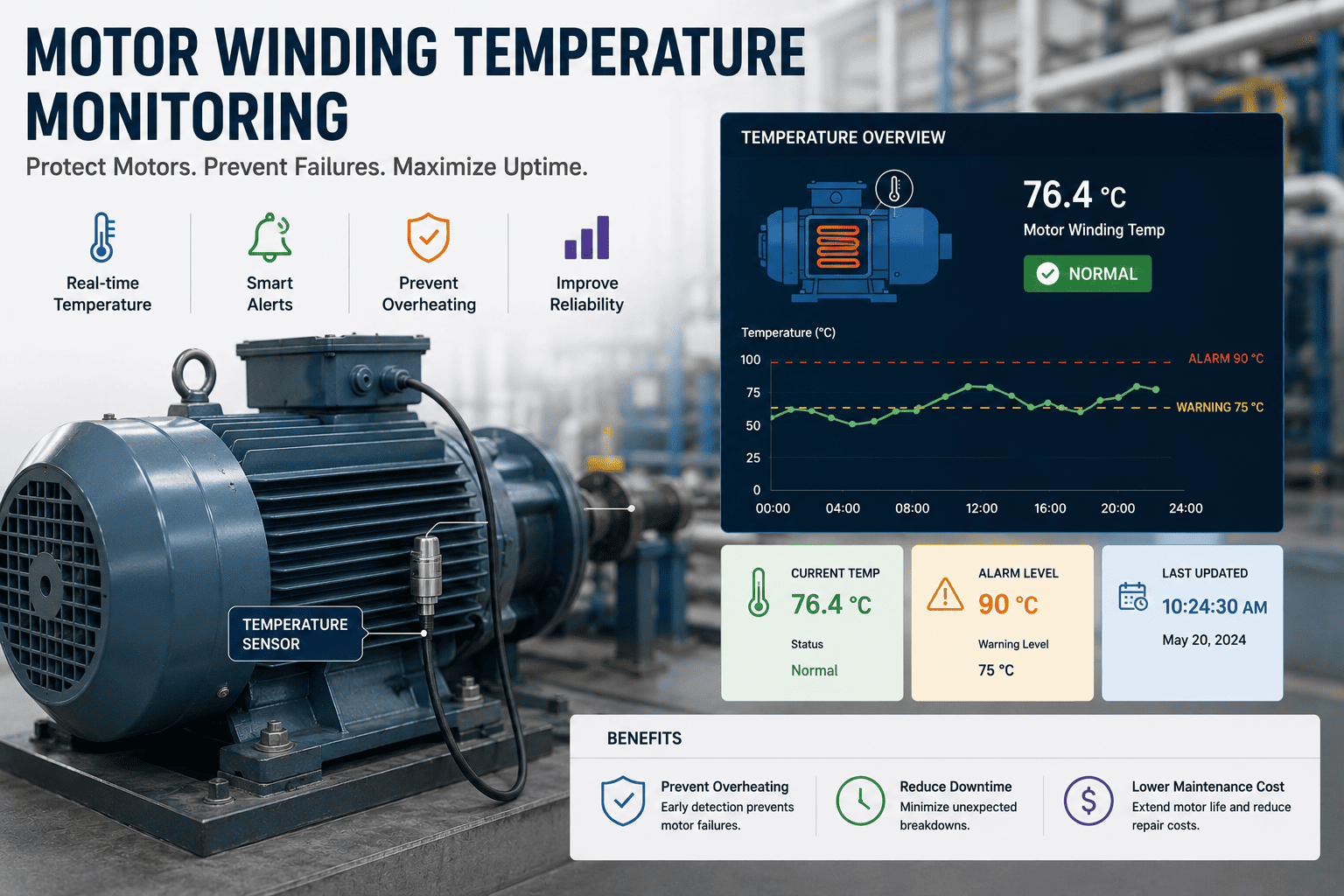
A motor rarely fails without warning — it warms up first. A loosening terminal, a starved bearing, a blocked cooling path or an overload all show as heat long before the motor trips or burns out. A thermal inspection catches that heat while it's still a hot spot, not a breakdown. This electric motor thermal inspection checklist walks the scan point by point, decodes what each pattern means, and turns the finding into a work order in OXMAINT AI — or book a demo of thermal inspection routes in OXMAINT AI.
ELECTRIC MOTOR THERMAL INSPECTION · ROTATING EQUIPMENT · CHECKLIST · 2026
Electric Motor Thermal Inspection Checklist for Manufacturing Plants
Overheating windings, hot bearings, loose connections and blocked cooling are the failures that stop a line without notice. OXMAINT AI is the AI-powered CMMS that turns each thermal finding into a ranked, scheduled work order — so a warm spot on a route becomes a planned repair, not an unplanned outage. Run the scan, read the pattern, log the fix.
1 · Scan
2 · Compare baseline
3 · Decode pattern
4 · Raise work order
10°C
every 10°C of winding temperature above design roughly halves insulation life
40%
minimum load to inspect under, per NFPA 70B — faults show more clearly as load rises
7
scan points — connections, windings, both bearings, coupling, cooling, gearbox
1
baseline per motor — a hot spot only means something measured against normal
The Thermal Zone Map: Where to Look and What Heat Means
A motor is not one heat source — it's several, and where the heat sits tells you what's wrong. Walk these seven zones on every scan, each read against the motor's own baseline. Start free and build your motor scan routes in OXMAINT AI.
01
Terminal Box & Connections
A loose or corroded lug runs hottest at the contact and cools with distance. High-resistance joints waste power and can fail open.
02
Stator Frame & Windings
A uniformly hot frame points to overload, under-sizing or blocked cooling. The exterior tracks the interior — a hot shell means hot windings.
03
Drive-End Bearing
A localised hot ring at the shaft end signals lubrication loss, wear, overload or misalignment pulling on the bearing.
04
Non-Drive-End Bearing
The opposite bearing, read the same way. A difference between the two ends often flags alignment or loading problems.
05
Shaft Coupling
A warm coupling is the classic misalignment signature — the driven load and the motor shaft are fighting each other.
06
Cooling Fan & Air Intake
Clogged fins, a packed intake or a damaged fan raise the whole motor's temperature by starving it of cooling air.
07
Gearbox & Driven End
Scan the gearbox and driven equipment too — heat here loads the motor and shortens its life from the outside in.
Why a Few Degrees Matter: Insulation Class & Life
A motor's insulation has a temperature rating, and heat spends that rating down. Every 10°C of sustained winding temperature above the design point roughly halves the insulation's remaining life — which is why a hot spot caught early is worth so much. The NEMA insulation classes below are the standard reference points.
Class
Max winding temp
Typical use
A
105°C
Older and light-duty motors
B
130°C
Common general-purpose motors
F
155°C
Most modern industrial motors
H
180°C
High-temperature and severe-duty
The exterior surface temperature tracks the interior — which is exactly what an infrared scan reads without opening or stopping the motor.
Signature RuleScan Under Real Load, Against a Baseline
A thermal reading only means something in context. Inspect the motor running at a minimum of 40% of design load (per NFPA 70B) — higher is better, because a fault that's subtle at low load widens as load rises. Then read every point against that motor's own baseline, not a fixed number.
✓Motor running at normal operating load, not idling
✓At least 40% of design load before readings count
✓Baseline image on file for this exact motor
✓Each phase compared against the other two
✓Emissivity and reflected temperature allowed for
✓Same route, same points, every inspection
The Electric Motor Thermal Inspection Checklist
Work the five stages in order — preparation, baseline, the scan itself, reading the pattern, and closing the loop. Tick each item as you go; the whole row toggles. Book a demo and run this checklist from a phone in OXMAINT AI.
Hot-Spot Pattern Decoder
The same temperature can mean very different things depending on its shape and location. This decoder maps the pattern you see to the likely cause and the action it calls for.
Thermal pattern
Likely cause
Action
Warmest at one point, cooling outward
High-resistance or loose connection
De-energise, clean and torque the joint
One phase uniformly warm end to end
Overload, under-sized cable or harmonics
Check load vs rating; review sizing
Whole motor frame hot
Overload or blocked cooling
Clear cooling path; verify duty and load
A line or component cooler than peers
Failed component / single-phasing
Check for open circuit or blown fuse
Localised hot ring at a bearing
Lubrication loss, wear or misalignment
Re-lubricate; check alignment; plan change
Warm shaft coupling
Shaft misalignment
Laser-align motor to driven load
Large difference between the two bearings
Alignment or uneven loading
Align and verify mounting and soft foot
How OXMAINT AI Runs Thermal Inspections End to End
OXMAINT AI is the AI-powered maintenance management software that carries a thermal finding from the route to the closed repair — scheduled routes, image-backed records, and automatic work orders on one platform. Put your critical motors on it when you start free and set your inspection cadence in OXMAINT AI.
Scheduled Scan Routes
Recurring thermal routes across every critical motor, so no asset is skipped and inspections happen on cadence.
Image-Backed Records
Each scan's image and reading saved to the asset history, building the baseline trend that makes a hot spot meaningful.
Finding → Work Order
An abnormal reading raises a ranked work order automatically, with the probable cause and action already attached.
Mobile Checklist
The seven-zone checklist runs from a phone or tablet at the motor, with readings logged where the technician stands.
Repair Verification
A post-repair re-scan closes the loop and proves the hot spot is gone before the job is signed off.
Motor Reliability Trend
Findings trended across the motor fleet so the recurring bad actor is engineered out, not just repaired again.
A Hot Spot Today Is a Burned-Out Motor Next Month.
Caught on a thermal route, a warm bearing or a loose lug is a planned repair booked for the next window. Missed, it's an unplanned line stop and a replacement motor. OXMAINT AI makes the route repeatable and the finding actionable.
EXPERT REVIEW
Written for maintenance, reliability and plant engineering teams. Infrared thermography is a screening technique — it tells you where heat is and roughly what it suggests, but a finding should be confirmed with the right follow-up (electrical testing, vibration analysis, alignment checks or a bearing inspection) before a major repair. Readings depend on load, emissivity, reflected temperature and distance, and energized inspection carries an arc-flash risk that calls for qualified personnel and proper PPE. The NEMA insulation classes and the temperature-life relationship cited here are standard references. OXMAINT AI is a maintenance management platform that schedules the routes, stores the evidence and automates the work orders — it does not replace a qualified thermographer or the diagnostic judgement behind a repair decision.
Frequently Asked Questions
How often should electric motors be thermally inspected?
Critical motors are commonly scanned quarterly, with more frequent routes for high-duty or high-consequence assets and less frequent for spares. The right cadence depends on criticality, duty cycle and operating environment — the key is that it's a repeatable route, same points every time, so readings are comparable.
Start free and set motor scan cadences in OXMAINT AI.
Why inspect a motor under load instead of idling?
Many faults — overload, connection resistance, bearing wear — only generate significant heat when the motor is working. NFPA 70B calls for a minimum of 40% of design load; the higher the load, the more clearly a developing fault separates from normal temperature. An idling motor can look healthy while a real problem stays hidden.
Why does a baseline image matter so much?
A thermal reading is only meaningful relative to that motor's normal. A reading that looks high may be normal for a hard-working motor, and a "moderate" one may be abnormal for a lightly loaded one. The baseline, plus phase-to-phase comparison, is what separates a real fault from ordinary operating heat.
What do the NEMA insulation classes mean for inspection?
They set the maximum winding temperature the motor is built to tolerate — roughly 105°C (A), 130°C (B), 155°C (F) and 180°C (H). Because every 10°C of sustained overheating above the design point roughly halves insulation life, a reading creeping toward the class limit is a strong signal to act early.
Can thermography alone diagnose the exact fault?
It localises and characterises heat, which narrows the cause quickly, but it's a screening step. A hot bearing could be lubrication, wear or misalignment; confirming which usually needs vibration analysis, electrical testing or a physical check before a major repair.
Book a demo of the thermal-to-work-order workflow in OXMAINT AI.
Turn Every Warm Motor Into a Planned Repair.
Run motor thermal inspections on OXMAINT AI: scheduled routes across your critical motors, image-backed baselines, pattern-decoded findings, and a ranked work order raised automatically for every hot spot — so overheating is caught on the route, not on the floor.