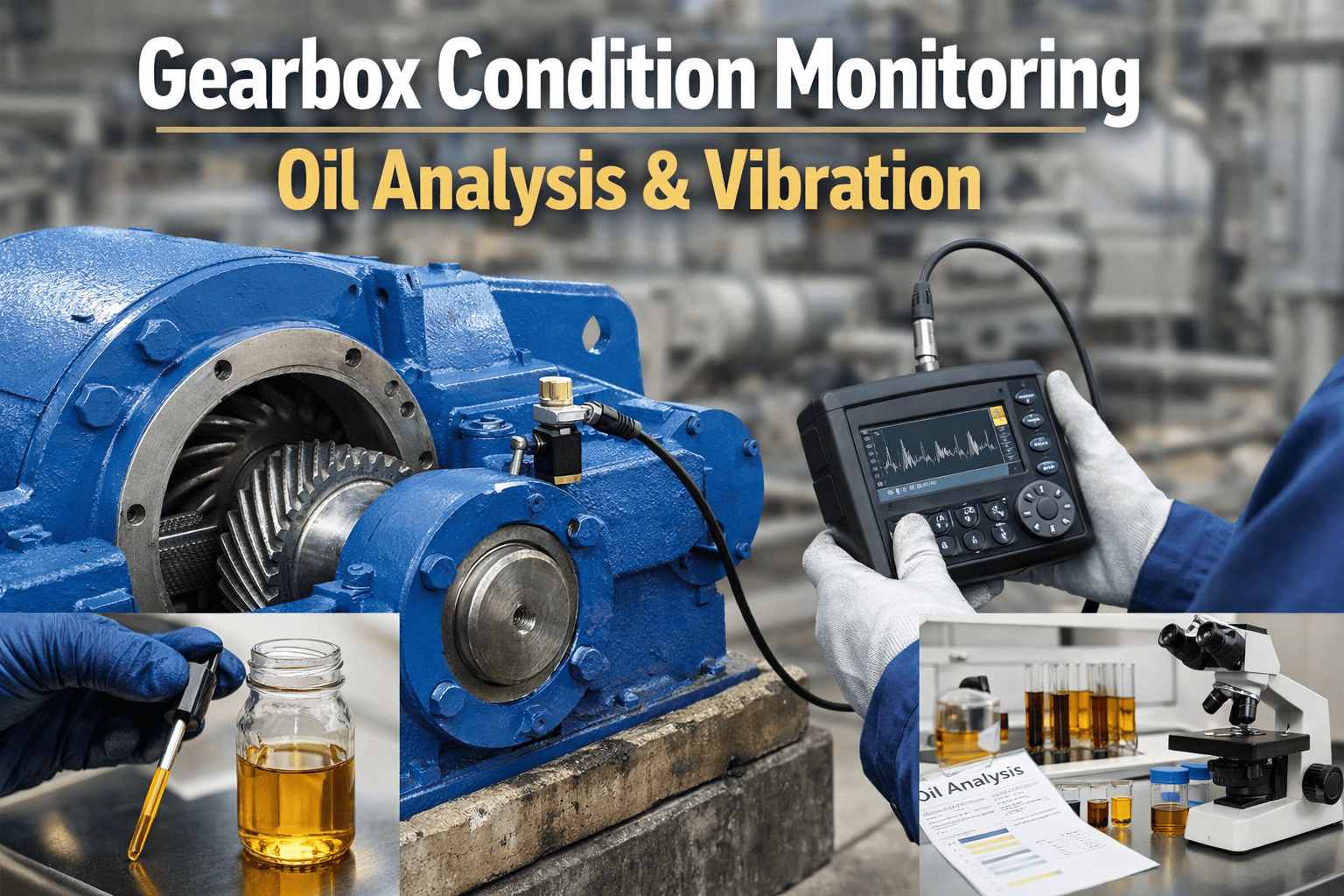
Manufacturing equipment does not fail without warning — it gives signals weeks and sometimes months in advance, through vibration patterns, heat signatures, ultrasonic emissions, and lubricant chemistry that shift measurably before any visible symptom appears. The plants that catch those signals early avoid the $260,000 average cost of a single unplanned industrial breakdown; the plants that don't are the ones replacing entire motors, gearboxes, and compressors on emergency timelines. OxMaint's AI-powered predictive maintenance platform integrates condition monitoring data from vibration sensors, thermal cameras, ultrasonic detectors, and oil analysis directly into your work order system — so every abnormal reading becomes a scheduled repair before it becomes a catastrophic failure. Book a free OxMaint demo to see how condition-based maintenance works in practice on your asset types.
Condition Monitoring · Predictive Maintenance · Manufacturing · OxMaint
Condition Monitoring in Manufacturing: Vibration, Thermal Imaging, Ultrasonic & Oil Analysis Guide
Your machines are communicating right now. The question is whether your maintenance program is listening. Condition monitoring translates the invisible physical signals of developing equipment failure into actionable intelligence — giving maintenance teams the 4 to 12 weeks of warning time needed to plan repairs before breakdowns dictate the schedule.
$6.98B
Global condition monitoring market by 2034 — growing at 6.55% CAGR as predictive maintenance becomes standard practice
4–12 wks
Advance warning time vibration analysis delivers before mechanical failure — enough to plan, schedule, and execute repairs
40%
Cost saving over reactive maintenance achievable with predictive maintenance strategies backed by condition monitoring
90–95%
Bearing fault detection accuracy with vibration analysis — the most widely adopted condition monitoring technique in industry
Why Condition Monitoring Matters
The Gap Between Scheduled Maintenance and Actual Equipment Health
Most manufacturing plants run either reactive maintenance — waiting for breakdowns — or time-based preventive maintenance — servicing equipment on fixed calendar intervals. Both approaches have a fundamental problem: neither is aligned to how equipment actually fails. Condition monitoring closes that gap by tracking the real physical state of each asset in real time.
Reactive Maintenance
$260K+
Average cost per unplanned industrial breakdown
Emergency parts procurement at premium cost
Production losses during unplanned stoppage
Secondary damage to connected equipment
Safety risks from sudden catastrophic failure
Overtime labor and contractor call-outs
VS
Condition-Based Maintenance
300–500%
Typical ROI within 18–24 months of condition monitoring deployment
Failures detected 4–12 weeks before they occur
Parts ordered at standard cost with full lead time
Repairs planned during scheduled production windows
Secondary damage prevented by early intervention
5–15x cost reduction vs emergency repair on same asset
The Four Core Technologies
Each Condition Monitoring Method Tells You Something Different
No single condition monitoring technique covers all failure modes. World-class predictive maintenance programs combine two or more technologies — each revealing a different dimension of equipment health that the others cannot see alone.
How It Works
Accelerometers mounted on rotating equipment capture frequency-domain vibration signatures. Each mechanical fault — bearing wear, shaft misalignment, gear tooth damage, rotor imbalance — generates a distinct vibration pattern at a specific frequency. Analysts or AI algorithms compare live signatures against healthy baselines to identify which fault is developing and how far it has progressed.
Detects
Bearing wear
Shaft misalignment
Rotor imbalance
Gear tooth damage
Looseness
Cavitation
6–12 weeks
typical advance warning for bearing faults before failure
Best for: Motors, pumps, compressors, gearboxes, fans, turbines — any rotating machinery above 600 RPM
How It Works
Infrared cameras capture heat emitted from equipment surfaces, creating thermal images that reveal hot spots invisible to the naked eye. Electrical faults — loose connections, failing insulation, overloaded circuits — nearly always generate localized heat before they cause outages. Mechanical issues like misalignment, bearing deterioration, and lubrication failure also produce characteristic thermal signatures that thermography identifies without physical contact or production shutdown.
Detects
Electrical hot spots
Loose connections
Overloaded circuits
Bearing overheating
Insulation failure
Process anomalies
Non-contact
inspections possible on live electrical systems without shutdown
Best for: Switchgear, transformers, motors, circuit breakers, conveyor systems, process heat exchangers
How It Works
Ultrasonic detectors convert high-frequency sound emissions — above the range of human hearing — into audible signals that trained technicians interpret as indicators of specific fault types. Leaking compressed air, steam trap failures, electrical arcing, and early bearing deterioration each produce a distinct ultrasonic signature. Unlike vibration analysis, ultrasound excels at low-speed applications and is particularly effective for lubrication optimization — determining exactly when a bearing needs grease without over or under lubricating.
Detects
Compressed air leaks
Steam trap failures
Electrical arcing
Bearing lubrication state
Valve integrity
Low-speed bearing faults
$1,000
entry-level cost — highest bang-per-dollar for leak detection and lubrication programs
Best for: Compressed air systems, steam distribution, electrical panels, slow-rotating equipment, hydraulic systems
How It Works
Lubricant samples extracted from engines, gearboxes, and hydraulic systems are analyzed for wear metal particles, contamination levels, additive depletion, and viscosity changes. Every internal component that wears — bearings, gears, seals, pistons — sheds particles into the lubricant at characteristic sizes and compositions. Oil analysis identifies which specific internal component is degrading and at what rate, providing data that no external sensor can replicate — because the information is inside the machine.
Detects
Internal component wear
Contamination ingress
Coolant leaks
Additive depletion
Viscosity breakdown
Seal failures
$20–40
per sample — diagnostic depth not achievable with any external sensor at this cost
Best for: Engines, gearboxes, hydraulic systems, turbines, compressors — any oil-lubricated machinery with high internal wear risk
Getting condition monitoring alerts but no system to act on them?
OxMaint connects your sensor data directly to work order creation — so every abnormal reading becomes a scheduled task, not a missed warning. Fully integrated with vibration, thermal, and oil analysis systems.
Technology Comparison
Choosing the Right Condition Monitoring Method for Each Asset
The right condition monitoring technology depends on the asset type, operating environment, failure modes of concern, and budget available per asset. This reference covers the primary selection criteria for each technique.
| Technique |
Primary Failure Modes Detected |
Equipment Types |
Entry Cost |
Warning Lead Time |
Skill Level Required |
| Vibration Analysis |
Bearing wear, misalignment, imbalance, gear damage, looseness |
Motors, pumps, compressors, gearboxes, turbines |
$3K–12K per asset (continuous) |
4–12 weeks |
Moderate — ISO 18436-2 certification available |
| Thermal Imaging |
Electrical faults, loose connections, bearing overheating, insulation failure |
Switchgear, motors, conveyors, process equipment |
$1K–5K for handheld camera |
Days to weeks |
Low — visual and intuitive output |
| Ultrasonic Testing |
Air/steam leaks, arcing, bearing lubrication state, valve faults |
Compressed air systems, electrical panels, steam lines, slow-speed bearings |
Under $1K for basic detector |
Immediate to weeks |
Low to Moderate — qualitative signal interpretation |
| Oil Analysis |
Internal wear, contamination, viscosity degradation, seal and gasket failure |
Engines, gearboxes, hydraulic systems, turbines |
$20–40 per sample (lab analysis) |
Weeks to months |
Low — lab report interpretation supported by service providers |
The P-F Curve
Understanding the P-F Interval: Why Timing Is Everything in Condition Monitoring
Every equipment failure follows a predictable deterioration curve — from the point where a fault first becomes detectable (P, Potential Failure) to the point of functional failure (F). The gap between P and F is the window condition monitoring must detect and the maintenance team must act within.
Normal Operation
Equipment running within design parameters. No fault indicators detectable by any method.
Oil Analysis Detects
Wear particles appear in lubricant. Weeks to months before any external symptom.
Vibration Analysis Detects
Bearing frequency patterns change. 4–12 weeks before failure — ideal intervention window.
Thermal & Ultrasonic Detect
Heat signatures and acoustic emissions become measurable. Days to weeks before failure.
Functional Failure
Breakdown occurs. Emergency repair required. 5–15x cost of planned intervention.
Using multiple condition monitoring techniques extends the total P-F detection window — giving maintenance teams more time to plan, source parts, and schedule the repair in a production-convenient window.
OxMaint Integration
From Sensor Alert to Closed Work Order: How OxMaint Closes the Loop
Condition monitoring data is only valuable if it results in a maintenance action. Most facilities have a critical gap between their sensor systems and their maintenance execution — alerts go into dashboards that nobody acts on systematically. OxMaint bridges that gap.
01
Alert Received
Condition monitoring system — vibration sensor, thermal camera, oil lab report, or ultrasonic detector — identifies an anomaly exceeding the defined threshold for a specific asset.
02
Automatic Work Order Created
OxMaint's API integration auto-generates a work order linked to the specific asset, pre-populated with the fault type, severity level, and recommended action from the condition monitoring system.
03
Priority and Scheduling
The work order is assigned a priority level based on fault severity and asset criticality. OxMaint's scheduler finds the optimal maintenance window — within the P-F interval — before failure can occur.
04
Parts and Labor Assigned
Required spare parts are verified against inventory. Technician with the correct skill profile is assigned. All information — fault description, asset history, repair procedure — travels with the work order to the field.
05
Repair Completed and Documented
Technician completes the repair, captures findings and measurements on mobile, and closes the work order. Asset history is updated. The condition monitoring baseline is recalibrated post-repair for accurate future trending.
Common Questions
What Manufacturing Teams Ask About Condition Monitoring
Which condition monitoring technique should a facility implement first?
For most manufacturing facilities with significant rotating equipment — motors, pumps, compressors — vibration analysis delivers the broadest coverage of the most critical failure modes and should be the first technique deployed. Ultrasonic testing is the best second choice for its low entry cost and immediate ROI through compressed air leak detection and lubrication optimization.
Book a technical consultation with OxMaint to map a condition monitoring implementation roadmap against your specific asset register and highest-cost failure history.
How does OxMaint connect to our existing condition monitoring sensors and systems?
OxMaint integrates with leading condition monitoring platforms via API, receiving sensor data and alert triggers that automatically generate work orders in the platform. This means your sensor system continues to do what it does best — detect anomalies — while OxMaint handles the maintenance execution workflow, parts management, scheduling, and compliance documentation.
Start a free OxMaint account to explore available integrations and configure the connection to your current sensor infrastructure without requiring a full rip-and-replace of existing hardware.
What is the typical ROI of a condition monitoring program in manufacturing?
Most facilities achieve 300–500% ROI within 18–24 months of implementing a structured condition monitoring program. Initial investments of $50,000–200,000 in sensor hardware typically generate $300,000–1.2 million in annual savings through prevented failures, reduced emergency repair costs, and optimized maintenance scheduling. A single avoided motor failure, typically costing $100,000–500,000 in parts, labor, and production loss, can justify an entire program's cost.
Speak with our team to model expected ROI against your facility's current reactive maintenance spend and top failure cost events.
Can condition monitoring work on older equipment without built-in sensor ports?
Yes — modern wireless vibration sensors and thermal cameras retrofit to virtually any equipment regardless of age or original design. Battery-powered wireless accelerometers attach to bearing housings with magnets or adhesives, eliminating wiring requirements entirely. Oil analysis works through a simple oil sample port that can be installed on any lubricated system in under an hour. The only equipment where condition monitoring faces limitations is very slow-rotating machinery below 10 RPM, where ultrasonic methods are more reliable than vibration analysis.
Sign up for OxMaint and begin building your asset condition monitoring register immediately — hardware and software integrated from day one.
Condition Monitoring · Predictive Maintenance · AI-Powered CMMS
Your Equipment Is Sending Warning Signals Right Now. Is Your Maintenance System Receiving Them?
OxMaint connects vibration analysis, thermal imaging, ultrasonic testing, and oil analysis data to your maintenance execution workflow — turning condition monitoring alerts into closed work orders, not ignored notifications. Predictive maintenance that actually drives action.