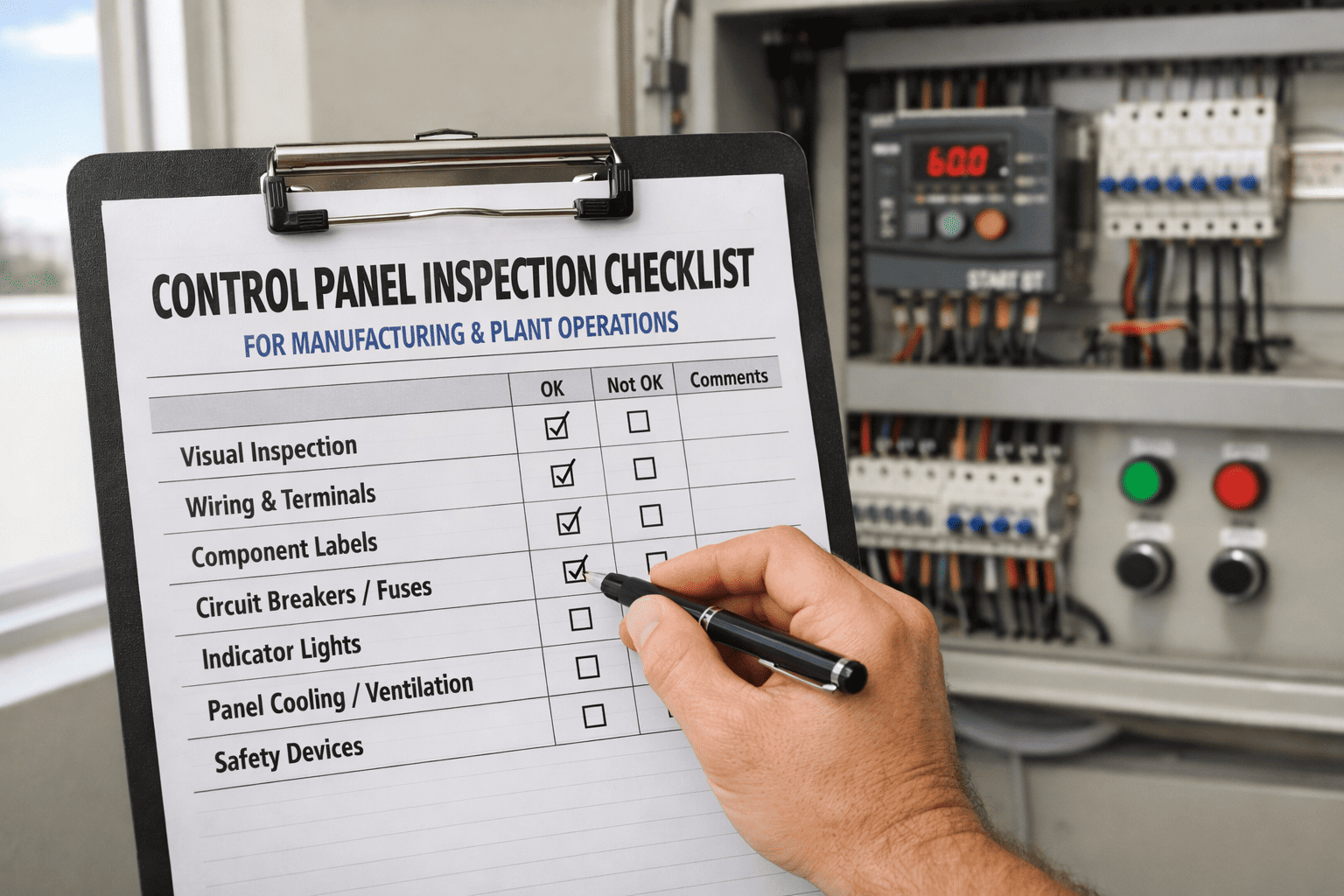
Electrical panel maintenance is the single most under-scheduled preventive task on the plant floor — yet loose connections and thermal runaway account for a disproportionate share of unplanned manufacturing downtime. This guide walks maintenance and reliability teams through a complete electrical preventive maintenance program for panels, controls, and switchgear: thermal imaging, torque verification, insulation resistance testing, cleaning, and the NFPA 70B intervals that keep people safe and assets online. If you are ready to replace clipboard-driven electrical maintenance with automated PM scheduling, you can Start Free Trial and configure your first panel inspection route in minutes.
Are hidden thermal faults quietly building inside your plant's electrical panels?
Over 30 percent of electrical failures in manufacturing plants trace back to loose connections, dust accumulation, and degraded insulation — problems that thermal imaging and torque checks catch long before an arc flash forces a shutdown.
Why electrical panel maintenance gets ignored — and what it costs
A single undetected loose lug on a 480V distribution panel can heat to over 200°C under load, arc, and trip an entire production line. The repair takes hours; the lost throughput can take days to recover.
Electrical panel inspection checklist for manufacturing plants
A defensible electrical preventive maintenance program breaks down into four disciplined inspection tiers. Each tier maps to a specific failure mode and a specific NFPA 70B interval.
Thermal Imaging Scan
Quarterly infrared scan of energized panels, breakers, and bus connections under normal load. Flag any point exceeding a 15°C rise over ambient or a 10°C delta between similar components.
- Scan all lugs, splices, and breaker terminals
- Compare phase-to-phase temperature deltas
- Photograph and geo-tag hot spots in the CMMS
- Generate a work order for any delta above 15°C
Visual & Mechanical Inspection
Annual de-energized inspection covering cleanliness, labeling, enclosure integrity, and torque verification on every bolted connection — the most effective defense against resistance heating.
- Vacuum dust and debris; inspect for moisture ingress
- Verify arc-flash and warning labels are legible
- Torque every lug to manufacturer spec with a calibrated wrench
- Confirm enclosure door seals and gaskets are intact
Insulation & Dielectric Testing
Biennial insulation resistance (Megger) testing on motors, cables, and switchgear buses to detect degraded insulation before it becomes a ground fault or arc-flash event.
- Perform 500V or 1000V Megger test on feeders
- Record megohm readings and trend over time
- Identify any circuit below 1 MΩ for immediate rework
- Log polarity and phase-rotation verification
Protective Device Calibration
Triennial primary or secondary injection testing on breakers and relays to verify trip curves match the coordination study — keeping arc-flash energy within calculated boundaries.
- Primary injection test on breakers over 400A
- Verify long-time, short-time, and instantaneous trip bands
- Update coordination study after any replacement
- Confirm ground-fault relay operation
How often should you inspect switchgear and control panels?
NFPA 70B defines recommended maintenance intervals based on equipment type and operating environment. Manufacturing environments — with heat, dust, and vibration — typically fall into the aggressive end of the scale. Use this table to align your CMMS schedule with the standard.
| Inspection Task | Equipment | NFPA 70B Interval | Plant-Floor Reality |
|---|---|---|---|
| Infrared thermography (energized) | Panelboards, breakers, bus | Annual | Quarterly on critical feeders |
| Torque verification (de-energized) | Lugs, splices, terminals | Annual | Annual + after any fault event |
| Insulation resistance test | Cables, motors, bus | Biennial to triennial | Annual on motors over 100 hp |
| Breaker trip testing (injection) | Molded-case, power breakers | Triennial | Biennial on critical/process breakers |
| Enclosure cleaning & sealing | All panels and MCCs | Annual | Semi-annual in high-dust areas |
| Coordination study update | Entire distribution system | 3–5 years or after changes | Whenever a breaker is replaced |
The math: what a panel PM program saves a 180-asset plant
Consider a mid-sized manufacturing operation with 180 electrical assets — panelboards, MCC buckets, VFDs, and switchgear — spending roughly $42,000 per year on reactive electrical repairs and associated downtime. Here is what a structured preventive program delivers.
See OxMaint schedule and track every panel inspection — book a 30-minute demo
Replace spreadsheets and clipboards with automated PM schedules, thermal-scan photo capture, and torque-check work orders tied to every asset.
How OxMaint powers electrical reliability for plant maintenance teams
OxMaint is an AI-powered CMMS and EAM platform that turns electrical panel maintenance from a calendar-driven chore into a condition-driven, auditable workflow. These are the four capabilities that most directly reduce electrical downtime.
Automated PM scheduling by NFPA 70B interval
Attach quarterly infrared scans, annual torque checks, and triennial injection tests to every panel asset record. OxMaint auto-generates work orders on the correct cycle and assigns them to the right technician — no missed intervals.
Thermal image capture and trending
Technicians attach infrared photos and temperature readings directly to the work order from the mobile app. OxMaint trends delta-T values over time so you can spot a connection that is slowly heating up before it crosses the failure threshold.
AI-driven predictive alerts
OxMaint's predictive engine analyzes insulation resistance trends, trip-test results, and load data to flag assets approaching failure — prioritizing electrical work orders by risk, not just calendar date.
Audit-ready compliance records
Every torque reading, Megger result, and trip-test value is time-stamped, geo-tagged, and stored against the asset history. Generate an NFPA 70B compliance report in seconds for insurance, OSHA, or internal audit purposes.
What plant maintenance teams say about OxMaint
"We went from missed quarterly thermal scans to 100% PM compliance in the first quarter. OxMaint auto-generates the work order, the tech attaches the infrared photo, and we trend the temperature delta right in the asset record."
"The predictive alerts caught a 480V breaker terminal heating up three weeks before it would have arced. That single save paid for the platform for two years. Switching from spreadsheets took our team one afternoon."
Electrical panel maintenance FAQs
How often should electrical panels be inspected in a manufacturing plant?
NFPA 70B recommends annual infrared thermography and visual inspections for most low-voltage panelboards, with de-energized torque verification and cleaning performed annually as well. Insulation resistance testing is typically biennial, and breaker injection testing is triennial. Plants with high dust, heat, or vibration should compress these intervals — quarterly thermal scans on critical feeders are common practice. OxMaint lets you assign each interval to every panel asset and auto-generates the work order when the cycle is due.
What temperature delta indicates a problem in an electrical panel?
A temperature rise of 15°C or more over ambient, or a 10°C delta between similar components under the same load, is the widely used action threshold. A delta above 40°C is considered critical and warrants immediate de-energization and repair. Thermal imaging electrical inspections should flag and photograph any hot spot exceeding these limits and generate a corrective work order on the spot.
What does an electrical preventive maintenance program include?
A complete program includes four tiers: quarterly thermal imaging of energized panels, annual de-energized visual and torque inspections, biennial insulation resistance testing, and triennial protective device calibration. It also covers enclosure cleaning, labeling verification, and coordination study updates. You can see how OxMaint maps each tier to a CMMS work-order schedule — Book a Demo and we will build your panel PM schedule live.
Can a CMMS help with NFPA 70B compliance?
Yes — a CMMS is the most reliable way to prove compliance. OxMaint stores every inspection result, torque reading, Megger value, and thermal image against the asset record with a time stamp and technician signature. When an auditor or insurer requests proof that your switchgear was inspected on the NFPA 70B cycle, you generate the report in seconds rather than digging through paper files.
How much does an electrical panel maintenance program cost?
For a 180-asset plant, a fully implemented program — including labor, tooling, and a CMMS like OxMaint — typically runs $15,000 to $20,000 per year. That investment is offset by $80,000 to $120,000 in avoided reactive repair and downtime costs, yielding a 5x to 6x return in year one. The cost of not having a program is far higher: a single unresolved thermal fault can exceed $50,000 in downtime and emergency repair.
Build your electrical panel PM program in OxMaint — free for 14 days
Import your asset list, assign NFPA 70B intervals, and issue your first inspection work orders this week. No credit card required to start.
Free 14-day trial · No credit card required