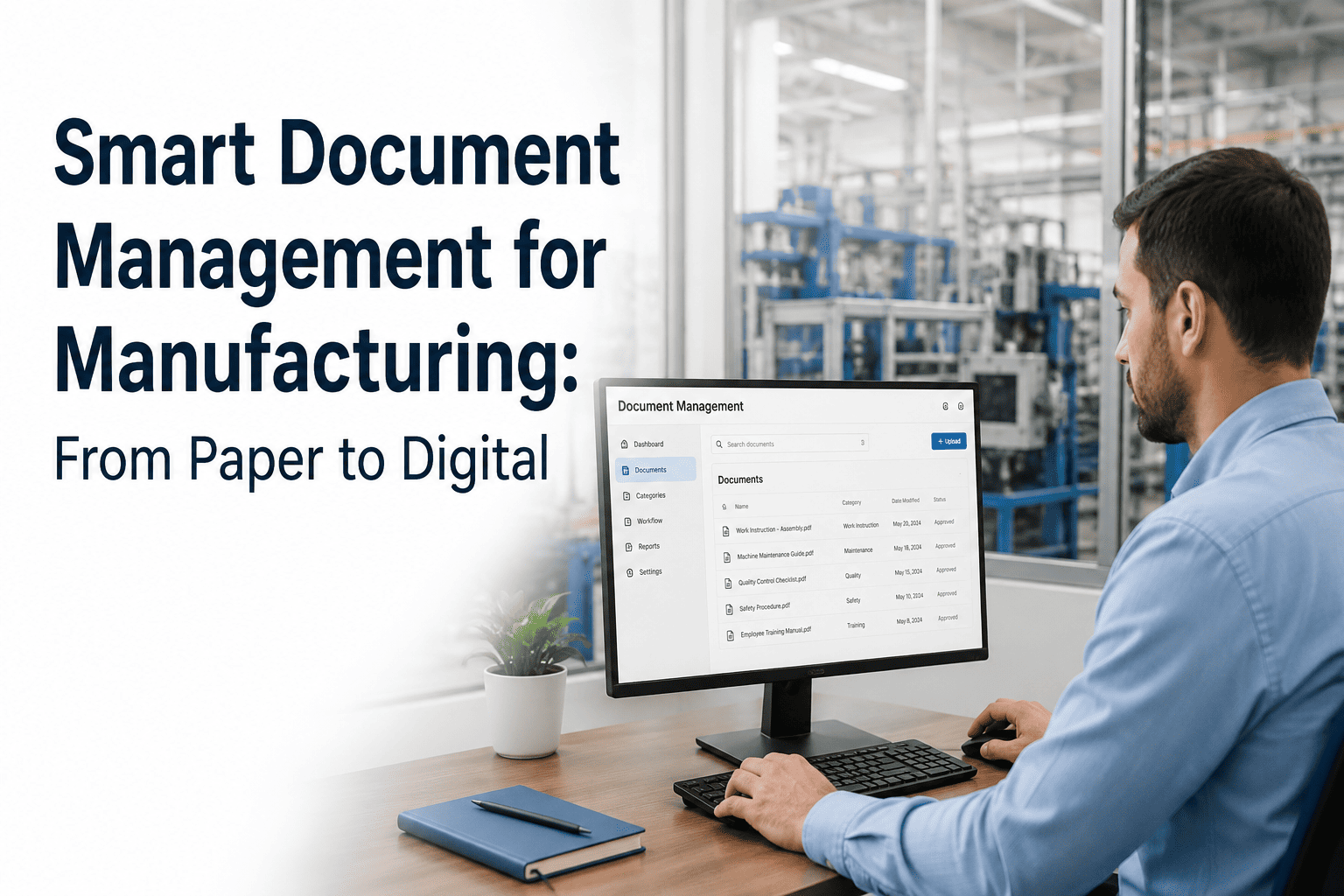
Manufacturing Plant Document Control System Implementation
By oxmaint on March 4, 2026
Every recalled product, every failed audit, and every quality incident on a manufacturing floor shares a common thread—someone followed the wrong version of a document. In plants still running on paper binders and shared drives, outdated SOPs reach operators before anyone catches the error, inspection records vanish before audits, and revision approvals stall for weeks in email chains. The cost is not just regulatory fines; it is lost production time, scrapped batches, and eroded customer trust. A structured document control system eliminates these risks by ensuring every procedure, work instruction, and quality record is created, approved, distributed, and archived through a single controlled workflow. Schedule a free 30-minute demo to see how Oxmaint helps manufacturing plants build audit-ready document control from day one.
What Is a Document Control System for Manufacturing Plants?
A document control system is the formal framework that governs how every piece of critical documentation in a manufacturing plant is authored, reviewed, approved, distributed, used, and eventually retired. It goes far beyond file storage—it is the mechanism that ensures the right person sees the right version of the right document at the right time, every single time.
Without Document Control
67%
of ISO audit non-conformances in manufacturing plants trace directly to document control failures—wrong versions, missing approvals, or inaccessible records
With Document Control
3x
faster audit preparation, near-zero obsolete document incidents, and full traceability from document creation through every revision and approval
In regulated industries—automotive, aerospace, food and beverage, pharmaceuticals—document control is not optional. Standards like ISO 9001 Clause 7.5, FDA 21 CFR Part 11, and IATF 16949 mandate specific controls over documented information. But even in plants without regulatory mandates, poor document practices quietly drain productivity: operators waste hours hunting for current procedures, supervisors re-explain processes that should be standardized, and quality teams scramble to assemble records for customer audits. Sign up free and start centralizing your plant documentation in one controlled, searchable platform.
Why Manufacturing Plants Lose Millions to Poor Document Practices
Document control failures are rarely dramatic. They are quiet, cumulative, and deeply expensive. A technician follows a superseded maintenance procedure and damages a critical asset. An operator uses last month's recipe specification and produces an out-of-spec batch. A quality manager cannot locate the calibration records an auditor requests. Each incident seems isolated—but together, they represent a systemic failure that impacts every department in the plant.
$1.8M
Average annual cost of quality failures linked to incorrect or outdated documentation in mid-size manufacturing operations
4.2 hrs
Time lost per employee per week searching for the correct version of documents across drives, emails, and filing cabinets
23 days
Average document approval cycle time in plants using email-based review—versus 3 days with automated workflows
The hidden multiplier
Every document control failure has downstream effects. A single outdated SOP can trigger a product deviation, which generates a CAPA, which requires a root cause investigation, which demands corrective training—all of which must themselves be documented and controlled. Poor document control does not just cause problems; it multiplies them.
Ready to stop losing time and money to document chaos? Oxmaint gives your plant a single source of truth for every SOP, work instruction, and quality record.
A document control system that actually works in a manufacturing environment is built on five interdependent pillars. Remove any one, and the entire system develops gaps that auditors, regulators, and—more importantly—production errors will quickly expose.
01
Standardized Authoring & Templates
Every document type—SOP, work instruction, batch record, inspection form—follows a defined template with mandatory fields, consistent formatting, and structured metadata. Standardized authoring eliminates ambiguity and ensures every document is complete before it enters the review cycle. Role-based permissions prevent unauthorized document creation.
02
Multi-Level Approval Workflows
Configurable routing sends each document to the correct sequence of reviewers and approvers based on document type, department, and criticality. Electronic signatures with timestamps satisfy ISO 9001, FDA 21 CFR Part 11, and other regulatory requirements. Parallel review paths cut approval times from weeks to days.
03
Automatic Version Control
Every revision is numbered, timestamped, and linked to its change request. Redline comparisons show exactly what changed between versions. The system ensures only the current approved version is accessible to plant floor users, while all prior versions remain available in the audit archive for regulatory review.
04
Controlled Distribution & Access
Approved documents are pushed to specific roles, departments, or workstations instantly. Read-receipt tracking confirms acknowledgment. When a document is revised, the system automatically recalls the previous version and notifies all holders—eliminating the risk of obsolete documents circulating on the shop floor.
05
Retention, Archival & Disposal
Automated retention schedules enforce industry-specific record-keeping requirements—whether that is 5 years for ISO quality records, 30 years for OSHA safety documents, or the full product lifecycle for FDA-regulated batch records. Secure archival protects document integrity while disposal workflows ensure proper destruction of expired records. Sign up for free to manage your complete document lifecycle—from authoring and approval through archival and disposal—in one platform.
Which Documents Must Be Controlled in a Manufacturing Plant?
Not every file in your plant needs formal control—but far more documents require it than most operations realize. Regulatory standards require control over any document that directly or indirectly affects product quality, worker safety, or environmental compliance. Here is the complete landscape of controlled documentation in a typical manufacturing facility.
Critical
Standard Operating Procedures
Production SOPs, cleaning validation, equipment startup/shutdown, changeover procedures
Safety data sheets, emergency response plans, environmental permits, hazard assessments, training records
Retention: Employee tenure + 30 years (OSHA)
Medium
Engineering & Design Documents
Process flow diagrams, P&IDs, equipment drawings, facility layouts, material specifications
Retention: Facility life + permanent archive
Managing SOPs, batch records, and safety docs across departments? Schedule a 30-minute demo to see how Oxmaint organizes every document type with automated version control, approval routing, and retention tracking—so your next audit is stress-free.
How to Meet ISO 9001 Clause 7.5 Document Control Requirements
ISO 9001:2015 Clause 7.5 is the global benchmark for document control in quality management systems. With ISO 9001:2026 expected to publish in September 2026 and a three-year transition window to follow, plants that build strong digital document control now will be positioned for seamless compliance when the updated standard takes effect. Here is what the standard requires—and how each requirement translates to practical plant operations.
Approval Before Issue
Every document must be reviewed and formally approved by authorized personnel before release to the plant floor. Digital approval workflows enforce this gate automatically—no document reaches operators without the required electronic signatures.
Review, Update & Re-Approval
Documents must be periodically reviewed for continued adequacy, updated when processes change, and re-approved through the same formal workflow. Automated review reminders prevent documents from going stale.
Change & Revision Identification
Current revision status must be identifiable on every document. Automatic version numbering, revision history logs, and redline comparisons make it immediately clear what changed, when, and by whom.
Availability at Point of Use
Applicable documents must be accessible where and when they are needed. Mobile-ready digital systems deliver current SOPs and work instructions to operator tablets, kiosks, or workstation displays at every production point.
Prevention of Obsolete Document Use
Outdated documents must be prevented from unintended use. Automated access revocation, watermarking, and recall notifications ensure superseded documents cannot be referenced once a new version is approved.
External Document Identification & Control
Supplier specifications, customer requirements, and regulatory standards must be identified and their distribution controlled. A centralized repository tracks every external document's origin, applicability, and update status across your plant.
Step-by-Step: Implementing Document Control in Your Plant
Rolling out document control across a manufacturing plant is not a software installation—it is an organizational transformation. Plants that succeed treat implementation as a phased project with clear milestones, stakeholder buy-in, and early wins that build momentum for plant-wide adoption.
1
Week 1–3
Document Audit & Gap Analysis
Inventory every document type in the plant. Map current authoring, approval, distribution, and storage practices. Identify compliance gaps against ISO 9001, industry standards, and customer requirements. Prioritize documents by risk impact—start with the ones that cause the most problems if wrong.
2
Week 4–6
System Design & Configuration
Define naming conventions, folder structures, and metadata schemas. Build document templates for each category. Configure approval workflows, permission roles, and retention schedules. Establish integration points with CMMS, ERP, and quality management systems.
3
Week 7–9
Priority Migration & Pilot
Migrate critical SOPs, quality records, and safety documents first. Run a pilot with the quality department—they understand document control requirements best and provide the most constructive feedback. Validate workflows, test approval routing, and refine the user experience before plant-wide deployment.
4
Week 10+
Plant-Wide Rollout & Continuous Improvement
Deploy across all departments with role-specific training. Migrate remaining document categories in priority batches. Establish periodic review cycles and track KPIs—document retrieval time, approval cycle duration, obsolete document incidents, and audit readiness scores. Schedule a demo to get a step-by-step project plan customized for your facility's document volume, compliance standards, and departmental structure.
Digital vs. Paper-Based Document Control: What the Data Shows
Many plants cling to paper-based document control not because it works better, but because it is familiar. The performance gap between paper and digital document management is not marginal—it is transformational across every metric that matters to plant operations, compliance, and quality.
Paper-Based Systems
Metric
Digital Document Control
15–30 minutes per search
Document Retrieval Time
Under 30 seconds
2–4 weeks average
Approval Cycle Duration
2–3 days average
42% of plants report incidents
Obsolete Document Use
Near-zero with auto-recall
Days of preparation scramble
Audit Readiness
Instant—always audit-ready
Manual sign-off sheets only
Distribution Tracking
Digital read receipts with timestamps
Filing cabinets, risk of loss
Record Security
Encrypted, backed up, role-based access
Your filing cabinets cannot prevent an operator from following a superseded SOP. Oxmaint replaces fragmented paper trails with centralized digital document control—version history, automated approvals, and instant shop-floor access in one platform.
Document control does not operate in isolation. The greatest value comes when your document system connects directly with the platforms that drive daily plant operations—especially your Computerized Maintenance Management System (CMMS). When documents and maintenance workflows share the same data backbone, every work order carries the right SOP, every equipment modification triggers a document review, and every audit question can be answered from a single screen.
CMMS / EAM
Bidirectional, real-time
Auto-attach SOPs and equipment manuals to work orders. Trigger document revisions when assets are modified. Link calibration certificates to preventive maintenance schedules for full traceability.
Quality Management (QMS)
Event-triggered
Link CAPAs and non-conformance reports to affected documents. Auto-initiate revision workflows when quality events require procedure changes. Maintain full traceability between quality incidents and document updates.
ERP System
Scheduled synchronization
Connect bills of materials and product specifications to production documents. Sync material specifications with procurement workflows. Ensure engineering changes flow automatically to shop-floor documentation.
Training / LMS
Change-triggered
Auto-assign retraining when SOPs are revised. Track operator competency against current document versions. Generate compliance reports showing training completion tied to specific document revisions.
Document control is the invisible backbone of manufacturing quality. When it works, nobody notices. When it fails, everyone does—from the operator on the floor to the auditor in the conference room. The plants that get this right are the ones that connect their documents to their daily workflows, not store them in a separate silo.
Plants that transition from paper or shared-drive document management to a structured digital system consistently report measurable improvements across compliance, productivity, and quality metrics within the first six months of deployment.
75%
Faster document retrieval across all departments
65%
Reduction in document approval cycle time
90%
Fewer obsolete document incidents on the plant floor
50%
Less time spent preparing for regulatory and customer audits
Want to cut your document retrieval time by 75% and eliminate obsolete SOP incidents? Sign up for a free Oxmaint account today—set up your first controlled document workflow in minutes, no credit card required.
Even well-intentioned document control implementations can stall or fail. The challenges are rarely technical—they are organizational, procedural, and cultural. Knowing the common pitfalls before you start means you can plan around them rather than react to them.
Pitfall
Trying to migrate everything at once
Solution: Prioritize by risk. Migrate critical SOPs and quality records first. Archive historical documents in batches. Set realistic timelines—most plants achieve full migration in 4 to 6 months, not 4 weeks.
Pitfall
Over-engineering approval workflows
Solution: Map actual versus required approval steps. Eliminate redundant sign-offs. Use parallel routing instead of serial chains. A five-person sequential approval for a minor work instruction update is a process designed to fail.
Pitfall
Ignoring shop-floor user experience
Solution: Deploy rugged tablets or kiosks at workstations. Simplify the operator interface—operators need to find and read documents, not administer the system. Enable offline access for areas with poor connectivity.
Pitfall
No naming conventions before migration
Solution: Define document numbering, naming standards, and metadata schemas before importing a single file. Use auto-numbering to enforce consistency. Mandatory metadata fields prevent incomplete records from entering the system.
Pitfall
Launching without floor champion buy-in
Solution: Identify document control champions in each department before go-live. Start with the pain points people already feel—audit scrambles, lost documents, approval delays. Show immediate time savings to build grassroots momentum.
Build Audit-Ready Document Control for Your Manufacturing Plant
Shared drives cannot route a document through a three-level approval workflow. Email cannot recall an obsolete SOP from every workstation on the floor. Oxmaint gives your plant a purpose-built document control system that manages version control, automates approvals, tracks distribution, and keeps every team audit-ready—all connected to your maintenance and operations workflows in a single platform.
How long does it take to implement a document control system in a manufacturing plant?
Most manufacturing plants can have critical documents migrated and core approval workflows running within 8 to 10 weeks. The first phase typically focuses on high-risk SOPs and quality records that cause the most audit exposure. Full plant-wide adoption, including training, secondary document categories, and workflow refinement, reaches maturity within 4 to 6 months. The timeline depends on the volume of existing documents, the number of departments involved, and how much legacy cleanup is required. Book a demo to map out a deployment timeline tailored to your specific plant's document volume and compliance requirements.
Does digital document control satisfy ISO 9001 audit requirements?
Yes. A properly configured digital document control system addresses every requirement in ISO 9001:2015 Clause 7.5—including approval controls, version identification, controlled distribution, retention management, and prevention of obsolete document use. Auditors typically prefer digital systems because they provide complete, timestamped audit trails that paper-based systems cannot match. With ISO 9001:2026 expected to publish in September 2026 and emphasize digital process monitoring, plants with established digital document control will be well positioned for the transition.
Can we still use printed documents on the shop floor after going digital?
Yes, but with controlled print management. The digital system generates watermarked, time-stamped printed copies clearly marked with their control status. The critical difference is that the digital system remains the master source—so when a revision occurs, all printed copies are flagged for immediate recall. Many plants start with a hybrid approach and gradually transition to tablets or kiosks at workstations as operators grow comfortable with the digital interface.
How does document control connect with a CMMS like Oxmaint?
Oxmaint connects document control directly into maintenance workflows. When a technician opens a work order, the relevant SOPs, equipment manuals, and safety procedures are automatically attached based on the asset and task type. When equipment is modified or a maintenance procedure changes, the system triggers document review workflows and retraining assignments. This integration eliminates the disconnect between what the work order says to do and the documentation that supports doing it correctly. Sign up for a free account to experience how work orders, SOPs, and equipment manuals connect automatically inside Oxmaint's CMMS-document integration.
What happens to our existing paper documents during migration?
Migration follows a structured process: inventory all existing documents, classify by priority and type, convert or import into the digital system with proper metadata tagging, and validate each document's current revision status. Original paper documents are archived according to your retention policy during the transition period. No documents are lost or discarded until the digital system is confirmed as the authoritative source and retention requirements for the physical copies have been satisfied.