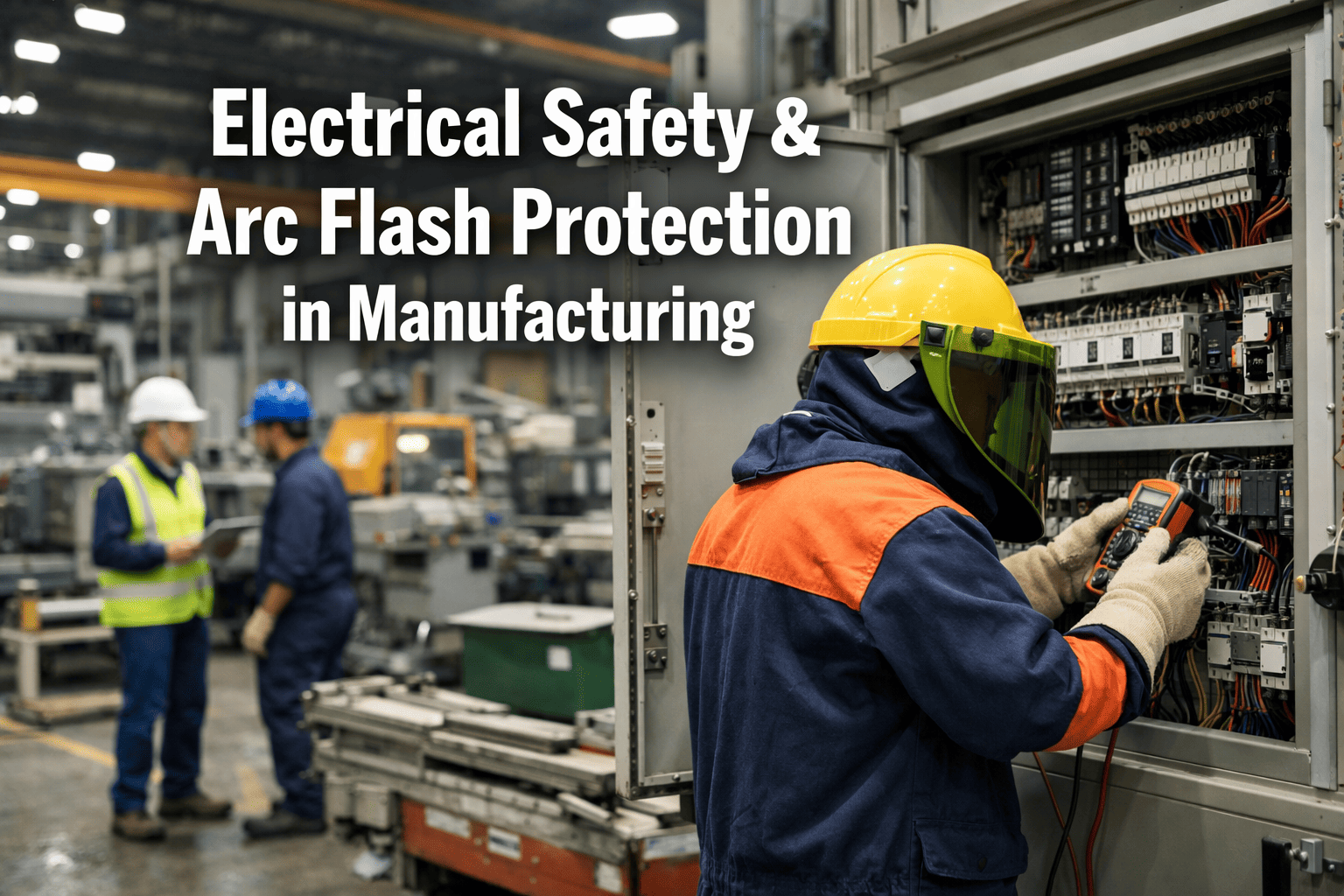
An electrical arc flash ignites in under one hundredth of a second, reaches 35,000 degrees Fahrenheit — hotter than the surface of the sun — and vaporizes copper conductors into a plasma explosion that can blow switchgear doors across a room. The United States records 30,000 arc flash incidents every year, resulting in 7,000 burn injuries, 2,000 hospitalizations, and 400 fatalities. A single incident averages $1.5 million in direct medical and equipment costs, and can exceed $15 million once litigation, downtime, and OSHA penalties are added. Oxmaint tracks every arc flash label, PPE issue, and electrical maintenance record against the asset it protects, and a 30-minute demo shows exactly how it works on your switchgear fleet.
Safety & Compliance
35,000 Degrees. 100 Milliseconds. One Missed PPE Category Can End a Career.
NFPA 70E does not care whether you meant to bypass the assessment. If the incident energy at your panel exceeds the arc rating your electrician is wearing, the burn is not survivable. Here is how electrical safety programs actually work in manufacturing plants — from risk assessment to PPE selection to the maintenance records that keep the program defensible.
Arc Flash Temperature vs Known Reference Points
Human skin second-degree burn threshold
176°F
Boiling point of water
212°F
Melting point of aluminum
1,221°F
Melting point of copper conductor
1,984°F
Surface of the sun
9,941°F
Arc flash plasma core
35,000°F
Quick Definition
An arc flash is an explosive release of electrical energy when current jumps across an air gap between conductors or between a conductor and ground. NFPA 70E is the U.S. standard for electrical safety in the workplace that requires employers to conduct arc flash risk assessments, label equipment with incident energy levels, select arc-rated PPE to match, and maintain documented work practices for any energized work. OSHA enforces compliance under 29 CFR 1910 Subpart S.
The Four Hazards Inside One Arc Flash Event
An arc flash is not a single danger — it is four simultaneous hazards hitting the worker in the same fraction of a second. PPE selection, work procedures, and approach boundaries all exist to defend against a different component of the same event.
01
Thermal Energy
Plasma temperatures above 35,000°F cause severe burns at distances of 10 feet or more from the arc source. Clothing ignites, synthetic fabrics melt into skin, and unprotected workers sustain third-degree burns in milliseconds.
02
Pressure Wave
Arc blast produces pressure waves exceeding 2,000 pounds per square foot. Workers are thrown backward, suffer broken bones, ruptured eardrums, and collapsed lungs. Equipment doors become shrapnel.
03
Molten Shrapnel
Copper bus bars vaporize and expand to 67,000 times their solid volume, ejecting molten metal particles at bullet-level velocity. Particles penetrate standard clothing and cause deep puncture burns.
04
Light and Sound
The arc flash produces ultraviolet and infrared radiation intense enough to cause temporary or permanent blindness. Blast noise exceeds 160 decibels — louder than a jet engine — causing immediate hearing damage.
NFPA 70E PPE Categories: What Actually Protects Against What
NFPA 70E Table 130.7(C)(15)(c) defines four PPE categories matched to minimum arc rating in cal/cm². The arc rating of the clothing must meet or exceed the incident energy exposure at the working distance. Falling one category short is not a gap to fill later — it is the difference between a survivable event and a burn-unit admission.
Single-Layer AR Clothing
Arc-rated long-sleeve shirt and pants (or coverall), arc-rated face shield or flash hood, hard hat, safety glasses, hearing protection, heavy-duty leather gloves, and leather footwear.
Typical use: Operating 240V panelboards with normal operating condition confirmed
AR Clothing with Hood or Balaclava
AR long-sleeve shirt and pants, arc flash hood OR face shield with balaclava, plus all Category 1 protective equipment. Many plants standardize here for both CAT 1 and CAT 2 tasks.
Typical use: Working on 600V equipment, meter testing, voltage measurement
Full Arc Flash Suit System
Arc flash suit jacket, pants or coverall, full flash suit hood at 25 cal/cm² minimum, rubber insulating gloves with leather protectors, plus all required protective equipment.
Typical use: Racking breakers on unenclosed switchgear, 600V maintenance
Maximum Protection Flash Suit
40 cal/cm² minimum flash suit with hood, often with multiple layers. Above 40 cal/cm² the arc blast pressure wave alone can cause fatal injuries — PPE alone is insufficient protection.
Typical use: Medium-voltage switchgear work, motor control centers
PPE category, arc flash label, and maintenance history in one record
Every Electrician in Your Plant Should Know the Arc Rating Before They Open the Door
Oxmaint links every arc flash label to the asset, every PPE issue to the qualified person, and every energized work permit to the maintenance record. When an auditor asks for proof of your electrical safety program, you deliver it in seconds — not weeks.
Three Approach Boundaries You Must Respect
NFPA 70E defines three concentric boundaries around exposed energized conductors. Each boundary has different qualification requirements and PPE rules. Crossing any boundary without meeting the requirements is a citable violation even if no injury occurs.
Arc Flash Boundary
Distance at which incident energy equals 1.2 cal/cm² — second-degree burn threshold. Determined by arc flash risk assessment. Anyone inside this boundary requires arc-rated PPE.
Limited Approach Boundary
Only qualified persons may enter. Unqualified persons must be continuously escorted by a qualified person. Table 130.4(E)(a) specifies distances by voltage.
Restricted Approach
Qualified persons only, with written energized work permit, shock PPE, and documented risk assessment.
Exposed
Energized
Conductor
The Hierarchy of Risk Controls for Electrical Safety
The 2018 edition of NFPA 70E made the hierarchy of risk controls mandatory, not advisory. PPE is the last line of defense — never the first. Plants that rely primarily on PPE are plants that have skipped the more effective controls sitting above it.
1
Elimination
De-energize and establish an electrically safe work condition. The only method that removes the hazard entirely. This is the default under NFPA 70E unless de-energizing creates greater hazard.
Most Effective
2
Substitution
Replace higher-hazard processes with lower-hazard ones. Example: infrared thermography through viewing windows instead of opening live panels for routine inspection.
3
Engineering Controls
Remote racking systems, arc-resistant switchgear, zone-selective interlocking, and current-limiting fuses. Reduces incident energy or removes worker from the blast path entirely.
4
Awareness
Arc flash warning labels on equipment, visible boundary markings, energized work permits, and pre-job briefings. Informs the worker of what they are facing before they engage.
5
Administrative Controls
Qualified person training, written work procedures, lockout/tagout programs, and job planning. Defines how work gets done but relies on human compliance.
6
Personal Protective Equipment
Arc-rated clothing, insulated gloves, face shields, and flash suits. Last line of defense when all other controls have been evaluated and the worker must still be within the arc flash boundary.
Least Effective
The Arc Flash Risk Assessment Workflow
NFPA 70E requires a documented arc flash risk assessment before any work within the arc flash boundary. The assessment must be reviewed at least every five years, and every time equipment is modified. Here is the sequence every qualified person must follow.
01
Identify the Task and Equipment
Determine exactly what work is being performed, which equipment is involved, and whether an electrically safe work condition can be established. De-energizing is the default unless infeasible or creates greater hazard.
02
Estimate Likelihood and Severity
Use NFPA 70E Table 130.5(C) to estimate arc flash likelihood based on equipment type and condition. Equipment not in normal operating condition requires higher PPE and additional controls.
03
Determine Incident Energy
Use either the Incident Energy Analysis Method (engineering calculation in cal/cm²) or the PPE Category Method (Table 130.7(C)(15)(c)). Employers must apply one method consistently across the facility.
04
Establish Approach Boundaries
Calculate the arc flash boundary where incident energy drops to 1.2 cal/cm². Define limited and restricted approach boundaries per Table 130.4(E). Mark boundaries physically during energized work.
05
Select and Verify PPE
Match arc-rated PPE to meet or exceed incident energy at the working distance. Verify arc rating markings, inspect for defects, confirm PPE fit. Document selection against the task permit.
06
Issue Energized Work Permit
Written permit signed by authorized personnel with full task description, hazard analysis, PPE selection, and emergency response plan. Copy retained in electrical safety program records.
The True Cost of One Arc Flash Event
Total Cost Range Per Incident
$1.5M to $15M+
Direct plus indirect costs combined, depending on injury severity and plant impact
Medical Treatment
$1.5M avg
Burn treatment averages one hospital day per 1% of body burned
Litigation & Settlement
$5M-$10M
General industry incidents routinely exceed $10 million in settlements
Equipment Replacement
$250K-$750K
Switchgear, panel, and adjacent equipment destroyed in the blast
Lost Production
$40K-$200K/day
Investigation, repair, and commissioning typically takes 5-14 days
OSHA Penalties
Up to $161K
Per willful or repeat violation under 2026 adjusted penalty schedule
Lost Work Time
6-12 months
Severe burn injuries end careers for many survivors
How Oxmaint Anchors Your Electrical Safety Program
01
Arc Flash Label Registry
Every panel, switchgear lineup, and motor control center linked to its current incident energy label, boundary distances, and last assessment date. Overdue assessments flag automatically before they become citations.
02
Qualified Person Tracking
Training records, certification expiration, and task qualifications stored per employee. Only qualified persons can be assigned energized electrical work orders. Expired certifications block assignment.
03
Energized Work Permits
Digital permit workflow with required hazard analysis, PPE selection, boundary determination, and supervisor approval. All permits archived against the asset and the qualified person who performed the work.
04
PPE Inventory and Inspection
Arc flash suits, insulating gloves, and face shields tracked by serial number with inspection and dielectric test schedules. Gloves requiring 6-month retest auto-generate work orders before expiration.
05
Maintenance History per Panel
Infrared thermography scans, torque inspection records, and cleaning activities tied to each asset. Equipment not in normal operating condition automatically elevates PPE requirements on the next work order.
06
Audit-Ready Compliance Evidence
One-click export of arc flash assessments, PPE records, qualified person rosters, and work permit history. OSHA and insurance auditors get a structured record instead of chasing paper.
From scattered paper records to one defensible program
Your Arc Flash Assessment Expires Every Five Years. Your PPE Needs Testing Every Six Months. Your Auditor Does Not Care Which Binder It Lives In.
Oxmaint is the system of record that makes electrical safety compliance automatic. Every label, every test, every permit, and every qualification in one place — available the moment you need it.
Frequently Asked Questions
Is NFPA 70E legally required, or is it just a recommended standard?
OSHA does not publish its own arc flash standard but enforces compliance through 29 CFR 1910 Subpart S and the General Duty Clause, citing NFPA 70E as recognized industry practice. In effect, it is legally enforceable in all U.S. workplaces.
How often must an arc flash risk assessment be updated?
NFPA 70E requires assessment review at least every five years, and immediately whenever equipment is modified, replaced, or added. Changes to upstream protective devices or available fault current also trigger reassessment.
Can 120V equipment cause an arc flash?
Yes. The 2024 NFPA 70E edition explicitly confirms that 120V circuits can produce arc flash hazards under conditions of high available fault current and slow clearing times. The "it's only 120V, it's safe" assumption has caused numerous injuries and fatalities.
Do rubber insulating gloves need periodic testing?
Yes. ASTM F496 requires dielectric retest every 6 months for rubber insulating gloves in service. Gloves must also be inspected visually before each use, with any damaged gloves removed from service immediately.
Electrical safety, documented and defensible
Turn Your Arc Flash Binders Into a Live System That Flags the Gap Before It Becomes the Incident
Oxmaint links every arc flash label, every PPE asset, every qualified person, and every energized work permit to the equipment it protects. Deploy in weeks, not quarters, with no changes to your electrical infrastructure.