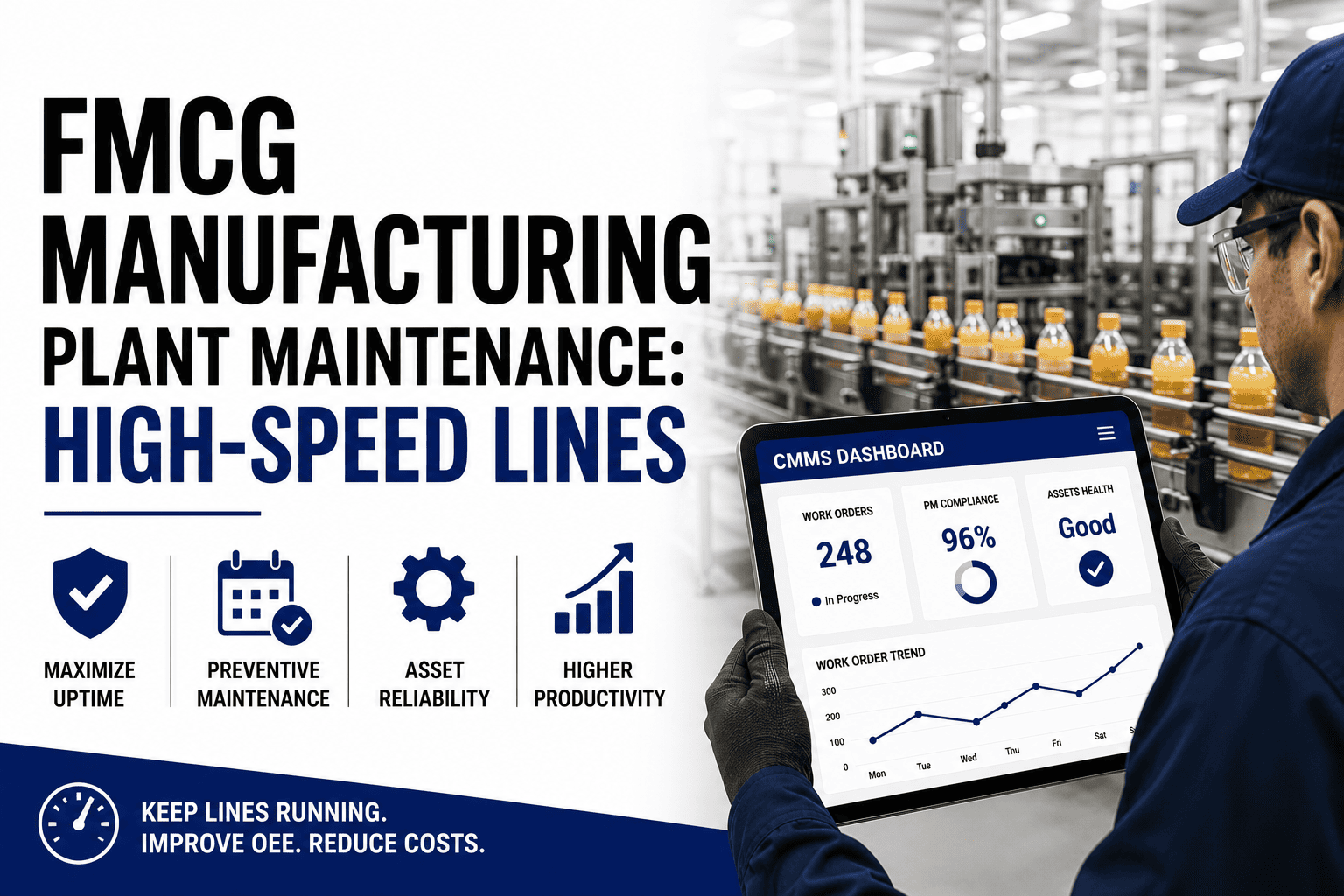
A personal care goods manufacturer running 18 filling lines at 400 units per minute does not have the same maintenance problem as a job shop making bespoke components. Their problem is velocity — the machine never stops long enough to fail slowly. A seal that would take three weeks to degrade in a standard industrial pump degrades in four days at FMCG line speeds. A conveyor bearing that would signal distress through vibration in a heavy plant goes from normal to seized in a single shift. In high-speed consumer goods manufacturing, reactive maintenance is not just inefficient — it is genuinely incompatible with the production model. The plants winning on OEE and cost-per-unit in 2026 are running predictive maintenance programs with real sensor data, structured PM schedules, and a CMMS that connects the two. If your FMCG plant is still managing maintenance from spreadsheets and shift logs, see how Oxmaint changes that in under two weeks.
FMCG Manufacturing — Production Reliability 2026
High-Speed Lines Demand a Different Level of Maintenance Intelligence
FMCG plants run at margins where 20 minutes of unplanned downtime can erase a shift's profit. Predictive maintenance is not a technology experiment — it is a financial necessity.
$47K
Average cost of 1 hour downtime on a high-speed FMCG line
3–8%
Typical FMCG OEE gap vs world-class benchmark
45%
Reduction in unplanned stoppages with PdM adoption
2.3×
Faster MTTR with mobile CMMS vs paper-based systems
Why FMCG Maintenance Is Harder Than Most Industries Realize
V
Extreme Velocity
A typical FMCG packaging line runs 200–1,200 cycles per minute. Component wear that takes months in a standard industrial setting occurs in days. PM intervals designed for standard industrial use are chronically too long for FMCG speed.
N
Near-Zero Downtime Tolerance
FMCG supply chains operate on next-day and same-day commitments to retail. A 4-hour line stoppage is not just a production loss — it triggers penalty clauses, empty shelf events, and sometimes permanent delisting by major retailers.
H
Hygienic Design Complexity
Food and personal care lines require sanitary equipment with specific gasket materials, stainless steel grade requirements, and CIP compatibility. Every PM task must account for hygiene — wrong lubricant, wrong gasket compound, or failed seal is a contamination risk and regulatory event.
S
SKU Proliferation and Changeovers
Modern FMCG plants run 40–200 SKUs through the same lines. Each changeover introduces wear, misalignment risk, and setting drift. Plants with 10+ changeovers per week without a structured CMMS tracking changeover PM actions consistently underperform on OEE.
The 5 Failure Modes That Cost FMCG Plants the Most
01
Filler Valve and Seal Failure
Most expensive failure per event
Filler head seals operating at 500+ cycles/minute degrade 4–6× faster than nameplate intervals. Seal failure causes product contamination, fill weight deviation, and a complete line stop for sanitary inspection. Predictive seal replacement on cycle count, not calendar time, cuts this failure rate by up to 70%.
PdM approach: cycle-count-based seal replacement trigger in CMMS
02
Conveyor Drive and Chain Failure
Highest frequency failure
Conveyor chains stretch, links crack, and drive motors overheat in high-speed continuous operations. Vibration sensors on conveyor drives catch bearing degradation 2–3 weeks before failure. Lubrication on fixed intervals rather than run-hour intervals is the most common PM error on FMCG conveyors.
PdM approach: vibration monitoring + run-hour lubrication triggers
03
Capper / Seamer Torque Drift
Quality and compliance risk
Capper torque heads wear over millions of cycles, producing undertorqued closures that fail tamper evidence and overtorqued caps that cause consumer complaints and returns. Torque verification on a cycle-count or statistical sample basis — logged in CMMS — is the control mechanism.
PdM approach: automated torque verification with SPC trending in CMMS
04
Heat Sealer Temperature Drift
Consumer safety risk
For food and pharmaceutical FMCG, heat sealer temperature deviation of 5–8°C produces weak seals that fail shelf-life tests and create contamination paths. Temperature calibration checks integrated into scheduled PM routines — not ad-hoc spot checks — are required for product safety compliance.
PdM approach: shift-level temperature logging with deviation alert thresholds
05
Label and Coding System Failure
Regulatory and recall risk
Inkjet coders, laser markers, and label applicators are the most neglected assets on FMCG lines — until a missed best-before date or misapplied barcode triggers a retailer audit or a regulatory hold. Preventive maintenance on coding and labeling systems is a compliance task, not just a quality task.
PdM approach: weekly printhead and applicator inspection with photo sign-off
CMMS for FMCG Production
Replace Reactive Firefighting with Predictive Precision on Every Line
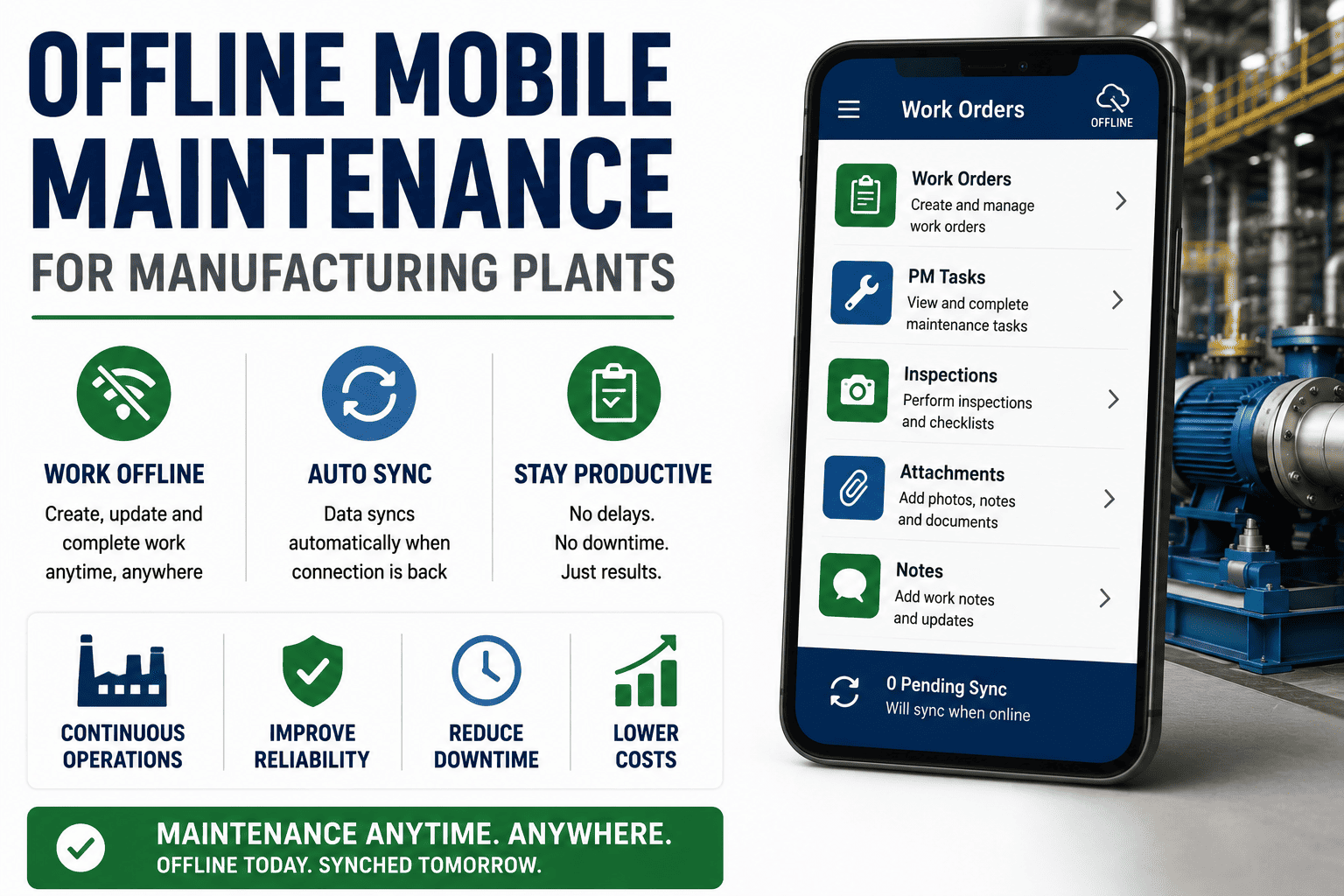
Oxmaint tracks cycle-count PM triggers, vibration and temperature condition data, filler seal replacement history, torque logs, and coding system maintenance — with mobile work orders your line technicians can execute in 90 seconds between changeovers.
Reactive vs Predictive: What the Maintenance Approach Difference Looks Like in Numbers
| KPI |
Reactive Maintenance |
Time-Based PM |
Predictive + CMMS |
| OEE |
58–66% |
70–78% |
82–90% |
| Unplanned downtime |
14–22% |
8–12% |
2–5% |
| Maintenance cost per unit |
Baseline 1× |
0.75–0.85× |
0.45–0.6× |
| Mean Time Between Failures |
Short — unpredictable |
2–3× reactive baseline |
4–6× reactive baseline |
| Food safety incidents |
High risk |
Moderate risk |
Low risk with audit trail |
| PM compliance |
35–50% |
60–75% |
90–97% (CMMS-managed) |
The FMCG Predictive Maintenance Roadmap — Where to Start
Step 1
Audit Your Asset Register
Build a complete list of every production asset: make, model, install date, current PM status, and failure history. This is the foundation. Without it, predictive maintenance is impossible — you cannot predict failure for assets you have not defined.
Step 2
Identify Your Top 10 Failure Modes
Rank assets by frequency of failure and cost per event — using CMMS data or, if starting from scratch, shift log review and maintenance team interview. Focus your PdM investment where failure cost is highest, not where sensors are easiest to install.
Step 3
Define Predictive Triggers Per Asset
For each failure mode, define the leading indicator: vibration threshold, temperature ceiling, cycle count limit, pressure differential, or current draw spike. Set CMMS alerts to trigger work orders before the threshold is breached — not after the machine has failed.
Step 4
Deploy Sensors and Connect to CMMS
Install vibration, temperature, or current sensors on your highest-priority assets. Connect data feeds to your CMMS. You do not need to instrument the entire plant — starting with 10–15 critical assets delivers measurable ROI within the first quarter.
Step 5
Measure, Tune, and Expand
After 90 days, review alert accuracy: false positives waste technician time, false negatives miss real failures. Tune thresholds, expand to additional asset classes, and build the business case for further investment with documented downtime and cost data from your CMMS.
Frequently Asked Questions
What is predictive maintenance in FMCG manufacturing?
Predictive maintenance uses real-time sensor data — vibration, temperature, current draw, cycle count — to forecast when equipment will fail and trigger maintenance before breakdown occurs. In FMCG, where lines run near-continuously, this replaces reactive repair with scheduled intervention at the optimal point in the asset's wear cycle.
Oxmaint connects sensor data to automated work orders for exactly this workflow.
How is FMCG predictive maintenance different from standard industrial PdM?
FMCG lines run at speeds and cycle counts that compress degradation timelines dramatically. Standard calendar-based PM intervals — designed for lower-speed industrial equipment — are too long for FMCG. Cycle-count triggers, shift-level condition checks, and hygienic design compliance requirements make FMCG PdM a distinct discipline from general industrial maintenance.
What sensors are most useful for FMCG packaging line predictive maintenance?
Vibration sensors on conveyor drives, motors, and pumps are the highest-ROI starting point. Temperature sensors on heat sealers, fillers, and motors provide early warning of thermal drift. Current monitoring on servo drives detects load changes before mechanical symptoms appear.
Book a demo to see how Oxmaint integrates with your sensor stack.
How does predictive maintenance support food safety compliance in FMCG plants?
By generating timestamped maintenance records for every PM action, seal replacement, temperature calibration, and CIP cycle, a CMMS creates the audit trail required under FSMA, BRC, and retailer audit standards. Predictive maintenance prevents the seal and seamer failures that cause contamination events before they occur.
What OEE improvement can FMCG plants realistically expect from PdM?
Plants moving from reactive to predictive maintenance typically see OEE improvements of 8–15 percentage points within the first 12 months, with unplanned downtime reductions of 40–60%. The gains are largest in plants with historically poor PM compliance and high reactive maintenance cost ratios.
Start a free trial to benchmark your current performance.
CMMS for FMCG Plant Reliability
Every High-Speed Line Deserves a Maintenance Program That Moves at Its Speed
Oxmaint gives FMCG maintenance teams cycle-count PM triggers, condition-based alerts, mobile work orders, OEE dashboards, and audit-ready records — in one platform designed for the velocity and compliance demands of consumer goods production.
45%
Fewer unplanned stoppages
Mobile
Work orders on any device