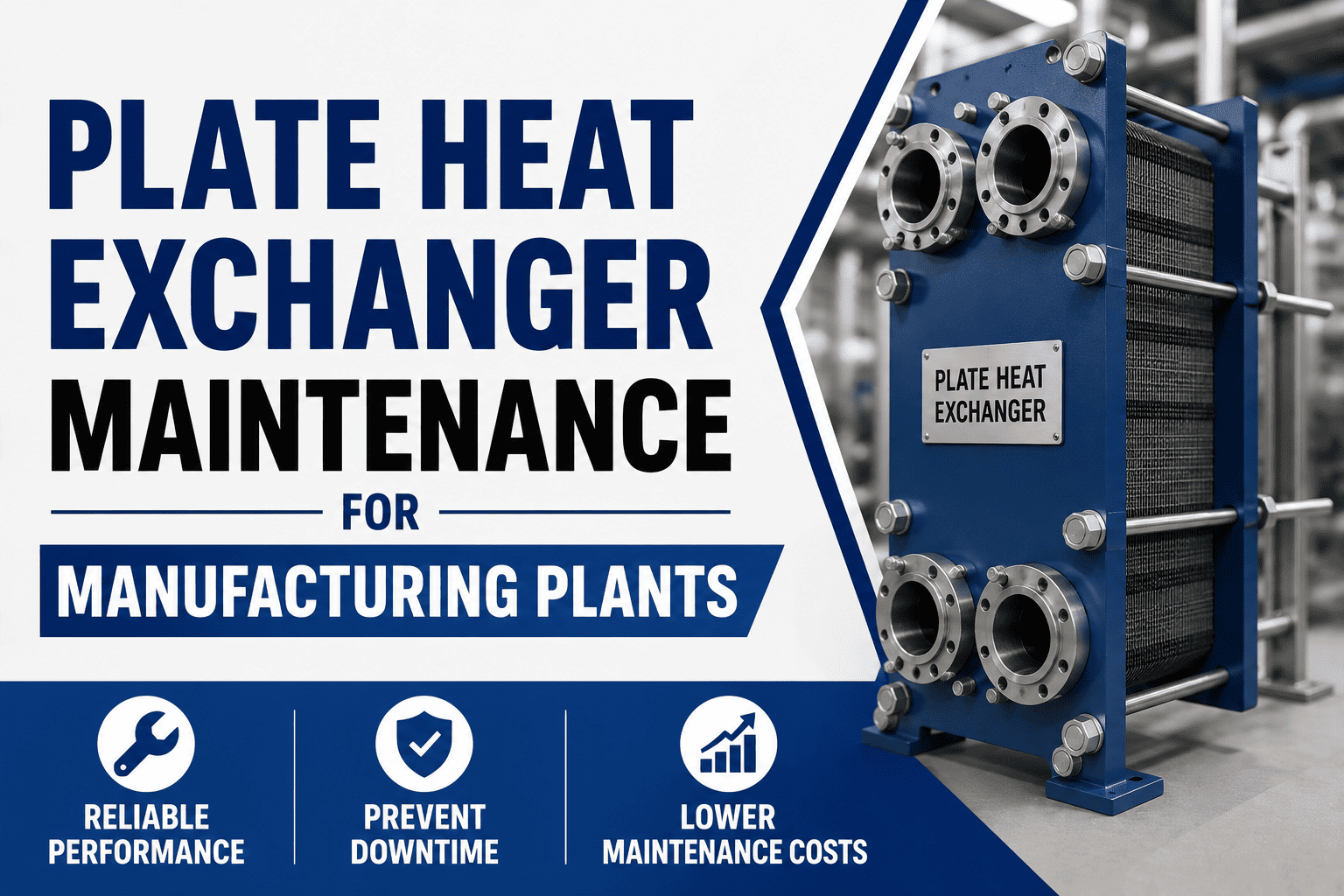
Plate heat exchanger maintenance for manufacturing plants centers on four disciplines — gasket integrity, plate cleanliness, pressure-drop monitoring, and pressure testing — because even a 0.5 mm scale layer can cut heat transfer by 10–15 percent and spike energy costs across a production line. This PHE maintenance guide breaks down gasket replacement schedules, chemical cleaning cycles, and plate inspection routines into a repeatable workflow you can automate inside a CMMS so that cleaning happens before fouling degrades output, not after a thermal failure sidelines a process loop. If you are ready to replace spreadsheets and whiteboards with a system that triggers each task automatically, you can Start Free Trial of OxMaint in minutes — or read on to build your own preventive plan.
In real manufacturing conditions, plate heat exchangers foul fast — scaling, biological growth, and gasket degradation erode thermal performance long before a failure triggers an alarm. This guide maps the full plate heat exchanger maintenance lifecycle, from gasket inspection to CIP cleaning cycles, and shows how to automate every checkpoint inside a CMMS so you protect heat transfer without unnecessary downtime.
The hidden cost of reactive plate heat exchanger maintenance
A single gasket blowout on a large process PHE can dump thousands of liters of product, trigger a 4–12 hour unplanned outage, and contaminate clean utility loops — yet most plants still run PHEs to failure before acting.
Consider a 180-asset food and beverage plant running six plate heat exchangers on pasteurization and CIP return loops. Without a scheduled PHE maintenance plan, the team was opening units only when outlet temperatures drifted 5°C off setpoint — by which point calcium sulfate scaling had already baked onto plates, requiring chemical soaking that consumed 14 labor-hours per unit and shortened gasket life by nearly 40 percent. After moving plate heat exchanger PM into a CMMS with automated pressure-drop triggers and 90-day inspection work orders, the same plant cut unplanned PHE downtime by 62 percent and recovered full thermal capacity within one cleaning cycle. The difference was not more labor — it was a system that scheduled the right task at the right interval.
Plate heat exchanger inspection checklist for manufacturing reliability teams
A structured plate heat exchanger inspection covers five layers — from exterior condition to internal plate integrity — and should run at fixed intervals tied to service severity, not just when a unit underperforms.
- Log inlet/outlet temperatures on both hot and cold sides; flag any 2°C drift from baseline
- Record pressure drop across each frame; a 15–20% rise signals early fouling
- Visually inspect tie bolts, carrier bar, and support column for grease leaks or corrosion
- Check for external seepage at port connections and frame gasket faces
- Open frame per OEM torque spec; photograph plate pack orientation before disassembly
- Inspect gaskets for compression set, cracking, swelling, or hardening — replace if any zone fails
- Examine plate surfaces for pitting, pinhole corrosion, cracking at contact points, and erosion
- Dye-penetrant test suspect plates; remove and tag any plate with through-wall defects
- Hydrotest each side to 1.3× design pressure; hold 30 min and verify zero pressure decay
- Conduct cross-leak test between media sides at differential pressure per OEM manual
- Calculate overall heat transfer coefficient (U-value); compare to design baseline
- Measure flow rates at design pump speed; reconcile against commissioning data
- Full gasket set replacement on units in aggressive, high-temperature, or hygienic service
- Retorque tie bolts to OEM specification after thermal cycling; document in asset history
- Review 12 months of pressure-drop and temperature data to re-optimize cleaning intervals
- Assess remaining plate life; plan frame or plate-pack replacement before year 8–12
PHE maintenance schedule: how often to inspect, clean, and regasket
Service severity — fluid chemistry, temperature, and duty cycle — drives the optimal plate heat exchanger PM interval. Use the matrix below as a starting point, then let actual pressure-drop trends refine the cadence inside your CMMS.
| Service Category | Inspection Interval | CIP / Cleaning Interval | Gasket Replacement | Pressure Test |
|---|---|---|---|---|
| Light — closed-loop HVAC, clean water | 180 days | Annual | 5 years | 12 months |
| Moderate — process water, mild chemicals | 90 days | 6 months | 3 years | 12 months |
| Heavy — food/beverage, CIP return, oils | 60 days | 3 months | 18–24 months | 6 months |
| Severe — high-temp, aggressive fouling, saline | 30 days | 1–2 months | 12 months | 6 months |
These ranges align with ISO 55000 asset-management principles and total productive maintenance (TPM) thinking: inspect on a fixed clock, clean on a condition-based trigger, and regasket on lifecycle data — never on guesswork.
Plate exchanger cleaning and pressure testing: methods that protect plates
Chemical cleaning and mechanical descaling are not interchangeable — the wrong method permanently damages plate corrugations and voids the frame warranty. Follow these protocols to restore heat transfer without shortening PHE lifecycle.
Never exceed OEM maximum cleaning temperature. For stainless 316 plates, avoid hydrochloric acid (HCl) — it initiates chloride pitting within hours.
Never use wire brushes, scrapers, or high-pressure lances on plate surfaces. Titanium plates require extra care — scratching destroys the passivation layer.
Document every test result, technician, and reading inside the CMMS asset record for ISO 55000 and audit compliance. Failing a test after regasketing usually means uneven bolt torque.
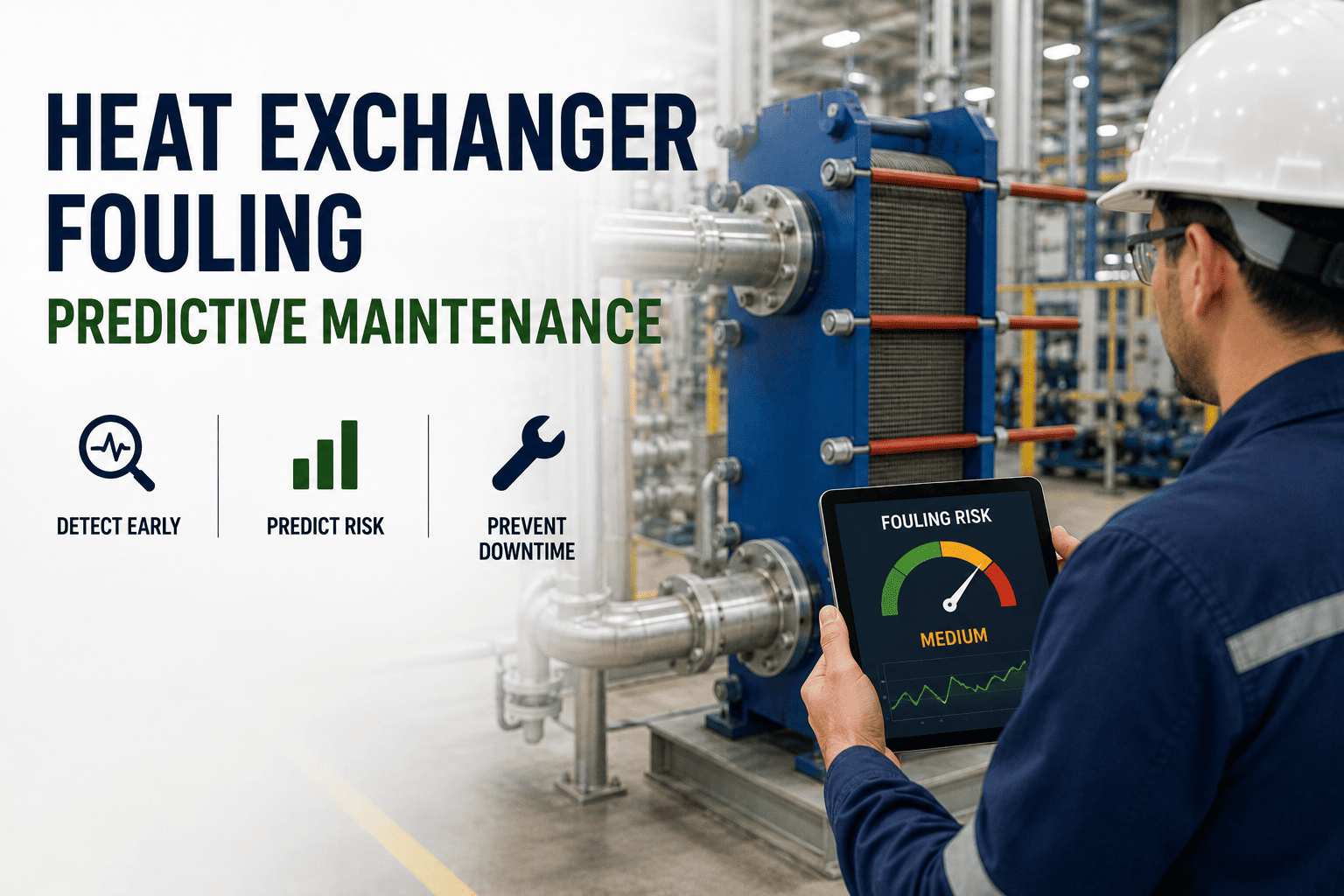
A 15–20% rise in pressure drop across a PHE is your earliest, most reliable indicator of fouling — it shows up weeks before outlet temperatures drift. Logging it daily inside a CMMS turns a guess into a trigger.
Plate heat exchanger lifecycle: from commissioning to replacement
A well-maintained plate heat exchanger delivers 12–20 years of service. The timeline below maps the maintenance focus, failure risk, and intervention cost at each lifecycle stage — so you can budget gasket sets, plate packs, and full frame replacements before they become emergencies.
Baseline performance established. Focus: daily temperature/pressure logging, verify OEM torque, confirm gasket warranty. Risk: improper start-up thermal shock. Intervention cost: low.
Stable performance if PM is followed. Focus: quarterly inspection, scheduled CIP cleaning, first gasket replacement at year 3–5. Risk: scaling acceleration if intervals slip. Intervention cost: moderate.
Gasket degradation accelerates; plates may show pitting or erosion. Focus: increase inspection frequency, annual gasket sets, dye-penetrant testing. Risk: cross-contamination from pinhole leaks. Intervention cost: high.
Frame fatigue, repeated plate failures, and diminishing thermal recovery. Focus: full asset replacement evaluation, spare-parts obsolescence check, capital budget request. Risk: catastrophic gasket blowout. Intervention cost: capital project.
Stop running plate heat exchangers to failure
See how OxMaint automates PHE inspection schedules, pressure-drop monitoring, and gasket lifecycle tracking — so your team cleans and regaskets before performance drops, not after a thermal failure.
How OxMaint CMMS automates plate heat exchanger PM
OxMaint turns the checklists and schedules above into an automated, auditable system — eliminating paper work orders, missed intervals, and the spreadsheet chaos that lets fouling slip past your team. Here is how four core capabilities map directly to PHE maintenance outcomes:
Generate recurring PHE inspection, cleaning, and regasket work orders based on service-severity rules — daily, 60-day, 90-day, or annual. Auto-assign to technicians with checklists, torque specs, and safety procedures attached.
Connect SCADA or IoT pressure-drop and temperature sensors to OxMaint. When a PHE exceeds a 15% pressure-drop threshold or a 2°C temperature-drift baseline, the platform auto-generates a cleaning work order — before fouling degrades output.
Track gasket sets, replacement plates, and cleaning chemicals by PHE asset. OxMaint flags low stock against upcoming PM work orders and auto-generates purchase requests — so the right gasket kit is always on the shelf when a frame is opened.
Every inspection reading, pressure-test result, gasket replacement, and cleaning cycle is logged to the asset record. Dashboards show U-value trends, MTBF, and cost-per-asset — ready for ISO 55000 audits and capital-replacement decisions.
Plate heat exchanger maintenance: frequently asked questions
Inspection frequency depends on service severity: every 180 days for clean HVAC loops, 90 days for moderate process water, 60 days for food and beverage or CIP service, and 30 days for aggressive or high-temperature duties. Daily temperature and pressure-drop logging should occur on all units regardless of service category — it is the single most effective early-warning tool for fouling and gasket failure.
For stainless steel 316 plates, a 2–5 percent nitric or phosphoric acid solution circulated at 50–60°C for 30–45 minutes is standard for scale removal, followed by a 1–2 percent sodium hydroxide neutralization pass. Never use hydrochloric acid (HCl) on stainless or titanium plates — chloride pitting occurs within hours and permanently destroys the plate. Always confirm chemical compatibility with the OEM plate-material spec sheet before cleaning.
Gasket replacement intervals range from 12 months in severe service to 5 years in light HVAC duty, with 3 years being typical for moderate manufacturing applications. Replace gaskets immediately if you observe compression set, cracking, swelling, hardening, or any external leakage during inspection — waiting risks cross-contamination between media streams. Scheduling gasket sets inside a CMMS like OxMaint ensures the parts are on the shelf and the labor is planned before a leak forces an unplanned outage. You can Book a Demo to see how automated gasket lifecycle tracking works.
A 15–20 percent increase in pressure drop across either side of a PHE, compared to the clean baseline reading at the same flow rate, is the industry-standard trigger for cleaning. Some aggressive fouling services set the threshold at 10 percent. Because pressure drop rises before outlet temperatures drift, logging it daily inside a CMMS gives you a 2–4 week head start — enough to schedule a CIP cycle during planned downtime rather than reacting to a thermal failure.
Yes — a CMMS eliminates the spreadsheet and whiteboard chaos that causes missed inspections and unplanned PHE failures. OxMaint automates recurring work orders, attaches checklists and torque specs, tracks gasket inventory, triggers cleaning based on pressure-drop data, and logs every result to an ISO 55000-ready audit trail. Plants typically cut unplanned PHE downtime 30–50 percent and extend asset lifecycle 2–4 years within the first 12 months of adoption.
Protect every plate heat exchanger with OxMaint
Automate PHE inspection schedules, pressure-drop monitoring, gasket lifecycle tracking, and spare-parts inventory in one AI-powered CMMS — built for manufacturing maintenance and reliability teams.
Free 14-day trial · No credit card


.png)
