Unplanned equipment stops in packaging operations drain more than production time — they consume maintenance capacity, inflate repair costs, and create cascading schedule failures that affect downstream fulfilment. One mid-size packaging plant operating three production lines and a 14-person maintenance team was absorbing a stop event rate that made reliable throughput impossible. Response times were inconsistent, failure patterns were invisible to supervisors, and the work queue had no priority structure that reflected operational urgency. The result: 22% of all stop events exceeded their target recovery window, and the maintenance backlog grew faster than the team could clear it. If your team is facing similar visibility and response gaps, Sign Up Free to see how Oxmaint closes them — or Book a Demo with a packaging operations specialist.
See how Oxmaint gives packaging maintenance teams real-time failure visibility and priority-driven dispatch in under 30 minutes.
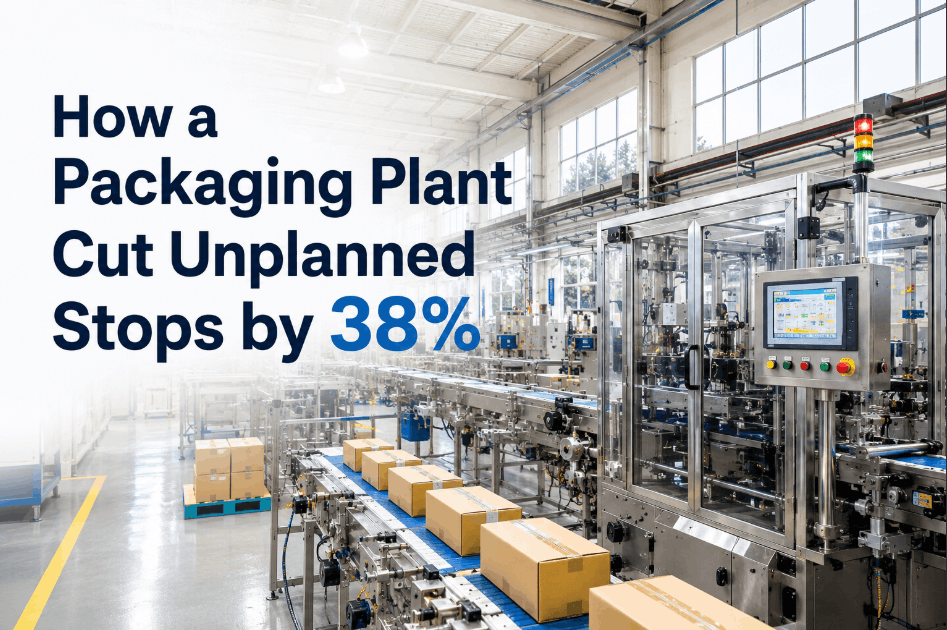
How a Packaging Plant Cut Unplanned Stops by 38% with Priority-Driven Maintenance Execution
How structured response rules, real-time failure visibility, and an organised work queue helped one packaging operation reduce stop events, recover faster, and clear a growing maintenance backlog.
The Operation: Three Production Lines, One Maintenance Team, No Priority Visibility
Why the Stop Events Were Happening — And Why Recovery Was Slow
Before deploying Oxmaint, the maintenance supervisor ran a manual analysis of 60 days of stop events and work order records. Four structural causes appeared consistently — none of which required hiring more technicians to fix. The problem was execution infrastructure, not workforce capacity. Dispatch decisions were made verbally. Priority was assigned by whoever raised the fault, not by operational impact. PM tasks aged in the queue alongside reactive repairs, invisible to supervisors until they became overdue. A Sign Up Free account gives your team a structured work queue from day one — or Book a Demo to see how Oxmaint maps priority rules to your specific asset classes.
How Oxmaint Structured the Work Queue and Closed the Visibility Gap
The plant did not change its technician roster or shift structure. Oxmaint was deployed to replace the verbal-and-whiteboard dispatch system with a structured digital work queue that enforced priority rules, surfaced asset history at every job, and gave supervisors real-time visibility into open faults, response status, and backlog composition. Every work order entered the system with a defined priority tier. Supervisors received instant notification on new stop events. PM schedules were locked to their intervals and surfaced before they became overdue. The change required no additional headcount — only better information reaching the right people faster.
Every work order is assigned a priority tier — line-down, safety, production-impact, or scheduled — at the moment it is created. The queue sorts automatically by priority and age. Technicians always pick the highest-impact available job, not the nearest or most familiar one.
Supervisors receive mobile alerts the moment a stop event work order is raised. Assignment is made digitally from the supervisor's phone — eliminating the 15–40 minute lag between fault report and technician dispatch that was the single largest driver of recovery time overruns.
PM tasks are scheduled at defined intervals and flagged as approaching-due before the window closes. Supervisors can see the full PM compliance picture alongside the reactive queue — making informed deferral decisions rather than defaulting to deferral under reactive pressure.
Every failure, repair, part used, and technician note is recorded against the asset and displayed at job creation. Technicians attending repeat faults arrive with the full repair history — reducing diagnosis time and eliminating repeat incomplete repairs on known-failure assets.
Ready to replace your whiteboard queue with a priority-driven system that dispatches the right technician to the right job in real time?
What the Numbers Looked Like Three Months After Deployment
| Metric | Before Oxmaint | 90 Days After | Change |
|---|---|---|---|
| Monthly stop events | 34 | 21 | -38% |
| Avg time-to-restore | 87 min | 43 min | -51% |
| Recovery window overruns | 22% | 7% | -67% |
| PM completion rate | 61% | 79% | +29% |
| Work order documentation | ~35% (paper) | 100% (digital) | Full compliance |
| Open backlog (avg) | 40+ WOs | 18 WOs | -55% backlog |
What Priority-Driven Maintenance Execution Actually Means for a Packaging Operation
"The backlog problem in packaging maintenance is almost never a people problem. It is a sequencing problem. When every work order looks the same — no priority, no age indicator, no link to production impact — technicians make locally rational choices that are globally inefficient. A line-down fault waits while a planned lubrication job gets done because it was written first. Priority rules cost nothing to implement and return disproportionate value immediately. The same team, the same shift, the same skills — sequenced correctly — can recover two or three additional line-hours per week without a single additional hire. In a packaging plant running five days, that is the difference between meeting fulfilment commitments and missing them."
Frequently Asked Questions
Every Unplanned Stop Your Team Recovers Faster Is a Throughput Hour You Keep
Oxmaint gives packaging maintenance teams the priority rules, dispatch visibility, and asset history they need to respond faster, clear the backlog, and reduce the stop events that are costing production capacity every week.